 |
PDBsum entry 4ykn

|
|
|
|
|
|

|

|

|

|
|

|
|

|
|

|
|

|
|

|
|
|
 |

|

|
|
|
|
|
|
|
|
|
|
|
|
|
|
|
|
|
|
|
|
|
|
|
|
|
|
|
|
|
|
|
|
|
|
Transferase/transferase inhibitor
|
PDB id
|
|
|
|
4ykn
|
|
|
|
|
|
|
|
|
|
|
|
|
|
|

|

|

|
|
|
|
|
|
|
PDB id:
|
|
|
|
| Name: |
|
Transferase/transferase inhibitor
|
|
|
Title:
|
|
Pi3k alpha lipid kinase with active site inhibitor
|
|
Structure:
|
|
Phosphatidylinositol 3-kinase regulatory subunit alpha, phosphatidylinositol 4,5-bisphosphate 3-kinase catalytic subunit alpha isoform fusion protein. Chain: a. Fragment: unp p27986 residues 318-615, linker (gspgisggggg), p42336 residues 2-1068. Synonym: ptdins-3-kinase regulatory subunit alpha, phosphatidylinositol 3-kinase 85 kda regulatory subunit alpha,ptdins- 3-kinase regulatory subunit p85-alpha,ptdins-3-kinase subunit alpha,
|
|
Source:
|
|
Homo sapiens. Human. Organism_taxid: 9606. Gene: pik3r1, grb1, pik3ca. Expressed in: unidentified baculovirus. Expression_system_taxid: 10469
|
|
Resolution:
|
|
|
2.90Å
|
R-factor:
|
0.204
|
R-free:
|
0.247
|
|
|
Authors:
|
|
P.A.Elkins
|
|
Key ref:
|
|
H.Yang
et al.
(2015).
Discovery of a Potent Class of PI3Kα Inhibitors with Unique Binding Mode via Encoded Library Technology (ELT).
Acs Med Chem Lett,
6,
531-536.
PubMed id:
DOI:
|
|
|
Date:
|
|
|
04-Mar-15
|
Release date:
|
17-Jun-15
|
|
|
|
|
|
|
PROCHECK
|

|
|
|
|
|
Headers
|
|
|
|
References
|
|
|
|
|
|
|
|
|
|
|
|
Enzyme class 2:
|
|
E.C.2.7.11.1
- non-specific serine/threonine protein kinase.
|
|
|
|
|
|
|
Reaction:
|
|
|
1.
|
L-seryl-[protein] + ATP = O-phospho-L-seryl-[protein] + ADP + H+
|
|
2.
|
L-threonyl-[protein] + ATP = O-phospho-L-threonyl-[protein] + ADP + H+
|
|
|
|
|
|
|
L-seryl-[protein]
|
+
|
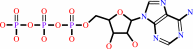 ATP
ATP
|
=
|
O-phospho-L-seryl-[protein]
|
+
|
 ADP
ADP
|
+
|
H(+)
|
|
|
|
|
|
|
L-threonyl-[protein]
|
+
|
ATP
|
=
|
O-phospho-L-threonyl-[protein]
|
+
|
ADP
|
+
|
H(+)
|
|
|
|
|
|
|
|
|
|
Enzyme class 3:
|
|
E.C.2.7.1.137
- phosphatidylinositol 3-kinase.
|
|
|
|
|
|
|
Pathway:
|
|
|
|
|
|
|
|
Reaction:
|
|
a 1,2-diacyl-sn-glycero-3-phospho-(1D-myo-inositol) + ATP = a 1,2-diacyl- sn-glycero-3-phospho-(1D-myo-inositol-3-phosphate) + ADP + H+
|
|
|
|
|
|
1,2-diacyl-sn-glycero-3-phospho-(1D-myo-inositol)
|
+
|
ATP
|
=
|
1,2-diacyl- sn-glycero-3-phospho-(1D-myo-inositol-3-phosphate)
|
+
|
ADP
|
+
|
H(+)
|
|
|
|
|
|
|
|
|
|
Enzyme class 4:
|
|
E.C.2.7.1.153
- phosphatidylinositol-4,5-bisphosphate 3-kinase.
|
|
|
|
|
|
|
Pathway:
|
|
|
|
|
|
|
|
Reaction:
|
|
a 1,2-diacyl-sn-glycero-3-phospho-(1D-myo-inositol-4,5-bisphosphate) + ATP = a 1,2-diacyl-sn-glycero-3-phospho-(1D-myo-inositol-3,4,5- trisphosphate) + ADP + H+
|
|
|
|
|
|
1,2-diacyl-sn-glycero-3-phospho-(1D-myo-inositol-4,5-bisphosphate)
|
+
|
ATP
|
=
|
1,2-diacyl-sn-glycero-3-phospho-(1D-myo-inositol-3,4,5- trisphosphate)
|
+
|
ADP
|
+
|
H(+)
|
|
|
|
|
|
|
|
|
|
|
|
|
Note, where more than one E.C. class is given (as above), each may
correspond to a different protein domain or, in the case of polyprotein
precursors, to a different mature protein.
|
|
|
|
Molecule diagrams generated from .mol files obtained from the
KEGG ftp site
|
|
|
|
|
|
|
|
|
|
|
|
|
|
 |
|
|
|
|
|
|
| |
|
|
| |
|
DOI no:
|
Acs Med Chem Lett
6:531-536
(2015)
|
|
PubMed id:
|
|
|
|
|
|
| |
|
Discovery of a Potent Class of PI3Kα Inhibitors with Unique Binding Mode via Encoded Library Technology (ELT).
|
|
H.Yang,
P.F.Medeiros,
K.Raha,
P.Elkins,
K.E.Lind,
R.Lehr,
N.D.Adams,
J.L.Burgess,
S.J.Schmidt,
S.D.Knight,
K.R.Auger,
M.D.Schaber,
G.J.Franklin,
Y.Ding,
J.L.DeLorey,
P.A.Centrella,
S.Mataruse,
S.R.Skinner,
M.A.Clark,
J.W.Cuozzo,
G.Evindar.
|
|
|
|
|
| |
ABSTRACT
|
|
|
|
| |
|
|
In the search of PI3K p110α wild type and H1047R mutant selective small
molecule leads, an encoded library technology (ELT) campaign against the desired
target proteins was performed which led to the discovery of a selective
chemotype for PI3K isoforms from a three-cycle DNA encoded library. An X-ray
crystal structure of a representative inhibitor from this chemotype demonstrated
a unique binding mode in the p110α protein.
|
|
|
|
|
|
|
|
|
|
|
|
|
|
|
|
|
|
 |
 |
 |
|
|


 Links
Links


