 |
PDBsum entry 3bep

|
|
|
|
|
|

|

|

|

|
|

|
|

|
|

|
|

|
|

|
|

|
|

|
|
|
 |

|

|
|
|
|
|
|
|
|
|
|
|
|
|
|
|
|
|
|
|
|
|
|
|
|
|
|
|
|
|
|
|
|
|
|
|
|
Transferase, transcription/DNA
|
PDB id
|
|
|
|
3bep
|
|
|
|
|
|
|
|
|
|
|
|
|
|
|

|

|

|
|
|
|
|
|
|
|
 |
Contents |
 |
|
|
|
|
|
|
|
|
|
|
|
|
|
|
* Residue conservation analysis
|
|
|
|
|
|
|
|
|
|
|
Enzyme class:
|
|
E.C.2.7.7.7
- DNA-directed Dna polymerase.
|
|
|
|
|
|
|
Reaction:
|
|
DNA(n) + a 2'-deoxyribonucleoside 5'-triphosphate = DNA(n+1) + diphosphate
|
|
|
|
|
|
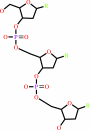 DNA(n)
|
+
|
2'-deoxyribonucleoside 5'-triphosphate
|
=
|
DNA(n+1)
|
+
|
 diphosphate
|
|
|
|
|
|
|
|
|
|
|
|
|
Molecule diagrams generated from .mol files obtained from the
KEGG ftp site
|
|
|
|
|
|
|
|
|
|
|
|
|
|
 |
|
|
|
|
|
|
| |
|
|
| |
|
DOI no:
|
Cell
132:43-54
(2008)
|
|
PubMed id:
|
|
|
|
|
|
| |
|
Structure of a sliding clamp on DNA.
|
|
R.E.Georgescu,
S.S.Kim,
O.Yurieva,
J.Kuriyan,
X.P.Kong,
M.O'Donnell.
|
|
|
|
|
| |
ABSTRACT
|
|
|
|
| |
|
|
The structure of the E. coli beta clamp polymerase processivity factor has been
solved in complex with primed DNA. Interestingly, the clamp directly binds the
DNA duplex and also forms a crystal contact with the ssDNA template strand,
which binds into the protein-binding pocket of the clamp. We demonstrate that
these clamp-DNA interactions function in clamp loading, perhaps by inducing the
ring to close around DNA. Clamp binding to template ssDNA may also serve to hold
the clamp at a primed site after loading or during switching of multiple factors
on the clamp. Remarkably, the DNA is highly tilted as it passes through the beta
ring. The pronounced 22 degrees angle of DNA through beta may enable DNA to
switch between multiple factors bound to a single clamp simply by alternating
from one protomer of the ring to the other.
|
|
|
|
|
|
| |
Selected figure(s)
|
|
|
|
| |
|
|

|
|

|
|
Figure 3.
Figure 3. Structure of the β-DNA Complex
(A) Ribbon
representation of the β-DNA complex: front and side views. DNA
is tilted  vert,
similar 22° from the C2 rotation axis of β. The Cy5 moiety
is not shown for clarity but is shown in Figure S4. vert,
similar 22° from the C2 rotation axis of β. The Cy5 moiety
is not shown for clarity but is shown in Figure S4.
(B)
Detailed view of R24 (top) and Q149 (bottom) in the β-DNA
complex compared to the apo β structure (blue).
(C)
Replication assays using primed M13 ssDNA coated with SSB
contain Pol III^* and the indicated amount of either WT β (blue
diamonds), β[Q149A] (red squares), β[R24A] (orange triangles),
or β[R24A/Q149A] (green circles).
(D) Polymerase extension
rate was determined with primed M13 ssDNA to which β, or mutant
β, is first assembled on the DNA, followed by initiating
synchronous chain extension. Reactions were quenched at the
indicated times, and products were analyzed in a native agarose
gel.
(E) The scheme illustrates the bead conjugated primed
DNA in which SSB blocks ^32P-β from sliding off the end of the
DNA. Clamp loading rate was assessed in assays with either
β[WT] (blue), β[Q149A] (red), β[R24A] (orange), or
β[R24A,Q149A] (green).
|
|
Figure 4.
Figure 4. Interaction of β with the ssDNA Region of the
Primed Site
(A) Crystal lattice showing two molecules of
the β-DNA complex. The ssDNA makes a crystal contact between
two molecules of β.
(B) Surface representation of the
charged residues that line the channel directing ssDNA to the
hydrophobic protein-binding site of β. Basic residues are
colored blue. The protein-binding site is shaded purple and
subsites I and II (defined in Burnouf et al., 2004) are
indicated.
(C) View of ssDNA (orange) positioned inside the
hydrophobic protein-binding pocket of β. Thy[11] and Thy[12]
occupy subsite I of the β hydrophobic pocket; the exposed R246,
R240 side chains interact with the DNA phosphate backbone. Y153
and Y154 (green) stack with Ade[15] and Thy[13], respectively.
|
|
|
|
|
|
| |
The above figures are
reprinted
from an Open Access publication published by Cell Press:
Cell
(2008,
132,
43-54)
copyright 2008.
|
|
| |
Figures were
selected
by an automated process.
|
|
|
|
|
|
|
|
|
|
|
|
|
|
|
|
 |
 |
 |
|
Literature references that cite this PDB file's key reference
|
|
|
| |
PubMed id
|
|
Reference
|
|
|
|
|
|
A.De Biasio,
R.Sánchez,
J.Prieto,
M.Villate,
R.Campos-Olivas,
and
F.J.Blanco
(2011).
Reduced Stability and Increased Dynamics in the Human Proliferating Cell Nuclear Antigen (PCNA) Relative to the Yeast Homolog.
|
| |
PLoS One,
6,
e16600.
|
|
|
|
|
|
|
K.Mayanagi,
S.Kiyonari,
H.Nishida,
M.Saito,
D.Kohda,
Y.Ishino,
T.Shirai,
and
K.Morikawa
(2011).
Architecture of the DNA polymerase B-proliferating cell nuclear antigen (PCNA)-DNA ternary complex.
|
| |
Proc Natl Acad Sci U S A,
108,
1845-1849.
|
|
|
|
|
|
|
L.Johnsen,
I.Flåtten,
Morigen,
B.Dalhus,
M.Bjørås,
T.Waldminghaus,
and
K.Skarstad
(2011).
The G157C mutation in the Escherichia coli sliding clamp specifically affects initiation of replication.
|
| |
Mol Microbiol,
79,
433-446.
|
|
|
PDB code:
|
|
|
|
|
|
|
|
N.A.Tanner,
G.Tolun,
J.J.Loparo,
S.Jergic,
J.D.Griffith,
N.E.Dixon,
and
A.M.van Oijen
(2011).
E. coli DNA replication in the absence of free β clamps.
|
| |
EMBO J,
30,
1830-1840.
|
|
|
|
|
|
|
A.Pluciennik,
L.Dzantiev,
R.R.Iyer,
N.Constantin,
F.A.Kadyrov,
and
P.Modrich
(2010).
PCNA function in the activation and strand direction of MutLα endonuclease in mismatch repair.
|
| |
Proc Natl Acad Sci U S A,
107,
16066-16071.
|
|
|
|
|
|
|
E.P.Geiduschek,
and
G.A.Kassavetis
(2010).
Transcription of the T4 late genes.
|
| |
Virol J,
7,
288.
|
|
|
|
|
|
|
J.D.Pata
(2010).
Structural diversity of the Y-family DNA polymerases.
|
| |
Biochim Biophys Acta,
1804,
1124-1135.
|
|
|
|
|
|
|
J.Peña-Diaz,
and
J.Jiricny
(2010).
PCNA and MutLα: partners in crime in triplet repeat expansion?
|
| |
Proc Natl Acad Sci U S A,
107,
16409-16410.
|
|
|
|
|
|
|
M.D.Sutton,
J.M.Duzen,
and
S.K.Scouten Ponticelli
(2010).
A single hydrophobic cleft in the Escherichia coli processivity clamp is sufficient to support cell viability and DNA damage-induced mutagenesis in vivo.
|
| |
BMC Mol Biol,
11,
102.
|
|
|
|
|
|
|
M.D.Sutton
(2010).
Coordinating DNA polymerase traffic during high and low fidelity synthesis.
|
| |
Biochim Biophys Acta,
1804,
1167-1179.
|
|
|
|
|
|
|
N.M.Dupes,
B.W.Walsh,
A.D.Klocko,
J.S.Lenhart,
H.L.Peterson,
D.A.Gessert,
C.E.Pavlick,
and
L.A.Simmons
(2010).
Mutations in the Bacillus subtilis beta clamp that separate its roles in DNA replication from mismatch repair.
|
| |
J Bacteriol,
192,
3452-3463.
|
|
|
|
|
|
|
R.Kumar,
V.C.Nashine,
P.P.Mishra,
S.J.Benkovic,
and
T.H.Lee
(2010).
Stepwise loading of yeast clamp revealed by ensemble and single-molecule studies.
|
| |
Proc Natl Acad Sci U S A,
107,
19736-19741.
|
|
|
|
|
|
|
R.McNally,
G.D.Bowman,
E.R.Goedken,
M.O'Donnell,
and
J.Kuriyan
(2010).
Analysis of the role of PCNA-DNA contacts during clamp loading.
|
| |
BMC Struct Biol,
10,
3.
|
|
|
PDB code:
|
|
|
|
|
|
|
|
R.Reyes-Lamothe,
D.J.Sherratt,
and
M.C.Leake
(2010).
Stoichiometry and architecture of active DNA replication machinery in Escherichia coli.
|
| |
Science,
328,
498-501.
|
|
|
|
|
|
|
T.Katayama,
S.Ozaki,
K.Keyamura,
and
K.Fujimitsu
(2010).
Regulation of the replication cycle: conserved and diverse regulatory systems for DnaA and oriC.
|
| |
Nat Rev Microbiol,
8,
163-170.
|
|
|
|
|
|
|
Y.Zhou,
F.Li,
Y.Chen,
L.Bi,
and
X.E.Zhang
(2010).
Functional analyses of Escherichia coli MutS-beta clamp interaction in vitro and in vivo.
|
| |
Curr Microbiol,
60,
466-470.
|
|
|
|
|
|
|
Z.Zhuang,
and
Y.Ai
(2010).
Processivity factor of DNA polymerase and its expanding role in normal and translesion DNA synthesis.
|
| |
Biochim Biophys Acta,
1804,
1081-1093.
|
|
|
|
|
|
|
A.Pluciennik,
V.Burdett,
O.Lukianova,
M.O'Donnell,
and
P.Modrich
(2009).
Involvement of the beta clamp in methyl-directed mismatch repair in vitro.
|
| |
J Biol Chem,
284,
32782-32791.
|
|
|
|
|
|
|
A.R.Parks,
Z.Li,
Q.Shi,
R.M.Owens,
M.M.Jin,
and
J.E.Peters
(2009).
Transposition into replicating DNA occurs through interaction with the processivity factor.
|
| |
Cell,
138,
685-695.
|
|
|
|
|
|
|
A.S.Doré,
M.L.Kilkenny,
N.J.Rzechorzek,
and
L.H.Pearl
(2009).
Crystal structure of the rad9-rad1-hus1 DNA damage checkpoint complex--implications for clamp loading and regulation.
|
| |
Mol Cell,
34,
735-745.
|
|
|
PDB code:
|
|
|
|
|
|
|
|
C.Jiang,
G.Komazin-Meredith,
W.Tian,
D.M.Coen,
and
C.B.Hwang
(2009).
Mutations that increase DNA binding by the processivity factor of herpes simplex virus affect virus production and DNA replication fidelity.
|
| |
J Virol,
83,
7573-7580.
|
|
|
|
|
|
|
H.Hashimoto,
J.R.Horton,
X.Zhang,
and
X.Cheng
(2009).
UHRF1, a modular multi-domain protein, regulates replication-coupled crosstalk between DNA methylation and histone modifications.
|
| |
Epigenetics,
4,
8.
|
|
|
PDB codes:
|
|
|
|
|
|
|
|
H.Nishida,
K.Mayanagi,
S.Kiyonari,
Y.Sato,
T.Oyama,
Y.Ishino,
and
K.Morikawa
(2009).
Structural determinant for switching between the polymerase and exonuclease modes in the PCNA-replicative DNA polymerase complex.
|
| |
Proc Natl Acad Sci U S A,
106,
20693-20698.
|
|
|
|
|
|
|
J.A.Thompson,
C.O.Paschall,
M.O'Donnell,
and
L.B.Bloom
(2009).
A slow ATP-induced conformational change limits the rate of DNA binding but not the rate of beta clamp binding by the escherichia coli gamma complex clamp loader.
|
| |
J Biol Chem,
284,
32147-32157.
|
|
|
|
|
|
|
J.L.Baltz,
D.J.Filman,
M.Ciustea,
J.E.Silverman,
C.L.Lautenschlager,
D.M.Coen,
R.P.Ricciardi,
and
J.M.Hogle
(2009).
The crystal structure of PF-8, the DNA polymerase accessory subunit from Kaposi's sarcoma-associated herpesvirus.
|
| |
J Virol,
83,
12215-12228.
|
|
|
PDB codes:
|
|
|
|
|
|
|
|
J.M.Heltzel,
S.K.Scouten Ponticelli,
L.H.Sanders,
J.M.Duzen,
V.Cody,
J.Pace,
E.H.Snell,
and
M.D.Sutton
(2009).
Sliding clamp-DNA interactions are required for viability and contribute to DNA polymerase management in Escherichia coli.
|
| |
J Mol Biol,
387,
74-91.
|
|
|
PDB code:
|
|
|
|
|
|
|
|
K.Mayanagi,
S.Kiyonari,
M.Saito,
T.Shirai,
Y.Ishino,
and
K.Morikawa
(2009).
Mechanism of replication machinery assembly as revealed by the DNA ligase-PCNA-DNA complex architecture.
|
| |
Proc Natl Acad Sci U S A,
106,
4647-4652.
|
|
|
|
|
|
|
K.Murayama,
S.Nakayama,
M.Kato-Murayama,
R.Akasaka,
N.Ohbayashi,
Y.Kamewari-Hayami,
T.Terada,
M.Shirouzu,
T.Tsurumi,
and
S.Yokoyama
(2009).
Crystal structure of epstein-barr virus DNA polymerase processivity factor BMRF1.
|
| |
J Biol Chem,
284,
35896-35905.
|
|
|
PDB code:
|
|
|
|
|
|
|
|
M.S.Park,
and
M.O'Donnell
(2009).
The clamp loader assembles the beta clamp onto either a 3' or 5' primer terminus: the underlying basis favoring 3' loading.
|
| |
J Biol Chem,
284,
31473-31483.
|
|
|
|
|
|
|
S.Chen,
M.K.Levin,
M.Sakato,
Y.Zhou,
and
M.M.Hingorani
(2009).
Mechanism of ATP-driven PCNA clamp loading by S. cerevisiae RFC.
|
| |
J Mol Biol,
388,
431-442.
|
|
|
|
|
|
|
S.K.Scouten Ponticelli,
J.M.Duzen,
and
M.D.Sutton
(2009).
Contributions of the individual hydrophobic clefts of the Escherichia coli beta sliding clamp to clamp loading, DNA replication and clamp recycling.
|
| |
Nucleic Acids Res,
37,
2796-2809.
|
|
|
|
|
|
|
S.Kiyonari,
S.Tahara,
T.Shirai,
S.Iwai,
S.Ishino,
and
Y.Ishino
(2009).
Biochemical properties and base excision repair complex formation of apurinic/apyrimidinic endonuclease from Pyrococcus furiosus.
|
| |
Nucleic Acids Res,
37,
6439-6453.
|
|
|
|
|
|
|
S.M.Hamdan,
and
C.C.Richardson
(2009).
Motors, switches, and contacts in the replisome.
|
| |
Annu Rev Biochem,
78,
205-243.
|
|
|
|
|
|
|
W.Strzalka,
T.Oyama,
K.Tori,
and
K.Morikawa
(2009).
Crystal structures of the Arabidopsis thaliana proliferating cell nuclear antigen 1 and 2 proteins complexed with the human p21 C-terminal segment.
|
| |
Protein Sci,
18,
1072-1080.
|
|
|
PDB codes:
|
|
|
|
|
|
|
|
A.Chari,
M.M.Golas,
M.Klingenhäger,
N.Neuenkirchen,
B.Sander,
C.Englbrecht,
A.Sickmann,
H.Stark,
and
U.Fischer
(2008).
An assembly chaperone collaborates with the SMN complex to generate spliceosomal SnRNPs.
|
| |
Cell,
135,
497-509.
|
|
|
|
|
|
|
G.Komazin-Meredith,
R.J.Petrella,
W.L.Santos,
D.J.Filman,
J.M.Hogle,
G.L.Verdine,
M.Karplus,
and
D.M.Coen
(2008).
The human cytomegalovirus UL44 C clamp wraps around DNA.
|
| |
Structure,
16,
1214-1225.
|
|
|
|
|
|
|
G.Komazin-Meredith,
R.Mirchev,
D.E.Golan,
A.M.van Oijen,
and
D.M.Coen
(2008).
Hopping of a processivity factor on DNA revealed by single-molecule assays of diffusion.
|
| |
Proc Natl Acad Sci U S A,
105,
10721-10726.
|
|
|
|
|
|
|
K.Palle,
L.Pattarello,
M.van der Merwe,
C.Losasso,
P.Benedetti,
and
M.A.Bjornsti
(2008).
Disulfide Cross-links Reveal Conserved Features of DNA Topoisomerase I Architecture and a Role for the N Terminus in Clamp Closure.
|
| |
J Biol Chem,
283,
27767-27775.
|
|
|
|
|
|
|
N.Y.Yao,
and
M.O'Donnell
(2008).
Replisome dynamics and use of DNA trombone loops to bypass replication blocks.
|
| |
Mol Biosyst,
4,
1075-1084.
|
|
|
|
|
|
|
P.Pietroni,
and
P.H.von Hippel
(2008).
Multiple ATP binding is required to stabilize the "activated" (clamp open) clamp loader of the t4 DNA replication complex.
|
| |
J Biol Chem,
283,
28338-28353.
|
|
|
|
|
|
|
R.A.Wing,
S.Bailey,
and
T.A.Steitz
(2008).
Insights into the replisome from the structure of a ternary complex of the DNA polymerase III alpha-subunit.
|
| |
J Mol Biol,
382,
859-869.
|
|
|
PDB code:
|
|
|
|
|
|
|
|
R.J.Evans,
D.R.Davies,
J.M.Bullard,
J.Christensen,
L.S.Green,
J.W.Guiles,
J.D.Pata,
W.K.Ribble,
N.Janjic,
and
T.C.Jarvis
(2008).
Structure of PolC reveals unique DNA binding and fidelity determinants.
|
| |
Proc Natl Acad Sci U S A,
105,
20695-20700.
|
|
|
PDB codes:
|
|
|
|
|
|
|
|
S.Chen,
M.M.Coman,
M.Sakato,
M.O'Donnell,
and
M.M.Hingorani
(2008).
Conserved residues in the delta subunit help the E. coli clamp loader, gamma complex, target primer-template DNA for clamp assembly.
|
| |
Nucleic Acids Res,
36,
3274-3286.
|
|
|
|
|
|
|
T.A.Laurence,
Y.Kwon,
A.Johnson,
C.W.Hollars,
M.O'Donnell,
J.A.Camarero,
and
D.Barsky
(2008).
Motion of a DNA sliding clamp observed by single molecule fluorescence spectroscopy.
|
| |
J Biol Chem,
283,
22895-22906.
|
|
|
|
|
|
The most recent references are shown first.
Citation data come partly from CiteXplore and partly
from an automated harvesting procedure. Note that this is likely to be
only a partial list as not all journals are covered by
either method. However, we are continually building up the citation data
so more and more references will be included with time.
Where a reference describes a PDB structure, the PDB
code is
shown on the right.
|
|


 Links
Links


