|
PDBsum entry 3f1v

|
|
|
|
|
 |
Contents |
 |
|
|
|
|
|
|
|
|
|
|
|
|
* Residue conservation analysis
|
|
|
|
|
|
|
|
|
|
|
Enzyme class:
|
|
E.C.2.7.7.7
- DNA-directed Dna polymerase.
|
|
|
|
|
|
|
Reaction:
|
|
DNA(n) + a 2'-deoxyribonucleoside 5'-triphosphate = DNA(n+1) + diphosphate
|
|
|
|
|
|
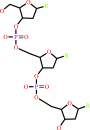 DNA(n)
|
+
|
2'-deoxyribonucleoside 5'-triphosphate
|
=
|
DNA(n+1)
|
+
|
 diphosphate
|
|
|
|
|
|
|
|
|
|
|
|
|
Molecule diagrams generated from .mol files obtained from the
KEGG ftp site
|
|
|
|
|
|
|
|
|
|
|
|
|
|
 |
|
|
|
|
|
|
| |
|
|
| |
|
|
J Mol Biol
387:74-91
(2009)
|
|
PubMed id:
|
|
|
|
|
|
| |
|
Sliding clamp-DNA interactions are required for viability and contribute to DNA polymerase management in Escherichia coli.
|
|
J.M.Heltzel,
S.K.Scouten Ponticelli,
L.H.Sanders,
J.M.Duzen,
V.Cody,
J.Pace,
E.H.Snell,
M.D.Sutton.
|
|
|
|
|
| |
ABSTRACT
|
|
|
|
| |
|
|
Sliding clamp proteins topologically encircle DNA and play vital roles in
coordinating the actions of various DNA replication, repair, and damage
tolerance proteins. At least three distinct surfaces of the Escherichia coli
beta clamp interact physically with the DNA that it topologically encircles. We
utilized mutant beta clamp proteins bearing G66E and G174A substitutions
(beta159), affecting the single-stranded DNA-binding region, or poly-Ala
substitutions in place of residues 148-HQDVR-152 (beta(148-152)), affecting the
double-stranded DNA binding region, to determine the biological relevance of
clamp-DNA interactions. As part of this work, we solved the X-ray crystal
structure of beta(148-152), which verified that the poly-Ala substitutions
failed to significantly alter the tertiary structure of the clamp. Based on
functional assays, both beta159 and beta(148-152) were impaired for loading and
retention on a linear primed DNA in vitro. In the case of beta(148-152), this
defect was not due to altered interactions with the DnaX clamp loader, but
rather was the result of impaired beta(148-152)-DNA interactions. Once loaded,
beta(148-152) was proficient for DNA polymerase III (Pol III) replication in
vitro. In contrast, beta(148-152) was severely impaired for Pol II and Pol IV
replication and was similarly impaired for direct physical interactions with
these Pols. Despite its ability to support Pol III replication in vitro,
beta(148-152) was unable to support viability of E. coli. Nevertheless,
physiological levels of beta(148-152) expressed from a plasmid efficiently
complemented the temperature-sensitive growth phenotype of a strain expressing
beta159 (dnaN159), provided that Pol II and Pol IV were inactivated. Although
this strain was impaired for Pol V-dependent mutagenesis, inactivation of Pol II
and Pol IV restored the Pol V mutator phenotype. Taken together, these results
support a model in which a sophisticated combination of competitive clamp-DNA,
clamp-partner, and partner-DNA interactions serve to manage the actions of the
different E. coli Pols in vivo.
|
|
|
|
|
|
|
|
|
|
|
|
|
|
|
|
|
|
 |
 |
 |
|
Literature references that cite this PDB file's key reference
|
|
|
| |
PubMed id
|
|
Reference
|
|
|
|
|
|
B.D.Kana,
G.L.Abrahams,
N.Sung,
D.F.Warner,
B.G.Gordhan,
E.E.Machowski,
L.Tsenova,
J.C.Sacchettini,
N.G.Stoker,
G.Kaplan,
and
V.Mizrahi
(2010).
Role of the DinB homologs Rv1537 and Rv3056 in Mycobacterium tuberculosis.
|
| |
J Bacteriol,
192,
2220-2227.
|
|
|
|
|
|
|
J.N.Ollivierre,
J.Fang,
and
P.J.Beuning
(2010).
The Roles of UmuD in Regulating Mutagenesis.
|
| |
J Nucleic Acids,
2010,
0.
|
|
|
|
|
|
|
M.D.Sutton,
J.M.Duzen,
and
S.K.Scouten Ponticelli
(2010).
A single hydrophobic cleft in the Escherichia coli processivity clamp is sufficient to support cell viability and DNA damage-induced mutagenesis in vivo.
|
| |
BMC Mol Biol,
11,
102.
|
|
|
|
|
|
|
M.D.Sutton
(2010).
Coordinating DNA polymerase traffic during high and low fidelity synthesis.
|
| |
Biochim Biophys Acta,
1804,
1167-1179.
|
|
|
|
|
|
|
N.M.Dupes,
B.W.Walsh,
A.D.Klocko,
J.S.Lenhart,
H.L.Peterson,
D.A.Gessert,
C.E.Pavlick,
and
L.A.Simmons
(2010).
Mutations in the Bacillus subtilis beta clamp that separate its roles in DNA replication from mismatch repair.
|
| |
J Bacteriol,
192,
3452-3463.
|
|
|
|
|
|
|
S.Chandani,
C.Jacobs,
and
E.L.Loechler
(2010).
Architecture of y-family DNA polymerases relevant to translesion DNA synthesis as revealed in structural and molecular modeling studies.
|
| |
J Nucleic Acids,
2010,
0.
|
|
|
|
|
|
|
B.W.Shurtleff,
J.N.Ollivierre,
M.Tehrani,
G.C.Walker,
and
P.J.Beuning
(2009).
Steric gate variants of UmuC confer UV hypersensitivity on Escherichia coli.
|
| |
J Bacteriol,
191,
4815-4823.
|
|
|
|
|
|
|
J.M.Heltzel,
R.W.Maul,
S.K.Scouten Ponticelli,
and
M.D.Sutton
(2009).
A model for DNA polymerase switching involving a single cleft and the rim of the sliding clamp.
|
| |
Proc Natl Acad Sci U S A,
106,
12664-12669.
|
|
|
|
|
|
|
P.J.Beuning,
S.Chan,
L.S.Waters,
H.Addepalli,
J.N.Ollivierre,
and
G.C.Walker
(2009).
Characterization of novel alleles of the Escherichia coli umuDC genes identifies additional interaction sites of UmuC with the beta clamp.
|
| |
J Bacteriol,
191,
5910-5920.
|
|
|
|
|
|
|
S.K.Scouten Ponticelli,
J.M.Duzen,
and
M.D.Sutton
(2009).
Contributions of the individual hydrophobic clefts of the Escherichia coli beta sliding clamp to clamp loading, DNA replication and clamp recycling.
|
| |
Nucleic Acids Res,
37,
2796-2809.
|
|
|
|
|
|
The most recent references are shown first.
Citation data come partly from CiteXplore and partly
from an automated harvesting procedure. Note that this is likely to be
only a partial list as not all journals are covered by
either method. However, we are continually building up the citation data
so more and more references will be included with time.
|
|


 Links
Links