
|
|
|
|
|
 |
Contents |
 |
|
|
|
|
|
|
|
|
|
|
|
 1418 a.a.
|
|
|
|
|
|
|
|
|
|
|
 1106 a.a.
|
|
|
|
|
|
|
|
|
|
|
 266 a.a.
|
|
|
|
|
|
|
|
|
|
|
 177 a.a.
|
|
|
|
|
|
|
|
|
|
|
 214 a.a.
|
|
|
|
|
|
|
|
|
|
|
 84 a.a.
|
|
|
|
|
|
|
|
|
|
|
 171 a.a.
|
|
|
|
|
|
|
|
|
|
|
 133 a.a.
|
|
|
|
|
|
|
|
|
|
|
 119 a.a.
|
|
|
|
|
|
|
|
|
|
|
 65 a.a.
|
|
|
|
|
|
|
|
|
|
|
 114 a.a.
|
|
|
|
|
|
|
|
|
|
|
 46 a.a.
|
|
|
|
|
|
|
|
|
|
|
|
|
* Residue conservation analysis
|
|
|
|
|
|
PDB id:
|
|
|
|
| Name: |
|
Transferase
|
|
|
Title:
|
|
Alpha-amanitin inhibited complete RNA polymerase ii elongation complex
|
|
Structure:
|
|
DNA-directed RNA polymerase ii subunit rpb1. Chain: a. Synonym: RNA polymerase ii subunit b1, RNA polymerase ii subunit 1, DNA-directed RNA polymerase iii largest subunit, b220, DNA-directed RNA polymerase ii largest subunit. DNA-directed RNA polymerase ii subunit rpb2. Chain: b. Synonym: DNA-directed RNA polymerase ii 140 kda, RNA polymerase ii subunit 2, DNA-directed RNA polymerase ii 140 kda polypeptide, b150
|
|
Source:
|
|
Saccharomyces cerevisiae. Bakers' yeast. Organism_taxid: 4932. Amanita phalloides. Death cap. Organism_taxid: 67723. Synthetic: yes. Synthetic construct. Organism_taxid: 32630.
|
|
Resolution:
|
|
|
3.40Å
|
R-factor:
|
0.255
|
R-free:
|
0.288
|
|
|
Authors:
|
|
F.Brueckner,P.Cramer
|
Key ref:

|
|
F.Brueckner
and
P.Cramer
(2008).
Structural basis of transcription inhibition by alpha-amanitin and implications for RNA polymerase II translocation.
Nat Struct Biol,
15,
811-818.
PubMed id:
DOI:

|
|
|
Date:
|
|
|
27-May-08
|
Release date:
|
17-Jun-08
|
|
|
|
|
|
|
PROCHECK
|

|
|
|
|
|
Headers
|
|
|
|
References
|
|
|
|
|
|

|
|
P04050
(RPB1_YEAST) -
DNA-directed RNA polymerase II subunit RPB1 from Saccharomyces cerevisiae (strain ATCC 204508 / S288c)
|
|
|
|
Seq:
Struc:
|
|
|
|
1733 a.a.
1418 a.a.
|
|

|

|
|
|
|
|
|
|
|
|
|
|
|
|

|
|
P08518
(RPB2_YEAST) -
DNA-directed RNA polymerase II subunit RPB2 from Saccharomyces cerevisiae (strain ATCC 204508 / S288c)
|
|
|
|
Seq:
Struc:
|
|
|
|
1224 a.a.
1106 a.a.
|
|
|

|
|
|
|
|
|
|
|
|
|
|
|
|

|
|
P16370
(RPB3_YEAST) -
DNA-directed RNA polymerase II subunit RPB3 from Saccharomyces cerevisiae (strain ATCC 204508 / S288c)
|
|
|
|
Seq:
Struc:
|
|
|
|
318 a.a.
266 a.a.
|
|
|

|

|
|
|
|
|
|
|
|
|
|
|
|

|
|
P20433
(RPB4_YEAST) -
DNA-directed RNA polymerase II subunit RPB4 from Saccharomyces cerevisiae (strain ATCC 204508 / S288c)
|
|
|
|
Seq:
Struc:
|
|
|
|
221 a.a.
177 a.a.
|
|
|

|
|
|
|
|
|
|
|
|
|
|
|
|

|
|
P20434
(RPAB1_YEAST) -
DNA-directed RNA polymerases I, II, and III subunit RPABC1 from Saccharomyces cerevisiae (strain ATCC 204508 / S288c)
|
|
|
|
Seq:
Struc:
|
|
|
|
215 a.a.
214 a.a.
|
|
|

|
|
|
|
|
|
|
|
|
|
|
|
|

|
|
P20435
(RPAB2_YEAST) -
DNA-directed RNA polymerases I, II, and III subunit RPABC2 from Saccharomyces cerevisiae (strain ATCC 204508 / S288c)
|
|
|
|
Seq:
Struc:
|
|
|
|
155 a.a.
84 a.a.
|
|
|

|
|
|
|
|
|
|
|
|
|
|
|
|

|
|
P34087
(RPB7_YEAST) -
DNA-directed RNA polymerase II subunit RPB7 from Saccharomyces cerevisiae (strain ATCC 204508 / S288c)
|
|
|
|
Seq:
Struc:
|
|
|
|
171 a.a.
171 a.a.
|
|
|

|
|
|
|
|
|
|
|
|
|
|
|
|

|
|
P20436
(RPAB3_YEAST) -
DNA-directed RNA polymerases I, II, and III subunit RPABC3 from Saccharomyces cerevisiae (strain ATCC 204508 / S288c)
|
|
|
|
Seq:
Struc:
|
|
|
|
146 a.a.
133 a.a.
|
|
|

|
|
|
|
|
|
|
|
|
|
|
|
|

|
|
P27999
(RPB9_YEAST) -
DNA-directed RNA polymerase II subunit RPB9 from Saccharomyces cerevisiae (strain ATCC 204508 / S288c)
|
|
|
|
Seq:
Struc:
|
|
|
|
122 a.a.
119 a.a.
|
|
|

|
|
|
|
|
|
|
|
|
|
|
|
|

|
|
P22139
(RPAB5_YEAST) -
DNA-directed RNA polymerases I, II, and III subunit RPABC5 from Saccharomyces cerevisiae (strain ATCC 204508 / S288c)
|
|
|
|
Seq:
Struc:
|
|
|
|
70 a.a.
65 a.a.
|
|
|

|
|
|
|
|
|
|
|
|
|
|
|
|
|
|
|
|
|
Enzyme class:
|
|
Chains A, B, C, D, E, F, G, H, I, J, K:
E.C.2.7.7.6
- DNA-directed Rna polymerase.
|
|
|
|
|
|
|
Reaction:
|
|
RNA(n) + a ribonucleoside 5'-triphosphate = RNA(n+1) + diphosphate
|
|
|
|
|
|
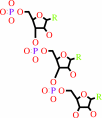 RNA(n)
|
+
|
ribonucleoside 5'-triphosphate
|
=
|
RNA(n+1)
|
+
|
 diphosphate
|
|
|
|
|
|
|
|
|
|
|
|
|
Molecule diagrams generated from .mol files obtained from the
KEGG ftp site
|
|
|
|
|
|
|
|
|
|
|
|
|
|
 |
|
|
|
|
|
|
| |
|
|
| |
|
DOI no:
|
Nat Struct Biol
15:811-818
(2008)
|
|
PubMed id:
|
|
|
|
|
|
| |
|
Structural basis of transcription inhibition by alpha-amanitin and implications for RNA polymerase II translocation.
|
|
F.Brueckner,
P.Cramer.
|
|
|
|
|
| |
ABSTRACT
|
|
|
|
| |
|
|
To study how RNA polymerase II translocates after nucleotide incorporation, we
prepared elongation complex crystals in which pre- and post-translocation states
interconvert. Crystal soaking with the inhibitor alpha-amanitin locked the
elongation complex in a new state, which was refined at 3.4-A resolution and
identified as a possible translocation intermediate. The DNA base entering the
active site occupies a 'pretemplating' position above the central bridge helix,
which is shifted and occludes the templating position. A leucine residue in the
trigger loop forms a wedge at the shifted bridge helix, but moves by 13 A to
close the active site during nucleotide incorporation. Our results support a
Brownian ratchet mechanism that involves swinging of the trigger loop between
open, wedged and closed positions, and suggest that alpha-amanitin impairs
nucleotide incorporation and translocation by trapping the trigger loop and
bridge helix.
|
|
|
|
|
|
| |
Selected figure(s)
|
|
|
|
| |
|
|

|
|

|
|
Figure 4.
(a,b) Superposition of the trigger loops and bridge helices
in the  -amanitin
inhibited Pol II EC and the free T. thermophilus (Tth) RNA
polymerase^6. The trigger loop residue Leu1081 (S. cerevisiae
(Sc) Pol II) or its homologous residue Met1238 (Tth) forms a
wedge between the bridge helix and helix 37
in Pol II or G' in Tth. The views are from the top (a) or the
side (b), as in Figure 3b or 1e, respectively. In the -amanitin–inhibited
Pol II EC, the central bridge helix is shifted, whereas in the
bacterial holoenzyme it adopts a flipped-out conformation. (c,d)
Four possible states of the EC. Above to below, the
pretranslocation state (PDB 1I6H)^1, a potential transition
state with a modeled flipped-out bridge helix (PDB 1IW7)^17, the
-amanitin–inhibited
EC (the apparent translocation intermediate with the shifted
bridge helix, this study), and the post-translocation state (PDB
1Y1W)^2 are shown with space-filling models (c) or ribbon
diagrams (d). The bridge helix residues Ala832/Ala1089 (Pol
II/Tth) and Thr831/Thr1088 (Pol II/Tth) are highlighted in
yellow and brown, respectively. (e,f) Comparison of trigger loop
conformations. Pol II EC structures in the post-translocation
state (PDB 1Y1W)^2, with bound NTP substrate (PDB 2E2H)^4, and
in the intermediary state are superimposed. Nucleic acids and
metal A are from the translocation intermediate. The trigger
loops of the three structures are depicted in dark red (wedged,
translocation intermediate), light blue (open, 1Y1W) and yellow
(closed, 2E2H, labels in black). (f) Also depicted are the
bridge helix (green, apparent translocation intermediate) and
the NTP in the insertion site (orange, 2E2H). (g) Comparison of
bridge helix conformations in the -amanitin–inhibited
EC (green, with residues Ala832 and Thr831 highlighted in yellow
and brown, respectively), the post-translocation EC^2 (light
green) and the core Pol II EC with bound NTP^4 (beige). -amanitin
inhibited Pol II EC and the free T. thermophilus (Tth) RNA
polymerase^6. The trigger loop residue Leu1081 (S. cerevisiae
(Sc) Pol II) or its homologous residue Met1238 (Tth) forms a
wedge between the bridge helix and helix 37
in Pol II or G' in Tth. The views are from the top (a) or the
side (b), as in Figure 3b or 1e, respectively. In the -amanitin–inhibited
Pol II EC, the central bridge helix is shifted, whereas in the
bacterial holoenzyme it adopts a flipped-out conformation. (c,d)
Four possible states of the EC. Above to below, the
pretranslocation state (PDB 1I6H)^1, a potential transition
state with a modeled flipped-out bridge helix (PDB 1IW7)^17, the
-amanitin–inhibited
EC (the apparent translocation intermediate with the shifted
bridge helix, this study), and the post-translocation state (PDB
1Y1W)^2 are shown with space-filling models (c) or ribbon
diagrams (d). The bridge helix residues Ala832/Ala1089 (Pol
II/Tth) and Thr831/Thr1088 (Pol II/Tth) are highlighted in
yellow and brown, respectively. (e,f) Comparison of trigger loop
conformations. Pol II EC structures in the post-translocation
state (PDB 1Y1W)^2, with bound NTP substrate (PDB 2E2H)^4, and
in the intermediary state are superimposed. Nucleic acids and
metal A are from the translocation intermediate. The trigger
loops of the three structures are depicted in dark red (wedged,
translocation intermediate), light blue (open, 1Y1W) and yellow
(closed, 2E2H, labels in black). (f) Also depicted are the
bridge helix (green, apparent translocation intermediate) and
the NTP in the insertion site (orange, 2E2H). (g) Comparison of
bridge helix conformations in the -amanitin–inhibited
EC (green, with residues Ala832 and Thr831 highlighted in yellow
and brown, respectively), the post-translocation EC^2 (light
green) and the core Pol II EC with bound NTP^4 (beige).
|
|
Figure 5.
Schematic representation of the extended model for the NAC.
The vertical dashed line indicates register +1. For details,
refer to text.
|
|
|
|
|
|
| |
The above figures are
reprinted
by permission from Macmillan Publishers Ltd:
Nat Struct Biol
(2008,
15,
811-818)
copyright 2008.
|
|
| |
Figures were
selected
by an automated process.
|
|
|
|
|
|
|
|
|
|
|
|
|
|
|
|
 |
 |
 |
|
Literature references that cite this PDB file's key reference
|
|
|
| |
PubMed id
|
|
Reference
|
|
|
|
|
|
A.C.Cheung,
and
P.Cramer
(2011).
Structural basis of RNA polymerase II backtracking, arrest and reactivation.
|
| |
Nature,
471,
249-253.
|
|
|
PDB codes:
|
|
|
|
|
|
|
|
D.Pupov,
N.Miropolskaya,
A.Sevostyanova,
I.Bass,
I.Artsimovitch,
and
A.Kulbachinskiy
(2010).
Multiple roles of the RNA polymerase {beta}' SW2 region in transcription initiation, promoter escape, and RNA elongation.
|
| |
Nucleic Acids Res,
38,
5784-5796.
|
|
|
|
|
|
|
J.Zhang,
M.Palangat,
and
R.Landick
(2010).
Role of the RNA polymerase trigger loop in catalysis and pausing.
|
| |
Nat Struct Mol Biol,
17,
99.
|
|
|
|
|
|
|
L.A.Selth,
S.Sigurdsson,
and
J.Q.Svejstrup
(2010).
Transcript Elongation by RNA Polymerase II.
|
| |
Annu Rev Biochem,
79,
271-293.
|
|
|
|
|
|
|
P.Cramer
(2010).
Towards molecular systems biology of gene transcription and regulation.
|
| |
Biol Chem,
391,
731-735.
|
|
|
|
|
|
|
P.P.Hein,
and
R.Landick
(2010).
The bridge helix coordinates movements of modules in RNA polymerase.
|
| |
BMC Biol,
8,
141.
|
|
|
|
|
|
|
R.O.Weinzierl
(2010).
The nucleotide addition cycle of RNA polymerase is controlled by two molecular hinges in the Bridge Helix domain.
|
| |
BMC Biol,
8,
134.
|
|
|
|
|
|
|
S.Tagami,
S.Sekine,
T.Kumarevel,
N.Hino,
Y.Murayama,
S.Kamegamori,
M.Yamamoto,
K.Sakamoto,
and
S.Yokoyama
(2010).
Crystal structure of bacterial RNA polymerase bound with a transcription inhibitor protein.
|
| |
Nature,
468,
978-982.
|
|
|
PDB codes:
|
|
|
|
|
|
|
|
W.J.Lane,
and
S.A.Darst
(2010).
Molecular evolution of multisubunit RNA polymerases: structural analysis.
|
| |
J Mol Biol,
395,
686-704.
|
|
|
|
|
|
|
X.Huang,
D.Wang,
D.R.Weiss,
D.A.Bushnell,
R.D.Kornberg,
and
M.Levitt
(2010).
RNA polymerase II trigger loop residues stabilize and position the incoming nucleotide triphosphate in transcription.
|
| |
Proc Natl Acad Sci U S A,
107,
15745-15750.
|
|
|
|
|
|
|
C.Walmacq,
M.L.Kireeva,
J.Irvin,
Y.Nedialkov,
L.Lubkowska,
F.Malagon,
J.N.Strathern,
and
M.Kashlev
(2009).
Rpb9 Subunit Controls Transcription Fidelity by Delaying NTP Sequestration in RNA Polymerase II.
|
| |
J Biol Chem,
284,
19601-19612.
|
|
|
|
|
|
|
D.Wang,
D.A.Bushnell,
X.Huang,
K.D.Westover,
M.Levitt,
and
R.D.Kornberg
(2009).
Structural basis of transcription: backtracked RNA polymerase II at 3.4 angstrom resolution.
|
| |
Science,
324,
1203-1206.
|
|
|
PDB codes:
|
|
|
|
|
|
|
|
E.Nudler
(2009).
RNA polymerase active center: the molecular engine of transcription.
|
| |
Annu Rev Biochem,
78,
335-361.
|
|
|
|
|
|
|
F.Brueckner,
J.Ortiz,
and
P.Cramer
(2009).
A movie of the RNA polymerase nucleotide addition cycle.
|
| |
Curr Opin Struct Biol,
19,
294-299.
|
|
|
|
|
|
|
G.A.Belogurov,
M.N.Vassylyeva,
A.Sevostyanova,
J.R.Appleman,
A.X.Xiang,
R.Lira,
S.E.Webber,
S.Klyuyev,
E.Nudler,
I.Artsimovitch,
and
D.G.Vassylyev
(2009).
Transcription inactivation through local refolding of the RNA polymerase structure.
|
| |
Nature,
457,
332-335.
|
|
|
PDB code:
|
|
|
|
|
|
|
|
G.E.Damsma,
and
P.Cramer
(2009).
Molecular basis of transcriptional mutagenesis at 8-oxoguanine.
|
| |
J Biol Chem,
284,
31658-31663.
|
|
|
PDB codes:
|
|
|
|
|
|
|
|
H.Spåhr,
G.Calero,
D.A.Bushnell,
and
R.D.Kornberg
(2009).
Schizosacharomyces pombe RNA polymerase II at 3.6-A resolution.
|
| |
Proc Natl Acad Sci U S A,
106,
9185-9190.
|
|
|
PDB code:
|
|
|
|
|
|
|
|
J.Andrecka,
B.Treutlein,
M.A.Arcusa,
A.Muschielok,
R.Lewis,
A.C.Cheung,
P.Cramer,
and
J.Michaelis
(2009).
Nano positioning system reveals the course of upstream and nontemplate DNA within the RNA polymerase II elongation complex.
|
| |
Nucleic Acids Res,
37,
5803-5809.
|
|
|
|
|
|
|
J.F.Sydow,
F.Brueckner,
A.C.Cheung,
G.E.Damsma,
S.Dengl,
E.Lehmann,
D.Vassylyev,
and
P.Cramer
(2009).
Structural basis of transcription: mismatch-specific fidelity mechanisms and paused RNA polymerase II with frayed RNA.
|
| |
Mol Cell,
34,
710-721.
|
|
|
PDB codes:
|
|
|
|
|
|
|
|
M.Kireeva,
Y.A.Nedialkov,
X.Q.Gong,
C.Zhang,
Y.Xiong,
W.Moon,
Z.F.Burton,
and
M.Kashlev
(2009).
Millisecond phase kinetic analysis of elongation catalyzed by human, yeast, and Escherichia coli RNA polymerase.
|
| |
Methods,
48,
333-345.
|
|
|
|
|
|
|
N.Miropolskaya,
I.Artsimovitch,
S.Klimasauskas,
V.Nikiforov,
and
A.Kulbachinskiy
(2009).
Allosteric control of catalysis by the F loop of RNA polymerase.
|
| |
Proc Natl Acad Sci U S A,
106,
18942-18947.
|
|
|
|
|
|
|
P.A.Meyer,
P.Ye,
M.H.Suh,
M.Zhang,
and
J.Fu
(2009).
Structure of the 12-Subunit RNA Polymerase II Refined with the Aid of Anomalous Diffraction Data.
|
| |
J Biol Chem,
284,
12933-12939.
|
|
|
PDB code:
|
|
|
|
|
|
|
|
L.Tan,
S.Wiesler,
D.Trzaska,
H.C.Carney,
and
R.O.Weinzierl
(2008).
Bridge helix and trigger loop perturbations generate superactive RNA polymerases.
|
| |
J Biol,
7,
40.
|
|
|
|
|
|
|
R.Sousa
(2008).
Tie me up, tie me down: inhibiting RNA polymerase.
|
| |
Cell,
135,
205-207.
|
|
|
|
|
|
The most recent references are shown first.
Citation data come partly from CiteXplore and partly
from an automated harvesting procedure. Note that this is likely to be
only a partial list as not all journals are covered by
either method. However, we are continually building up the citation data
so more and more references will be included with time.
Where a reference describes a PDB structure, the PDB
codes are
shown on the right.
|

| |


 Links
Links


