
|
|
|
|
|
 |
Contents |
 |
|
|
|
|
|
|
|
|
|
|
|
 1416 a.a.
|
|
|
|
|
|
|
|
|
|
|
 1108 a.a.
|
|
|
|
|
|
|
|
|
|
|
 266 a.a.
|
|
|
|
|
|
|
|
|
|
|
 177 a.a.
|
|
|
|
|
|
|
|
|
|
|
 214 a.a.
|
|
|
|
|
|
|
|
|
|
|
 84 a.a.
|
|
|
|
|
|
|
|
|
|
|
 171 a.a.
|
|
|
|
|
|
|
|
|
|
|
 133 a.a.
|
|
|
|
|
|
|
|
|
|
|
 119 a.a.
|
|
|
|
|
|
|
|
|
|
|
 65 a.a.
|
|
|
|
|
|
|
|
|
|
|
 114 a.a.
|
|
|
|
|
|
|
|
|
|
|
 46 a.a.
|
|
|
|
|
|
|
|
|
|
|
|
|
* Residue conservation analysis
|
|
|
|
|
|
PDB id:
|
|
|
|
| Name: |
|
Transcription/DNA-RNA hybrid
|
|
|
Title:
|
|
Cisplatin lesion containing RNA polymerase ii elongation complex
|
|
Structure:
|
|
5'-d( Tp Ap Cp Tp Tp Gup Cp Cp Cp Tp Cp Cp Tp Cp Ap T)-3'. Chain: t. Engineered: yes. 5'-d( Cp Ap Ap Gp Tp Ap G)-3'. Chain: n. Engineered: yes. 5'-r( Up Up Up Gp Ap Gp Gp Ap Gp G)-3'. Chain: p. Engineered: yes.
|
|
Source:
|
|
Synthetic: yes. Saccharomyces cerevisiae. Baker's yeast. Organism_taxid: 4932. Organism_taxid: 4932
|
|
Resolution:
|
|
|
3.80Å
|
R-factor:
|
0.215
|
R-free:
|
0.240
|
|
|
Authors:
|
|
G.E.Damsma,A.Alt,F.Brueckner,T.Carell,P.Cramer
|
Key ref:

|
|
G.E.Damsma
et al.
(2007).
Mechanism of transcriptional stalling at cisplatin-damaged DNA.
Nat Struct Biol,
14,
1127-1133.
PubMed id:
DOI:

|
|
|
Date:
|
|
|
10-Sep-07
|
Release date:
|
20-Nov-07
|
|
|
|
|
|
|
PROCHECK
|

|
|
|
|
|
Headers
|
|
|
|
References
|
|
|
|
|
|

|
|
P04050
(RPB1_YEAST) -
DNA-directed RNA polymerase II subunit RPB1 from Saccharomyces cerevisiae (strain ATCC 204508 / S288c)
|
|
|
|
Seq:
Struc:
|
|
|
|
1733 a.a.
1416 a.a.
|
|

|

|
|
|
|
|
|
|
|
|
|
|
|
|

|
|
P08518
(RPB2_YEAST) -
DNA-directed RNA polymerase II subunit RPB2 from Saccharomyces cerevisiae (strain ATCC 204508 / S288c)
|
|
|
|
Seq:
Struc:
|
|
|
|
1224 a.a.
1108 a.a.
|
|
|

|
|
|
|
|
|
|
|
|
|
|
|
|

|
|
P16370
(RPB3_YEAST) -
DNA-directed RNA polymerase II subunit RPB3 from Saccharomyces cerevisiae (strain ATCC 204508 / S288c)
|
|
|
|
Seq:
Struc:
|
|
|
|
318 a.a.
266 a.a.
|
|
|

|

|
|
|
|
|
|
|
|
|
|
|
|

|
|
P20433
(RPB4_YEAST) -
DNA-directed RNA polymerase II subunit RPB4 from Saccharomyces cerevisiae (strain ATCC 204508 / S288c)
|
|
|
|
Seq:
Struc:
|
|
|
|
221 a.a.
177 a.a.
|
|
|

|
|
|
|
|
|
|
|
|
|
|
|
|

|
|
P20434
(RPAB1_YEAST) -
DNA-directed RNA polymerases I, II, and III subunit RPABC1 from Saccharomyces cerevisiae (strain ATCC 204508 / S288c)
|
|
|
|
Seq:
Struc:
|
|
|
|
215 a.a.
214 a.a.
|
|
|

|
|
|
|
|
|
|
|
|
|
|
|
|

|
|
P20435
(RPAB2_YEAST) -
DNA-directed RNA polymerases I, II, and III subunit RPABC2 from Saccharomyces cerevisiae (strain ATCC 204508 / S288c)
|
|
|
|
Seq:
Struc:
|
|
|
|
155 a.a.
84 a.a.
|
|
|

|
|
|
|
|
|
|
|
|
|
|
|
|

|
|
P34087
(RPB7_YEAST) -
DNA-directed RNA polymerase II subunit RPB7 from Saccharomyces cerevisiae (strain ATCC 204508 / S288c)
|
|
|
|
Seq:
Struc:
|
|
|
|
171 a.a.
171 a.a.
|
|
|

|
|
|
|
|
|
|
|
|
|
|
|
|

|
|
P20436
(RPAB3_YEAST) -
DNA-directed RNA polymerases I, II, and III subunit RPABC3 from Saccharomyces cerevisiae (strain ATCC 204508 / S288c)
|
|
|
|
Seq:
Struc:
|
|
|
|
146 a.a.
133 a.a.
|
|
|

|
|
|
|
|
|
|
|
|
|
|
|
|

|
|
P27999
(RPB9_YEAST) -
DNA-directed RNA polymerase II subunit RPB9 from Saccharomyces cerevisiae (strain ATCC 204508 / S288c)
|
|
|
|
Seq:
Struc:
|
|
|
|
122 a.a.
119 a.a.
|
|
|

|
|
|
|
|
|
|
|
|
|
|
|
|

|
|
P22139
(RPAB5_YEAST) -
DNA-directed RNA polymerases I, II, and III subunit RPABC5 from Saccharomyces cerevisiae (strain ATCC 204508 / S288c)
|
|
|
|
Seq:
Struc:
|
|
|
|
70 a.a.
65 a.a.
|
|
|

|
|
|
|
|
|
|
|
|
|
|
|
|
|
|
|
|
|
Enzyme class:
|
|
Chains A, B, C, D, E, F, G, H, I, J, K, L:
E.C.2.7.7.6
- DNA-directed Rna polymerase.
|
|
|
|
|
|
|
Reaction:
|
|
RNA(n) + a ribonucleoside 5'-triphosphate = RNA(n+1) + diphosphate
|
|
|
|
|
|
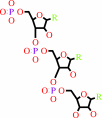 RNA(n)
|
+
|
ribonucleoside 5'-triphosphate
|
=
|
RNA(n+1)
|
+
|
 diphosphate
|
|
|
|
|
|
|
|
|
|
|
|
|
Molecule diagrams generated from .mol files obtained from the
KEGG ftp site
|
|
|
|
|
|
|
|
|
|
|
|
|
|
 |
|
|
|
|
|
|
| |
|
|
| |
|
DOI no:
|
Nat Struct Biol
14:1127-1133
(2007)
|
|
PubMed id:
|
|
|
|
|
|
| |
|
Mechanism of transcriptional stalling at cisplatin-damaged DNA.
|
|
G.E.Damsma,
A.Alt,
F.Brueckner,
T.Carell,
P.Cramer.
|
|
|
|
|
| |
ABSTRACT
|
|
|
|
| |
|
|
The anticancer drug cisplatin forms 1,2-d(GpG) DNA intrastrand cross-links
(cisplatin lesions) that stall RNA polymerase II (Pol II) and trigger
transcription-coupled DNA repair. Here we present a structure-function analysis
of Pol II stalling at a cisplatin lesion in the DNA template. Pol II stalling
results from a translocation barrier that prevents delivery of the lesion to the
active site. AMP misincorporation occurs at the barrier and also at an abasic
site, suggesting that it arises from nontemplated synthesis according to an
'A-rule' known for DNA polymerases. Pol II can bypass a cisplatin lesion that is
artificially placed beyond the translocation barrier, even in the presence of a
G.A mismatch. Thus, the barrier prevents transcriptional mutagenesis. The
stalling mechanism differs from that of Pol II stalling at a photolesion, which
involves delivery of the lesion to the active site and lesion-templated
misincorporation that blocks transcription.
|
|
|
|
|
|
| |
Selected figure(s)
|
|
|
|
| |
|
|

|
|

|
|
Figure 3.
(a,b) Anomalous difference Fourier maps of Pol II elongation
complexes B (a) and C (b), contoured at 6  .
Model of complex A is shown, viewed from the side. .
Model of complex A is shown, viewed from the side.
|
|
Figure 5.
(a) Pol II stalling at the cisplatin lesion (this study),
shown as a schematic representation of RNA extension in complex
A. The initial RNA (top) corresponds to the unextended RNA of
scaffold A. Dashed line represents translocation barrier. The
artificial conditions leading to lesion bypass are depicted at
the bottom. (b) Pol II stalling at a CPD lesion. Schematic is
adapted from reference 8.
|
|
|
|
|
|
| |
The above figures are
reprinted
by permission from Macmillan Publishers Ltd:
Nat Struct Biol
(2007,
14,
1127-1133)
copyright 2007.
|
|
| |
Figures were
selected
by an automated process.
|
|
|
|
|
|
|
|
|
|
|
|
|
|
|
|
 |
 |
 |
|
Literature references that cite this PDB file's key reference
|
|
|
| |
PubMed id
|
|
Reference
|
|
|
|
|
|
D.Brégeon,
and
P.W.Doetsch
(2011).
Transcriptional mutagenesis: causes and involvement in tumour development.
|
| |
Nat Rev Cancer,
11,
218-227.
|
|
|
|
|
|
|
E.Czeko,
M.Seizl,
C.Augsberger,
T.Mielke,
and
P.Cramer
(2011).
Iwr1 directs RNA polymerase II nuclear import.
|
| |
Mol Cell,
42,
261-266.
|
|
|
|
|
|
|
N.Graf,
W.H.Ang,
G.Zhu,
M.Myint,
and
S.J.Lippard
(2011).
Role of endonucleases XPF and XPG in nucleotide excision repair of platinated DNA and cisplatin/oxaliplatin cytotoxicity.
|
| |
Chembiochem,
12,
1115-1123.
|
|
|
|
|
|
|
Y.Abe
(2011).
[Safety studies of nanomaterials about intracellular distribution and genotoxicity].
|
| |
Yakugaku Zasshi,
131,
215-219.
|
|
|
|
|
|
|
A.Atipairin,
B.Canyuk,
and
A.Ratanaphan
(2010).
Cisplatin affects the conformation of apo form, not holo form, of BRCA1 RING finger domain and confers thermal stability.
|
| |
Chem Biodivers,
7,
1949-1967.
|
|
|
|
|
|
|
D.Wang,
G.Zhu,
X.Huang,
and
S.J.Lippard
(2010).
X-ray structure and mechanism of RNA polymerase II stalled at an antineoplastic monofunctional platinum-DNA adduct.
|
| |
Proc Natl Acad Sci U S A,
107,
9584-9589.
|
|
|
PDB codes:
|
|
|
|
|
|
|
|
L.Zerzankova,
T.Suchankova,
O.Vrana,
N.P.Farrell,
V.Brabec,
and
J.Kasparkova
(2010).
Conformation and recognition of DNA modified by a new antitumor dinuclear PtII complex resistant to decomposition by sulfur nucleophiles.
|
| |
Biochem Pharmacol,
79,
112-121.
|
|
|
|
|
|
|
P.Cramer
(2010).
Towards molecular systems biology of gene transcription and regulation.
|
| |
Biol Chem,
391,
731-735.
|
|
|
|
|
|
|
S.Malik,
P.Chaurasia,
S.Lahudkar,
G.Durairaj,
A.Shukla,
and
S.R.Bhaumik
(2010).
Rad26p, a transcription-coupled repair factor, is recruited to the site of DNA lesion in an elongating RNA polymerase II-dependent manner in vivo.
|
| |
Nucleic Acids Res,
38,
1461-1477.
|
|
|
|
|
|
|
A.A.Hostetter,
E.G.Chapman,
and
V.J.DeRose
(2009).
Rapid cross-linking of an RNA internal loop by the anticancer drug cisplatin.
|
| |
J Am Chem Soc,
131,
9250-9257.
|
|
|
|
|
|
|
G.E.Damsma,
and
P.Cramer
(2009).
Molecular basis of transcriptional mutagenesis at 8-oxoguanine.
|
| |
J Biol Chem,
284,
31658-31663.
|
|
|
PDB codes:
|
|
|
|
|
|
|
|
J.F.Sydow,
F.Brueckner,
A.C.Cheung,
G.E.Damsma,
S.Dengl,
E.Lehmann,
D.Vassylyev,
and
P.Cramer
(2009).
Structural basis of transcription: mismatch-specific fidelity mechanisms and paused RNA polymerase II with frayed RNA.
|
| |
Mol Cell,
34,
710-721.
|
|
|
PDB codes:
|
|
|
|
|
|
|
|
J.M.Ceruti,
M.E.Scassa,
M.C.Marazita,
A.C.Carcagno,
P.F.Sirkin,
and
E.T.Cánepa
(2009).
Transcriptional upregulation of p19INK4d upon diverse genotoxic stress is critical for optimal DNA damage response.
|
| |
Int J Biochem Cell Biol,
41,
1344-1353.
|
|
|
|
|
|
|
R.C.Todd,
and
S.J.Lippard
(2009).
Inhibition of transcription by platinum antitumor compounds.
|
| |
Metallomics,
1,
280-291.
|
|
|
|
|
|
|
F.Brueckner,
and
P.Cramer
(2008).
Structural basis of transcription inhibition by alpha-amanitin and implications for RNA polymerase II translocation.
|
| |
Nat Struct Mol Biol,
15,
811-818.
|
|
|
PDB code:
|
|
|
|
|
|
|
|
K.S.Lovejoy,
R.C.Todd,
S.Zhang,
M.S.McCormick,
J.A.D'Aquino,
J.T.Reardon,
A.Sancar,
K.M.Giacomini,
and
S.J.Lippard
(2008).
cis-Diammine(pyridine)chloroplatinum(II), a monofunctional platinum(II) antitumor agent: Uptake, structure, function, and prospects.
|
| |
Proc Natl Acad Sci U S A,
105,
8902-8907.
|
|
|
PDB code:
|
|
|
|
|
|
|
|
P.C.Hanawalt,
and
G.Spivak
(2008).
Transcription-coupled DNA repair: two decades of progress and surprises.
|
| |
Nat Rev Mol Cell Biol,
9,
958-970.
|
|
|
|
|
|
|
P.Cramer,
K.J.Armache,
S.Baumli,
S.Benkert,
F.Brueckner,
C.Buchen,
G.E.Damsma,
S.Dengl,
S.R.Geiger,
A.J.Jasiak,
A.Jawhari,
S.Jennebach,
T.Kamenski,
H.Kettenberger,
C.D.Kuhn,
E.Lehmann,
K.Leike,
J.F.Sydow,
and
A.Vannini
(2008).
Structure of eukaryotic RNA polymerases.
|
| |
Annu Rev Biophys,
37,
337-352.
|
|
|
|
|
|
The most recent references are shown first.
Citation data come partly from CiteXplore and partly
from an automated harvesting procedure. Note that this is likely to be
only a partial list as not all journals are covered by
either method. However, we are continually building up the citation data
so more and more references will be included with time.
Where a reference describes a PDB structure, the PDB
codes are
shown on the right.
|

| |


 Links
Links


