
|
|
|
|
|
 |
Contents |
 |
|
|
|
|
|
|
|
|
* Residue conservation analysis
|
|
|
|
|
|
|
|
|
|
Enzyme class 1:
|
|
Chains A, B:
E.C.2.1.1.56
- mRNA (guanine-N(7))-methyltransferase.
|
|
|
|
|
|
|
Reaction:
|
|
a 5'-end (5'-triphosphoguanosine)-ribonucleoside in mRNA + S-adenosyl-L- methionine = a 5'-end (N(7)-methyl 5'-triphosphoguanosine)-ribonucleoside in mRNA + S-adenosyl-L-homocysteine
|
|
|
|
|
|
5'-end (5'-triphosphoguanosine)-ribonucleoside in mRNA
|
+
|
 S-adenosyl-L- methionine
|
=
|
5'-end (N(7)-methyl 5'-triphosphoguanosine)-ribonucleoside in mRNA
|
+
|
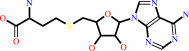 S-adenosyl-L-homocysteine
|
|
|
|
|
|
|
|
|
|
Enzyme class 2:
|
|
Chains A, B:
E.C.2.1.1.57
- methyltransferase cap1.
|
|
|
|
|
|
|
Reaction:
|
|
a 5'-end (N(7)-methyl 5'-triphosphoguanosine)-ribonucleoside in mRNA + S-adenosyl-L-methionine = a 5'-end (N(7)-methyl 5'-triphosphoguanosine)- (2'-O-methyl-ribonucleoside) in mRNA + S-adenosyl-L-homocysteine + H+
|
|
|
|
|
|
5'-end (N(7)-methyl 5'-triphosphoguanosine)-ribonucleoside in mRNA
|
+
|
S-adenosyl-L-methionine
|
=
|
5'-end (N(7)-methyl 5'-triphosphoguanosine)- (2'-O-methyl-ribonucleoside) in mRNA
|
+
|
S-adenosyl-L-homocysteine
|
+
|
H(+)
|
|
|
|
|
|
|
|
|
|
Enzyme class 3:
|
|
Chains A, B:
E.C.2.7.7.48
- RNA-directed Rna polymerase.
|
|
|
|
|
|
|
Reaction:
|
|
RNA(n) + a ribonucleoside 5'-triphosphate = RNA(n+1) + diphosphate
|
|
|
|
|
|
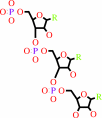 RNA(n)
|
+
|
ribonucleoside 5'-triphosphate
|
=
|
RNA(n+1)
|
+
|
 diphosphate
|
|
|
|
|
|
|
|
|
|
Enzyme class 4:
|
|
Chains A, B:
E.C.3.4.21.91
- flavivirin.
|
|
|
|
|
|
|
Reaction:
|
|
Selective hydrolysis of Xaa-Xaa-|-Xbb bonds in which each of the Xaa can be either Arg or Lys and Xbb can be either Ser or Ala.
|
|
|
|
|
|
Enzyme class 5:
|
|
Chains A, B:
E.C.3.6.1.15
- nucleoside-triphosphate phosphatase.
|
|
|
|
|
|
|
Reaction:
|
|
a ribonucleoside 5'-triphosphate + H2O = a ribonucleoside 5'-diphosphate + phosphate + H+
|
|
|
|
|
|
ribonucleoside 5'-triphosphate
|
+
|
H2O
|
=
|
ribonucleoside 5'-diphosphate
|
+
|
 phosphate
|
+
|
H(+)
|
|
|
|
|
|
|
|
|
|
Enzyme class 6:
|
|
Chains A, B:
E.C.3.6.4.13
- Rna helicase.
|
|
|
|
|
|
|
Reaction:
|
|
ATP + H2O = ADP + phosphate + H+
|
|
|
|
|
|
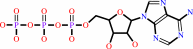 ATP
ATP
|
+
|
H2O
|
=
|
 ADP
ADP
|
+
|
phosphate
|
+
|
H(+)
|
|
|
|
|
|
|
|
|
|
|
|
|
Note, where more than one E.C. class is given (as above), each may
correspond to a different protein domain or, in the case of polyprotein
precursors, to a different mature protein.
|
|
|
|
Molecule diagrams generated from .mol files obtained from the
KEGG ftp site
|
|
|
|
|
|
|
|
|
|
|
|
|
|
 |
|
|
|
|
|
|
| |
|
|
| |
|
DOI no:
|
J Mol Biol
372:444-455
(2007)
|
|
PubMed id:
|
|
|
|
|
|
| |
|
Crystal structure and activity of kunjin virus NS3 helicase; protease and helicase domain assembly in the full length NS3 protein.
|
|
E.Mastrangelo,
M.Milani,
M.Bollati,
B.Selisko,
F.Peyrane,
V.Pandini,
G.Sorrentino,
B.Canard,
P.V.Konarev,
D.I.Svergun,
X.de Lamballerie,
B.Coutard,
A.A.Khromykh,
M.Bolognesi.
|
|
|
|
|
| |
ABSTRACT
|
|
|
|
| |
|
|
Flaviviral NS3 is a multifunctional protein displaying N-terminal protease
activity in addition to C-terminal helicase, nucleoside 5'-triphosphatase
(NTPase), and 5'-terminal RNA triphosphatase (RTPase) activities. NS3 is held to
support the separation of RNA daughter and template strands during viral
replication. In addition, NS3 assists the initiation of replication by unwinding
the RNA secondary structure in the 3' non-translated region (NTR). We report
here the three-dimensional structure (at 3.1 A resolution) of the NS3 helicase
domain (residues 186-619; NS3:186-619) from Kunjin virus, an Australian variant
of the West Nile virus. As for homologous helicases, NS3:186-619 is composed of
three domains, two of which are structurally related and held to host the NTPase
and RTPase active sites. The third domain (C-terminal) is involved in RNA
binding/recognition. The NS3:186-619 construct occurs as a dimer in solution and
in the crystals. We show that NS3:186-619 displays both ATPase and RTPase
activities, that it can unwind a double-stranded RNA substrate, being however
inactive on a double-stranded DNA substrate. Analysis of different constructs
shows that full length NS3 displays increased helicase activity, suggesting that
the protease domain plays an assisting role in the RNA unwinding process. The
structural interaction between the helicase and protease domain has been
assessed using small angle X-ray scattering on full length NS3, disclosing that
the protease and helicase domains build a rather elongated molecular assembly
differing from that observed in the NS3 protein from hepatitis C virus.
|
|
|
|
|
|
| |
Selected figure(s)
|
|
|
|
| |
|
|

|
|

|
|
Figure 2.
Figure 2. Structural alignment of Flavivirus helicase domain
of KUNV, DENV and YFV. The conserved motifs among superfamily 2
helicases are boxed in pink (motif I, corresponding to Walker
A), cyan (motif II, corresponding to Walker B), and gray (motif
Ia, III, IV, V and VI). The different constructs are identified
above the sequences, for KUNV (in black), and below for YFV (in
yellow), respectively. The secondary structure elements
stretches indicated refer to KUNV NS3:186–619 chain A: blue,
domain I; red, domain II; and green, domain III. In dark green
is the alignment of HCV with KUNV showing the only homologues
amino acids.
|
|
Figure 4.
Figure 4. Superposition of the KUNV (red), DENV (blue) and
YFV (yellow) helicase structures. (a) The Walker A motif
(P-loop, in domain I), and motif V in domain II flank the ATP
binding pocket in the flaviviral helicases (stereo view). In
particular, the Walker A motif in KUNV NS3:186–619 adopts a
conformation that partially closes the ATP binding cavity,
filling the space occupied by ADP α and β-phosphate groups in
the structure of ADP-bound YFV helicase. (b) Details of the
separation between the α2 helix, in domain II, and the α9
helix, in domain III, displayed for the three flaviviral
helicase structures (color-coded as in (a)). The access site for
ssRNA in the protein central cleft is proposed to be located
between these two α-helices.
|
|
|
|
|
|
| |
The above figures are
reprinted
by permission from Elsevier:
J Mol Biol
(2007,
372,
444-455)
copyright 2007.
|
|
| |
Figures were
selected
by an automated process.
|
|
|
|
|
|
|
|
|
|
|
|
|
|
|
|
 |
 |
 |
|
Literature references that cite this PDB file's key reference
|
|
|
| |
PubMed id
|
|
Reference
|
|
|
|
|
|
A.J.Schuh,
R.B.Tesh,
and
A.D.Barrett
(2011).
Genetic characterization of Japanese encephalitis virus genotype II strains isolated from 1951 to 1978.
|
| |
J Gen Virol,
92,
516-527.
|
|
|
|
|
|
|
S.A.Shiryaev,
and
A.Y.Strongin
(2010).
Structural and functional parameters of the flaviviral protease: a promising antiviral drug target.
|
| |
Future Virol,
5,
593-606.
|
|
|
|
|
|
|
A.Sampath,
and
R.Padmanabhan
(2009).
Molecular targets for flavivirus drug discovery.
|
| |
Antiviral Res,
81,
6.
|
|
|
|
|
|
|
B.J.Geiss,
H.Stahla,
A.M.Hannah,
H.H.Gari,
and
S.M.Keenan
(2009).
Focus on flaviviruses: current and future drug targets.
|
| |
Future Med Chem,
1,
327.
|
|
|
|
|
|
|
R.Assenberg,
E.Mastrangelo,
T.S.Walter,
A.Verma,
M.Milani,
R.J.Owens,
D.I.Stuart,
J.M.Grimes,
and
E.J.Mancini
(2009).
Crystal structure of a novel conformational state of the flavivirus NS3 protein: implications for polyprotein processing and viral replication.
|
| |
J Virol,
83,
12895-12906.
|
|
|
PDB code:
|
|
|
|
|
|
|
|
S.A.Shiryaev,
A.V.Chernov,
A.E.Aleshin,
T.N.Shiryaeva,
and
A.Y.Strongin
(2009).
NS4A regulates the ATPase activity of the NS3 helicase: a novel cofactor role of the non-structural protein NS4A from West Nile virus.
|
| |
J Gen Virol,
90,
2081-2085.
|
|
|
|
|
|
|
A.V.Chernov,
S.A.Shiryaev,
A.E.Aleshin,
B.I.Ratnikov,
J.W.Smith,
R.C.Liddington,
and
A.Y.Strongin
(2008).
The two-component NS2B-NS3 proteinase represses DNA unwinding activity of the West Nile virus NS3 helicase.
|
| |
J Biol Chem,
283,
17270-17278.
|
|
|
|
|
|
|
D.Luo,
T.Xu,
C.Hunke,
G.Grüber,
S.G.Vasudevan,
and
J.Lescar
(2008).
Crystal structure of the NS3 protease-helicase from dengue virus.
|
| |
J Virol,
82,
173-183.
|
|
|
PDB code:
|
|
|
|
|
|
|
|
J.Li,
A.Rahmeh,
M.Morelli,
and
S.P.Whelan
(2008).
A conserved motif in region v of the large polymerase proteins of nonsegmented negative-sense RNA viruses that is essential for mRNA capping.
|
| |
J Virol,
82,
775-784.
|
|
|
|
|
|
|
K.U.Wendt,
M.S.Weiss,
P.Cramer,
and
D.W.Heinz
(2008).
Structures and diseases.
|
| |
Nat Struct Mol Biol,
15,
117-120.
|
|
|
|
|
|
The most recent references are shown first.
Citation data come partly from CiteXplore and partly
from an automated harvesting procedure. Note that this is likely to be
only a partial list as not all journals are covered by
either method. However, we are continually building up the citation data
so more and more references will be included with time.
Where a reference describes a PDB structure, the PDB
code is
shown on the right.
|
 |


 Links
Links


