 |
PDBsum entry 2q66

|
|
|
|
|
|

|

|

|

|
|

|
|

|
|

|
|

|
|

|
|

|
|
|
 |

|

|
|
|
|
|
|
|
|
|
|
|
|
|
|
|
|
|
|
|
|
|
|
|
|
|
|
|
|
|
|
|
|
|
|
|
Transferase/RNA
|
PDB id
|
|
|
|
2q66
|
|
|
|
|
|
|
|
|
|
|
|
|
|
|

|

|

|
|
|
|
|
|
|
|
 |
Contents |
 |
|
|
|
|
|
|
|
|
|
|
|
|
|
|
|
|
* Residue conservation analysis
|
|
|
|
|
|
|
|
|
|
|
Enzyme class:
|
|
E.C.2.7.7.19
- polynucleotide adenylyltransferase.
|
|
|
|
|
|
|
Reaction:
|
|
RNA(n) + ATP = RNA(n)-3'-adenine ribonucleotide + diphosphate
|
|
|
|
|
|
RNA(n)
Bound ligand (Het Group name = )
corresponds exactly
|
+
|
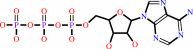 ATP
ATP
|
=
|
RNA(n)-3'-adenine ribonucleotide
|
+
|
 diphosphate
|
|
|
|
|
|
|
|
|
|
|
|
|
Molecule diagrams generated from .mol files obtained from the
KEGG ftp site
|
|
|
|
|
|
|
|
|
|
|
|
|
|
 |
|
|
|
|
|
|
| |
|
|
| |
|
DOI no:
|
Structure
15:1117-1131
(2007)
|
|
PubMed id:
|
|
|
|
|
|
| |
|
Mechanism of Poly(A) Polymerase: Structure of the Enzyme-MgATP-RNA Ternary Complex and Kinetic Analysis.
|
|
P.B.Balbo,
A.Bohm.
|
|
|
|
|
| |
ABSTRACT
|
|
|
|
| |
|
|
We report the 1.8 A structure of yeast poly(A) polymerase (PAP) trapped in
complex with ATP and a five residue poly(A) by mutation of the catalytically
required aspartic acid 154 to alanine. The enzyme has undergone significant
domain movement and reveals a closed conformation with extensive interactions
between the substrates and all three polymerase domains. Both substrates and 31
buried water molecules are enclosed within a central cavity that is open at both
ends. Four PAP mutants were subjected to detailed kinetic analysis, and studies
of the adenylyltransfer (forward), pyrophosphorolysis (reverse), and
nucleotidyltransfer reaction utilizing CTP for the mutants are presented. The
results support a model in which binding of both poly(A) and the correct
nucleotide, MgATP, induces a conformational change, resulting in formation of a
stable, closed enzyme state. Thermodynamic considerations of the data are
discussed as they pertain to domain closure, substrate specificity, and
catalytic strategies utilized by PAP.
|
|
|
|
|
|
| |
Selected figure(s)
|
|
|
|
| |
|
|

|
|

|
|
Figure 2.
Figure 2. Determinants of ATP and RNA Binding
Interacting residues from the N-terminal, middle, and C-terminal
domains are colored yellow, green, and cyan, respectively.
Residues within cloud-shaped bubbles on either side of the bases
indicate hydrophobic/van der Waals interactions. Water molecules
(circles) are color coded based on the degree to which they are
buried within the interior of the protein; those colored dark
blue are completely buried (see Experimental Procedures). Those
colored gray-blue are at the protein surface. Others are colored
intermediate shades of blue depending on how many shells of
water needed to be removed in order for the water atoms to
become exposed. Asp154 and the second Mg^2+ ion are shown in
gray. Eight additional water molecules interact with the
triphosphate moiety of the ATP. These are not shown for clarity,
and because the water structure in this region may be altered
due to the D154A mutation. The base at position −5 interacts
with a neighboring PAP molecule and is not shown.
|
|
Figure 3.
Figure 3. Stereo Views of the Substrate Binding Sites of PAP
Detailed substrate interactions formed in the closed,
ternary complex. ATP (yellow carbons) and the 3′ end (blue
carbons) are shown along with PAP with the surrounding amino
acids (green carbons) and water molecules (red spheres).
|
|
|
|
|
|
| |
The above figures are
reprinted
from an Open Access publication published by Cell Press:
Structure
(2007,
15,
1117-1131)
copyright 2007.
|
|
| |
Figures were
selected
by an automated process.
|
|
|
|
|
|
|
|
|
|
|
|
|
|
|
|
 |
 |
 |
|
Literature references that cite this PDB file's key reference
|
|
|
| |
PubMed id
|
|
Reference
|
|
|
|
|
|
Y.Bai,
S.K.Srivastava,
J.H.Chang,
J.L.Manley,
and
L.Tong
(2011).
Structural basis for dimerization and activity of human PAPD1, a noncanonical poly(A) polymerase.
|
| |
Mol Cell,
41,
311-320.
|
|
|
PDB code:
|
|
|
|
|
|
|
|
B.Pan,
Y.Xiong,
and
T.A.Steitz
(2010).
How the CCA-adding enzyme selects adenine over cytosine at position 76 of tRNA.
|
| |
Science,
330,
937-940.
|
|
|
PDB codes:
|
|
|
|
|
|
|
|
L.S.Chen,
L.Du-Cuny,
V.Vethantham,
D.H.Hawke,
J.L.Manley,
S.Zhang,
and
V.Gandhi
(2010).
Chain termination and inhibition of mammalian poly(A) polymerase by modified ATP analogues.
|
| |
Biochem Pharmacol,
79,
669-677.
|
|
|
|
|
|
|
C.Li,
H.Li,
S.Zhou,
E.Sun,
J.Yoshizawa,
T.L.Poulos,
and
P.D.Gershon
(2009).
Polymerase translocation with respect to single-stranded nucleic acid: looping or wrapping of primer around a poly(A) polymerase.
|
| |
Structure,
17,
680-689.
|
|
|
PDB codes:
|
|
|
|
|
|
|
|
F.Romain,
I.Barbosa,
J.Gouge,
F.Rougeon,
and
M.Delarue
(2009).
Conferring a template-dependent polymerase activity to terminal deoxynucleotidyltransferase by mutations in the Loop1 region.
|
| |
Nucleic Acids Res,
37,
4642-4656.
|
|
|
|
|
|
|
P.B.Balbo,
and
A.Bohm
(2009).
Proton transfer in the mechanism of polyadenylate polymerase.
|
| |
Biochem J,
420,
229-238.
|
|
|
|
|
|
|
C.R.Mandel,
Y.Bai,
and
L.Tong
(2008).
Protein factors in pre-mRNA 3'-end processing.
|
| |
Cell Mol Life Sci,
65,
1099-1122.
|
|
|
|
|
|
|
G.Martin,
S.Doublié,
and
W.Keller
(2008).
Determinants of substrate specificity in RNA-dependent nucleotidyl transferases.
|
| |
Biochim Biophys Acta,
1779,
206-216.
|
|
|
|
|
|
|
G.Meinke,
C.Ezeokonkwo,
P.Balbo,
W.Stafford,
C.Moore,
and
A.Bohm
(2008).
Structure of yeast poly(A) polymerase in complex with a peptide from Fip1, an intrinsically disordered protein.
|
| |
Biochemistry,
47,
6859-6869.
|
|
|
PDB code:
|
|
|
|
|
|
|
|
S.Holbein,
F.M.Freimoser,
T.P.Werner,
A.Wengi,
and
B.Dichtl
(2008).
Cordycepin-hypersensitive growth links elevated polyphosphate levels to inhibition of poly(A) polymerase in Saccharomyces cerevisiae.
|
| |
Nucleic Acids Res,
36,
353-363.
|
|
|
|
|
|
The most recent references are shown first.
Citation data come partly from CiteXplore and partly
from an automated harvesting procedure. Note that this is likely to be
only a partial list as not all journals are covered by
either method. However, we are continually building up the citation data
so more and more references will be included with time.
Where a reference describes a PDB structure, the PDB
code is
shown on the right.
|
|


 Links
Links


