 |
PDBsum entry 2zye

|
|
|
|
|
|

|

|

|

|
|

|
|

|
|

|
|

|
|

|
|
|
 |

|

|
|
|
|
|
|
|
|
|
|
|
|
|
|
|
|
|
|
|
|
|
|
|
|
|
|
|
|
|
|
|
|
|
|
Hydrolase/hydrolase inhibitor
|
PDB id
|
|
|
|
2zye
|
|
|
|
|
|
|
|
|
|
|
|
|
|
|

|

|

|
|
|
|
|
|
|
|
 |
Contents |
 |
|
|
|
|
|
|
|
|
|
|
|
|
* Residue conservation analysis
|
|
|
|
|
|
|
|
|
|
|
Enzyme class 1:
|
|
E.C.2.7.7.-
- ?????
|
|
|
|
|
|
|
Enzyme class 2:
|
|
E.C.2.7.7.49
- RNA-directed Dna polymerase.
|
|
|
|
|
|
|
Reaction:
|
|
DNA(n) + a 2'-deoxyribonucleoside 5'-triphosphate = DNA(n+1) + diphosphate
|
|
|
|
|
|
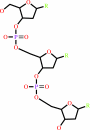 DNA(n)
|
+
|
2'-deoxyribonucleoside 5'-triphosphate
|
=
|
DNA(n+1)
|
+
|
 diphosphate
|
|
|
|
|
|
|
|
|
|
Enzyme class 3:
|
|
E.C.2.7.7.7
- DNA-directed Dna polymerase.
|
|
|
|
|
|
|
Reaction:
|
|
DNA(n) + a 2'-deoxyribonucleoside 5'-triphosphate = DNA(n+1) + diphosphate
|
|
|
|
|
|
DNA(n)
|
+
|
2'-deoxyribonucleoside 5'-triphosphate
|
=
|
DNA(n+1)
|
+
|
diphosphate
|
|
|
|
|
|
|
|
|
|
Enzyme class 4:
|
|
E.C.3.1.-.-
|
|
|
|
|
|
|
Enzyme class 5:
|
|
E.C.3.1.13.2
- exoribonuclease H.
|
|
|
|
|
|
|
Reaction:
|
|
Exonucleolytic cleavage to 5'-phosphomonoester oligonucleotides in both 5'- to 3'- and 3'- to 5'-directions.
|
|
|
|
|
|
Enzyme class 6:
|
|
E.C.3.1.26.13
- retroviral ribonuclease H.
|
|
|
|
|
|
|
Enzyme class 7:
|
|
E.C.3.4.23.16
- HIV-1 retropepsin.
|
|
|
|
|
|
|
Reaction:
|
|
Specific for a P1 residue that is hydrophobic, and P1' variable, but often Pro.
|
|
|
|
|
|
|
|
|
Note, where more than one E.C. class is given (as above), each may
correspond to a different protein domain or, in the case of polyprotein
precursors, to a different mature protein.
|
|
|
|
Molecule diagrams generated from .mol files obtained from the
KEGG ftp site
|
|
|
|
|
|
|
|
|
|
|
|
|
|
 |
|
|
|
|
|
|
| |
|
|
| |
|
DOI no:
|
Proc Natl Acad Sci U S A
106:4641-4646
(2009)
|
|
PubMed id:
|
|
|
|
|
|
| |
|
Structure of HIV-1 protease in complex with potent inhibitor KNI-272 determined by high-resolution X-ray and neutron crystallography.
|
|
M.Adachi,
T.Ohhara,
K.Kurihara,
T.Tamada,
E.Honjo,
N.Okazaki,
S.Arai,
Y.Shoyama,
K.Kimura,
H.Matsumura,
S.Sugiyama,
H.Adachi,
K.Takano,
Y.Mori,
K.Hidaka,
T.Kimura,
Y.Hayashi,
Y.Kiso,
R.Kuroki.
|
|
|
|
|
| |
ABSTRACT
|
|
|
|
| |
|
|
HIV-1 protease is a dimeric aspartic protease that plays an essential role in
viral replication. To further understand the catalytic mechanism and inhibitor
recognition of HIV-1 protease, we need to determine the locations of key
hydrogen atoms in the catalytic aspartates Asp-25 and Asp-125. The structure of
HIV-1 protease in complex with transition-state analog KNI-272 was determined by
combined neutron crystallography at 1.9-A resolution and X-ray crystallography
at 1.4-A resolution. The resulting structural data show that the catalytic
residue Asp-25 is protonated and that Asp-125 (the catalytic residue from the
corresponding diad-related molecule) is deprotonated. The proton on Asp-25 makes
a hydrogen bond with the carbonyl group of the allophenylnorstatine (Apns) group
in KNI-272. The deprotonated Asp-125 bonds to the hydroxyl proton of Apns. The
results provide direct experimental evidence for proposed aspects of the
catalytic mechanism of HIV-1 protease and can therefore contribute substantially
to the development of specific inhibitors for therapeutic application.
|
|
|
|
|
|
| |
Selected figure(s)
|
|
|
|
| |
|
|

|
|

|
|
Figure 1.
Tertiary structure of HIV-1 protease determined by neutron
diffraction. The HIV protease dimer is shown by a ball and stick
model; water molecules and bound inhibitor are shown by
space-filling representation. Hydrogen and deuterium atoms are
colored gray. Carbon (green), oxygen (red), nitrogen (blue), and
sulfur (yellow) atoms in protease are indicated. Carbon atoms in
KNI-272 are colored dark gray. Figs. 1, 2, and 4 were made by
using the program Pymol (www.pymol.org).
|
|
Figure 3.
Schematic diagram of the interaction between HIV-1 protease
and KNI-272 (bold lines). Hydrogen bonds are shown by broken
lines. Asterisks indicate the hydrogen atoms replaced with
deuterium atom (occupancies of deuterium atom are >0.5).
|
|
|
|
| |
Figures were
selected
by an automated process.
|
|
|
|
|
|
|
|
|
|
|
|
|
|
|
|
 |
 |
 |
|
Literature references that cite this PDB file's key reference
|
|
|
| |
PubMed id
|
|
Reference
|
|
|
|
|
|
H.Matsumura,
S.Sugiyama,
M.Hirose,
K.Kakinouchi,
M.Maruyama,
R.Murai,
H.Adachi,
K.Takano,
S.Murakami,
Y.Mori,
and
T.Inoue
(2011).
Approach for growth of high-quality and large protein crystals.
|
| |
J Synchrotron Radiat,
18,
16-19.
|
|
|
|
|
|
|
M.M.Blum,
S.J.Tomanicek,
H.John,
B.L.Hanson,
H.Rüterjans,
B.P.Schoenborn,
P.Langan,
and
J.C.Chen
(2010).
X-ray structure of perdeuterated diisopropyl fluorophosphatase (DFPase): perdeuteration of proteins for neutron diffraction.
|
| |
Acta Crystallogr Sect F Struct Biol Cryst Commun,
66,
379-385.
|
|
|
PDB code:
|
|
|
|
|
|
|
|
R.Kuroki,
T.Tamada,
K.Kurihara,
T.Ohhara,
and
M.Adachi
(2010).
[Collaborative use of neutron and X-ray for determination of drug target proteins].
|
| |
Yakugaku Zasshi,
130,
657-664.
|
|
|
|
|
|
|
V.Prashar,
S.Bihani,
A.Das,
J.L.Ferrer,
and
M.Hosur
(2009).
Catalytic water co-existing with a product peptide in the active site of HIV-1 protease revealed by X-ray structure analysis.
|
| |
PLoS One,
4,
e7860.
|
|
|
PDB code:
|
|
|
|
|
|
|
The most recent references are shown first.
Citation data come partly from CiteXplore and partly
from an automated harvesting procedure. Note that this is likely to be
only a partial list as not all journals are covered by
either method. However, we are continually building up the citation data
so more and more references will be included with time.
Where a reference describes a PDB structure, the PDB
code is
shown on the right.
|
|


 Links
Links


