 |
PDBsum entry 2whh

|
|
|
|
|
 |
Contents |
 |
|
|
|
|
|
|
|
|
|
|
|
|
* Residue conservation analysis
|
|
|
|
|
|
|
|
|
|
|
Enzyme class 1:
|
|
E.C.2.7.7.-
- ?????
|
|
|
|
|
|
|
Enzyme class 2:
|
|
E.C.2.7.7.49
- RNA-directed Dna polymerase.
|
|
|
|
|
|
|
Reaction:
|
|
DNA(n) + a 2'-deoxyribonucleoside 5'-triphosphate = DNA(n+1) + diphosphate
|
|
|
|
|
|
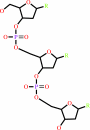 DNA(n)
|
+
|
2'-deoxyribonucleoside 5'-triphosphate
|
=
|
DNA(n+1)
|
+
|
 diphosphate
|
|
|
|
|
|
|
|
|
|
Enzyme class 3:
|
|
E.C.2.7.7.7
- DNA-directed Dna polymerase.
|
|
|
|
|
|
|
Reaction:
|
|
DNA(n) + a 2'-deoxyribonucleoside 5'-triphosphate = DNA(n+1) + diphosphate
|
|
|
|
|
|
DNA(n)
|
+
|
2'-deoxyribonucleoside 5'-triphosphate
|
=
|
DNA(n+1)
|
+
|
diphosphate
|
|
|
|
|
|
|
|
|
|
Enzyme class 4:
|
|
E.C.3.1.-.-
|
|
|
|
|
|
|
Enzyme class 5:
|
|
E.C.3.1.13.2
- exoribonuclease H.
|
|
|
|
|
|
|
Reaction:
|
|
Exonucleolytic cleavage to 5'-phosphomonoester oligonucleotides in both 5'- to 3'- and 3'- to 5'-directions.
|
|
|
|
|
|
Enzyme class 6:
|
|
E.C.3.1.26.13
- retroviral ribonuclease H.
|
|
|
|
|
|
|
Enzyme class 7:
|
|
E.C.3.4.23.16
- HIV-1 retropepsin.
|
|
|
|
|
|
|
Reaction:
|
|
Specific for a P1 residue that is hydrophobic, and P1' variable, but often Pro.
|
|
|
|
|
|
|
|
|
Note, where more than one E.C. class is given (as above), each may
correspond to a different protein domain or, in the case of polyprotein
precursors, to a different mature protein.
|
|
|
|
Molecule diagrams generated from .mol files obtained from the
KEGG ftp site
|
|
|
|
|
|
|
|
|
|
|
|
|
|
 |
|
|
|
|
|
|
| |
|
|
| |
|
|
Plos One
4:e7860
(2009)
|
|
PubMed id:
|
|
|
|
|
|
| |
|
Catalytic water co-existing with a product peptide in the active site of HIV-1 protease revealed by X-ray structure analysis.
|
|
V.Prashar,
S.Bihani,
A.Das,
J.L.Ferrer,
M.Hosur.
|
|
|
|
|
| |
ABSTRACT
|
|
|
|
| |
|
|
BACKGROUND: It is known that HIV-1 protease is an important target for design of
antiviral compounds in the treatment of Acquired Immuno Deficiency Syndrome
(AIDS). In this context, understanding the catalytic mechanism of the enzyme is
of crucial importance as transition state structure directs inhibitor design.
Most mechanistic proposals invoke nucleophilic attack on the scissile peptide
bond by a water molecule. But such a water molecule coexisting with any ligand
in the active site has not been found so far in the crystal structures.
PRINCIPAL FINDINGS: We report here the first observation of the coexistence in
the active site, of a water molecule WAT1, along with the carboxyl terminal
product (Q product) peptide. The product peptide has been generated in situ
through cleavage of the full-length substrate. The N-terminal product (P
product) has diffused out and is replaced by a set of water molecules while the
Q product is still held in the active site through hydrogen bonds. The position
of WAT1, which hydrogen bonds to both the catalytic aspartates, is different
from when there is no substrate bound in the active site. We propose WAT1 to be
the position from where catalytic water attacks the scissile peptide bond.
Comparison of structures of HIV-1 protease complexed with the same oligopeptide
substrate, but at pH 2.0 and at pH 7.0 shows interesting changes in the
conformation and hydrogen bonding interactions from the catalytic aspartates.
CONCLUSIONS/SIGNIFICANCE: The structure is suggestive of the repositioning,
during substrate binding, of the catalytic water for activation and subsequent
nucleophilic attack. The structure could be a snap shot of the enzyme active
site primed for the next round of catalysis. This structure further suggests
that to achieve the goal of designing inhibitors mimicking the transition-state,
the hydrogen-bonding pattern between WAT1 and the enzyme should be replicated.
|
|
|
|
|
|
|
|
|
|
|
|
|
|
|
|
|
|
 |
 |
 |
|


 Links
Links


