 |
PDBsum entry 2o4n

|
|
|
|
|
|

|

|

|

|
|

|
|

|
|

|
|

|
|

|
|
|
 |

|

|
|
|
|
|
|
|
|
|
|
|
|
|
|
|
|
|
|
|
|
|
|
|
|
|
|
|
|
|
|
|
|
|
|
Viral protein
|
PDB id
|
|
|
|
2o4n
|
|
|
|
|
|
|
|
|
|
|
|
|
|
|

|

|

|
|
|
|
|
|
|
|
 |
Contents |
 |
|
|
|
|
|
|
|
|
|
|
|
|
* Residue conservation analysis
|
|
|
|
|
|
PDB id:
|
|
|
|
| Name: |
|
Viral protein
|
|
|
Title:
|
|
Crystal structure of HIV-1 protease (trm mutant) in complex with tipranavir
|
|
Structure:
|
|
Protease. Chain: a, b. Engineered: yes. Mutation: yes
|
|
Source:
|
|
Human immunodeficiency virus 1. Organism_taxid: 11676. Strain: subtype b. Gene: gag-pol. Expressed in: escherichia coli bl21(de3). Expression_system_taxid: 469008.
|
|
Biol. unit:
|
|
Dimer (from
)
|
|
Resolution:
|
|
|
2.00Å
|
R-factor:
|
0.189
|
R-free:
|
0.227
|
|
|
Authors:
|
|
L.W.Kang,A.A.Armstrong,S.Muzammil,A.Jakalian,P.R.Bonneau,V.Schmelmer, E.Freire,L.M.Amzel
|
|
Key ref:
|
|
S.Muzammil
et al.
(2007).
Unique thermodynamic response of tipranavir to human immunodeficiency virus type 1 protease drug resistance mutations.
J Virol,
81,
5144-5154.
PubMed id:
|
|
|
Date:
|
|
|
04-Dec-06
|
Release date:
|
12-Dec-06
|
|
|
|
|
|
|
PROCHECK
|

|
|
|
|
|
Headers
|
|
|
|
References
|
|
|
|
|
|

|
|
Q90SN9
(Q90SN9_9HIV1) -
Pol protein (Fragment) from Human immunodeficiency virus 1
|
|
|
|
Seq:
Struc:
|
|
|
|
423 a.a.
99 a.a.*
|
|

|

|

|
|
|
|
|
|
|
|
|
|
|
Key: |
 |
PfamA domain |
|
|
 |
Secondary structure |
|
 |
CATH domain |
|
|
*
PDB and UniProt seqs differ
at 4 residue positions (black
crosses)
|
|
|
|
|
|
|
|
|
|
|
|
|
Enzyme class 1:
|
|
E.C.3.1.26.13
- retroviral ribonuclease H.
|
|
|
|
|
|
|
Enzyme class 2:
|
|
E.C.2.7.7.-
- ?????
|
|
|
|
|
|
|
Enzyme class 3:
|
|
E.C.2.7.7.49
- RNA-directed Dna polymerase.
|
|
|
|
|
|
|
Reaction:
|
|
DNA(n) + a 2'-deoxyribonucleoside 5'-triphosphate = DNA(n+1) + diphosphate
|
|
|
|
|
|
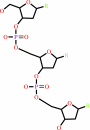 DNA(n)
|
+
|
2'-deoxyribonucleoside 5'-triphosphate
|
=
|
DNA(n+1)
|
+
|
 diphosphate
|
|
|
|
|
|
|
|
|
|
Enzyme class 4:
|
|
E.C.2.7.7.7
- DNA-directed Dna polymerase.
|
|
|
|
|
|
|
Reaction:
|
|
DNA(n) + a 2'-deoxyribonucleoside 5'-triphosphate = DNA(n+1) + diphosphate
|
|
|
|
|
|
DNA(n)
|
+
|
2'-deoxyribonucleoside 5'-triphosphate
|
=
|
DNA(n+1)
|
+
|
diphosphate
|
|
|
|
|
|
|
|
|
|
Enzyme class 5:
|
|
E.C.3.1.-.-
|
|
|
|
|
|
|
Enzyme class 6:
|
|
E.C.3.1.13.2
- exoribonuclease H.
|
|
|
|
|
|
|
Reaction:
|
|
Exonucleolytic cleavage to 5'-phosphomonoester oligonucleotides in both 5'- to 3'- and 3'- to 5'-directions.
|
|
|
|
|
|
Enzyme class 7:
|
|
E.C.3.4.23.16
- HIV-1 retropepsin.
|
|
|
|
|
|
|
Reaction:
|
|
Specific for a P1 residue that is hydrophobic, and P1' variable, but often Pro.
|
|
|
|
|
|
|
|
|
Note, where more than one E.C. class is given (as above), each may
correspond to a different protein domain or, in the case of polyprotein
precursors, to a different mature protein.
|
|
|
|
Molecule diagrams generated from .mol files obtained from the
KEGG ftp site
|
|
|
|
|
|
|
|
|
|
|
|
|
|
 |
|
|
|
|
|
|
| |
|
|
| |
|
|
J Virol
81:5144-5154
(2007)
|
|
PubMed id:
|
|
|
|
|
|
| |
|
Unique thermodynamic response of tipranavir to human immunodeficiency virus type 1 protease drug resistance mutations.
|
|
S.Muzammil,
A.A.Armstrong,
L.W.Kang,
A.Jakalian,
P.R.Bonneau,
V.Schmelmer,
L.M.Amzel,
E.Freire.
|
|
|
|
|
| |
ABSTRACT
|
|
|
|
| |
|
|
Drug resistance is a major problem affecting the clinical efficacy of
antiretroviral agents, including protease inhibitors, in the treatment of
infection with human immunodeficiency virus type 1 (HIV-1)/AIDS. Consequently,
the elucidation of the mechanisms by which HIV-1 protease inhibitors maintain
antiviral activity in the presence of mutations is critical to the development
of superior inhibitors. Tipranavir, a nonpeptidic HIV-1 protease inhibitor, has
been recently approved for the treatment of HIV infection. Tipranavir inhibits
wild-type protease with high potency (K(i) = 19 pM) and demonstrates durable
efficacy in the treatment of patients infected with HIV-1 strains containing
multiple common mutations associated with resistance. The high potency of
tipranavir results from a very large favorable entropy change (-TDeltaS = -14.6
kcal/mol) combined with a favorable, albeit small, enthalpy change (DeltaH =
-0.7 kcal/mol, 25 degrees C). Characterization of tipranavir binding to
wild-type protease, active site mutants I50V and V82F/I84V, the
multidrug-resistant mutant L10I/L33I/M46I/I54V/L63I/V82A/I84V/L90M, and the
tipranavir in vitro-selected mutant I13V/V32L/L33F/K45I/V82L/I84V was performed
by isothermal titration calorimetry and crystallography. Thermodynamically, the
good response of tipranavir arises from a unique behavior: it compensates for
entropic losses by actual enthalpic gains or by sustaining minimal enthalpic
losses when facing the mutants. The net result is a small loss in binding
affinity. Structurally, tipranavir establishes a very strong hydrogen bond
network with invariant regions of the protease, which is maintained with the
mutants, including catalytic Asp25 and the backbone of Asp29, Asp30, Gly48 and
Ile50. Moreover, tipranavir forms hydrogen bonds directly to Ile50, while all
other inhibitors do so by being mediated by a water molecule.
|
|
|
|
|
|
|
|
|
|
|
|
|
|
|
|
|
|
 |
 |
 |
|
Literature references that cite this PDB file's key reference
|
|
|
| |
PubMed id
|
|
Reference
|
|
|
|
|
|
A.Schön,
N.Madani,
A.B.Smith,
J.M.Lalonde,
and
E.Freire
(2011).
Some binding-related drug properties are dependent on thermodynamic signature.
|
| |
Chem Biol Drug Des,
77,
161-165.
|
|
|
|
|
|
|
D.Das,
Y.Koh,
Y.Tojo,
A.K.Ghosh,
and
H.Mitsuya
(2009).
Prediction of potency of protease inhibitors using free energy simulations with polarizable quantum mechanics-based ligand charges and a hybrid water model.
|
| |
J Chem Inf Model,
49,
2851-2862.
|
|
|
|
|
|
|
E.S.Bolstad,
and
A.C.Anderson
(2009).
In pursuit of virtual lead optimization: pruning ensembles of receptor structures for increased efficiency and accuracy during docking.
|
| |
Proteins,
75,
62-74.
|
|
|
|
|
|
|
J.M.Sayer,
and
J.M.Louis
(2009).
Interactions of different inhibitors with active-site aspartyl residues of HIV-1 protease and possible relevance to pepsin.
|
| |
Proteins,
75,
556-568.
|
|
|
|
|
|
|
M.L.Barreca,
N.Iraci,
L.De Luca,
and
A.Chimirri
(2009).
Induced-fit docking approach provides insight into the binding mode and mechanism of action of HIV-1 integrase inhibitors.
|
| |
ChemMedChem,
4,
1446-1456.
|
|
|
|
|
|
|
P.M.Colman
(2009).
New antivirals and drug resistance.
|
| |
Annu Rev Biochem,
78,
95.
|
|
|
|
|
|
|
E.Freire
(2008).
Do enthalpy and entropy distinguish first in class from best in class?
|
| |
Drug Discov Today,
13,
869-874.
|
|
|
|
|
|
|
E.Lefebvre,
and
C.A.Schiffer
(2008).
Resilience to resistance of HIV-1 protease inhibitors: profile of darunavir.
|
| |
AIDS Rev,
10,
131-142.
|
|
|
|
|
|
|
E.T.Brower,
U.M.Bacha,
Y.Kawasaki,
and
E.Freire
(2008).
Inhibition of HIV-2 protease by HIV-1 protease inhibitors in clinical use.
|
| |
Chem Biol Drug Des,
71,
298-305.
|
|
|
|
|
|
|
J.S.Orman,
and
C.M.Perry
(2008).
Tipranavir: a review of its use in the management of HIV infection.
|
| |
Drugs,
68,
1435-1463.
|
|
|
|
|
|
The most recent references are shown first.
Citation data come partly from CiteXplore and partly
from an automated harvesting procedure. Note that this is likely to be
only a partial list as not all journals are covered by
either method. However, we are continually building up the citation data
so more and more references will be included with time.
|
|


 Links
Links


