
|
|
|
|
|
 |
Contents |
 |
|
|
|
|
|
|
|
|
|
|
|
 92 a.a.
|
|
|
|
|
|
|
|
|
|
|
 86 a.a.
|
|
|
|
|
|
|
|
|
|
|
 83 a.a.
|
|
|
|
|
|
|
|
|
|
|
 59 a.a.
|
|
|
|
|
|
|
* Residue conservation analysis
|
|
|
|
|
|
PDB id:
|
|
|
|
| Name: |
|
Membrane protein/hormone/growth factor
|
|
|
Title:
|
|
Crystal structure of activin a bound to the ecd of actriib
|
|
Structure:
|
|
Activin receptor. Chain: a, c. Fragment: n-terminal extracellular domain (residues 19-119). Engineered: yes. Inhibin beta a chain. Chain: b, d. Fragment: mature domain (residues 311-426). Synonym: activin beta-a chain, erythroid differentiation protein, edf.
|
|
Source:
|
|
Rattus norvegicus. Norway rat. Organism_taxid: 10116. Gene: actriib. Expressed in: spodoptera frugiperda. Expression_system_taxid: 7108. Homo sapiens. Human. Organism_taxid: 9606.
|
|
Biol. unit:
|
|
 Dimer (from
)
Dimer (from
)
|
|
Resolution:
|
|
|
3.10Å
|
R-factor:
|
0.268
|
R-free:
|
0.291
|
|
|
Authors:
|
|
T.B.Thompson,T.K.Woodruff,T.S.Jardetzky
|
Key ref:

|
|
T.B.Thompson
et al.
(2003).
Structures of an ActRIIB:activin A complex reveal a novel binding mode for TGF-beta ligand:receptor interactions.
EMBO J,
22,
1555-1566.
PubMed id:
DOI:

|
|
|
Date:
|
|
|
13-Feb-03
|
Release date:
|
08-Apr-03
|
|
|
|
|
|
|
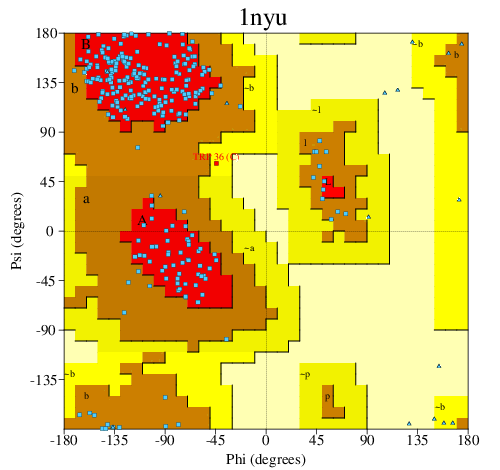
PROCHECK
|
|
|
|
|
|
Headers
|
|
|
|
References
|
|
|
|
|
|

|
|
P38445
(AVR2B_RAT) -
Activin receptor type-2B from Rattus norvegicus
|
|
|
|
Seq:
Struc:
|
|
|
|
513 a.a.
92 a.a.
|
|

|

|

|
|
|
|
|
|
|
|
|
|
|
|

|
|
P08476
(INHBA_HUMAN) -
Inhibin beta A chain from Homo sapiens
|
|
|
|
Seq:
Struc:
|
|
|
|
426 a.a.
86 a.a.
|
|
|

|

|
|
|
|
|
|
|
|
|
|
|
|
|
|
|
|
|
Enzyme class:
|
|
Chains A, C:
E.C.2.7.11.30
- receptor protein serine/threonine kinase.
|
|
|
|
|
|
|
Reaction:
|
|
|
1.
|
L-seryl-[receptor-protein] + ATP = O-phospho-L-seryl-[receptor- protein] + ADP + H+
|
|
2.
|
L-threonyl-[receptor-protein] + ATP = O-phospho-L-threonyl-[receptor- protein] + ADP + H+
|
|
|
|
|
|
|
L-seryl-[receptor-protein]
|
+
|
 ATP
ATP
|
=
|
O-phospho-L-seryl-[receptor- protein]
|
+
|
 ADP
ADP
|
+
|
H(+)
|
|
|
|
|
|
|
L-threonyl-[receptor-protein]
|
+
|
ATP
|
=
|
O-phospho-L-threonyl-[receptor- protein]
|
+
|
ADP
|
+
|
H(+)
|
|
|
|
|
|
|
|
|
|
|
|
|
Molecule diagrams generated from .mol files obtained from the
KEGG ftp site
|
|
|
|
|
|
|
|
|
|
|
|
|
|
 |
|
|
|
|
|
|
| |
|
|
| |
|
DOI no:
|
EMBO J
22:1555-1566
(2003)
|
|
PubMed id:
|
|
|
|
|
|
| |
|
Structures of an ActRIIB:activin A complex reveal a novel binding mode for TGF-beta ligand:receptor interactions.
|
|
T.B.Thompson,
T.K.Woodruff,
T.S.Jardetzky.
|
|
|
|
|
| |
ABSTRACT
|
|
|
|
| |
|
|
The TGF-beta superfamily of ligands and receptors stimulate cellular events in
diverse processes ranging from cell fate specification in development to immune
suppression. Activins define a major subgroup of TGF-beta ligands that regulate
cellular differentiation, proliferation, activation and apoptosis. Activins
signal through complexes formed with type I and type II serine/threonine kinase
receptors. We have solved the crystal structure of activin A bound to the
extracellular domain of a type II receptor, ActRIIB, revealing the details of
this interaction. ActRIIB binds to the outer edges of the activin finger
regions, with the two receptors juxtaposed in close proximity, in a mode that
differs from TGF-beta3 binding to type II receptors. The dimeric activin A
structure differs from other known TGF-beta ligand structures, adopting a
compact folded-back conformation. The crystal structure of the complex is
consistent with recruitment of two type I receptors into a close packed
arrangement at the cell surface and suggests that diversity in the
conformational arrangements of TGF-beta ligand dimers could influence cellular
signaling processes.
|
|
|
|
|
|
| |
Selected figure(s)
|
|
|
|
| |
|
|

|
|

|
|
Figure 1.
Figure 1 Structure of the ActRIIB:activin A complex. (A) Ribbon
diagram of the complex. The activin A dimer is shown in light
and dark blue for each monomer and the fingers are labeled F1
-F4; ActRIIB models are represented in yellow and red CPK atoms
with the hydrophobic cluster (Y60, W78, F101) are shown in grey.
(B) Superposition of the P4[1] (black) and P4[1]2[1]2 (red and
blue) crystal forms. (C) Electron density showing the edge of
the hydrophobic interface and the intramolecular salt bridge
between K102 and D104 (activin A shown in red; ActRIIB, yellow).
(D) Expanded stereo view of the electron density of the complex
interface. Electron density is from a simulated annealing
composite omit map contoured at 1.5 and 0.9  ,
respectively. ,
respectively.
|
|
Figure 4.
Figure 4 The ActRIIB:activin A interface. (A) Surfaces of
interaction between activin A and ActRIIB. Molecular surfaces
showing contact residues at the complex interface for the
activin A monomer (right) and ActRIIB (left). Positively and
negatively charged residues are colored blue and red,
respectively, while polar and hydrophobic residues are colored
purple and green, respectively. (B) Hydrophobic interactions at
the ActRIIB:activin A interface. (C) Hydrophilic interactions at
the ActRIIB:activin A interface.
|
|
|
|
|
|
| |
The above figures are
reprinted
from an Open Access publication published by Macmillan Publishers Ltd:
EMBO J
(2003,
22,
1555-1566)
copyright 2003.
|
|
| |
Figures were
selected
by the author.
|
|
|
|
|
|
|
|
|
|
|
|
|
|
|
|
 |
 |
 |
|
Literature references that cite this PDB file's key reference
|
|
|
| |
PubMed id
|
|
Reference
|
|
|
|
|
|
J.Zhu,
E.L.Braun,
S.Kohno,
M.Antenos,
E.Y.Xu,
R.W.Cook,
S.J.Lin,
B.C.Moore,
L.J.Guillette,
T.S.Jardetzky,
and
T.K.Woodruff
(2010).
Phylogenomic analyses reveal the evolutionary origin of the inhibin alpha-subunit, a unique TGFbeta superfamily antagonist.
|
| |
PLoS One,
5,
e9457.
|
|
|
|
|
|
|
L.Calvanese,
D.Marasco,
N.Doti,
A.Saporito,
G.D'Auria,
L.Paolillo,
M.Ruvo,
and
L.Falcigno
(2010).
Structural investigations on the Nodal-Cripto binding: a theoretical and experimental approach.
|
| |
Biopolymers,
93,
1011-1021.
|
|
|
|
|
|
|
A.Kotzsch,
J.Nickel,
A.Seher,
W.Sebald,
and
T.D.Müller
(2009).
Crystal structure analysis reveals a spring-loaded latch as molecular mechanism for GDF-5-type I receptor specificity.
|
| |
EMBO J,
28,
937-947.
|
|
|
PDB code:
|
|
|
|
|
|
|
|
C.Belville,
J.D.Maréchal,
S.Pennetier,
P.Carmillo,
L.Masgrau,
L.Messika-Zeitoun,
J.Galey,
G.Machado,
D.Treton,
J.Gonzalès,
J.Y.Picard,
N.Josso,
R.L.Cate,
and
N.di Clemente
(2009).
Natural mutations of the anti-Mullerian hormone type II receptor found in persistent Mullerian duct syndrome affect ligand binding, signal transduction and cellular transport.
|
| |
Hum Mol Genet,
18,
3002-3013.
|
|
|
|
|
|
|
J.Baardsnes,
C.S.Hinck,
A.P.Hinck,
and
M.D.O'Connor-McCourt
(2009).
TbetaR-II discriminates the high- and low-affinity TGF-beta isoforms via two hydrogen-bonded ion pairs.
|
| |
Biochemistry,
48,
2146-2155.
|
|
|
|
|
|
|
J.N.Cash,
C.A.Rejon,
A.C.McPherron,
D.J.Bernard,
and
T.B.Thompson
(2009).
The structure of myostatin:follistatin 288: insights into receptor utilization and heparin binding.
|
| |
EMBO J,
28,
2662-2676.
|
|
|
PDB code:
|
|
|
|
|
|
|
|
J.Nickel,
W.Sebald,
J.C.Groppe,
and
T.D.Mueller
(2009).
Intricacies of BMP receptor assembly.
|
| |
Cytokine Growth Factor Rev,
20,
367-377.
|
|
|
|
|
|
|
K.Heinecke,
A.Seher,
W.Schmitz,
T.D.Mueller,
W.Sebald,
and
J.Nickel
(2009).
Receptor oligomerization and beyond: a case study in bone morphogenetic proteins.
|
| |
BMC Biol,
7,
59.
|
|
|
|
|
|
|
K.L.Walton,
Y.Makanji,
M.C.Wilce,
K.L.Chan,
D.M.Robertson,
and
C.A.Harrison
(2009).
A common biosynthetic pathway governs the dimerization and secretion of inhibin and related transforming growth factor beta (TGFbeta) ligands.
|
| |
J Biol Chem,
284,
9311-9320.
|
|
|
|
|
|
|
Y.Xia,
and
A.L.Schneyer
(2009).
The biology of activin: recent advances in structure, regulation and function.
|
| |
J Endocrinol,
202,
1.
|
|
|
|
|
|
|
A.Galat,
G.Gross,
P.Drevet,
A.Sato,
and
A.Ménez
(2008).
Conserved structural determinants in three-fingered protein domains.
|
| |
FEBS J,
275,
3207-3225.
|
|
|
|
|
|
|
A.Kotzsch,
J.Nickel,
A.Seher,
K.Heinecke,
L.van Geersdaele,
T.Herrmann,
W.Sebald,
and
T.D.Mueller
(2008).
Structure analysis of bone morphogenetic protein-2 type I receptor complexes reveals a mechanism of receptor inactivation in juvenile polyposis syndrome.
|
| |
J Biol Chem,
283,
5876-5887.
|
|
|
PDB codes:
|
|
|
|
|
|
|
|
J.A.Kelber,
G.Shani,
E.C.Booker,
W.W.Vale,
and
P.C.Gray
(2008).
Cripto is a noncompetitive activin antagonist that forms analogous signaling complexes with activin and nodal.
|
| |
J Biol Chem,
283,
4490-4500.
|
|
|
|
|
|
|
J.Groppe,
C.S.Hinck,
P.Samavarchi-Tehrani,
C.Zubieta,
J.P.Schuermann,
A.B.Taylor,
P.M.Schwarz,
J.L.Wrana,
and
A.P.Hinck
(2008).
Cooperative assembly of TGF-beta superfamily signaling complexes is mediated by two disparate mechanisms and distinct modes of receptor binding.
|
| |
Mol Cell,
29,
157-168.
|
|
|
PDB code:
|
|
|
|
|
|
|
|
K.Tsuchida,
M.Nakatani,
A.Uezumi,
T.Murakami,
and
X.Cui
(2008).
Signal transduction pathway through activin receptors as a therapeutic target of musculoskeletal diseases and cancer.
|
| |
Endocr J,
55,
11-21.
|
|
|
|
|
|
|
R.Stamler,
H.T.Keutmann,
Y.Sidis,
C.Kattamuri,
A.Schneyer,
and
T.B.Thompson
(2008).
The Structure of FSTL3{middle dot}Activin A Complex: DIFFERENTIAL BINDING OF N-TERMINAL DOMAINS INFLUENCES FOLLISTATIN-TYPE ANTAGONIST SPECIFICITY.
|
| |
J Biol Chem,
283,
32831-32838.
|
|
|
PDB code:
|
|
|
|
|
|
|
|
R.V.Korupolu,
U.Muenster,
J.D.Read,
W.Vale,
and
W.H.Fischer
(2008).
Activin A/bone morphogenetic protein (BMP) chimeras exhibit BMP-like activity and antagonize activin and myostatin.
|
| |
J Biol Chem,
283,
3782-3790.
|
|
|
|
|
|
|
Y.Makanji,
K.L.Walton,
M.C.Wilce,
K.L.Chan,
D.M.Robertson,
and
C.A.Harrison
(2008).
Suppression of inhibin A biological activity by alterations in the binding site for betaglycan.
|
| |
J Biol Chem,
283,
16743-16751.
|
|
|
|
|
|
|
D.Weber,
A.Kotzsch,
J.Nickel,
S.Harth,
A.Seher,
U.Mueller,
W.Sebald,
and
T.D.Mueller
(2007).
A silent H-bond can be mutationally activated for high-affinity interaction of BMP-2 and activin type IIB receptor.
|
| |
BMC Struct Biol,
7,
6.
|
|
|
PDB codes:
|
|
|
|
|
|
|
|
J.L.Zhang,
Y.Huang,
L.Y.Qiu,
J.Nickel,
and
W.Sebald
(2007).
von Willebrand factor type C domain-containing proteins regulate bone morphogenetic protein signaling through different recognition mechanisms.
|
| |
J Biol Chem,
282,
20002-20014.
|
|
|
|
|
|
|
P.M.Smallwood,
J.Williams,
Q.Xu,
D.J.Leahy,
and
J.Nathans
(2007).
Mutational analysis of Norrin-Frizzled4 recognition.
|
| |
J Biol Chem,
282,
4057-4068.
|
|
|
|
|
|
|
P.T.Loverde,
A.Osman,
and
A.Hinck
(2007).
Schistosoma mansoni: TGF-beta signaling pathways.
|
| |
Exp Parasitol,
117,
304-317.
|
|
|
|
|
|
|
S.Han,
P.Loulakis,
M.Griffor,
and
Z.Xie
(2007).
Crystal structure of activin receptor type IIB kinase domain from human at 2.0 Angstrom resolution.
|
| |
Protein Sci,
16,
2272-2277.
|
|
|
PDB code:
|
|
|
|
|
|
|
|
T.F.Lerch,
M.Xu,
T.S.Jardetzky,
K.E.Mayo,
I.Radhakrishnan,
R.Kazer,
L.D.Shea,
and
T.K.Woodruff
(2007).
The structures that underlie normal reproductive function.
|
| |
Mol Cell Endocrinol,
267,
1-5.
|
|
|
|
|
|
|
T.F.Lerch,
S.Shimasaki,
T.K.Woodruff,
and
T.S.Jardetzky
(2007).
Structural and biophysical coupling of heparin and activin binding to follistatin isoform functions.
|
| |
J Biol Chem,
282,
15930-15939.
|
|
|
PDB code:
|
|
|
|
|
|
|
|
T.Shimanuki,
T.Hara,
T.Furuya,
T.Imamura,
and
K.Miyazono
(2007).
Modulation of the functional binding sites for TGF-beta on the type II receptor leads to suppression of TGF-beta signaling.
|
| |
Oncogene,
26,
3311-3320.
|
|
|
|
|
|
|
A.E.Harrington,
S.A.Morris-Triggs,
B.T.Ruotolo,
C.V.Robinson,
S.Ohnuma,
and
M.Hyvönen
(2006).
Structural basis for the inhibition of activin signalling by follistatin.
|
| |
EMBO J,
25,
1035-1045.
|
|
|
PDB codes:
|
|
|
|
|
|
|
|
G.P.Allendorph,
W.W.Vale,
and
S.Choe
(2006).
Structure of the ternary signaling complex of a TGF-beta superfamily member.
|
| |
Proc Natl Acad Sci U S A,
103,
7643-7648.
|
|
|
PDB code:
|
|
|
|
|
|
|
|
X.Wang,
R.H.Baloh,
J.Milbrandt,
and
K.C.Garcia
(2006).
Structure of artemin complexed with its receptor GFRalpha3: convergent recognition of glial cell line-derived neurotrophic factors.
|
| |
Structure,
14,
1083-1092.
|
|
|
PDB codes:
|
|
|
|
|
|
|
|
A.J.Gore,
D.P.Philips,
W.L.Miller,
and
D.J.Bernard
(2005).
Differential regulation of follicle stimulating hormone by activin A and TGFB1 in murine gonadotropes.
|
| |
Reprod Biol Endocrinol,
3,
73.
|
|
|
|
|
|
|
C.A.Harrison,
P.C.Gray,
W.W.Vale,
and
D.M.Robertson
(2005).
Antagonists of activin signaling: mechanisms and potential biological applications.
|
| |
Trends Endocrinol Metab,
16,
73-78.
|
|
|
|
|
|
|
H.H.Keah,
and
M.T.Hearn
(2005).
A molecular recognition paradigm: promiscuity associated with the ligand-receptor interactions of the activin members of the TGF-beta superfamily.
|
| |
J Mol Recognit,
18,
385-403.
|
|
|
|
|
|
|
M.A.Brown,
Q.Zhao,
K.A.Baker,
C.Naik,
C.Chen,
L.Pukac,
M.Singh,
T.Tsareva,
Y.Parice,
A.Mahoney,
V.Roschke,
I.Sanyal,
and
S.Choe
(2005).
Crystal structure of BMP-9 and functional interactions with pro-region and receptors.
|
| |
J Biol Chem,
280,
25111-25118.
|
|
|
PDB code:
|
|
|
|
|
|
|
|
P.Llinas,
M.H.Le Du,
H.Gårdsvoll,
K.Danø,
M.Ploug,
B.Gilquin,
E.A.Stura,
and
A.Ménez
(2005).
Crystal structure of the human urokinase plasminogen activator receptor bound to an antagonist peptide.
|
| |
EMBO J,
24,
1655-1663.
|
|
|
PDB code:
|
|
|
|
|
|
|
|
R.W.Cook,
T.B.Thompson,
S.P.Kurup,
T.S.Jardetzky,
and
T.K.Woodruff
(2005).
Structural basis for a functional antagonist in the transforming growth factor beta superfamily.
|
| |
J Biol Chem,
280,
40177-40186.
|
|
|
|
|
|
|
U.Muenster,
C.A.Harrison,
C.Donaldson,
W.Vale,
and
W.H.Fischer
(2005).
An activin-A/C chimera exhibits activin and myostatin antagonistic properties.
|
| |
J Biol Chem,
280,
36626-36632.
|
|
|
|
|
|
|
C.A.Harrison,
P.C.Gray,
W.H.Fischer,
C.Donaldson,
S.Choe,
and
W.Vale
(2004).
An activin mutant with disrupted ALK4 binding blocks signaling via type II receptors.
|
| |
J Biol Chem,
279,
28036-28044.
|
|
|
|
|
|
|
E.del Re,
Y.Sidis,
D.A.Fabrizio,
H.Y.Lin,
and
A.Schneyer
(2004).
Reconstitution and analysis of soluble inhibin and activin receptor complexes in a cell-free system.
|
| |
J Biol Chem,
279,
53126-53135.
|
|
|
|
|
|
|
J.P.Hanrahan,
S.M.Gregan,
P.Mulsant,
M.Mullen,
G.H.Davis,
R.Powell,
and
S.M.Galloway
(2004).
Mutations in the genes for oocyte-derived growth factors GDF9 and BMP15 are associated with both increased ovulation rate and sterility in Cambridge and Belclare sheep (Ovis aries).
|
| |
Biol Reprod,
70,
900-909.
|
|
|
|
|
|
|
M.de Caestecker
(2004).
The transforming growth factor-beta superfamily of receptors.
|
| |
Cytokine Growth Factor Rev,
15,
1.
|
|
|
|
|
|
|
S.J.Lee
(2004).
Regulation of muscle mass by myostatin.
|
| |
Annu Rev Cell Dev Biol,
20,
61-86.
|
|
|
|
|
|
|
S.K.Cheng,
F.Olale,
A.H.Brivanlou,
and
A.F.Schier
(2004).
Lefty blocks a subset of TGFbeta signals by antagonizing EGF-CFC coreceptors.
|
| |
PLoS Biol,
2,
E30.
|
|
|
|
|
|
|
S.Keller,
J.Nickel,
J.L.Zhang,
W.Sebald,
and
T.D.Mueller
(2004).
Molecular recognition of BMP-2 and BMP receptor IA.
|
| |
Nat Struct Mol Biol,
11,
481-488.
|
|
|
PDB codes:
|
|
|
|
|
|
|
|
V.M.Leppänen,
M.M.Bespalov,
P.Runeberg-Roos,
U.Puurand,
A.Merits,
M.Saarma,
and
A.Goldman
(2004).
The structure of GFRalpha1 domain 3 reveals new insights into GDNF binding and RET activation.
|
| |
EMBO J,
23,
1452-1462.
|
|
|
PDB code:
|
|
|
|
|
|
|
|
W.Sebald,
J.Nickel,
J.L.Zhang,
and
T.D.Mueller
(2004).
Molecular recognition in bone morphogenetic protein (BMP)/receptor interaction.
|
| |
Biol Chem,
385,
697-710.
|
|
|
|
|
|
|
W.Sebald,
and
T.D.Mueller
(2003).
The interaction of BMP-7 and ActRII implicates a new mode of receptor assembly.
|
| |
Trends Biochem Sci,
28,
518-521.
|
|
|
|
|
|
|
Y.Shi,
and
J.Massagué
(2003).
Mechanisms of TGF-beta signaling from cell membrane to the nucleus.
|
| |
Cell,
113,
685-700.
|
|
|
|
|
|
The most recent references are shown first.
Citation data come partly from CiteXplore and partly
from an automated harvesting procedure. Note that this is likely to be
only a partial list as not all journals are covered by
either method. However, we are continually building up the citation data
so more and more references will be included with time.
Where a reference describes a PDB structure, the PDB
code is
shown on the right.
|

| |


 Links
Links


