 |
PDBsum entry 1jkt

|
|
|
|
|
 |
Contents |
 |
|
|
|
|
|
|
|
|
* Residue conservation analysis
|
|
|
|
|
|
|
|
|
|
|
Enzyme class:
|
|
E.C.2.7.11.1
- non-specific serine/threonine protein kinase.
|
|
|
|
|
|
|
Reaction:
|
|
|
1.
|
L-seryl-[protein] + ATP = O-phospho-L-seryl-[protein] + ADP + H+
|
|
2.
|
L-threonyl-[protein] + ATP = O-phospho-L-threonyl-[protein] + ADP + H+
|
|
|
|
|
|
|
L-seryl-[protein]
|
+
|
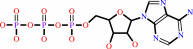 ATP
ATP
|
=
|
O-phospho-L-seryl-[protein]
|
+
|
 ADP
ADP
|
+
|
H(+)
|
|
|
|
|
|
|
L-threonyl-[protein]
|
+
|
ATP
|
=
|
O-phospho-L-threonyl-[protein]
|
+
|
ADP
|
+
|
H(+)
|
|
|
|
|
|
|
|
|
|
|
|
|
Molecule diagrams generated from .mol files obtained from the
KEGG ftp site
|
|
|
|
|
|
|
|
|
|
|
|
|
|
 |
|
|
|
|
|
|
| |
|
|
| |
|
DOI no:
|
Nat Struct Biol
8:899-907
(2001)
|
|
PubMed id:
|
|
|
|
|
|
| |
|
Crystal structures of the catalytic domain of human protein kinase associated with apoptosis and tumor suppression.
|
|
V.Tereshko,
M.Teplova,
J.Brunzelle,
D.M.Watterson,
M.Egli.
|
|
|
|
|
| |
ABSTRACT
|
|
|
|
| |
|
|
We have determined X-ray crystal structures with up to 1.5 A resolution of the
catalytic domain of death-associated protein kinase (DAPK), the first described
member of a novel family of pro-apoptotic and tumor-suppressive serine/threonine
kinases. The geometry of the active site was studied in the apo form, in a
complex with nonhydrolyzable AMPPnP and in a ternary complex consisting of
kinase, AMPPnP and either Mg2+ or Mn2+. The structures revealed a previously
undescribed water-mediated stabilization of the interaction between the lysine
that is conserved in protein kinases and the beta- and gamma-phosphates of ATP,
as well as conformational changes at the active site upon ion binding.
Comparison between these structures and nucleotide triphosphate complexes of
several other kinases disclosed a number of unique features of the DAPK
catalytic domain, among which is a highly ordered basic loop in the N-terminal
domain that may participate in enzyme regulation.
|
|
|
|
|
|
| |
Selected figure(s)
|
|
|
|
| |
|
|

|
|

|
|
Figure 1.
Figure 1. Domain organization of DAPK (numbers refer to amino
acids).
|
|
Figure 5.
Figure 5. Lattice interactions in the orthorhombic and cubic
crystal forms of the DAPK catalytic domain. a, Orthorhombic
form. Overview of the environment of the putative
peptide-binding region preceding the F-helix and the basic loop
linking  3
and helix C. Three symmetry mates colored blue, pink and cyan
make up the immediate surroundings of the loop region of each
DAPK molecule (red). Secondary structure elements are
represented as cylinders and arrows, and AMPPnP molecules and
four residues of the C-terminal streptavidin-tag visible in the
electron density maps are in a ball-and-stick representation. b,
Cubic form. The crystallographic asymmetric unit consists of
DAPK dimers related by a noncrystallographic two-fold rotation
axis running approximately along the vertical in the plane of
projection. Thus, basic loops and peptide binding regions of the
two molecules face each other. 3
and helix C. Three symmetry mates colored blue, pink and cyan
make up the immediate surroundings of the loop region of each
DAPK molecule (red). Secondary structure elements are
represented as cylinders and arrows, and AMPPnP molecules and
four residues of the C-terminal streptavidin-tag visible in the
electron density maps are in a ball-and-stick representation. b,
Cubic form. The crystallographic asymmetric unit consists of
DAPK dimers related by a noncrystallographic two-fold rotation
axis running approximately along the vertical in the plane of
projection. Thus, basic loops and peptide binding regions of the
two molecules face each other.
|
|
|
|
|
|
| |
The above figures are
reprinted
by permission from Macmillan Publishers Ltd:
Nat Struct Biol
(2001,
8,
899-907)
copyright 2001.
|
|
| |
Figures were
selected
by an automated process.
|
|
|
|
|
|
|
|
|
|
|
|
|
|
|
|
 |
 |
 |
|
Literature references that cite this PDB file's key reference
|
|
|
| |
PubMed id
|
|
Reference
|
|
|
|
|
|
L.K.McNamara,
J.S.Brunzelle,
J.P.Schavocky,
D.M.Watterson,
and
V.Grum-Tokars
(2011).
Site-directed mutagenesis of the glycine-rich loop of death associated protein kinase (DAPK) identifies it as a key structure for catalytic activity.
|
| |
Biochim Biophys Acta,
1813,
1068-1073.
|
|
|
|
|
|
|
M.Rabiller,
M.Getlik,
S.Klüter,
A.Richters,
S.Tückmantel,
J.R.Simard,
and
D.Rauh
(2010).
Proteus in the world of proteins: conformational changes in protein kinases.
|
| |
Arch Pharm (Weinheim),
343,
193-206.
|
|
|
|
|
|
|
M.Zimmermann,
C.Atmanene,
Q.Xu,
L.Fouillen,
A.Van Dorsselaer,
D.Bonnet,
C.Marsol,
M.Hibert,
S.Sanglier-Cianferani,
C.Pigault,
L.K.McNamara,
D.M.Watterson,
J.Haiech,
and
M.C.Kilhoffer
(2010).
Homodimerization of the death-associated protein kinase catalytic domain: development of a new small molecule fluorescent reporter.
|
| |
PLoS One,
5,
e14120.
|
|
|
|
|
|
|
J.D.Knight,
D.Hamelberg,
J.A.McCammon,
and
R.Kothary
(2009).
The role of conserved water molecules in the catalytic domain of protein kinases.
|
| |
Proteins,
76,
527-535.
|
|
|
|
|
|
|
L.K.McNamara,
D.M.Watterson,
and
J.S.Brunzelle
(2009).
Structural insight into nucleotide recognition by human death-associated protein kinase.
|
| |
Acta Crystallogr D Biol Crystallogr,
65,
241-248.
|
|
|
PDB codes:
|
|
|
|
|
|
|
|
K.Mukherjee,
M.Sharma,
H.Urlaub,
G.P.Bourenkov,
R.Jahn,
T.C.Südhof,
and
M.C.Wahl
(2008).
CASK Functions as a Mg2+-independent neurexin kinase.
|
| |
Cell,
133,
328-339.
|
|
|
PDB codes:
|
|
|
|
|
|
|
|
A.L.Craig,
J.A.Chrystal,
J.A.Fraser,
N.Sphyris,
Y.Lin,
B.J.Harrison,
M.T.Scott,
I.Dornreiter,
and
T.R.Hupp
(2007).
The MDM2 ubiquitination signal in the DNA-binding domain of p53 forms a docking site for calcium calmodulin kinase superfamily members.
|
| |
Mol Cell Biol,
27,
3542-3555.
|
|
|
|
|
|
|
J.D.Knight,
B.Qian,
D.Baker,
and
R.Kothary
(2007).
Conservation, variability and the modeling of active protein kinases.
|
| |
PLoS ONE,
2,
e982.
|
|
|
|
|
|
|
Y.Shoval,
S.Pietrokovski,
and
A.Kimchi
(2007).
ZIPK: a unique case of murine-specific divergence of a conserved vertebrate gene.
|
| |
PLoS Genet,
3,
1884-1893.
|
|
|
|
|
|
|
A.Raichaudhuri,
R.Bhattacharyya,
S.Chaudhuri,
P.Chakrabarti,
and
M.Dasgupta
(2006).
Domain analysis of a groundnut calcium-dependent protein kinase: nuclear localization sequence in the junction domain is coupled with nonconsensus calcium binding domains.
|
| |
J Biol Chem,
281,
10399-10409.
|
|
|
PDB code:
|
|
|
|
|
|
|
|
R.Jauch,
M.K.Cho,
S.Jäkel,
C.Netter,
K.Schreiter,
B.Aicher,
M.Zweckstetter,
H.Jäckle,
and
M.C.Wahl
(2006).
Mitogen-activated protein kinases interacting kinases are autoinhibited by a reprogrammed activation segment.
|
| |
EMBO J,
25,
4020-4032.
|
|
|
PDB codes:
|
|
|
|
|
|
|
|
S.Bialik,
and
A.Kimchi
(2006).
The death-associated protein kinases: structure, function, and beyond.
|
| |
Annu Rev Biochem,
75,
189-210.
|
|
|
|
|
|
|
Y.Jin,
E.K.Blue,
and
P.J.Gallagher
(2006).
Control of death-associated protein kinase (DAPK) activity by phosphorylation and proteasomal degradation.
|
| |
J Biol Chem,
281,
39033-39040.
|
|
|
|
|
|
|
E.D.Scheeff,
and
P.E.Bourne
(2005).
Structural evolution of the protein kinase-like superfamily.
|
| |
PLoS Comput Biol,
1,
e49.
|
|
|
|
|
|
|
M.D.Jacobs,
J.Black,
O.Futer,
L.Swenson,
B.Hare,
M.Fleming,
and
K.Saxena
(2005).
Pim-1 ligand-bound structures reveal the mechanism of serine/threonine kinase inhibition by LY294002.
|
| |
J Biol Chem,
280,
13728-13734.
|
|
|
PDB codes:
|
|
|
|
|
|
|
|
R.Jauch,
S.Jäkel,
C.Netter,
K.Schreiter,
B.Aicher,
H.Jäckle,
and
M.C.Wahl
(2005).
Crystal structures of the Mnk2 kinase domain reveal an inhibitory conformation and a zinc binding site.
|
| |
Structure,
13,
1559-1568.
|
|
|
PDB codes:
|
|
|
|
|
|
|
|
G.Shani,
L.Marash,
D.Gozuacik,
S.Bialik,
L.Teitelbaum,
G.Shohat,
and
A.Kimchi
(2004).
Death-associated protein kinase phosphorylates ZIP kinase, forming a unique kinase hierarchy to activate its cell death functions.
|
| |
Mol Cell Biol,
24,
8611-8626.
|
|
|
|
|
|
|
A.M.Schumacher,
A.V.Velentza,
and
D.M.Watterson
(2002).
Death-associated protein kinase as a potential therapeutic target.
|
| |
Expert Opin Ther Targets,
6,
497-506.
|
|
|
|
|
|
|
A.V.Velentza,
A.M.Schumacher,
and
D.M.Watterson
(2002).
Structure, activity, regulation, and inhibitor discovery for a protein kinase associated with apoptosis and neuronal death.
|
| |
Pharmacol Ther,
93,
217-224.
|
|
|
|
|
|
|
E.Gozal,
D.Gozal,
W.M.Pierce,
V.Thongboonkerd,
J.A.Scherzer,
L.R.Sachleben,
K.R.Brittian,
S.Z.Guo,
J.Cai,
and
J.B.Klein
(2002).
Proteomic analysis of CA1 and CA3 regions of rat hippocampus and differential susceptibility to intermittent hypoxia.
|
| |
J Neurochem,
83,
331-345.
|
|
|
|
|
|
|
G.M.Cheetham,
R.M.Knegtel,
J.T.Coll,
S.B.Renwick,
L.Swenson,
P.Weber,
J.A.Lippke,
and
D.A.Austen
(2002).
Crystal structure of aurora-2, an oncogenic serine/threonine kinase.
|
| |
J Biol Chem,
277,
42419-42422.
|
|
|
PDB code:
|
|
|
|
|
|
|
|
L.J.Van Eldik
(2002).
Structure and enzymology of a death-associated protein kinase.
|
| |
Trends Pharmacol Sci,
23,
302-304.
|
|
|
|
|
|
|
A.Kimchi
(2001).
A cell death-promoting kinase.
|
| |
Nat Struct Biol,
8,
824-826.
|
|
|
|
|
|
The most recent references are shown first.
Citation data come partly from CiteXplore and partly
from an automated harvesting procedure. Note that this is likely to be
only a partial list as not all journals are covered by
either method. However, we are continually building up the citation data
so more and more references will be included with time.
Where a reference describes a PDB structure, the PDB
codes are
shown on the right.
|
|


 Links
Links


