 |
PDBsum entry 3c0h

|
|
|
|
|
 |
Contents |
 |
|
|
|
|
|
|
|
|
|
|
|
|
* Residue conservation analysis
|
|
|
|
|
|
|
|
|
|
|
Enzyme class:
|
|
E.C.2.7.11.1
- non-specific serine/threonine protein kinase.
|
|
|
|
|
|
|
Reaction:
|
|
|
1.
|
L-seryl-[protein] + ATP = O-phospho-L-seryl-[protein] + ADP + H+
|
|
2.
|
L-threonyl-[protein] + ATP = O-phospho-L-threonyl-[protein] + ADP + H+
|
|
|
|
|
|
|
L-seryl-[protein]
|
+
|
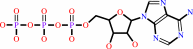 ATP
ATP
|
=
|
O-phospho-L-seryl-[protein]
Bound ligand (Het Group name = )
matches with 85.19% similarity
|
+
|
 ADP
ADP
|
+
|
H(+)
|
|
|
|
|
|
|
L-threonyl-[protein]
|
+
|
ATP
|
=
|
O-phospho-L-threonyl-[protein]
Bound ligand (Het Group name = )
matches with 85.19% similarity
|
+
|
ADP
|
+
|
H(+)
|
|
|
|
|
|
|
|
|
|
|
|
|
Molecule diagrams generated from .mol files obtained from the
KEGG ftp site
|
|
|
|
|
|
|
|
|
|
|
|
|
|
 |
|
|
|
|
|
|
| |
|
|
| |
|
DOI no:
|
Cell
133:328-339
(2008)
|
|
PubMed id:
|
|
|
|
|
|
| |
|
CASK Functions as a Mg2+-independent neurexin kinase.
|
|
K.Mukherjee,
M.Sharma,
H.Urlaub,
G.P.Bourenkov,
R.Jahn,
T.C.Südhof,
M.C.Wahl.
|
|
|
|
|
| |
ABSTRACT
|
|
|
|
| |
|
|
CASK is a unique MAGUK protein that contains an N-terminal CaM-kinase domain
besides the typical MAGUK domains. The CASK CaM-kinase domain is presumed to be
a catalytically inactive pseudokinase because it lacks the canonical DFG motif
required for Mg2+ binding that is thought to be indispensable for kinase
activity. Here we show, however, that CASK functions as an active protein kinase
even without Mg2+ binding. High-resolution crystal structures reveal that the
CASK CaM-kinase domain adopts a constitutively active conformation that binds
ATP and catalyzes phosphotransfer without Mg2+. The CASK CaM-kinase domain
phosphorylates itself and at least one physiological interactor, the synaptic
protein neurexin-1, to which CASK is recruited via its PDZ domain. Thus, our
data indicate that CASK combines the scaffolding activity of MAGUKs with an
unusual kinase activity that phosphorylates substrates recuited by the
scaffolding activity. Moreover, our study suggests that other pseudokinases (10%
of the kinome) could also be catalytically active.
|
|
|
|
|
|
| |
Selected figure(s)
|
|
|
|
| |
|
|

|
|

|
|
Figure 1.
Figure 1. Structure of the CASK CaM-Kinase Domain
(A and
B) Ribbon diagrams depicting the overall fold of the CASK
CaM-kinase domain in a complex with 3′-AMP (orthorhombic form,
A; see Figure S3 for the triclinic form) or AMPPNP (triclinic
form, B).
(C and D) Ribbon diagrams of rat CaMKI (C;
Goldberg et al., 1996; PDB ID: 1A06) and rat DAPK1 in a complex
with Mn^2+-AMPPNP (D; Tereshko et al., 2001; PDB ID: 1IG1).
All structures are shown in the same orientation with the
N-terminal lobes (dark gray) at the top and the C-terminal lobes
(light gray) at the bottom. Specific structural elements are
color-coded: portion of the glycine-rich loop (GR-loop) = brown;
catalytic loop (C-loop) = yellow; D/GFG of the Mg^2+ binding
loop = orange (the third residue is disordered in the CaMKI
structure); activation segment = green; C-terminal
Ca^2+/CaM-binding segment (CaM-segment) = red. Bound nucleotides
in (A) (3′-AMP), (B) (5′-AMP portion of AMPPNP), and (D)
(AMPPNP) are shown in ball-and-sticks.
|
|
Figure 7.
Figure 7. Model of Neurexin Phosphorylation by CASK
Neurexin (Nx) and neuroligin (NL) are thought to interact
extracellularly with each other across the synaptic cleft and to
associate intracellularly with the MAGUKs CASK and PSD-95,
respectively. CASK is recruited to the cytosolic C-tail of
neurexin via the CASK PDZ domain and phosphorylates the neurexin
C-terminal tail. Protein 4.1, which binds the C-tail of neurexin
as well as CASK, nucleates actin filaments, modulating the
presynaptic cytoskeleton. The red indicator depicts the
inhibition of CASK CaM-kinase activity due to an increase in
cytosolic divalent cations.
|
|
|
|
|
|
| |
The above figures are
reprinted
by permission from Cell Press:
Cell
(2008,
133,
328-339)
copyright 2008.
|
|
| |
Figures were
selected
by an automated process.
|
|
|
|
|
|
|
|
|
|
|
|
|
|
|
|
 |
 |
 |
|
Literature references that cite this PDB file's key reference
|
|
|
| |
PubMed id
|
|
Reference
|
|
|
|
|
|
C.Adrain,
and
M.Freeman
(2012).
New lives for old: evolution of pseudoenzyme function illustrated by iRhoms.
|
| |
Nat Rev Mol Cell Biol,
13,
489-498.
|
|
|
|
|
|
|
D.Ungureanu,
J.Wu,
T.Pekkala,
Y.Niranjan,
C.Young,
O.N.Jensen,
C.F.Xu,
T.A.Neubert,
R.C.Skoda,
S.R.Hubbard,
and
O.Silvennoinen
(2011).
The pseudokinase domain of JAK2 is a dual-specificity protein kinase that negatively regulates cytokine signaling.
|
| |
Nat Struct Mol Biol,
18,
971-976.
|
|
|
|
|
|
|
E.B.Madsen,
M.Antolín-Llovera,
C.Grossmann,
J.Ye,
S.Vieweg,
A.Broghammer,
L.Krusell,
S.Radutoiu,
O.N.Jensen,
J.Stougaard,
and
M.Parniske
(2011).
Autophosphorylation is essential for the in vivo function of the Lotus japonicus Nod factor receptor 1 and receptor-mediated signalling in cooperation with Nod factor receptor 5.
|
| |
Plant J,
65,
404-417.
|
|
|
|
|
|
|
S.S.Taylor,
and
A.P.Kornev
(2011).
Protein kinases: evolution of dynamic regulatory proteins.
|
| |
Trends Biochem Sci,
36,
65-77.
|
|
|
|
|
|
|
A.Dusa,
C.Mouton,
C.Pecquet,
M.Herman,
and
S.N.Constantinescu
(2010).
JAK2 V617F constitutive activation requires JH2 residue F595: a pseudokinase domain target for specific inhibitors.
|
| |
PLoS One,
5,
e11157.
|
|
|
|
|
|
|
A.Hackett,
P.S.Tarpey,
A.Licata,
J.Cox,
A.Whibley,
J.Boyle,
C.Rogers,
J.Grigg,
M.Partington,
R.E.Stevenson,
J.Tolmie,
J.R.Yates,
G.Turner,
M.Wilson,
A.P.Futreal,
M.Corbett,
M.Shaw,
J.Gecz,
F.L.Raymond,
M.R.Stratton,
C.E.Schwartz,
and
F.E.Abidi
(2010).
CASK mutations are frequent in males and cause X-linked nystagmus and variable XLMR phenotypes.
|
| |
Eur J Hum Genet,
18,
544-552.
|
|
|
|
|
|
|
E.D.Scheeff,
H.L.Axelrod,
M.D.Miller,
H.J.Chiu,
A.M.Deacon,
I.A.Wilson,
and
G.Manning
(2010).
Genomics, evolution, and crystal structure of a new family of bacterial spore kinases.
|
| |
Proteins,
78,
1470-1482.
|
|
|
PDB code:
|
|
|
|
|
|
|
|
E.Zeqiraj,
and
D.M.van Aalten
(2010).
Pseudokinases-remnants of evolution or key allosteric regulators?
|
| |
Curr Opin Struct Biol,
20,
772-781.
|
|
|
|
|
|
|
F.Shi,
S.E.Telesco,
Y.Liu,
R.Radhakrishnan,
and
M.A.Lemmon
(2010).
ErbB3/HER3 intracellular domain is competent to bind ATP and catalyze autophosphorylation.
|
| |
Proc Natl Acad Sci U S A,
107,
7692-7697.
|
|
|
PDB code:
|
|
|
|
|
|
|
|
G.Bereta,
B.Wang,
P.D.Kiser,
W.Baehr,
G.F.Jang,
and
K.Palczewski
(2010).
A functional kinase homology domain is essential for the activity of photoreceptor guanylate cyclase 1.
|
| |
J Biol Chem,
285,
1899-1908.
|
|
|
|
|
|
|
L.Kaufman,
M.Ayub,
and
J.B.Vincent
(2010).
The genetic basis of non-syndromic intellectual disability: a review.
|
| |
J Neurodev Disord,
2,
182-209.
|
|
|
|
|
|
|
M.Maydan,
P.C.McDonald,
J.Sanghera,
J.Yan,
C.Rallis,
S.Pinchin,
G.E.Hannigan,
L.J.Foster,
D.Ish-Horowicz,
M.P.Walsh,
and
S.Dedhar
(2010).
Integrin-linked kinase is a functional Mn2+-dependent protein kinase that regulates glycogen synthase kinase-3β (GSK-3beta) phosphorylation.
|
| |
PLoS One,
5,
e12356.
|
|
|
|
|
|
|
Q.Sun,
and
G.M.Kelly
(2010).
Post-translational modification of CASK leads to its proteasome-dependent degradation.
|
| |
Int J Biochem Cell Biol,
42,
90-97.
|
|
|
|
|
|
|
S.S.Taylor,
and
A.P.Kornev
(2010).
Yet another "active" pseudokinase, Erb3.
|
| |
Proc Natl Acad Sci U S A,
107,
8047-8048.
|
|
|
|
|
|
|
A.P.Kornev,
and
S.S.Taylor
(2009).
Pseudokinases: functional insights gleaned from structure.
|
| |
Structure,
17,
5-7.
|
|
|
|
|
|
|
A.S.Shaw,
and
E.L.Filbert
(2009).
Scaffold proteins and immune-cell signalling.
|
| |
Nat Rev Immunol,
9,
47-56.
|
|
|
|
|
|
|
E.D.Scheeff,
J.Eswaran,
G.Bunkoczi,
S.Knapp,
and
G.Manning
(2009).
Structure of the Pseudokinase VRK3 Reveals a Degraded Catalytic Site, a Highly Conserved Kinase Fold, and a Putative Regulatory Binding Site.
|
| |
Structure,
17,
128-138.
|
|
|
PDB codes:
|
|
|
|
|
|
|
|
E.Zeqiraj,
B.M.Filippi,
M.Deak,
D.R.Alessi,
and
D.M.van Aalten
(2009).
Structure of the LKB1-STRAD-MO25 complex reveals an allosteric mechanism of kinase activation.
|
| |
Science,
326,
1707-1711.
|
|
|
PDB code:
|
|
|
|
|
|
|
|
E.Zeqiraj,
B.M.Filippi,
S.Goldie,
I.Navratilova,
J.Boudeau,
M.Deak,
D.R.Alessi,
and
D.M.van Aalten
(2009).
ATP and MO25alpha regulate the conformational state of the STRADalpha pseudokinase and activation of the LKB1 tumour suppressor.
|
| |
PLoS Biol,
7,
e1000126.
|
|
|
PDB code:
|
|
|
|
|
|
|
|
G.Piluso,
F.D'Amico,
V.Saccone,
E.Bismuto,
I.L.Rotundo,
M.Di Domenico,
S.Aurino,
C.E.Schwartz,
G.Neri,
and
V.Nigro
(2009).
A missense mutation in CASK causes FG syndrome in an Italian family.
|
| |
Am J Hum Genet,
84,
162-177.
|
|
|
|
|
|
|
K.Fukuda,
S.Gupta,
K.Chen,
C.Wu,
and
J.Qin
(2009).
The pseudoactive site of ILK is essential for its binding to alpha-Parvin and localization to focal adhesions.
|
| |
Mol Cell,
36,
819-830.
|
|
|
PDB codes:
|
|
|
|
|
|
|
|
K.H.Biswas,
A.R.Shenoy,
A.Dutta,
and
S.S.Visweswariah
(2009).
The evolution of guanylyl cyclases as multidomain proteins: conserved features of kinase-cyclase domain fusions.
|
| |
J Mol Evol,
68,
587-602.
|
|
|
|
|
|
|
M.Bayer,
T.Nawy,
C.Giglione,
M.Galli,
T.Meinnel,
and
W.Lukowitz
(2009).
Paternal control of embryonic patterning in Arabidopsis thaliana.
|
| |
Science,
323,
1485-1488.
|
|
|
|
|
|
|
M.H.Rider,
E.Waelkens,
R.Derua,
and
D.Vertommen
(2009).
Fulfilling the Krebs and Beavo criteria for studying protein phosphorylation in the era of mass spectrometry-driven kinome research.
|
| |
Arch Physiol Biochem,
115,
298-310.
|
|
|
|
|
|
|
N.Jura,
Y.Shan,
X.Cao,
D.E.Shaw,
and
J.Kuriyan
(2009).
Structural analysis of the catalytically inactive kinase domain of the human EGF receptor 3.
|
| |
Proc Natl Acad Sci U S A,
106,
21608-21613.
|
|
|
PDB code:
|
|
|
|
|
|
|
|
S.B.Cheng,
S.A.Amici,
X.Q.Ren,
S.B.McKay,
M.W.Treuil,
J.M.Lindstrom,
J.Rao,
and
R.Anand
(2009).
Presynaptic targeting of alpha4beta 2 nicotinic acetylcholine receptors is regulated by neurexin-1beta.
|
| |
J Biol Chem,
284,
23251-23259.
|
|
|
|
|
|
|
W.Qiu,
A.Wernimont,
K.Tang,
S.Taylor,
V.Lunin,
M.Schapira,
S.Fentress,
R.Hui,
and
L.D.Sibley
(2009).
Novel structural and regulatory features of rhoptry secretory kinases in Toxoplasma gondii.
|
| |
EMBO J,
28,
969-979.
|
|
|
PDB codes:
|
|
|
|
|
|
|
|
Y.P.Hsueh
(2009).
Calcium/calmodulin-dependent serine protein kinase and mental retardation.
|
| |
Ann Neurol,
66,
438-443.
|
|
|
|
|
|
|
T.C.Südhof
(2008).
Neuroligins and neurexins link synaptic function to cognitive disease.
|
| |
Nature,
455,
903-911.
|
|
|
|
|
|
|
V.Pena,
A.Rozov,
P.Fabrizio,
R.Lührmann,
and
M.C.Wahl
(2008).
Structure and function of an RNase H domain at the heart of the spliceosome.
|
| |
EMBO J,
27,
2929-2940.
|
|
|
PDB codes:
|
|
|
|
|
|
|
The most recent references are shown first.
Citation data come partly from CiteXplore and partly
from an automated harvesting procedure. Note that this is likely to be
only a partial list as not all journals are covered by
either method. However, we are continually building up the citation data
so more and more references will be included with time.
Where a reference describes a PDB structure, the PDB
code is
shown on the right.
|
|


 Links
Links


