 |
PDBsum entry 1j1c

|
|
|
|
|
 |
Contents |
 |
|
|
|
|
|
|
|
|
|
|
|
|
|
|
* Residue conservation analysis
|
|
|
|
|
|
PDB id:
|
|
|
|
| Name: |
|
Transferase
|
|
|
Title:
|
|
Binary complex structure of human tau protein kinase i with adp
|
|
Structure:
|
|
Glycogen synthase kinase-3 beta. Chain: a, b. Synonym: tau protein kinase i, gsk-3 beta. Engineered: yes
|
|
Source:
|
|
Homo sapiens. Human. Organism_taxid: 9606. Expressed in: escherichia coli. Expression_system_taxid: 562
|
|
Biol. unit:
|
|
Dimer (from
)
|
|
Resolution:
|
|
|
2.10Å
|
R-factor:
|
0.218
|
R-free:
|
0.242
|
|
|
Authors:
|
|
M.Aoki,T.Yokota,I.Sugiura,C.Sasaki,T.Hasegawa,C.Okumura,T.Kohno, S.Sugio,T.Matsuzaki
|
Key ref:

|
|
M.Aoki
et al.
(2004).
Structural insight into nucleotide recognition in tau-protein kinase I/glycogen synthase kinase 3 beta.
Acta Crystallogr D Biol Crystallogr,
60,
439-446.
PubMed id:
DOI:

|
|
|
Date:
|
|
|
03-Dec-02
|
Release date:
|
03-Dec-03
|
|
|
|
|
|
|
PROCHECK
|

|
|
|
|
|
Headers
|
|
|
|
References
|
|
|
|
|
|

|
|
P49841
(GSK3B_HUMAN) -
Glycogen synthase kinase-3 beta from Homo sapiens
|
|
|
|
Seq:
Struc:
|
|
|
|
420 a.a.
354 a.a.
|
|

|

|

|
|
|
|
|
|
|
|
|
|
|
Key: |
 |
PfamA domain |
|
|
 |
Secondary structure |
|
 |
CATH domain |
|
|
|
|
|
|
|
|
|
|
|
|
|
Enzyme class 1:
|
|
E.C.2.7.11.1
- non-specific serine/threonine protein kinase.
|
|
|
|
|
|
|
Reaction:
|
|
|
1.
|
L-seryl-[protein] + ATP = O-phospho-L-seryl-[protein] + ADP + H+
|
|
2.
|
L-threonyl-[protein] + ATP = O-phospho-L-threonyl-[protein] + ADP + H+
|
|
|
|
|
|
|
L-seryl-[protein]
|
+
|
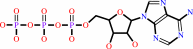 ATP
ATP
|
=
|
O-phospho-L-seryl-[protein]
Bound ligand (Het Group name = )
corresponds exactly
|
+
|
 ADP
ADP
|
+
|
H(+)
|
|
|
|
|
|
|
L-threonyl-[protein]
|
+
|
ATP
|
=
|
O-phospho-L-threonyl-[protein]
Bound ligand (Het Group name = )
corresponds exactly
|
+
|
ADP
|
+
|
H(+)
|
|
|
|
|
|
|
|
|
|
Enzyme class 2:
|
|
E.C.2.7.11.26
- [tau protein] kinase.
|
|
|
|
|
|
|
Reaction:
|
|
|
1.
|
L-seryl-[tau protein] + ATP = O-phospho-L-seryl-[tau protein] + ADP + H+
|
|
2.
|
L-threonyl-[tau protein] + ATP = O-phospho-L-threonyl-[tau protein] + ADP + H+
|
|
|
|
|
|
|
L-seryl-[tau protein]
|
+
|
ATP
|
=
|
O-phospho-L-seryl-[tau protein]
Bound ligand (Het Group name = )
corresponds exactly
|
+
|
ADP
|
+
|
H(+)
|
|
|
|
|
|
|
L-threonyl-[tau protein]
|
+
|
ATP
|
=
|
O-phospho-L-threonyl-[tau protein]
Bound ligand (Het Group name = )
corresponds exactly
|
+
|
ADP
|
+
|
H(+)
|
|
|
|
|
|
|
|
|
|
|
|
|
Note, where more than one E.C. class is given (as above), each may
correspond to a different protein domain or, in the case of polyprotein
precursors, to a different mature protein.
|
|
|
|
Molecule diagrams generated from .mol files obtained from the
KEGG ftp site
|
|
|
|
|
|
|
|
|
|
|
|
|
|
 |
|
|
|
|
|
|
| |
|
|
| |
|
DOI no:
|
Acta Crystallogr D Biol Crystallogr
60:439-446
(2004)
|
|
PubMed id:
|
|
|
|
|
|
| |
|
Structural insight into nucleotide recognition in tau-protein kinase I/glycogen synthase kinase 3 beta.
|
|
M.Aoki,
T.Yokota,
I.Sugiura,
C.Sasaki,
T.Hasegawa,
C.Okumura,
K.Ishiguro,
T.Kohno,
S.Sugio,
T.Matsuzaki.
|
|
|
|
|
| |
ABSTRACT
|
|
|
|
| |
|
|
Human tau-protein kinase I (TPK I; also known as glycogen synthase kinase 3
beta; GSK3 beta) is a serine/threonine protein kinase that participates in
Alzheimer's disease. Here, binary complex structures of full-length TPK I/GSK3
beta with the ATP analogues ADP and AMPPNP solved by the X-ray diffraction
method at 2.1 and 1.8 A resolution, respectively, are reported. TPK I/GSK3 beta
is composed of three domains: an N-terminal domain consisting of a closed
beta-barrel structure, a C-terminal domain containing a 'kinase fold' structure
and a small extra-domain subsequent to the C-terminal domain. The catalytic site
is between the two major domains and has an ATP-analogue molecule in its
ATP-binding site. The adenine ring is buried in the hydrophobic pocket and
interacts specifically with the main-chain atoms of the hinge loop. The overall
structure and substrate-binding residues are similar to those observed in other
Ser/Thr protein kinases, while Arg141 (which is not conserved among other
Ser/Thr protein kinases) is one of the key residues for specific ATP/ADP
recognition by TPK I/GSK3 beta. No residues are phosphorylated, while the
orientation of the activation loop in TPK I/GSK3 beta is similar to that in
phosphorylated CDK2 and ERK2, suggesting that TPK I/GSK3 beta falls into a
conformation that enables it to be constitutively active.
|
|
|
|
|
|
| |
Selected figure(s)
|
|
|
|
| |
|
|

|
|

|
|
Figure 3.
Figure 3 Residues participating in binding of (a) ADP and (b)
AMPPNP in the ATP-binding site of GSK3  .
GSK3 is
drawn as a white ribbon; amino-acid residues, ATP analogues,
magnesium ion and water molecules are shown as black sticks,
grey sticks, a black sphere and light grey spheres,
respectively. Hydrogen bonds are shown as dotted lines. These
figures were produced using the program MOLSCRIPT. .
GSK3 is
drawn as a white ribbon; amino-acid residues, ATP analogues,
magnesium ion and water molecules are shown as black sticks,
grey sticks, a black sphere and light grey spheres,
respectively. Hydrogen bonds are shown as dotted lines. These
figures were produced using the program MOLSCRIPT.
|
|
Figure 4.
Figure 4 Magnesium-binding site in (a) the GSK3 -ADP
complex and (b) the GSK3 -AMPPNP
complex. GSK3 is
drawn as a white ribbon; amino-acid residues, ATP analogues,
magnesium ion and water molecules are shown as black sticks,
grey sticks, a black sphere and light grey spheres,
respectively. Hydrogen bonds are shown as dotted lines. These
figures were produced using the program MOLSCRIPT.
|
|
|
|
|
|
| |
The above figures are
reprinted
by permission from the IUCr:
Acta Crystallogr D Biol Crystallogr
(2004,
60,
439-446)
copyright 2004.
|
|
| |
Figures were
selected
by an automated process.
|
|
|
|
|
|
|
|
|
|
|
|
|
|
|
|
 |
 |
 |
|
Literature references that cite this PDB file's key reference
|
|
|
| |
PubMed id
|
|
Reference
|
|
|
|
|
|
K.Saeki,
M.Machida,
Y.Kinoshita,
R.Takasawa,
and
S.Tanuma
(2011).
Glycogen synthase kinase-3β2 has lower phosphorylation activity to tau than glycogen synthase kinase-3β1.
|
| |
Biol Pharm Bull,
34,
146-149.
|
|
|
|
|
|
|
J.L.Buescher,
and
C.J.Phiel
(2010).
A noncatalytic domain of glycogen synthase kinase-3 (GSK-3) is essential for activity.
|
| |
J Biol Chem,
285,
7957-7963.
|
|
|
|
|
|
|
O.Doppelt-Azeroual,
F.Delfaud,
F.Moriaud,
and
A.G.de Brevern
(2010).
Fast and automated functional classification with MED-SuMo: an application on purine-binding proteins.
|
| |
Protein Sci,
19,
847-867.
|
|
|
|
|
|
|
K.H.Kim,
I.Gaisina,
F.Gallier,
D.Holzle,
S.Y.Blond,
A.Mesecar,
and
A.P.Kozikowski
(2009).
Use of molecular modeling, docking, and 3D-QSAR studies for the determination of the binding mode of benzofuran-3-yl-(indol-3-yl)maleimides as GSK-3beta inhibitors.
|
| |
J Mol Model,
15,
1463-1479.
|
|
|
|
|
|
|
S.Kruggel,
and
T.Lemcke
(2009).
Generation and evaluation of a homology model of PfGSK-3.
|
| |
Arch Pharm (Weinheim),
342,
327-332.
|
|
|
|
|
|
The most recent references are shown first.
Citation data come partly from CiteXplore and partly
from an automated harvesting procedure. Note that this is likely to be
only a partial list as not all journals are covered by
either method. However, we are continually building up the citation data
so more and more references will be included with time.
|
|


 Links
Links


