 |
PDBsum entry 1s0m

|
|
|
|
|
|

|

|

|

|
|

|
|

|
|

|
|

|
|

|
|

|
|

|
|
|
 |

|

|
|
|
|
|
|
|
|
|
|
|
|
|
|
|
|
|
|
|
|
|
|
|
|
|
|
|
|
|
|
|
|
|
|
|
|
Transferase/DNA
|
PDB id
|
|
|
|
1s0m
|
|
|
|
|
|
|
|
|
|
|
|
|
|
|

|

|

|
|
|
|
|
|
|
|
 |
Contents |
 |
|
|
|
|
|
|
|
|
|
|
|
|
|
|
|
|
* Residue conservation analysis
|
|
|
|
|
|
PDB id:
|
|
|
|
| Name: |
|
Transferase/DNA
|
|
|
Title:
|
|
Crystal structure of a benzo[a]pyrene diol epoxide adduct in a ternary complex with a DNA polymerase
|
|
Structure:
|
|
5'-d( Gp Gp Gp Gp Gp Ap Ap Gp Gp Ap Tp Tp T)-3'. Chain: c, e. Engineered: yes. 5'-d(p Ap Tp Ap Ap Ap Tp Cp Cp Tp Tp Cp Cp Cp Cp Cp A)-3'. Chain: d, f. Engineered: yes. DNA polymerase iv. Chain: a, b. Synonym: pol iv.
|
|
Source:
|
|
Synthetic: yes. Sulfolobus solfataricus. Organism_taxid: 273057. Strain: p2. Gene: dpo4. Expressed in: escherichia coli. Expression_system_taxid: 562.
|
|
Biol. unit:
|
|
 Trimer (from
)
Trimer (from
)
|
|
Resolution:
|
|
|
2.70Å
|
R-factor:
|
0.207
|
R-free:
|
0.246
|
|
|
Authors:
|
|
H.Ling,J.M.Sayer,F.Boudsocq,B.S.Plosky,R.Woodgate,W.Yang
|
Key ref:

|
|
H.Ling
et al.
(2004).
Crystal structure of a benzo[a]pyrene diol epoxide adduct in a ternary complex with a DNA polymerase.
Proc Natl Acad Sci U S A,
101,
2265-2269.
PubMed id:
DOI:

|
|
|
Date:
|
|
|
31-Dec-03
|
Release date:
|
30-Mar-04
|
|
|
|
|
|
|
PROCHECK
|

|
|
|
|
|
Headers
|
|
|
|
References
|
|
|
|
|
|

|
|
Q97W02
(DPO4_SULSO) -
DNA polymerase IV from Saccharolobus solfataricus (strain ATCC 35092 / DSM 1617 / JCM 11322 / P2)
|
|
|
|
Seq:
Struc:
|
|
|
|
352 a.a.
341 a.a.
|
|

|

|

|
|
|
|
|
|
|
|
|
|
|
Key: |
 |
PfamA domain |
|
|
 |
Secondary structure |
|
 |
CATH domain |
|
|
|
|
|
|
|
|

|
|
|
|
G-G-G-G-G-A-A-G-G-A-T-T-T
13 bases
|
|
|
|
A-T-A-A-A-T-C-C-T-T-C-C-C-C-C-A
16 bases
|
|
|
|
G-G-G-G-G-A-A-G-G-A-T-T-T
13 bases
|
|
|
|
A-T-A-A-A-T-C-C-T-T-C-C-C-C-C-A
16 bases
|
|
|
|
|
|
|
|
|
|
|
|
|
|
Enzyme class:
|
|
E.C.2.7.7.7
- DNA-directed Dna polymerase.
|
|
|
|
|
|
|
Reaction:
|
|
DNA(n) + a 2'-deoxyribonucleoside 5'-triphosphate = DNA(n+1) + diphosphate
|
|
|
|
|
|
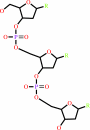 DNA(n)
|
+
|
2'-deoxyribonucleoside 5'-triphosphate
|
=
|
DNA(n+1)
|
+
|
 diphosphate
|
|
|
|
|
|
|
|
|
|
|
|
|
Molecule diagrams generated from .mol files obtained from the
KEGG ftp site
|
|
|
|
|
|
|
|
|
|
|
|
|
|
 |
|
|
|
|
|
|
| |
|
|
| |
|
DOI no:
|
Proc Natl Acad Sci U S A
101:2265-2269
(2004)
|
|
PubMed id:
|
|
|
|
|
|
| |
|
Crystal structure of a benzo[a]pyrene diol epoxide adduct in a ternary complex with a DNA polymerase.
|
|
H.Ling,
J.M.Sayer,
B.S.Plosky,
H.Yagi,
F.Boudsocq,
R.Woodgate,
D.M.Jerina,
W.Yang.
|
|
|
|
|
| |
ABSTRACT
|
|
|
|
| |
|
|
The first occupation-associated cancers to be recognized were the sooty warts
(cancers of the scrotum) suffered by chimney sweeps in 18th century England. In
the 19th century, high incidences of skin cancers were noted among fuel industry
workers. By the early 20th century, malignant skin tumors were produced in
laboratory animals by repeatedly painting them with coal tar. The culprit in
coal tar that induces cancer was finally isolated in 1933 and determined to be
benzo[a]pyrene (BP), a polycyclic aromatic hydrocarbon. A residue of fuel and
tobacco combustion and frequently ingested by humans, BP is metabolized in
mammals to benzo[a]pyrene diol epoxide (BPDE), which forms covalent DNA adducts
and induces tumor growth. In the 70 yr since its isolation, BP has been the most
studied carcinogen. Yet, there has been no crystal structure of a BPDE DNA
adduct. We report here the crystal structure of a BPDE-adenine adduct
base-paired with thymine at a template-primer junction and complexed with the
lesion-bypass DNA polymerase Dpo4 and an incoming nucleotide. Two conformations
of the BPDE, one intercalated between base pairs and another solvent-exposed in
the major groove, are observed. The latter conformation, which can be stabilized
by organic solvents that reduce the dielectric constant, seems more favorable
for DNA replication by Dpo4. These structures also suggest a mechanism by which
mutations are generated during replication of DNA containing BPDE adducts.
|
|
|
|
|
|
| |
Selected figure(s)
|
|
|
|
| |
|
|

|
|

|
|
Figure 2.
Fig. 2. Crystal structures of BP-1 and BP-2. Dpo4 is
represented by a purple molecular surface, the DNA and the
incoming dATP are shown as blue sticks, and the PAH is
highlighted in yellow. The divalent cations (Ca^2+) are shown as
green spheres. The unpaired dAMP at the 3' end of the template
strand was added by the terminal deoxynucleotide transferase
(TdT) activity of Dpo4 that is common to archael D in B-like
polymerases (34) (Fig. 4, which is published as supporting
information on the PNAS web site). Figs. 2 and 3 were generated
by using RIBBONS and GRASP (35, 36).
|
|
Figure 3.
Fig. 3. Distortion of DNA by the BPDE adduct. (A)
Comparison of the crystal and NMR structures. The dA*·dT
and the surrounding base pairs including the replicating base
pair are shown as ball-and-stick models. The crystal structures
are shown with the F[o] - F[c] omit electron density maps
contoured at 1.0  in blue. The carbon,
oxygen, nitrogen, and phosphorus atoms are colored yellow, red,
blue, and purple, respectively. (B) Hydrogen bond formation at
dA*·dT and the adjacent replicating base pair
dT·dATP. Looking down the DNA helical axis, the two
layers of the base pair and the PAH adduct are shown, purple for
the replicating base pair, gold for the dA* adduct, and green
for its partner dT. The incoming nucleotide in BP-1 is in the
syn conformation. In the BP-2 complex, where the PAH is in the
major groove, the adenine base of the dA* is shifted to the
major groove, disrupting the normal hydrogen bonds with its
partner, dT. The location of a normal dA is modeled in gray. (C)
Stereo view of the overlay of the DNA structures from BP-1
(blue) and BP-2 (gold) after superimposition of the Dpo4
structures. With the PAH intercalated, the base pair ladder in
the BP-1 complex is shifted by one register compared with that
in the BP-2 complex. in blue. The carbon,
oxygen, nitrogen, and phosphorus atoms are colored yellow, red,
blue, and purple, respectively. (B) Hydrogen bond formation at
dA*·dT and the adjacent replicating base pair
dT·dATP. Looking down the DNA helical axis, the two
layers of the base pair and the PAH adduct are shown, purple for
the replicating base pair, gold for the dA* adduct, and green
for its partner dT. The incoming nucleotide in BP-1 is in the
syn conformation. In the BP-2 complex, where the PAH is in the
major groove, the adenine base of the dA* is shifted to the
major groove, disrupting the normal hydrogen bonds with its
partner, dT. The location of a normal dA is modeled in gray. (C)
Stereo view of the overlay of the DNA structures from BP-1
(blue) and BP-2 (gold) after superimposition of the Dpo4
structures. With the PAH intercalated, the base pair ladder in
the BP-1 complex is shifted by one register compared with that
in the BP-2 complex.
|
|
|
|
| |
Figures were
selected
by an automated process.
|
|
|
|
|
|
|
|
|
|
|
|
|
|
|
|
 |
 |
 |
|
Literature references that cite this PDB file's key reference
|
|
|
| |
PubMed id
|
|
Reference
|
|
|
|
|
|
J.D.Pata
(2010).
Structural diversity of the Y-family DNA polymerases.
|
| |
Biochim Biophys Acta,
1804,
1124-1135.
|
|
|
|
|
|
|
S.Obeid,
N.Blatter,
R.Kranaster,
A.Schnur,
K.Diederichs,
W.Welte,
and
A.Marx
(2010).
Replication through an abasic DNA lesion: structural basis for adenine selectivity.
|
| |
EMBO J,
29,
1738-1747.
|
|
|
PDB codes:
|
|
|
|
|
|
|
|
H.Zhang,
J.W.Beckman,
and
F.P.Guengerich
(2009).
Frameshift deletion by Sulfolobus solfataricus P2 DNA polymerase Dpo4 T239W is selective for purines and involves normal conformational change followed by slow phosphodiester bond formation.
|
| |
J Biol Chem,
284,
35144-35153.
|
|
|
|
|
|
|
H.Zhang,
R.L.Eoff,
I.D.Kozekov,
C.J.Rizzo,
M.Egli,
and
F.P.Guengerich
(2009).
Versatility of Y-family Sulfolobus solfataricus DNA polymerase Dpo4 in translesion synthesis past bulky N2-alkylguanine adducts.
|
| |
J Biol Chem,
284,
3563-3576.
|
|
|
PDB codes:
|
|
|
|
|
|
|
|
K.N.Kirouac,
and
H.Ling
(2009).
Structural basis of error-prone replication and stalling at a thymine base by human DNA polymerase iota.
|
| |
EMBO J,
28,
1644-1654.
|
|
|
PDB codes:
|
|
|
|
|
|
|
|
K.Y.Seo,
J.Yin,
P.Donthamsetti,
S.Chandani,
C.H.Lee,
and
E.L.Loechler
(2009).
Amino acid architecture that influences dNTP insertion efficiency in Y-family DNA polymerase V of E. coli.
|
| |
J Mol Biol,
392,
270-282.
|
|
|
|
|
|
|
L.S.Waters,
B.K.Minesinger,
M.E.Wiltrout,
S.D'Souza,
R.V.Woodruff,
and
G.C.Walker
(2009).
Eukaryotic translesion polymerases and their roles and regulation in DNA damage tolerance.
|
| |
Microbiol Mol Biol Rev,
73,
134-154.
|
|
|
|
|
|
|
O.Rechkoblit,
L.Malinina,
Y.Cheng,
N.E.Geacintov,
S.Broyde,
and
D.J.Patel
(2009).
Impact of conformational heterogeneity of OxoG lesions and their pairing partners on bypass fidelity by Y family polymerases.
|
| |
Structure,
17,
725-736.
|
|
|
PDB codes:
|
|
|
|
|
|
|
|
P.Xu,
L.Oum,
Y.C.Lee,
N.E.Geacintov,
and
S.Broyde
(2009).
Visualizing sequence-governed nucleotide selectivities and mutagenic consequences through a replicative cycle: processing of a bulky carcinogen N2-dG lesion in a Y-family DNA polymerase.
|
| |
Biochemistry,
48,
4677-4690.
|
|
|
|
|
|
|
R.L.Eoff,
R.Sanchez-Ponce,
and
F.P.Guengerich
(2009).
Conformational changes during nucleotide selection by Sulfolobus solfataricus DNA polymerase Dpo4.
|
| |
J Biol Chem,
284,
21090-21099.
|
|
|
|
|
|
|
S.M.Sherrer,
J.A.Brown,
L.R.Pack,
V.P.Jasti,
J.D.Fowler,
A.K.Basu,
and
Z.Suo
(2009).
Mechanistic studies of the bypass of a bulky single-base lesion catalyzed by a Y-family DNA polymerase.
|
| |
J Biol Chem,
284,
6379-6388.
|
|
|
|
|
|
|
S.Schneider,
S.Schorr,
and
T.Carell
(2009).
Crystal structure analysis of DNA lesion repair and tolerance mechanisms.
|
| |
Curr Opin Struct Biol,
19,
87-95.
|
|
|
|
|
|
|
J.W.Beckman,
Q.Wang,
and
F.P.Guengerich
(2008).
Kinetic analysis of correct nucleotide insertion by a Y-family DNA polymerase reveals conformational changes both prior to and following phosphodiester bond formation as detected by tryptophan fluorescence.
|
| |
J Biol Chem,
283,
36711-36723.
|
|
|
|
|
|
|
L.DeCarlo,
A.S.Gowda,
Z.Suo,
and
T.E.Spratt
(2008).
Formation of purine-purine mispairs by Sulfolobus solfataricus DNA polymerase IV.
|
| |
Biochemistry,
47,
8157-8164.
|
|
|
|
|
|
|
S.Broyde,
L.Wang,
O.Rechkoblit,
N.E.Geacintov,
and
D.J.Patel
(2008).
Lesion processing: high-fidelity versus lesion-bypass DNA polymerases.
|
| |
Trends Biochem Sci,
33,
209-219.
|
|
|
|
|
|
|
A.P.Silverman,
Q.Jiang,
M.F.Goodman,
and
E.T.Kool
(2007).
Steric and electrostatic effects in DNA synthesis by the SOS-induced DNA polymerases II and IV of Escherichia coli.
|
| |
Biochemistry,
46,
13874-13881.
|
|
|
|
|
|
|
J.Bauer,
G.Xing,
H.Yagi,
J.M.Sayer,
D.M.Jerina,
and
H.Ling
(2007).
A structural gap in Dpo4 supports mutagenic bypass of a major benzo[a]pyrene dG adduct in DNA through template misalignment.
|
| |
Proc Natl Acad Sci U S A,
104,
14905-14910.
|
|
|
PDB codes:
|
|
|
|
|
|
|
|
K.A.Fiala,
J.A.Brown,
H.Ling,
A.K.Kshetry,
J.Zhang,
J.S.Taylor,
W.Yang,
and
Z.Suo
(2007).
Mechanism of template-independent nucleotide incorporation catalyzed by a template-dependent DNA polymerase.
|
| |
J Mol Biol,
365,
590-602.
|
|
|
PDB code:
|
|
|
|
|
|
|
|
L.Wang,
X.Yu,
P.Hu,
S.Broyde,
and
Y.Zhang
(2007).
A water-mediated and substrate-assisted catalytic mechanism for Sulfolobus solfataricus DNA polymerase IV.
|
| |
J Am Chem Soc,
129,
4731-4737.
|
|
|
|
|
|
|
R.W.Maul,
S.K.Ponticelli,
J.M.Duzen,
and
M.D.Sutton
(2007).
Differential binding of Escherichia coli DNA polymerases to the beta-sliding clamp.
|
| |
Mol Microbiol,
65,
811-827.
|
|
|
|
|
|
|
W.Yang,
and
R.Woodgate
(2007).
What a difference a decade makes: insights into translesion DNA synthesis.
|
| |
Proc Natl Acad Sci U S A,
104,
15591-15598.
|
|
|
|
|
|
|
J.P.McDonald,
A.Hall,
D.Gasparutto,
J.Cadet,
J.Ballantyne,
and
R.Woodgate
(2006).
Novel thermostable Y-family polymerases: applications for the PCR amplification of damaged or ancient DNAs.
|
| |
Nucleic Acids Res,
34,
1102-1111.
|
|
|
|
|
|
|
L.Wang,
and
S.Broyde
(2006).
A new anti conformation for N-(deoxyguanosin-8-yl)-2-acetylaminofluorene (AAF-dG) allows Watson-Crick pairing in the Sulfolobus solfataricus P2 DNA polymerase IV (Dpo4).
|
| |
Nucleic Acids Res,
34,
785-795.
|
|
|
|
|
|
|
L.Zhang,
O.Rechkoblit,
L.Wang,
D.J.Patel,
R.Shapiro,
and
S.Broyde
(2006).
Mutagenic nucleotide incorporation and hindered translocation by a food carcinogen C8-dG adduct in Sulfolobus solfataricus P2 DNA polymerase IV (Dpo4): modeling and dynamics studies.
|
| |
Nucleic Acids Res,
34,
3326-3337.
|
|
|
|
|
|
|
O.Rechkoblit,
L.Malinina,
Y.Cheng,
V.Kuryavyi,
S.Broyde,
N.E.Geacintov,
and
D.J.Patel
(2006).
Stepwise translocation of Dpo4 polymerase during error-free bypass of an oxoG lesion.
|
| |
PLoS Biol,
4,
e11.
|
|
|
PDB codes:
|
|
|
|
|
|
|
|
V.K.Batra,
D.D.Shock,
R.Prasad,
W.A.Beard,
E.W.Hou,
L.C.Pedersen,
J.M.Sayer,
H.Yagi,
S.Kumar,
D.M.Jerina,
and
S.H.Wilson
(2006).
Structure of DNA polymerase beta with a benzo[c]phenanthrene diol epoxide-adducted template exhibits mutagenic features.
|
| |
Proc Natl Acad Sci U S A,
103,
17231-17236.
|
|
|
PDB code:
|
|
|
|
|
|
|
|
Y.Wang,
K.Arora,
and
T.Schlick
(2006).
Subtle but variable conformational rearrangements in the replication cycle of Sulfolobus solfataricus P2 DNA polymerase IV (Dpo4) may accommodate lesion bypass.
|
| |
Protein Sci,
15,
135-151.
|
|
|
|
|
|
|
D.S.Goodsell
(2004).
The molecular perspective: polycyclic aromatic hydrocarbons.
|
| |
Stem Cells,
22,
873-874.
|
|
|
|
|
|
|
O.Fleck,
and
P.Schär
(2004).
Translesion DNA synthesis: little fingers teach tolerance.
|
| |
Curr Biol,
14,
R389-R391.
|
|
|
|
|
|
The most recent references are shown first.
Citation data come partly from CiteXplore and partly
from an automated harvesting procedure. Note that this is likely to be
only a partial list as not all journals are covered by
either method. However, we are continually building up the citation data
so more and more references will be included with time.
Where a reference describes a PDB structure, the PDB
codes are
shown on the right.
|
|


 Links
Links


