 |
PDBsum entry 2ibk

|
|
|
|
|
|

|

|

|

|
|

|
|

|
|

|
|

|
|

|
|

|
|

|
|
|
 |

|

|
|
|
|
|
|
|
|
|
|
|
|
|
|
|
|
|
|
|
|
|
|
|
|
|
|
|
|
|
|
|
|
|
|
|
|
Transferase/DNA
|
PDB id
|
|
|
|
2ibk
|
|
|
|
|
|
|
|
|
|
|
|
|
|
|

|

|

|
|
|
|
|
|
|
|
 |
Contents |
 |
|
|
|
|
|
|
|
|
|
|
|
|
|
|
|
|
* Residue conservation analysis
|
|
|
|
|
|
|
|
|
|
|
Enzyme class:
|
|
E.C.2.7.7.7
- DNA-directed Dna polymerase.
|
|
|
|
|
|
|
Reaction:
|
|
DNA(n) + a 2'-deoxyribonucleoside 5'-triphosphate = DNA(n+1) + diphosphate
|
|
|
|
|
|
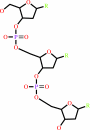 DNA(n)
|
+
|
2'-deoxyribonucleoside 5'-triphosphate
|
=
|
DNA(n+1)
Bound ligand (Het Group name = )
corresponds exactly
|
+
|
 diphosphate
|
|
|
|
|
|
|
|
|
|
|
|
|
Molecule diagrams generated from .mol files obtained from the
KEGG ftp site
|
|
|
|
|
|
|
|
|
|
|
|
|
|
 |
|
|
|
|
|
|
| |
|
|
| |
|
DOI no:
|
Proc Natl Acad Sci U S A
104:14905-14910
(2007)
|
|
PubMed id:
|
|
|
|
|
|
| |
|
A structural gap in Dpo4 supports mutagenic bypass of a major benzo[a]pyrene dG adduct in DNA through template misalignment.
|
|
J.Bauer,
G.Xing,
H.Yagi,
J.M.Sayer,
D.M.Jerina,
H.Ling.
|
|
|
|
|
| |
ABSTRACT
|
|
|
|
| |
|
|
Erroneous replication of lesions in DNA by DNA polymerases leads to elevated
mutagenesis. To understand the molecular basis of DNA damage-induced
mutagenesis, we have determined the x-ray structures of the Y-family polymerase,
Dpo4, in complex with a DNA substrate containing a bulky DNA lesion and incoming
nucleotides. The DNA lesion is derived from an environmentally widespread
carcinogenic polycyclic aromatic hydrocarbon, benzo[a]pyrene (BP). The potent
carcinogen BP is metabolized to diol epoxides that form covalent adducts with
cellular DNA. In the present study, the major BP diol epoxide adduct in DNA,
BP-N(2)-deoxyguanosine (BP-dG), was placed at a template-primer junction. Three
ternary complexes reveal replication blockage, extension past a mismatched
lesion, and a -1 frameshift mutation. In the productive structures, the bulky
adduct is flipped/looped out of the DNA helix into a structural gap between the
little finger and core domains. Sequestering of the hydrophobic BP adduct in
this new substrate-binding site permits the DNA to exhibit normal geometry for
primer extension. Extrusion of the lesion by template misalignment allows the
base 5' to the adduct to serve as the template, resulting in a -1 frameshift.
Subsequent strand realignment produces a mismatched base opposite the lesion.
These structural observations, in combination with replication and mutagenesis
data, suggest a model in which the additional substrate-binding site stabilizes
the extrahelical nucleotide for lesion bypass and generation of base
substitutions and -1 frameshift mutations.
|
|
|
|
|
|
| |
Selected figure(s)
|
|
|
|
| |
|
|

|
|

|
|
Figure 2.
Structures of BPG-1A, BPG-1B and BPG-2. (A–C) Dpo4 is
represented as a molecular surface with the polymerase core in
cyan and the LF domain in purple; DNA and nucleotide are shown
as sticks, and BP–dG is highlighted in orange. BPG-1B and
BPG-2 in B and C are rotated 180° relative to BPG-1A in A
around the DNA helix axis, to show the extrahelical BP–dG in
the gap between the core and LF domains. (D–F) The DNA
conformations corresponding to (A–C) as stick models, all with
the same orientations as in A. The primer strands are in gray,
and incoming dATP is in pink. The single-stranded portion of the
template DNA is not shown. Figs. 2, 3, and 4 were generated by
using PYMOL (46).
|
|
Figure 4.
Close-up views of BP–dG in the structure gap between the
core and the LF domains. (A) BPG-1B. (B) BPG-2. The protein is
in ribbon models covered by a transparent molecular surface. The
key residues interacting with the adduct G* are shown as stick
models. The BP ring system is in van der Waals contact with the
LF domain (purple); the adducted G base interacts with the core
domain (cyan). The glycerol molecule is in gray.
|
|
|
|
| |
Figures were
selected
by an automated process.
|
|
|
|
|
|
|
|
|
|
|
|
|
|
|
|
 |
 |
 |
|
Literature references that cite this PDB file's key reference
|
|
|
| |
PubMed id
|
|
Reference
|
|
|
|
|
|
J.E.Sale,
A.R.Lehmann,
and
R.Woodgate
(2012).
Y-family DNA polymerases and their role in tolerance of cellular DNA damage.
|
| |
Nat Rev Mol Cell Biol,
13,
141-152.
|
|
|
|
|
|
|
C.Biertümpfel,
Y.Zhao,
Y.Kondo,
S.Ramón-Maiques,
M.Gregory,
J.Y.Lee,
C.Masutani,
A.R.Lehmann,
F.Hanaoka,
and
W.Yang
(2010).
Structure and mechanism of human DNA polymerase eta.
|
| |
Nature,
465,
1044-1048.
|
|
|
PDB codes:
|
|
|
|
|
|
|
|
G.Shanmugam,
I.D.Kozekov,
F.P.Guengerich,
C.J.Rizzo,
and
M.P.Stone
(2010).
Structure of the 1,N(2)-etheno-2'-deoxyguanosine lesion in the 3'-G(epsilon dG)T-5' sequence opposite a one-base deletion.
|
| |
Biochemistry,
49,
2615-2626.
|
|
|
PDB code:
|
|
|
|
|
|
|
|
J.D.Pata
(2010).
Structural diversity of the Y-family DNA polymerases.
|
| |
Biochim Biophys Acta,
1804,
1124-1135.
|
|
|
|
|
|
|
O.Rechkoblit,
A.Kolbanovskiy,
L.Malinina,
N.E.Geacintov,
S.Broyde,
and
D.J.Patel
(2010).
Mechanism of error-free and semitargeted mutagenic bypass of an aromatic amine lesion by Y-family polymerase Dpo4.
|
| |
Nat Struct Mol Biol,
17,
379-388.
|
|
|
PDB codes:
|
|
|
|
|
|
|
|
S.Chandani,
C.Jacobs,
and
E.L.Loechler
(2010).
Architecture of y-family DNA polymerases relevant to translesion DNA synthesis as revealed in structural and molecular modeling studies.
|
| |
J Nucleic Acids,
2010,
0.
|
|
|
|
|
|
|
H.Zhang,
J.W.Beckman,
and
F.P.Guengerich
(2009).
Frameshift deletion by Sulfolobus solfataricus P2 DNA polymerase Dpo4 T239W is selective for purines and involves normal conformational change followed by slow phosphodiester bond formation.
|
| |
J Biol Chem,
284,
35144-35153.
|
|
|
|
|
|
|
H.Zhang,
R.L.Eoff,
I.D.Kozekov,
C.J.Rizzo,
M.Egli,
and
F.P.Guengerich
(2009).
Versatility of Y-family Sulfolobus solfataricus DNA polymerase Dpo4 in translesion synthesis past bulky N2-alkylguanine adducts.
|
| |
J Biol Chem,
284,
3563-3576.
|
|
|
PDB codes:
|
|
|
|
|
|
|
|
K.N.Kirouac,
and
H.Ling
(2009).
Structural basis of error-prone replication and stalling at a thymine base by human DNA polymerase iota.
|
| |
EMBO J,
28,
1644-1654.
|
|
|
PDB codes:
|
|
|
|
|
|
|
|
K.Y.Seo,
J.Yin,
P.Donthamsetti,
S.Chandani,
C.H.Lee,
and
E.L.Loechler
(2009).
Amino acid architecture that influences dNTP insertion efficiency in Y-family DNA polymerase V of E. coli.
|
| |
J Mol Biol,
392,
270-282.
|
|
|
|
|
|
|
O.Rechkoblit,
L.Malinina,
Y.Cheng,
N.E.Geacintov,
S.Broyde,
and
D.J.Patel
(2009).
Impact of conformational heterogeneity of OxoG lesions and their pairing partners on bypass fidelity by Y family polymerases.
|
| |
Structure,
17,
725-736.
|
|
|
PDB codes:
|
|
|
|
|
|
|
|
P.Xu,
L.Oum,
Y.C.Lee,
N.E.Geacintov,
and
S.Broyde
(2009).
Visualizing sequence-governed nucleotide selectivities and mutagenic consequences through a replicative cycle: processing of a bulky carcinogen N2-dG lesion in a Y-family DNA polymerase.
|
| |
Biochemistry,
48,
4677-4690.
|
|
|
|
|
|
|
S.Chandani,
and
E.L.Loechler
(2009).
Y-Family DNA polymerases may use two different dNTP shapes for insertion: a hypothesis and its implications.
|
| |
J Mol Graph Model,
27,
759-769.
|
|
|
|
|
|
|
S.M.Sherrer,
J.A.Brown,
L.R.Pack,
V.P.Jasti,
J.D.Fowler,
A.K.Basu,
and
Z.Suo
(2009).
Mechanistic studies of the bypass of a bulky single-base lesion catalyzed by a Y-family DNA polymerase.
|
| |
J Biol Chem,
284,
6379-6388.
|
|
|
|
|
|
|
S.Schneider,
S.Schorr,
and
T.Carell
(2009).
Crystal structure analysis of DNA lesion repair and tolerance mechanisms.
|
| |
Curr Opin Struct Biol,
19,
87-95.
|
|
|
|
|
|
|
L.Jia,
N.E.Geacintov,
and
S.Broyde
(2008).
The N-clasp of human DNA polymerase kappa promotes blockage or error-free bypass of adenine- or guanine-benzo[a]pyrenyl lesions.
|
| |
Nucleic Acids Res,
36,
6571-6584.
|
|
|
|
|
|
|
S.Broyde,
L.Wang,
O.Rechkoblit,
N.E.Geacintov,
and
D.J.Patel
(2008).
Lesion processing: high-fidelity versus lesion-bypass DNA polymerases.
|
| |
Trends Biochem Sci,
33,
209-219.
|
|
|
|
|
|
|
Y.Wang,
N.C.Schnetz-Boutaud,
H.Kroth,
H.Yagi,
J.M.Sayer,
S.Kumar,
D.M.Jerina,
and
M.P.Stone
(2008).
3'-Intercalation of a N2-dG 1R-trans-anti-benzo[c]phenanthrene DNA adduct in an iterated (CG)3 repeat.
|
| |
Chem Res Toxicol,
21,
1348-1358.
|
|
|
PDB code:
|
|
|
|
|
|
|
The most recent references are shown first.
Citation data come partly from CiteXplore and partly
from an automated harvesting procedure. Note that this is likely to be
only a partial list as not all journals are covered by
either method. However, we are continually building up the citation data
so more and more references will be included with time.
Where a reference describes a PDB structure, the PDB
codes are
shown on the right.
|
|


 Links
Links


