 |
PDBsum entry 1n49

|
|
|
|
|
|

|

|

|

|
|

|
|

|
|

|
|

|
|

|
|
|
 |

|

|
|
|
|
|
|
|
|
|
|
|
|
|
|
|
|
|
|
|
|
|
|
|
|
|
|
|
|
|
|
|
|
|
|
Hydrolase/hydrolase inhibitor
|
PDB id
|
|
|
|
1n49
|
|
|
|
|
|
|
|
|
|
|
|
|
|
|

|

|

|
|
|
|
|
|
|
|
 |
Contents |
 |
|
|
|
|
|
|
|
|
|
|
|
|
* Residue conservation analysis
|
|
|
|
|
|
|
|
|
|
|
Enzyme class 1:
|
|
E.C.2.7.7.-
- ?????
|
|
|
|
|
|
|
Enzyme class 2:
|
|
E.C.2.7.7.49
- RNA-directed Dna polymerase.
|
|
|
|
|
|
|
Reaction:
|
|
DNA(n) + a 2'-deoxyribonucleoside 5'-triphosphate = DNA(n+1) + diphosphate
|
|
|
|
|
|
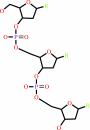 DNA(n)
|
+
|
2'-deoxyribonucleoside 5'-triphosphate
|
=
|
DNA(n+1)
|
+
|
 diphosphate
|
|
|
|
|
|
|
|
|
|
Enzyme class 3:
|
|
E.C.2.7.7.7
- DNA-directed Dna polymerase.
|
|
|
|
|
|
|
Reaction:
|
|
DNA(n) + a 2'-deoxyribonucleoside 5'-triphosphate = DNA(n+1) + diphosphate
|
|
|
|
|
|
DNA(n)
|
+
|
2'-deoxyribonucleoside 5'-triphosphate
|
=
|
DNA(n+1)
|
+
|
diphosphate
|
|
|
|
|
|
|
|
|
|
Enzyme class 4:
|
|
E.C.3.1.-.-
|
|
|
|
|
|
|
Enzyme class 5:
|
|
E.C.3.1.13.2
- exoribonuclease H.
|
|
|
|
|
|
|
Reaction:
|
|
Exonucleolytic cleavage to 5'-phosphomonoester oligonucleotides in both 5'- to 3'- and 3'- to 5'-directions.
|
|
|
|
|
|
Enzyme class 6:
|
|
E.C.3.1.26.13
- retroviral ribonuclease H.
|
|
|
|
|
|
|
Enzyme class 7:
|
|
E.C.3.4.23.16
- HIV-1 retropepsin.
|
|
|
|
|
|
|
Reaction:
|
|
Specific for a P1 residue that is hydrophobic, and P1' variable, but often Pro.
|
|
|
|
|
|
|
|
|
Note, where more than one E.C. class is given (as above), each may
correspond to a different protein domain or, in the case of polyprotein
precursors, to a different mature protein.
|
|
|
|
Molecule diagrams generated from .mol files obtained from the
KEGG ftp site
|
|
|
|
|
|
|
|
|
|
|
|
|
|
 |
|
|
|
|
|
|
| |
|
|
| |
|
|
J Virol
77:1306-1315
(2003)
|
|
PubMed id:
|
|
|
|
|
|
| |
|
Viability of a drug-resistant human immunodeficiency virus type 1 protease variant: structural insights for better antiviral therapy.
|
|
M.Prabu-Jeyabalan,
E.A.Nalivaika,
N.M.King,
C.A.Schiffer.
|
|
|
|
|
| |
ABSTRACT
|
|
|
|
| |
|
|
Under the selective pressure of protease inhibitor therapy, patients infected
with human immunodeficiency virus (HIV) often develop drug-resistant HIV
strains. One of the first drug-resistant mutations to arise in the protease,
particularly in patients receiving indinavir or ritonavir treatment, is V82A,
which compromises the binding of these and other inhibitors but allows the virus
to remain viable. To probe this drug resistance, we solved the crystal
structures of three natural substrates and two commercial drugs in complex with
an inactive drug-resistant mutant (D25N/V82A) HIV-1 protease. Through structural
analysis and comparison of the protein-ligand interactions, we found that Val82
interacts more closely with the drugs than with the natural substrate peptides.
The V82A mutation compromises these interactions with the drugs while not
greatly affecting the substrate interactions, which is consistent with
previously published kinetic data. Coupled with our earlier observations, these
findings suggest that future inhibitor design may reduce the probability of the
appearance of drug-resistant mutations by targeting residues that are essential
for substrate recognition.
|
|
|
|
|
|
|
|
|
|
|
|
|
|
|
|
|
|
 |
 |
 |
|
Literature references that cite this PDB file's key reference
|
|
|
| |
PubMed id
|
|
Reference
|
|
|
|
|
|
A.S.Reddy,
V.Jalahalli,
S.Kumar,
R.Garg,
X.Zhang,
and
G.N.Sastry
(2011).
Analysis of HIV protease binding pockets based on 3D shape and electrostatic potential descriptors.
|
| |
Chem Biol Drug Des,
77,
137-151.
|
|
|
|
|
|
|
J.P.Yesudas,
F.B.Sayyed,
and
C.H.Suresh
(2011).
Analysis of structural water and CH···π interactions in HIV-1 protease and PTP1B complexes using a hydrogen bond prediction tool, HBPredicT.
|
| |
J Mol Model,
17,
401-413.
|
|
|
|
|
|
|
S.K.Sadiq,
and
G.De Fabritiis
(2010).
Explicit solvent dynamics and energetics of HIV-1 protease flap opening and closing.
|
| |
Proteins,
78,
2873-2885.
|
|
|
|
|
|
|
Y.Cai,
and
C.A.Schiffer
(2010).
Decomposing the energetic impact of drug resistant mutations in HIV-1 protease on binding DRV.
|
| |
J Chem Theory Comput,
6,
1358-1368.
|
|
|
|
|
|
|
P.M.Colman
(2009).
New antivirals and drug resistance.
|
| |
Annu Rev Biochem,
78,
95.
|
|
|
|
|
|
|
S.Bihani,
A.Das,
V.Prashar,
J.L.Ferrer,
and
M.V.Hosur
(2009).
X-ray structure of HIV-1 protease in situ product complex.
|
| |
Proteins,
74,
594-602.
|
|
|
PDB code:
|
|
|
|
|
|
|
|
E.Lefebvre,
and
C.A.Schiffer
(2008).
Resilience to resistance of HIV-1 protease inhibitors: profile of darunavir.
|
| |
AIDS Rev,
10,
131-142.
|
|
|
|
|
|
|
M.D.Altman,
E.A.Nalivaika,
M.Prabu-Jeyabalan,
C.A.Schiffer,
and
B.Tidor
(2008).
Computational design and experimental study of tighter binding peptides to an inactivated mutant of HIV-1 protease.
|
| |
Proteins,
70,
678-694.
|
|
|
PDB codes:
|
|
|
|
|
|
|
|
M.N.Nalam,
and
C.A.Schiffer
(2008).
New approaches to HIV protease inhibitor drug design II: testing the substrate envelope hypothesis to avoid drug resistance and discover robust inhibitors.
|
| |
Curr Opin HIV AIDS,
3,
642-646.
|
|
|
|
|
|
|
A.Y.Kovalevsky,
A.A.Chumanevich,
F.Liu,
J.M.Louis,
and
I.T.Weber
(2007).
Caught in the Act: the 1.5 A resolution crystal structures of the HIV-1 protease and the I54V mutant reveal a tetrahedral reaction intermediate.
|
| |
Biochemistry,
46,
14854-14864.
|
|
|
PDB codes:
|
|
|
|
|
|
|
|
H.E.Klei,
K.Kish,
P.F.Lin,
Q.Guo,
J.Friborg,
R.E.Rose,
Y.Zhang,
V.Goldfarb,
D.R.Langley,
M.Wittekind,
and
S.Sheriff
(2007).
X-ray crystal structures of human immunodeficiency virus type 1 protease mutants complexed with atazanavir.
|
| |
J Virol,
81,
9525-9535.
|
|
|
PDB codes:
|
|
|
|
|
|
|
|
H.Heaslet,
R.Rosenfeld,
M.Giffin,
Y.C.Lin,
K.Tam,
B.E.Torbett,
J.H.Elder,
D.E.McRee,
and
C.D.Stout
(2007).
Conformational flexibility in the flap domains of ligand-free HIV protease.
|
| |
Acta Crystallogr D Biol Crystallogr,
63,
866-875.
|
|
|
PDB codes:
|
|
|
|
|
|
|
|
M.N.Nalam,
A.Peeters,
T.H.Jonckers,
I.Dierynck,
and
C.A.Schiffer
(2007).
Crystal structure of lysine sulfonamide inhibitor reveals the displacement of the conserved flap water molecule in human immunodeficiency virus type 1 protease.
|
| |
J Virol,
81,
9512-9518.
|
|
|
PDB code:
|
|
|
|
|
|
|
|
S.Chellappan,
G.S.Kiran Kumar Reddy,
A.Ali,
M.N.Nalam,
S.G.Anjum,
H.Cao,
V.Kairys,
M.X.Fernandes,
M.D.Altman,
B.Tidor,
T.M.Rana,
C.A.Schiffer,
and
M.K.Gilson
(2007).
Design of mutation-resistant HIV protease inhibitors with the substrate envelope hypothesis.
|
| |
Chem Biol Drug Des,
69,
298-313.
|
|
|
PDB codes:
|
|
|
|
|
|
|
|
S.Chellappan,
V.Kairys,
M.X.Fernandes,
C.Schiffer,
and
M.K.Gilson
(2007).
Evaluation of the substrate envelope hypothesis for inhibitors of HIV-1 protease.
|
| |
Proteins,
68,
561-567.
|
|
|
|
|
|
|
Y.Tie,
A.Y.Kovalevsky,
P.Boross,
Y.F.Wang,
A.K.Ghosh,
J.Tozser,
R.W.Harrison,
and
I.T.Weber
(2007).
Atomic resolution crystal structures of HIV-1 protease and mutants V82A and I84V with saquinavir.
|
| |
Proteins,
67,
232-242.
|
|
|
PDB codes:
|
|
|
|
|
|
|
|
J.E.Foulkes,
M.Prabu-Jeyabalan,
D.Cooper,
G.J.Henderson,
J.Harris,
R.Swanstrom,
and
C.A.Schiffer
(2006).
Role of invariant Thr80 in human immunodeficiency virus type 1 protease structure, function, and viral infectivity.
|
| |
J Virol,
80,
6906-6916.
|
|
|
PDB codes:
|
|
|
|
|
|
|
|
M.Prabu-Jeyabalan,
E.A.Nalivaika,
K.Romano,
and
C.A.Schiffer
(2006).
Mechanism of substrate recognition by drug-resistant human immunodeficiency virus type 1 protease variants revealed by a novel structural intermediate.
|
| |
J Virol,
80,
3607-3616.
|
|
|
PDB codes:
|
|
|
|
|
|
|
|
M.Prabu-Jeyabalan,
N.M.King,
E.A.Nalivaika,
G.Heilek-Snyder,
N.Cammack,
and
C.A.Schiffer
(2006).
Substrate envelope and drug resistance: crystal structure of RO1 in complex with wild-type human immunodeficiency virus type 1 protease.
|
| |
Antimicrob Agents Chemother,
50,
1518-1521.
|
|
|
PDB code:
|
|
|
|
|
|
|
|
F.Bouchonnet,
E.Dam,
F.Mammano,
V.de Soultrait,
G.Henneré,
H.Benech,
F.Clavel,
and
A.J.Hance
(2005).
Quantification of the effects on viral DNA synthesis of reverse transcriptase mutations conferring human immunodeficiency virus type 1 resistance to nucleoside analogues.
|
| |
J Virol,
79,
812-822.
|
|
|
|
|
|
|
K.Gendron,
D.Dulude,
G.Lemay,
G.Ferbeyre,
and
L.Brakier-Gingras
(2005).
The virion-associated Gag-Pol is decreased in chimeric Moloney murine leukemia viruses in which the readthrough region is replaced by the frameshift region of the human immunodeficiency virus type 1.
|
| |
Virology,
334,
342-352.
|
|
|
|
|
|
|
K.Wittayanarakul,
O.Aruksakunwong,
S.Saen-oon,
W.Chantratita,
V.Parasuk,
P.Sompornpisut,
and
S.Hannongbua
(2005).
Insights into saquinavir resistance in the G48V HIV-1 protease: quantum calculations and molecular dynamic simulations.
|
| |
Biophys J,
88,
867-879.
|
|
|
|
|
|
|
P.Martin,
J.F.Vickrey,
G.Proteasa,
Y.L.Jimenez,
Z.Wawrzak,
M.A.Winters,
T.C.Merigan,
and
L.C.Kovari
(2005).
"Wide-open" 1.3 A structure of a multidrug-resistant HIV-1 protease as a drug target.
|
| |
Structure,
13,
1887-1895.
|
|
|
PDB code:
|
|
|
|
|
|
|
|
Y.Tie,
P.I.Boross,
Y.F.Wang,
L.Gaddis,
F.Liu,
X.Chen,
J.Tozser,
R.W.Harrison,
and
I.T.Weber
(2005).
Molecular basis for substrate recognition and drug resistance from 1.1 to 1.6 angstroms resolution crystal structures of HIV-1 protease mutants with substrate analogs.
|
| |
FEBS J,
272,
5265-5277.
|
|
|
PDB codes:
|
|
|
|
|
|
|
|
B.C.Logsdon,
J.F.Vickrey,
P.Martin,
G.Proteasa,
J.I.Koepke,
S.R.Terlecky,
Z.Wawrzak,
M.A.Winters,
T.C.Merigan,
and
L.C.Kovari
(2004).
Crystal structures of a multidrug-resistant human immunodeficiency virus type 1 protease reveal an expanded active-site cavity.
|
| |
J Virol,
78,
3123-3132.
|
|
|
PDB codes:
|
|
|
|
|
|
|
|
B.Mahalingam,
Y.F.Wang,
P.I.Boross,
J.Tozser,
J.M.Louis,
R.W.Harrison,
and
I.T.Weber
(2004).
Crystal structures of HIV protease V82A and L90M mutants reveal changes in the indinavir-binding site.
|
| |
Eur J Biochem,
271,
1516-1524.
|
|
|
PDB codes:
|
|
|
|
|
|
|
|
C.Charpentier,
D.E.Dwyer,
F.Mammano,
D.Lecossier,
F.Clavel,
and
A.J.Hance
(2004).
Role of minority populations of human immunodeficiency virus type 1 in the evolution of viral resistance to protease inhibitors.
|
| |
J Virol,
78,
4234-4247.
|
|
|
|
|
|
|
M.Prabu-Jeyabalan,
E.A.Nalivaika,
N.M.King,
and
C.A.Schiffer
(2004).
Structural basis for coevolution of a human immunodeficiency virus type 1 nucleocapsid-p1 cleavage site with a V82A drug-resistant mutation in viral protease.
|
| |
J Virol,
78,
12446-12454.
|
|
|
PDB codes:
|
|
|
|
|
|
|
|
N.M.King,
M.Prabu-Jeyabalan,
E.A.Nalivaika,
and
C.A.Schiffer
(2004).
Combating susceptibility to drug resistance: lessons from HIV-1 protease.
|
| |
Chem Biol,
11,
1333-1338.
|
|
|
|
|
|
|
N.M.King,
M.Prabu-Jeyabalan,
E.A.Nalivaika,
P.Wigerinck,
M.P.de Béthune,
and
C.A.Schiffer
(2004).
Structural and thermodynamic basis for the binding of TMC114, a next-generation human immunodeficiency virus type 1 protease inhibitor.
|
| |
J Virol,
78,
12012-12021.
|
|
|
|
|
|
The most recent references are shown first.
Citation data come partly from CiteXplore and partly
from an automated harvesting procedure. Note that this is likely to be
only a partial list as not all journals are covered by
either method. However, we are continually building up the citation data
so more and more references will be included with time.
Where a reference describes a PDB structure, the PDB
code is
shown on the right.
|
|


 Links
Links


