 |
PDBsum entry 1hsg

|
|
|
|
|
|

|

|

|

|
|

|
|

|
|

|
|

|
|

|
|

|
|
|
 |

|

|
|
|
|
|
|
|
|
|
|
|
|
|
|
|
|
|
|
|
|
|
|
|
|
|
|
|
|
|
|
|
|
|
|
|
Hydrolase (acid proteinase)
|
PDB id
|
|
|
|
1hsg
|
|
|
|
|
|
|
|
|
|
|
|
|
|
|

|

|

|
|
|
|
|
|
|
|
 |
Contents |
 |
|
|
|
|
|
|
|
|
|
|
|
|
* Residue conservation analysis
|
|
|
|
|
|
|
|
|
|
|
Enzyme class 1:
|
|
E.C.2.7.7.-
- ?????
|
|
|
|
|
|
|
Enzyme class 2:
|
|
E.C.2.7.7.49
- RNA-directed Dna polymerase.
|
|
|
|
|
|
|
Reaction:
|
|
DNA(n) + a 2'-deoxyribonucleoside 5'-triphosphate = DNA(n+1) + diphosphate
|
|
|
|
|
|
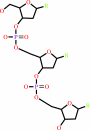 DNA(n)
|
+
|
2'-deoxyribonucleoside 5'-triphosphate
|
=
|
DNA(n+1)
|
+
|
 diphosphate
|
|
|
|
|
|
|
|
|
|
Enzyme class 3:
|
|
E.C.2.7.7.7
- DNA-directed Dna polymerase.
|
|
|
|
|
|
|
Reaction:
|
|
DNA(n) + a 2'-deoxyribonucleoside 5'-triphosphate = DNA(n+1) + diphosphate
|
|
|
|
|
|
DNA(n)
|
+
|
2'-deoxyribonucleoside 5'-triphosphate
|
=
|
DNA(n+1)
|
+
|
diphosphate
|
|
|
|
|
|
|
|
|
|
Enzyme class 4:
|
|
E.C.3.1.-.-
|
|
|
|
|
|
|
Enzyme class 5:
|
|
E.C.3.1.13.2
- exoribonuclease H.
|
|
|
|
|
|
|
Reaction:
|
|
Exonucleolytic cleavage to 5'-phosphomonoester oligonucleotides in both 5'- to 3'- and 3'- to 5'-directions.
|
|
|
|
|
|
Enzyme class 6:
|
|
E.C.3.1.26.13
- retroviral ribonuclease H.
|
|
|
|
|
|
|
Enzyme class 7:
|
|
E.C.3.4.23.16
- HIV-1 retropepsin.
|
|
|
|
|
|
|
Reaction:
|
|
Specific for a P1 residue that is hydrophobic, and P1' variable, but often Pro.
|
|
|
|
|
|
|
|
|
Note, where more than one E.C. class is given (as above), each may
correspond to a different protein domain or, in the case of polyprotein
precursors, to a different mature protein.
|
|
|
|
Molecule diagrams generated from .mol files obtained from the
KEGG ftp site
|
|
|
|
|
|
|
|
|
|
|
|
|
|
 |
|
|
|
|
|
|
| |
|
|
| |
|
|
J Biol Chem
269:26344-26348
(1994)
|
|
PubMed id:
|
|
|
|
|
|
| |
|
Crystal structure at 1.9-A resolution of human immunodeficiency virus (HIV) II protease complexed with L-735,524, an orally bioavailable inhibitor of the HIV proteases.
|
|
Z.Chen,
Y.Li,
E.Chen,
D.L.Hall,
P.L.Darke,
C.Culberson,
J.A.Shafer,
L.C.Kuo.
|
|
|
|
|
| |
ABSTRACT
|
|
|
|
| |
|
|
L-735,524 is a potent, orally bioavailable inhibitor of human immunodeficiency
virus (HIV) protease currently in a Phase II clinical trial. We report here the
three-dimensional structure of L-735,524 complexed to HIV-2 protease at 1.9-A
resolution, as well as the structure of the native HIV-2 protease at 2.5-A
resolution. The structure of HIV-2 protease is found to be essentially identical
to that of HIV-1 protease. In the crystal lattice of the HIV-2 protease
complexed with L-735,524, the inhibitor is chelated to the active site of the
homodimeric enzyme in one orientation. This feature allows an unambiguous
assignment of protein-ligand interactions from the electron density map. Both
Fourier and difference Fourier maps reveal clearly the closure of the flap
domains of the protease upon L-735,524 binding. Specific interactions between
the enzyme and the inhibitor include the hydroxy group of the
hydroxyaminopentane amide moiety of L-735,524 ligating to the carboxyl groups of
the essential Asp-25 and Asp-25' enzymic residues and the amide oxygens of the
inhibitor hydrogen bonding to the backbone amide nitrogen of Ile-50 and Ile-50'
via an intervening water molecule. A second bridging water molecule is found
between the amide nitrogen N2 of L-735,524 and the carboxyl oxygen of Asp-29'.
Although other hydrogen bonds also add to binding, an equally significant
contribution to affinity arises from hydrophobic interactions between the
protease and the inhibitor throughout the pseudo-symmetric S1/S1', S2/S2', and
S3/S3' regions of the enzyme. Except for its pyridine ring, all lipophilic
moieties (t-butyl, indanyl, benzyl, and piperidyl) of L-735,524 are rigidly
defined in the active site.
|
|
|
|
|
|
|
|
|
|
|
|
|
|
|
|
|
|
 |
 |
 |
|
Literature references that cite this PDB file's key reference
|
|
|
| |
PubMed id
|
|
Reference
|
|
|
|
|
|
K.M.Merz
(2010).
Limits of Free Energy Computation for Protein-Ligand Interactions.
|
| |
J Chem Theory Comput,
6,
1018-1027.
|
|
|
|
|
|
|
S.Brouillet,
T.Valere,
E.Ollivier,
L.Marsan,
and
A.Vanet
(2010).
Co-lethality studied as an asset against viral drug escape: the HIV protease case.
|
| |
Biol Direct,
5,
40.
|
|
|
|
|
|
|
J.M.Louis,
R.Ishima,
A.Aniana,
and
J.M.Sayer
(2009).
Revealing the dimer dissociation and existence of a folded monomer of the mature HIV-2 protease.
|
| |
Protein Sci,
18,
2442-2453.
|
|
|
|
|
|
|
M.Arenas,
M.C.Villaverde,
and
F.Sussman
(2009).
Prediction and analysis of binding affinities for chemically diverse HIV-1 PR inhibitors by the modified SAFE_p approach.
|
| |
J Comput Chem,
30,
1229-1240.
|
|
|
|
|
|
|
T.Kamenecka,
J.Habel,
D.Duckett,
W.Chen,
Y.Y.Ling,
B.Frackowiak,
R.Jiang,
Y.Shin,
X.Song,
and
P.LoGrasso
(2009).
Structure-activity relationships and X-ray structures describing the selectivity of aminopyrazole inhibitors for c-Jun N-terminal kinase 3 (JNK3) over p38.
|
| |
J Biol Chem,
284,
12853-12861.
|
|
|
PDB codes:
|
|
|
|
|
|
|
|
A.Y.Kovalevsky,
J.M.Louis,
A.Aniana,
A.K.Ghosh,
and
I.T.Weber
(2008).
Structural evidence for effectiveness of darunavir and two related antiviral inhibitors against HIV-2 protease.
|
| |
J Mol Biol,
384,
178-192.
|
|
|
PDB codes:
|
|
|
|
|
|
|
|
E.Lefebvre,
and
C.A.Schiffer
(2008).
Resilience to resistance of HIV-1 protease inhibitors: profile of darunavir.
|
| |
AIDS Rev,
10,
131-142.
|
|
|
|
|
|
|
G.Verkhivker,
G.Tiana,
C.Camilloni,
D.Provasi,
and
R.A.Broglia
(2008).
Atomistic simulations of the HIV-1 protease folding inhibition.
|
| |
Biophys J,
95,
550-562.
|
|
|
|
|
|
|
K.Wittayanarakul,
S.Hannongbua,
and
M.Feig
(2008).
Accurate prediction of protonation state as a prerequisite for reliable MM-PB(GB)SA binding free energy calculations of HIV-1 protease inhibitors.
|
| |
J Comput Chem,
29,
673-685.
|
|
|
|
|
|
|
M.N.Nalam,
and
C.A.Schiffer
(2008).
New approaches to HIV protease inhibitor drug design II: testing the substrate envelope hypothesis to avoid drug resistance and discover robust inhibitors.
|
| |
Curr Opin HIV AIDS,
3,
642-646.
|
|
|
|
|
|
|
T.Hou,
W.A.McLaughlin,
and
W.Wang
(2008).
Evaluating the potency of HIV-1 protease drugs to combat resistance.
|
| |
Proteins,
71,
1163-1174.
|
|
|
|
|
|
|
S.Chellappan,
V.Kairys,
M.X.Fernandes,
C.Schiffer,
and
M.K.Gilson
(2007).
Evaluation of the substrate envelope hypothesis for inhibitors of HIV-1 protease.
|
| |
Proteins,
68,
561-567.
|
|
|
|
|
|
|
S.Muzammil,
A.A.Armstrong,
L.W.Kang,
A.Jakalian,
P.R.Bonneau,
V.Schmelmer,
L.M.Amzel,
and
E.Freire
(2007).
Unique thermodynamic response of tipranavir to human immunodeficiency virus type 1 protease drug resistance mutations.
|
| |
J Virol,
81,
5144-5154.
|
|
|
PDB codes:
|
|
|
|
|
|
|
|
E.Specker,
J.Böttcher,
S.Brass,
A.Heine,
H.Lilie,
A.Schoop,
G.Müller,
N.Griebenow,
and
G.Klebe
(2006).
Unexpected novel binding mode of pyrrolidine-based aspartyl protease inhibitors: design, synthesis and crystal structure in complex with HIV protease.
|
| |
ChemMedChem,
1,
106-117.
|
|
|
|
|
|
|
H.B.Thorsteinsdottir,
T.Schwede,
V.Zoete,
and
M.Meuwly
(2006).
How inaccuracies in protein structure models affect estimates of protein-ligand interactions: computational analysis of HIV-I protease inhibitor binding.
|
| |
Proteins,
65,
407-423.
|
|
|
|
|
|
|
M.Prabu-Jeyabalan,
N.M.King,
E.A.Nalivaika,
G.Heilek-Snyder,
N.Cammack,
and
C.A.Schiffer
(2006).
Substrate envelope and drug resistance: crystal structure of RO1 in complex with wild-type human immunodeficiency virus type 1 protease.
|
| |
Antimicrob Agents Chemother,
50,
1518-1521.
|
|
|
PDB code:
|
|
|
|
|
|
|
|
A.T.Laurie,
and
R.M.Jackson
(2005).
Q-SiteFinder: an energy-based method for the prediction of protein-ligand binding sites.
|
| |
Bioinformatics,
21,
1908-1916.
|
|
|
|
|
|
|
J.Yanchunas,
D.R.Langley,
L.Tao,
R.E.Rose,
J.Friborg,
R.J.Colonno,
and
M.L.Doyle
(2005).
Molecular basis for increased susceptibility of isolates with atazanavir resistance-conferring substitution I50L to other protease inhibitors.
|
| |
Antimicrob Agents Chemother,
49,
3825-3832.
|
|
|
|
|
|
|
M.Kontoyianni,
G.S.Sokol,
and
L.M.McClellan
(2005).
Evaluation of library ranking efficacy in virtual screening.
|
| |
J Comput Chem,
26,
11-22.
|
|
|
|
|
|
|
B.Mahalingam,
Y.F.Wang,
P.I.Boross,
J.Tozser,
J.M.Louis,
R.W.Harrison,
and
I.T.Weber
(2004).
Crystal structures of HIV protease V82A and L90M mutants reveal changes in the indinavir-binding site.
|
| |
Eur J Biochem,
271,
1516-1524.
|
|
|
PDB codes:
|
|
|
|
|
|
|
|
M.Lepsík,
Z.Kríz,
and
Z.Havlas
(2004).
Efficiency of a second-generation HIV-1 protease inhibitor studied by molecular dynamics and absolute binding free energy calculations.
|
| |
Proteins,
57,
279-293.
|
|
|
|
|
|
|
N.M.King,
M.Prabu-Jeyabalan,
E.A.Nalivaika,
and
C.A.Schiffer
(2004).
Combating susceptibility to drug resistance: lessons from HIV-1 protease.
|
| |
Chem Biol,
11,
1333-1338.
|
|
|
|
|
|
|
X.Chen,
I.T.Weber,
and
R.W.Harrison
(2004).
Molecular dynamics simulations of 14 HIV protease mutants in complexes with indinavir.
|
| |
J Mol Model,
10,
373-381.
|
|
|
|
|
|
|
A.Nayeem,
S.Krystek,
and
T.Stouch
(2003).
An assessment of protein-ligand binding site polarizability.
|
| |
Biopolymers,
70,
201-211.
|
|
|
|
|
|
|
L.Kinman,
S.J.Brodie,
C.C.Tsai,
T.Bui,
K.Larsen,
A.Schmidt,
D.Anderson,
W.R.Morton,
S.L.Hu,
and
R.J.Ho
(2003).
Lipid-drug association enhanced HIV-1 protease inhibitor indinavir localization in lymphoid tissues and viral load reduction: a proof of concept study in HIV-2287-infected macaques.
|
| |
J Acquir Immune Defic Syndr,
34,
387-397.
|
|
|
|
|
|
|
M.Prabu-Jeyabalan,
E.A.Nalivaika,
N.M.King,
and
C.A.Schiffer
(2003).
Viability of a drug-resistant human immunodeficiency virus type 1 protease variant: structural insights for better antiviral therapy.
|
| |
J Virol,
77,
1306-1315.
|
|
|
PDB codes:
|
|
|
|
|
|
|
|
S.Sirois,
E.I.Proynov,
J.F.Truchon,
C.M.Tsoukas,
and
D.R.Salahub
(2003).
A density functional study of the hydrogen-bond network within the HIV-1 protease catalytic site cleft.
|
| |
J Comput Chem,
24,
1110-1119.
|
|
|
|
|
|
|
T.D.Wu,
C.A.Schiffer,
M.J.Gonzales,
J.Taylor,
R.Kantor,
S.Chou,
D.Israelski,
A.R.Zolopa,
W.J.Fessel,
and
R.W.Shafer
(2003).
Mutation patterns and structural correlates in human immunodeficiency virus type 1 protease following different protease inhibitor treatments.
|
| |
J Virol,
77,
4836-4847.
|
|
|
|
|
|
|
T.Gossas,
and
U.H.Danielson
(2003).
Analysis of the pH-dependencies of the association and dissociation kinetics of HIV-1 protease inhibitors.
|
| |
J Mol Recognit,
16,
203-212.
|
|
|
|
|
|
|
N.M.King,
L.Melnick,
M.Prabu-Jeyabalan,
E.A.Nalivaika,
S.S.Yang,
Y.Gao,
X.Nie,
C.Zepp,
D.L.Heefner,
and
C.A.Schiffer
(2002).
Lack of synergy for inhibitors targeting a multi-drug-resistant HIV-1 protease.
|
| |
Protein Sci,
11,
418-429.
|
|
|
PDB codes:
|
|
|
|
|
|
|
|
R.W.Shafer
(2002).
Genotypic testing for human immunodeficiency virus type 1 drug resistance.
|
| |
Clin Microbiol Rev,
15,
247-277.
|
|
|
|
|
|
|
B.Pillai,
K.K.Kannan,
and
M.V.Hosur
(2001).
1.9 A x-ray study shows closed flap conformation in crystals of tethered HIV-1 PR.
|
| |
Proteins,
43,
57-64.
|
|
|
PDB code:
|
|
|
|
|
|
|
|
G.Pujadas,
and
J.Palau
(2001).
Molecular mimicry of substrate oxygen atoms by water molecules in the beta-amylase active site.
|
| |
Protein Sci,
10,
1645-1657.
|
|
|
|
|
|
|
M.J.Todd,
I.Luque,
A.Velázquez-Campoy,
and
E.Freire
(2000).
Thermodynamic basis of resistance to HIV-1 protease inhibition: calorimetric analysis of the V82F/I84V active site resistant mutant.
|
| |
Biochemistry,
39,
11876-11883.
|
|
|
|
|
|
|
S.Munshi,
Z.Chen,
Y.Yan,
Y.Li,
D.B.Olsen,
H.B.Schock,
B.B.Galvin,
B.Dorsey,
and
L.C.Kuo
(2000).
An alternate binding site for the P1-P3 group of a class of potent HIV-1 protease inhibitors as a result of concerted structural change in the 80s loop of the protease.
|
| |
Acta Crystallogr D Biol Crystallogr,
56,
381-388.
|
|
|
PDB codes:
|
|
|
|
|
|
|
|
B.N.Dominy,
and
C.L.Brooks
(1999).
Methodology for protein-ligand binding studies: application to a model for drug resistance, the HIV/FIV protease system.
|
| |
Proteins,
36,
318-331.
|
|
|
|
|
|
|
R.Ishima,
D.I.Freedberg,
Y.X.Wang,
J.M.Louis,
and
D.A.Torchia
(1999).
Flap opening and dimer-interface flexibility in the free and inhibitor-bound HIV protease, and their implications for function.
|
| |
Structure,
7,
1047-1055.
|
|
|
|
|
|
|
P.J.Ala,
E.E.Huston,
R.M.Klabe,
P.K.Jadhav,
P.Y.Lam,
and
C.H.Chang
(1998).
Counteracting HIV-1 protease drug resistance: structural analysis of mutant proteases complexed with XV638 and SD146, cyclic urea amides with broad specificities.
|
| |
Biochemistry,
37,
15042-15049.
|
|
|
PDB codes:
|
|
|
|
|
|
|
|
S.W.Rick,
I.A.Topol,
J.W.Erickson,
and
S.K.Burt
(1998).
Molecular mechanisms of resistance: free energy calculations of mutation effects on inhibitor binding to HIV-1 protease.
|
| |
Protein Sci,
7,
1750-1756.
|
|
|
|
|
|
|
E.M.Towler,
S.K.Thompson,
T.Tomaszek,
and
C.Debouck
(1997).
Identification of a loop outside the active site cavity of the human immunodeficiency virus proteases which confers inhibitor specificity.
|
| |
Biochemistry,
36,
5128-5133.
|
|
|
|
|
|
|
J.P.Priestle,
A.Fässler,
J.Rösel,
M.Tintelnot-Blomley,
P.Strop,
and
M.G.Grütter
(1995).
Comparative analysis of the X-ray structures of HIV-1 and HIV-2 proteases in complex with CGP 53820, a novel pseudosymmetric inhibitor.
|
| |
Structure,
3,
381-389.
|
|
|
PDB codes:
|
|
|
|
|
|
|
The most recent references are shown first.
Citation data come partly from CiteXplore and partly
from an automated harvesting procedure. Note that this is likely to be
only a partial list as not all journals are covered by
either method. However, we are continually building up the citation data
so more and more references will be included with time.
Where a reference describes a PDB structure, the PDB
codes are
shown on the right.
|
|


 Links
Links


