|
PDBsum entry 1k6c

|
|
|
|
|
 |
Contents |
 |
|
|
|
|
|
|
|
|
|
|
|
|
* Residue conservation analysis
|
|
|
|
|
|
|
|
|
|
|
Enzyme class 1:
|
|
E.C.2.7.7.-
- ?????
|
|
|
|
|
|
|
Enzyme class 2:
|
|
E.C.2.7.7.49
- RNA-directed Dna polymerase.
|
|
|
|
|
|
|
Reaction:
|
|
DNA(n) + a 2'-deoxyribonucleoside 5'-triphosphate = DNA(n+1) + diphosphate
|
|
|
|
|
|
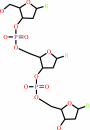 DNA(n)
|
+
|
2'-deoxyribonucleoside 5'-triphosphate
|
=
|
DNA(n+1)
|
+
|
 diphosphate
|
|
|
|
|
|
|
|
|
|
Enzyme class 3:
|
|
E.C.2.7.7.7
- DNA-directed Dna polymerase.
|
|
|
|
|
|
|
Reaction:
|
|
DNA(n) + a 2'-deoxyribonucleoside 5'-triphosphate = DNA(n+1) + diphosphate
|
|
|
|
|
|
DNA(n)
|
+
|
2'-deoxyribonucleoside 5'-triphosphate
|
=
|
DNA(n+1)
|
+
|
diphosphate
|
|
|
|
|
|
|
|
|
|
Enzyme class 4:
|
|
E.C.3.1.-.-
|
|
|
|
|
|
|
Enzyme class 5:
|
|
E.C.3.1.13.2
- exoribonuclease H.
|
|
|
|
|
|
|
Reaction:
|
|
Exonucleolytic cleavage to 5'-phosphomonoester oligonucleotides in both 5'- to 3'- and 3'- to 5'-directions.
|
|
|
|
|
|
Enzyme class 6:
|
|
E.C.3.1.26.13
- retroviral ribonuclease H.
|
|
|
|
|
|
|
Enzyme class 7:
|
|
E.C.3.4.23.16
- HIV-1 retropepsin.
|
|
|
|
|
|
|
Reaction:
|
|
Specific for a P1 residue that is hydrophobic, and P1' variable, but often Pro.
|
|
|
|
|
|
|
|
|
Note, where more than one E.C. class is given (as above), each may
correspond to a different protein domain or, in the case of polyprotein
precursors, to a different mature protein.
|
|
|
|
Molecule diagrams generated from .mol files obtained from the
KEGG ftp site
|
|
|
|
|
|
|
|
|
|
|
|
|
|
 |
|
|
|
|
|
|
| |
|
|
| |
|
DOI no:
|
Protein Sci
11:418-429
(2002)
|
|
PubMed id:
|
|
|
|
|
|
| |
|
Lack of synergy for inhibitors targeting a multi-drug-resistant HIV-1 protease.
|
|
N.M.King,
L.Melnick,
M.Prabu-Jeyabalan,
E.A.Nalivaika,
S.S.Yang,
Y.Gao,
X.Nie,
C.Zepp,
D.L.Heefner,
C.A.Schiffer.
|
|
|
|
|
| |
ABSTRACT
|
|
|
|
| |
|
|
The three-dimensional structures of indinavir and three newly synthesized
indinavir analogs in complex with a multi-drug-resistant variant (L63P, V82T,
I84V) of HIV-1 protease were determined to approximately 2.2 A resolution. Two
of the three analogs have only a single modification of indinavir, and their
binding affinities to the variant HIV-1 protease are enhanced over that of
indinavir. However, when both modifications were combined into a single
compound, the binding affinity to the protease variant was reduced. On close
examination, the structural rearrangements in the protease that occur in the
tightest binding inhibitor complex are mutually exclusive with the structural
rearrangements seen in the second tightest inhibitor complex. This occurs as
adaptations in the S1 pocket of one monomer propagate through the dimer and
affect the conformation of the S1 loop near P81 of the other monomer. Therefore,
structural rearrangements that occur within the protease when it binds to an
inhibitor with a single modification must be accounted for in the design of
inhibitors with multiple modifications. This consideration is necessary to
develop inhibitors that bind sufficiently tightly to drug-resistant variants of
HIV-1 protease to potentially become the next generation of therapeutic agents.
|
|
|
|
|
|
| |
Selected figure(s)
|
|
|
|
| |
|
|

|
|

|
|
Figure 1.
Fig. 1. (a) A chemical schematic diagram of indinavir, with the protease substrate subsites labeled. (b) A schematic representation of
the synthesis pathway for indinavir analogs.
|
|
Figure 2.
Fig. 2. Ribbon diagrams of two views of the drug-resistant variant of
HIV-1 protease dimer (in cyan and yellow) bound to indinavir (in ma-
genta). The three modifications L63P, V82T, I84V are displayed and la-
beled in blue and green for each monomer, respectively. Figures were
made with MIDAS (Ferrin et al. 1988).
|
|
|
|
|
|
| |
The above figures are
reprinted
from an Open Access publication published by the Protein Society:
Protein Sci
(2002,
11,
418-429)
copyright 2002.
|
|
| |
Figures were
selected
by an automated process.
|
|
|
|
|
|
|
|
|
|
|
|
|
|
|
|
 |
 |
 |
|
Literature references that cite this PDB file's key reference
|
|
|
| |
PubMed id
|
|
Reference
|
|
|
|
|
|
R.M.Bandaranayake,
M.Kolli,
N.M.King,
E.A.Nalivaika,
A.Heroux,
J.Kakizawa,
W.Sugiura,
and
C.A.Schiffer
(2010).
The effect of clade-specific sequence polymorphisms on HIV-1 protease activity and inhibitor resistance pathways.
|
| |
J Virol,
84,
9995.
|
|
|
PDB codes:
|
|
|
|
|
|
|
|
Y.Cai,
and
C.A.Schiffer
(2010).
Decomposing the energetic impact of drug resistant mutations in HIV-1 protease on binding DRV.
|
| |
J Chem Theory Comput,
6,
1358-1368.
|
|
|
|
|
|
|
A.F.Noel,
O.Bilsel,
A.Kundu,
Y.Wu,
J.A.Zitzewitz,
and
C.R.Matthews
(2009).
The folding free-energy surface of HIV-1 protease: insights into the thermodynamic basis for resistance to inhibitors.
|
| |
J Mol Biol,
387,
1002-1016.
|
|
|
|
|
|
|
E.Lefebvre,
and
C.A.Schiffer
(2008).
Resilience to resistance of HIV-1 protease inhibitors: profile of darunavir.
|
| |
AIDS Rev,
10,
131-142.
|
|
|
|
|
|
|
I.Dierynck,
M.De Wit,
E.Gustin,
I.Keuleers,
J.Vandersmissen,
S.Hallenberger,
and
K.Hertogs
(2007).
Binding kinetics of darunavir to human immunodeficiency virus type 1 protease explain the potent antiviral activity and high genetic barrier.
|
| |
J Virol,
81,
13845-13851.
|
|
|
|
|
|
|
M.N.Nalam,
A.Peeters,
T.H.Jonckers,
I.Dierynck,
and
C.A.Schiffer
(2007).
Crystal structure of lysine sulfonamide inhibitor reveals the displacement of the conserved flap water molecule in human immunodeficiency virus type 1 protease.
|
| |
J Virol,
81,
9512-9518.
|
|
|
PDB code:
|
|
|
|
|
|
|
|
J.C.Clemente,
R.M.Coman,
M.M.Thiaville,
L.K.Janka,
J.A.Jeung,
S.Nukoolkarn,
L.Govindasamy,
M.Agbandje-McKenna,
R.McKenna,
W.Leelamanit,
M.M.Goodenow,
and
B.M.Dunn
(2006).
Analysis of HIV-1 CRF_01 A/E protease inhibitor resistance: structural determinants for maintaining sensitivity and developing resistance to atazanavir.
|
| |
Biochemistry,
45,
5468-5477.
|
|
|
PDB code:
|
|
|
|
|
|
|
|
J.E.Foulkes,
M.Prabu-Jeyabalan,
D.Cooper,
G.J.Henderson,
J.Harris,
R.Swanstrom,
and
C.A.Schiffer
(2006).
Role of invariant Thr80 in human immunodeficiency virus type 1 protease structure, function, and viral infectivity.
|
| |
J Virol,
80,
6906-6916.
|
|
|
PDB codes:
|
|
|
|
|
|
|
|
F.Liu,
P.I.Boross,
Y.F.Wang,
J.Tozser,
J.M.Louis,
R.W.Harrison,
and
I.T.Weber
(2005).
Kinetic, stability, and structural changes in high-resolution crystal structures of HIV-1 protease with drug-resistant mutations L24I, I50V, and G73S.
|
| |
J Mol Biol,
354,
789-800.
|
|
|
PDB codes:
|
|
|
|
|
|
|
|
J.Brynda,
P.Rezácová,
M.Fábry,
M.Horejsí,
R.Stouracová,
M.Soucek,
M.Hradílek,
J.Konvalinka,
and
J.Sedlácek
(2004).
Inhibitor binding at the protein interface in crystals of a HIV-1 protease complex.
|
| |
Acta Crystallogr D Biol Crystallogr,
60,
1943-1948.
|
|
|
PDB code:
|
|
|
|
|
|
|
|
M.Prabu-Jeyabalan,
E.A.Nalivaika,
N.M.King,
and
C.A.Schiffer
(2004).
Structural basis for coevolution of a human immunodeficiency virus type 1 nucleocapsid-p1 cleavage site with a V82A drug-resistant mutation in viral protease.
|
| |
J Virol,
78,
12446-12454.
|
|
|
PDB codes:
|
|
|
|
|
|
|
|
N.M.King,
M.Prabu-Jeyabalan,
E.A.Nalivaika,
P.Wigerinck,
M.P.de Béthune,
and
C.A.Schiffer
(2004).
Structural and thermodynamic basis for the binding of TMC114, a next-generation human immunodeficiency virus type 1 protease inhibitor.
|
| |
J Virol,
78,
12012-12021.
|
|
|
|
|
|
|
X.Chen,
I.T.Weber,
and
R.W.Harrison
(2004).
Molecular dynamics simulations of 14 HIV protease mutants in complexes with indinavir.
|
| |
J Mol Model,
10,
373-381.
|
|
|
|
|
|
|
M.D.Shenderovich,
R.M.Kagan,
P.N.Heseltine,
and
K.Ramnarayan
(2003).
Structure-based phenotyping predicts HIV-1 protease inhibitor resistance.
|
| |
Protein Sci,
12,
1706-1718.
|
|
|
|
|
|
|
M.Prabu-Jeyabalan,
E.A.Nalivaika,
N.M.King,
and
C.A.Schiffer
(2003).
Viability of a drug-resistant human immunodeficiency virus type 1 protease variant: structural insights for better antiviral therapy.
|
| |
J Virol,
77,
1306-1315.
|
|
|
PDB codes:
|
|
|
|
|
|
|
The most recent references are shown first.
Citation data come partly from CiteXplore and partly
from an automated harvesting procedure. Note that this is likely to be
only a partial list as not all journals are covered by
either method. However, we are continually building up the citation data
so more and more references will be included with time.
Where a reference describes a PDB structure, the PDB
codes are
shown on the right.
|
|


 Links
Links