 |
PDBsum entry 5ugp

|
|
|
|
|
|

|

|

|

|
|

|
|

|
|

|
|

|
|

|
|

|
|

|
|
|
 |

|

|
|
|
|
|
|
|
|
|
|
|
|
|
|
|
|
|
|
|
|
|
|
|
|
|
|
|
|
|
|
|
|
|
|
|
|
Transferase/DNA
|
PDB id
|
|
|
|
5ugp
|
|
|
|
|
|
|
|
|
|
|
|
|
|
|

|

|

|
|
|
|
|
|
|
|
|
Enzyme class 1:
|
|
E.C.2.7.7.7
- DNA-directed Dna polymerase.
|
|
|
|
|
|
|
Reaction:
|
|
DNA(n) + a 2'-deoxyribonucleoside 5'-triphosphate = DNA(n+1) + diphosphate
|
|
|
|
|
|
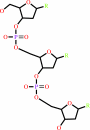 DNA(n)
|
+
|
2'-deoxyribonucleoside 5'-triphosphate
|
=
|
DNA(n+1)
|
+
|
 diphosphate
|
|
|
|
|
|
|
|
|
|
Enzyme class 2:
|
|
E.C.4.2.99.-
- ?????
|
|
|
|
|
|
|
Enzyme class 3:
|
|
E.C.4.2.99.18
- DNA-(apurinic or apyrimidinic site) lyase.
|
|
|
|
|
|
|
Reaction:
|
|
2'-deoxyribonucleotide-(2'-deoxyribose 5'-phosphate)- 2'-deoxyribonucleotide-DNA = a 3'-end 2'-deoxyribonucleotide-(2,3- dehydro-2,3-deoxyribose 5'-phosphate)-DNA + a 5'-end 5'-phospho- 2'-deoxyribonucleoside-DNA + H+
|
|
|
|
|
|
|
|
|
Note, where more than one E.C. class is given (as above), each may
correspond to a different protein domain or, in the case of polyprotein
precursors, to a different mature protein.
|
|
|
|
Molecule diagrams generated from .mol files obtained from the
KEGG ftp site
|
|
|
|
|
|
|
|
|
|
|
|
|
|
 |
|
|
|
|
|
|
| |
|
|
| |
|
|
Nat Chem Biol
13:1074-1080
(2017)
|
|
PubMed id:
|
|
|
|
|
|
| |
|
Modulating the DNA polymerase β reaction equilibrium to dissect the reverse reaction.
|
|
D.D.Shock,
B.D.Freudenthal,
W.A.Beard,
S.H.Wilson.
|
|
|
|
|
| |
ABSTRACT
|
|
|
|
| |
|
|
DNA polymerases catalyze efficient and high-fidelity DNA synthesis. While this
reaction favors nucleotide incorporation, polymerases also catalyze a reverse
reaction, pyrophosphorolysis, that removes the DNA primer terminus and generates
deoxynucleoside triphosphates. Because pyrophosphorolysis can influence
polymerase fidelity and sensitivity to chain-terminating nucleosides, we
analyzed pyrophosphorolysis with human DNA polymerase β and found the reaction
to be inefficient. The lack of a thio-elemental effect indicated that this
reaction was limited by a nonchemical step. Use of a pyrophosphate analog, in
which the bridging oxygen is replaced with an imido group (PNP), increased the
rate of the reverse reaction and displayed a large thio-elemental effect,
indicating that chemistry was now rate determining. Time-lapse crystallography
with PNP captured structures consistent with a chemical equilibrium favoring the
reverse reaction. These results highlight the importance of the bridging atom
between the β- and γ-phosphates of the incoming nucleotide in reaction
chemistry, enzyme conformational changes, and overall reaction equilibrium.
|
|
|
|
|
|
|
|
|
|
|
|
|
|
|
|
|
|
 |
 |
 |
|


 Links
Links


