|
PDBsum entry 5u9h

|
|
|
|
|
|

|

|

|

|
|

|
|

|
|

|
|

|
|

|
|

|
|

|
|
|
 |

|

|
|
|
|
|
|
|
|
|
|
|
|
|
|
|
|
|
|
|
|
|
|
|
|
|
|
|
|
|
|
|
|
|
|
|
|
Transferase/DNA
|
PDB id
|
|
|
|
5u9h
|
|
|
|
|
|
|
|
|
|
|
|
|
|
|

|

|

|
|
|
|
|
|
|
|
|
Enzyme class 1:
|
|
E.C.2.7.7.7
- DNA-directed Dna polymerase.
|
|
|
|
|
|
|
Reaction:
|
|
DNA(n) + a 2'-deoxyribonucleoside 5'-triphosphate = DNA(n+1) + diphosphate
|
|
|
|
|
|
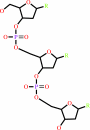 DNA(n)
|
+
|
2'-deoxyribonucleoside 5'-triphosphate
|
=
|
DNA(n+1)
Bound ligand (Het Group name = )
corresponds exactly
|
+
|
 diphosphate
|
|
|
|
|
|
|
|
|
|
Enzyme class 2:
|
|
E.C.4.2.99.-
- ?????
|
|
|
|
|
|
|
Enzyme class 3:
|
|
E.C.4.2.99.18
- DNA-(apurinic or apyrimidinic site) lyase.
|
|
|
|
|
|
|
Reaction:
|
|
2'-deoxyribonucleotide-(2'-deoxyribose 5'-phosphate)- 2'-deoxyribonucleotide-DNA = a 3'-end 2'-deoxyribonucleotide-(2,3- dehydro-2,3-deoxyribose 5'-phosphate)-DNA + a 5'-end 5'-phospho- 2'-deoxyribonucleoside-DNA + H+
|
|
|
|
|
|
|
|
|
Note, where more than one E.C. class is given (as above), each may
correspond to a different protein domain or, in the case of polyprotein
precursors, to a different mature protein.
|
|
|
|
Molecule diagrams generated from .mol files obtained from the
KEGG ftp site
|
|
|
|
|
|
|
|
|
|
|
|
|
|
 |
|
|
|
|
|
|
| |
|
|
| |
|
|
Nucleic Acids Res
45:2736-2745
(2017)
|
|
PubMed id:
|
|
|
|
|
|
| |
|
Revealing the role of the product metal in DNA polymerase β catalysis.
|
|
L.Perera,
B.D.Freudenthal,
W.A.Beard,
L.G.Pedersen,
S.H.Wilson.
|
|
|
|
|
| |
ABSTRACT
|
|
|
|
| |
|
|
DNA polymerases catalyze a metal-dependent nucleotidyl transferase reaction
during extension of a DNA strand using the complementary strand as a template.
The reaction has long been considered to require two magnesium ions. Recently, a
third active site magnesium ion was identified in some DNA polymerase product
crystallographic structures, but its role is not known. Using quantum
mechanical/ molecular mechanical calculations of polymerase β, we find that a
third magnesium ion positioned near the newly identified product metal site does
not alter the activation barrier for the chemical reaction indicating that it
does not have a role in the forward reaction. This is consistent with time-lapse
crystallographic structures following insertion of Sp-dCTPαS. Although sulfur
substitution deters product metal binding, this has only a minimal effect on the
rate of the forward reaction. Surprisingly, monovalent sodium or ammonium ions,
positioned in the product metal site, lowered the activation barrier. These
calculations highlight the impact that an active site water network can have on
the energetics of the forward reaction and how metals or enzyme side chains may
interact with the network to modulate the reaction barrier. These results also
are discussed in the context of earlier findings indicating that magnesium at
the product metal position blocks the reverse pyrophosphorolysis reaction.
|
|
|
|
|
|
|
|
|
|
|
|
|
|
|
|
|
|
 |
 |
 |
|


 Links
Links