 |
PDBsum entry 5t5t

|
|
|
|
|
 |
Contents |
 |
|
|
|
|
|
|
|
|
|
|
|
 369 a.a.
|
|
|
|
|
|
|
|
|
|
|
 163 a.a.
|
|
|
|
|
|
|
|
|
|
|
 293 a.a.
|
|
|
|
|
|
|
|
|
|
|
|
|
|
|
PDB id:
|
|
|
|
| Name: |
|
Transferase
|
|
|
Title:
|
|
Ampk bound to allosteric activator
|
|
Structure:
|
|
5'-amp-activated protein kinase catalytic subunit alpha-1. Chain: a. Synonym: ampk subunit alpha-1,acetyl-coa carboxylase kinase,acaca kinase,hydroxymethylglutaryl-coa reductase kinase,hmgcr kinase,tau- protein kinase prkaa1. Ec: 2.7.11.1,2.7.11.27,2.7.11.31,2.7.11.26. Engineered: yes. 5'-amp-activated protein kinase subunit beta-1. Chain: b.
|
|
Source:
|
|
Rattus norvegicus. Rat. Organism_taxid: 10116. Gene: prkaa1, ampk1. Expressed in: escherichia coli. Expression_system_taxid: 562. Gene: prkab1. Gene: prkag1. Expression_system_taxid: 562
|
|
Resolution:
|
|
|
3.46Å
|
R-factor:
|
0.212
|
R-free:
|
0.231
|
|
|
Authors:
|
|
M.F.Calabrese,R.G.Kurumbail
|
|
Key ref:
|
|
C.T.Salatto
et al.
(2017).
Selective Activation of AMPK β1-Containing Isoforms Improves Kidney Function in a Rat Model of Diabetic Nephropathy.
J Pharmacol Exp Ther,
361,
303-311.
PubMed id:
DOI:
|
|
|
Date:
|
|
|
31-Aug-16
|
Release date:
|
29-Mar-17
|
|
|
|
|
|
|
PROCHECK
|

|
|
|
|
|
Headers
|
|
|
|
References
|
|
|
|
|
|

|
|
P54645
(AAPK1_RAT) -
5'-AMP-activated protein kinase catalytic subunit alpha-1 from Rattus norvegicus
|
|
|
|
Seq:
Struc:
|
|
|
|
559 a.a.
369 a.a.*
|
|

|

|
|
|
|
|
|
|
|
|
|
|
|
|
|
|
|
|
|
Enzyme class 1:
|
|
Chain A:
E.C.2.7.11.1
- non-specific serine/threonine protein kinase.
|
|
|
|
|
|
|
Reaction:
|
|
|
1.
|
L-seryl-[protein] + ATP = O-phospho-L-seryl-[protein] + ADP + H+
|
|
2.
|
L-threonyl-[protein] + ATP = O-phospho-L-threonyl-[protein] + ADP + H+
|
|
|
|
|
|
|
L-seryl-[protein]
|
+
|
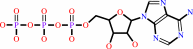 ATP
ATP
|
=
|
O-phospho-L-seryl-[protein]
Bound ligand (Het Group name = )
corresponds exactly
|
+
|
 ADP
ADP
|
+
|
H(+)
|
|
|
|
|
|
|
L-threonyl-[protein]
|
+
|
ATP
|
=
|
O-phospho-L-threonyl-[protein]
Bound ligand (Het Group name = )
corresponds exactly
|
+
|
ADP
|
+
|
H(+)
|
|
|
|
|
|
|
|
|
|
Enzyme class 2:
|
|
Chain A:
E.C.2.7.11.26
- [tau protein] kinase.
|
|
|
|
|
|
|
Reaction:
|
|
|
1.
|
L-seryl-[tau protein] + ATP = O-phospho-L-seryl-[tau protein] + ADP + H+
|
|
2.
|
L-threonyl-[tau protein] + ATP = O-phospho-L-threonyl-[tau protein] + ADP + H+
|
|
|
|
|
|
|
L-seryl-[tau protein]
|
+
|
ATP
|
=
|
O-phospho-L-seryl-[tau protein]
Bound ligand (Het Group name = )
corresponds exactly
|
+
|
ADP
|
+
|
H(+)
|
|
|
|
|
|
|
L-threonyl-[tau protein]
|
+
|
ATP
|
=
|
O-phospho-L-threonyl-[tau protein]
Bound ligand (Het Group name = )
corresponds exactly
|
+
|
ADP
|
+
|
H(+)
|
|
|
|
|
|
|
|
|
|
Enzyme class 3:
|
|
Chain A:
E.C.2.7.11.31
- [hydroxymethylglutaryl-CoA reductase (NADPH)] kinase.
|
|
|
|
|
|
|
Reaction:
|
|
L-seryl-[3-hydroxy-3-methylglutaryl-coenzyme A reductase] + ATP = O-phospho-L-seryl-[3-hydroxy-3-methylglutaryl-coenzyme A reductase] + ADP + H+
|
|
|
|
|
|
L-seryl-[3-hydroxy-3-methylglutaryl-coenzyme A reductase]
|
+
|
ATP
|
=
|
O-phospho-L-seryl-[3-hydroxy-3-methylglutaryl-coenzyme A reductase]
Bound ligand (Het Group name = )
corresponds exactly
|
+
|
ADP
|
+
|
H(+)
|
|
|
|
|
|
|
|
|
|
|
|
|
Note, where more than one E.C. class is given (as above), each may
correspond to a different protein domain or, in the case of polyprotein
precursors, to a different mature protein.
|
|
|
|
Molecule diagrams generated from .mol files obtained from the
KEGG ftp site
|
|
|
|
|
|
|
|
|
|
|
|
|
|
 |
|
|
|
|
|
|
| |
|
|
| |
|
DOI no:
|
J Pharmacol Exp Ther
361:303-311
(2017)
|
|
PubMed id:
|
|
|
|
|
|
| |
|
Selective Activation of AMPK β1-Containing Isoforms Improves Kidney Function in a Rat Model of Diabetic Nephropathy.
|
|
C.T.Salatto,
R.A.Miller,
K.O.Cameron,
E.Cokorinos,
A.Reyes,
J.Ward,
M.F.Calabrese,
R.G.Kurumbail,
F.Rajamohan,
A.S.Kalgutkar,
D.A.Tess,
A.Shavnya,
N.E.Genung,
D.J.Edmonds,
A.Jatkar,
B.S.Maciejewski,
M.Amaro,
H.Gandhok,
M.Monetti,
K.Cialdea,
E.Bollinger,
J.M.Kreeger,
T.M.Coskran,
A.C.Opsahl,
G.G.Boucher,
M.J.Birnbaum,
P.DaSilva-Jardine,
T.Rolph.
|
|
|
|
|
| |
ABSTRACT
|
|
|
|
| |
|
|
Diabetic nephropathy remains an area of high unmet medical need, with current
therapies that slow down, but do not prevent, the progression of disease. A
reduced phosphorylation state of adenosine monophosphate-activated protein
kinase (AMPK) has been correlated with diminished kidney function in both humans
and animal models of renal disease. Here, we describe the identification of
novel, potent, small molecule activators of AMPK that selectively activate AMPK
heterotrimers containing the β1 subunit. After confirming that human and rodent
kidney predominately express AMPK β1, we explore the effects of pharmacological
activation of AMPK in the ZSF1 rat model of diabetic nephropathy. Chronic
administration of these direct activators elevates the phosphorylation of AMPK
in the kidney, without impacting blood glucose levels, and reduces the
progression of proteinuria to a greater degree than the current standard of
care, angiotensin-converting enzyme inhibitor ramipril. Further analyses of
urine biomarkers and kidney tissue gene expression reveal AMPK activation leads
to the modulation of multiple pathways implicated in kidney injury, including
cellular hypertrophy, fibrosis, and oxidative stress. These results support the
need for further investigation into the potential beneficial effects of AMPK
activation in kidney disease.
|
|
|
|
|
|
|
|
|
|
|
|
|
|
|
|
|
|
 |
 |
 |
|
| |


 Links
Links


