 |
PDBsum entry 4pha

|
|
|
|
|
|

|

|

|

|
|

|
|

|
|

|
|

|
|

|
|

|
|

|
|
|
 |

|

|
|
|
|
|
|
|
|
|
|
|
|
|
|
|
|
|
|
|
|
|
|
|
|
|
|
|
|
|
|
|
|
|
|
|
|
Transferase,lyase/DNA
|
PDB id
|
|
|
|
4pha
|
|
|
|
|
|
|
|
|
|
|
|
|
|
|

|

|

|
|
|
|
|
|
|
|
|
Enzyme class 1:
|
|
E.C.2.7.7.7
- DNA-directed Dna polymerase.
|
|
|
|
|
|
|
Reaction:
|
|
DNA(n) + a 2'-deoxyribonucleoside 5'-triphosphate = DNA(n+1) + diphosphate
|
|
|
|
|
|
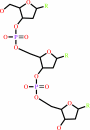 DNA(n)
|
+
|
2'-deoxyribonucleoside 5'-triphosphate
|
=
|
DNA(n+1)
|
+
|
 diphosphate
|
|
|
|
|
|
|
|
|
|
Enzyme class 2:
|
|
E.C.4.2.99.-
- ?????
|
|
|
|
|
|
|
Enzyme class 3:
|
|
E.C.4.2.99.18
- DNA-(apurinic or apyrimidinic site) lyase.
|
|
|
|
|
|
|
Reaction:
|
|
2'-deoxyribonucleotide-(2'-deoxyribose 5'-phosphate)- 2'-deoxyribonucleotide-DNA = a 3'-end 2'-deoxyribonucleotide-(2,3- dehydro-2,3-deoxyribose 5'-phosphate)-DNA + a 5'-end 5'-phospho- 2'-deoxyribonucleoside-DNA + H+
|
|
|
|
|
|
|
|
|
Note, where more than one E.C. class is given (as above), each may
correspond to a different protein domain or, in the case of polyprotein
precursors, to a different mature protein.
|
|
|
|
Molecule diagrams generated from .mol files obtained from the
KEGG ftp site
|
|
|
|
|
|
|
|
|
|
|
|
|
|
 |
|
|
|
|
|
|
| |
|
|
| |
|
DOI no:
|
Nucleic Acids Res
42:11233-11245
(2014)
|
|
PubMed id:
|
|
|
|
|
|
| |
|
The spontaneous replication error and the mismatch discrimination mechanisms of human DNA polymerase β.
|
|
M.C.Koag,
K.Nam,
S.Lee.
|
|
|
|
|
| |
ABSTRACT
|
|
|
|
| |
|
|
To provide molecular-level insights into the spontaneous replication error and
the mismatch discrimination mechanisms of human DNA polymerase β (polβ), we
report four crystal structures of polβ complexed with dG•dTTP and dA•dCTP
mismatches in the presence of Mg(2+) or Mn(2+). The Mg(2+)-bound ground-state
structures show that the dA•dCTP-Mg(2+) complex adopts an 'intermediate'
protein conformation while the dG•dTTP-Mg(2+) complex adopts an open protein
conformation. The Mn(2+)-bound 'pre-chemistry-state' structures show that the
dA•dCTP-Mn(2+) complex is structurally very similar to the dA•dCTP-Mg(2+)
complex, whereas the dG•dTTP-Mn(2+) complex undergoes a large-scale
conformational change to adopt a Watson-Crick-like dG•dTTP base pair and a
closed protein conformation. These structural differences, together with our
molecular dynamics simulation studies, suggest that polβ increases replication
fidelity via a two-stage mismatch discrimination mechanism, where one is in the
ground state and the other in the closed conformation state. In the closed
conformation state, polβ appears to allow only a Watson-Crick-like conformation
for purine•pyrimidine base pairs, thereby discriminating the mismatched base
pairs based on their ability to form the Watson-Crick-like conformation.
Overall, the present studies provide new insights into the spontaneous
replication error and the replication fidelity mechanisms of polβ.
|
|
|
|
|
|
|
|
|
|
|
|
|
|
|
|
|
|
 |
 |
 |
|


 Links
Links


