 |
PDBsum entry 2j6t

|
|
|
|
|
|

|

|

|

|
|

|
|

|
|

|
|

|
|

|
|

|
|

|
|
|
 |

|

|
|
|
|
|
|
|
|
|
|
|
|
|
|
|
|
|
|
|
|
|
|
|
|
|
|
|
|
|
|
|
|
|
|
|
|
Transferase/DNA
|
PDB id
|
|
|
|
2j6t
|
|
|
|
|
|
|
|
|
|
|
|
|
|
|

|

|

|
|
|
|
|
|
|
|
 |
Contents |
 |
|
|
|
|
|
|
|
|
|
|
|
|
|
|
|
|
* Residue conservation analysis
|
|
|
|
|
|
|
|
|
|
|
Enzyme class:
|
|
E.C.2.7.7.7
- DNA-directed Dna polymerase.
|
|
|
|
|
|
|
Reaction:
|
|
DNA(n) + a 2'-deoxyribonucleoside 5'-triphosphate = DNA(n+1) + diphosphate
|
|
|
|
|
|
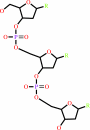 DNA(n)
|
+
|
2'-deoxyribonucleoside 5'-triphosphate
|
=
|
DNA(n+1)
|
+
|
 diphosphate
|
|
|
|
|
|
|
|
|
|
|
|
|
Molecule diagrams generated from .mol files obtained from the
KEGG ftp site
|
|
|
|
|
|
|
|
|
|
|
|
|
|
 |
|
|
|
|
|
|
| |
|
|
| |
|
DOI no:
|
J Biol Chem
282:1456-1467
(2007)
|
|
PubMed id:
|
|
|
|
|
|
| |
|
Sulfolobus solfataricus DNA polymerase Dpo4 is partially inhibited by "wobble" pairing between O6-methylguanine and cytosine, but accurate bypass is preferred.
|
|
R.L.Eoff,
A.Irimia,
M.Egli,
F.P.Guengerich.
|
|
|
|
|
| |
ABSTRACT
|
|
|
|
| |
|
|
We examined the effect of a single O6-methylguanine (O6-MeG) template residue on
catalysis by a model Y family polymerase, Dpo4 from Sulfolobus solfataricus.
Mass spectral analysis of Dpo4-catalyzed extension products revealed that the
enzyme accurately bypasses O6-MeG, with C being the major product (approximately
70%) and T or A being the minor species (approximately 20% or approximately 10%,
respectively), consistent with steady-state kinetic parameters. Transient-state
kinetic experiments revealed that kpol, the maximum forward rate constant
describing polymerization, for dCTP incorporation opposite O6-MeG was
approximately 6-fold slower than observed for unmodified G, and no measurable
product was observed for dTTP incorporation in the pre-steady state. The lack of
any structural information regarding how O6-MeG paired in a polymerase active
site led us to perform x-ray crystallographic studies, which show that
"wobble" pairing occurs between C and O6-MeG. A structure containing T
opposite O6-MeG was solved, but much of the ribose and pyrimidine base density
was disordered, in accordance with a much higher Km,dTTP that drives the
difference in efficiency between C and T incorporation. The more stabilized
C:O6-MeG pairing reinforces the importance of hydrogen bonding with respect to
nucleotide selection within a geometrically tolerant polymerase active site.
|
|
|
|
|
|
| |
Selected figure(s)
|
|
|
|
| |
|
|

|
|

|
|
Figure 6.
FIGURE 6. Electron density and DNA duplex conformations
observed at the active site of ternary complexes. A, O^6-MeG:C;
B, O^6-MeG:T; and C, O^6-MeG:dATP. Dpo4 is shown in schematic
form (cyan). The DNA duplex is shown in ball-and-stick
representation. Calcium ions are shown as green spheres. The
electron density map (black mesh) 3F[o] - 2F[c] is contoured at
the 1  level. level.
|
|
Figure 7.
FIGURE 7. Comparative C and T base pairing orientations
opposite O^6-MeG at the catalytic center of the ternary
complexes. A, the 14th nucleotide C forms a wobble base pair
with template O^6-MeG in the O^6-MeG:C structure. B, the 14th
nucleotide T is positioned in three conformations opposite
O^6-MeG, owing to the disorder observed in the region near
thymidine in the O^6-MeG:T structure. The electron density map
(black mesh) 3F[o] - 2F[c] is contoured at the 1 level.
|
|
|
|
|
|
| |
The above figures are
reprinted
by permission from the ASBMB:
J Biol Chem
(2007,
282,
1456-1467)
copyright 2007.
|
|
| |
Figures were
selected
by an automated process.
|
|
|
|
|
|
|
|
|
|
|
|
|
|
|
|
 |
 |
 |
|
Literature references that cite this PDB file's key reference
|
|
|
| |
PubMed id
|
|
Reference
|
|
|
|
|
|
J.D.Pata
(2010).
Structural diversity of the Y-family DNA polymerases.
|
| |
Biochim Biophys Acta,
1804,
1124-1135.
|
|
|
|
|
|
|
P.Raychaudhury,
and
A.K.Basu
(2010).
Replication Past the γ-Radiation-Induced Guanine-Thymine Cross-Link G[8,5-Me]T by Human and Yeast DNA Polymerase η.
|
| |
J Nucleic Acids,
2010,
0.
|
|
|
|
|
|
|
R.L.Eoff,
J.Y.Choi,
and
F.P.Guengerich
(2010).
Mechanistic Studies with DNA Polymerases Reveal Complex Outcomes following Bypass of DNA Damage.
|
| |
J Nucleic Acids,
2010,
0.
|
|
|
|
|
|
|
H.A.Dahlmann,
V.G.Vaidyanathan,
and
S.J.Sturla
(2009).
Investigating the biochemical impact of DNA damage with structure-based probes: abasic sites, photodimers, alkylation adducts, and oxidative lesions.
|
| |
Biochemistry,
48,
9347-9359.
|
|
|
|
|
|
|
H.Zhang,
R.L.Eoff,
I.D.Kozekov,
C.J.Rizzo,
M.Egli,
and
F.P.Guengerich
(2009).
Versatility of Y-family Sulfolobus solfataricus DNA polymerase Dpo4 in translesion synthesis past bulky N2-alkylguanine adducts.
|
| |
J Biol Chem,
284,
3563-3576.
|
|
|
PDB codes:
|
|
|
|
|
|
|
|
H.Zhang,
R.L.Eoff,
I.D.Kozekov,
C.J.Rizzo,
M.Egli,
and
F.P.Guengerich
(2009).
Structure-function relationships in miscoding by Sulfolobus solfataricus DNA polymerase Dpo4: guanine N2,N2-dimethyl substitution produces inactive and miscoding polymerase complexes.
|
| |
J Biol Chem,
284,
17687-17699.
|
|
|
PDB codes:
|
|
|
|
|
|
|
|
P.P.Christov,
K.C.Angel,
F.P.Guengerich,
and
C.J.Rizzo
(2009).
Replication past the N5-methyl-formamidopyrimidine lesion of deoxyguanosine by DNA polymerases and an improved procedure for sequence analysis of in vitro bypass products by mass spectrometry.
|
| |
Chem Res Toxicol,
22,
1086-1095.
|
|
|
|
|
|
|
R.L.Eoff,
J.B.Stafford,
J.Szekely,
C.J.Rizzo,
M.Egli,
F.P.Guengerich,
and
L.J.Marnett
(2009).
Structural and functional analysis of Sulfolobus solfataricus Y-family DNA polymerase Dpo4-catalyzed bypass of the malondialdehyde-deoxyguanosine adduct.
|
| |
Biochemistry,
48,
7079-7088.
|
|
|
PDB codes:
|
|
|
|
|
|
|
|
R.L.Eoff,
R.Sanchez-Ponce,
and
F.P.Guengerich
(2009).
Conformational changes during nucleotide selection by Sulfolobus solfataricus DNA polymerase Dpo4.
|
| |
J Biol Chem,
284,
21090-21099.
|
|
|
|
|
|
|
S.M.Sherrer,
J.A.Brown,
L.R.Pack,
V.P.Jasti,
J.D.Fowler,
A.K.Basu,
and
Z.Suo
(2009).
Mechanistic studies of the bypass of a bulky single-base lesion catalyzed by a Y-family DNA polymerase.
|
| |
J Biol Chem,
284,
6379-6388.
|
|
|
|
|
|
|
A.Dimitri,
J.A.Burns,
S.Broyde,
and
D.A.Scicchitano
(2008).
Transcription elongation past O6-methylguanine by human RNA polymerase II and bacteriophage T7 RNA polymerase.
|
| |
Nucleic Acids Res,
36,
6459-6471.
|
|
|
|
|
|
|
J.C.Delaney,
and
J.M.Essigmann
(2008).
Biological properties of single chemical-DNA adducts: a twenty year perspective.
|
| |
Chem Res Toxicol,
21,
232-252.
|
|
|
|
|
|
|
J.W.Beckman,
Q.Wang,
and
F.P.Guengerich
(2008).
Kinetic analysis of correct nucleotide insertion by a Y-family DNA polymerase reveals conformational changes both prior to and following phosphodiester bond formation as detected by tryptophan fluorescence.
|
| |
J Biol Chem,
283,
36711-36723.
|
|
|
|
|
|
|
J.Y.Choi,
and
F.P.Guengerich
(2008).
Kinetic analysis of translesion synthesis opposite bulky N2- and O6-alkylguanine DNA adducts by human DNA polymerase REV1.
|
| |
J Biol Chem,
283,
23645-23655.
|
|
|
|
|
|
|
N.Böge,
M.I.Jacobsen,
Z.Szombati,
S.Baerns,
F.Di Pasquale,
A.Marx,
and
C.Meier
(2008).
Synthesis of DNA strands site-specifically damaged by c8-arylamine purine adducts and effects on various DNA polymerases.
|
| |
Chemistry,
14,
11194-11208.
|
|
|
|
|
|
|
S.J.Sturla
(2007).
DNA adduct profiles: chemical approaches to addressing the biological impact of DNA damage from small molecules.
|
| |
Curr Opin Chem Biol,
11,
293-299.
|
|
|
|
|
|
|
W.Yang,
and
R.Woodgate
(2007).
What a difference a decade makes: insights into translesion DNA synthesis.
|
| |
Proc Natl Acad Sci U S A,
104,
15591-15598.
|
|
|
|
|
|
The most recent references are shown first.
Citation data come partly from CiteXplore and partly
from an automated harvesting procedure. Note that this is likely to be
only a partial list as not all journals are covered by
either method. However, we are continually building up the citation data
so more and more references will be included with time.
Where a reference describes a PDB structure, the PDB
codes are
shown on the right.
|
|


 Links
Links


