 |
PDBsum entry 2v4r

|
|
|
|
|
 |
Contents |
 |
|
|
|
|
|
|
|
|
|
|
|
|
|
|
|
|
* Residue conservation analysis
|
|
|
|
|
|
|
|
|
|
|
Enzyme class:
|
|
E.C.2.7.7.7
- DNA-directed Dna polymerase.
|
|
|
|
|
|
|
Reaction:
|
|
DNA(n) + a 2'-deoxyribonucleoside 5'-triphosphate = DNA(n+1) + diphosphate
|
|
|
|
|
|
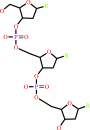 DNA(n)
|
+
|
2'-deoxyribonucleoside 5'-triphosphate
|
=
|
DNA(n+1)
|
+
|
 diphosphate
|
|
|
|
|
|
|
|
|
|
|
|
|
Molecule diagrams generated from .mol files obtained from the
KEGG ftp site
|
|
|
|
|
|
|
|
|
|
|
|
|
|
 |
|
|
|
|
|
|
| |
|
|
| |
|
|
Biochemistry
48:7079-7088
(2009)
|
|
PubMed id:
|
|
|
|
|
|
| |
|
Structural and functional analysis of Sulfolobus solfataricus Y-family DNA polymerase Dpo4-catalyzed bypass of the malondialdehyde-deoxyguanosine adduct.
|
|
R.L.Eoff,
J.B.Stafford,
J.Szekely,
C.J.Rizzo,
M.Egli,
F.P.Guengerich,
L.J.Marnett.
|
|
|
|
|
| |
ABSTRACT
|
|
|
|
| |
|
|
Oxidative stress can induce the formation of reactive electrophiles, such as DNA
peroxidation products, e.g., base propenals, and lipid peroxidation products,
e.g., malondialdehyde. Base propenals and malondialdehyde react with DNA to form
adducts, including
3-(2'-deoxy-beta-D-erythro-pentofuranosyl)pyrimido[1,2-alpha]purin-10(3H)-one
(M1dG). When paired opposite cytosine in duplex DNA at physiological pH, M1dG
undergoes ring opening to form N2-(3-oxo-1-propenyl)-dG (N2-OPdG). Previous work
has shown that M1dG is mutagenic in bacteria and mammalian cells and that its
mutagenicity in Escherichia coli is dependent on induction of the SOS response,
indicating a role for translesion DNA polymerases in the bypass of M1dG. To
probe the mechanism by which translesion polymerases bypass M1dG, kinetic and
structural studies were conducted with a model Y-family DNA polymerase, Dpo4
from Sulfolobus solfataricus. The level of steady-state incorporation of dNTPs
opposite M1dG was reduced 260-2900-fold and exhibited a preference for dATP
incorporation. Liquid chromatography-tandem mass spectrometry analysis of the
full-length extension products revealed a spectrum of products arising
principally by incorporation of dC or dA opposite M1dG followed by partial or
full-length extension. A greater proportion of -1 deletions were observed when
dT was positioned 5' of M1dG. Two crystal structures were determined, including
a "type II" frameshift deletion complex and another complex with Dpo4 bound to a
dC.M1dG pair located in the postinsertion context. Importantly, M1dG was in the
ring-closed state in both structures, and in the structure with dC opposite
M1dG, the dC residue moved out of the Dpo4 active site, into the minor groove.
The results are consistent with the reported mutagenicity of M1dG and illustrate
how the lesion may affect replication events.
|
|
|
|
|
|
|
|
|
|
|
|
|
|
|
|
|
|
 |
 |
 |
|
Literature references that cite this PDB file's key reference
|
|
|
| |
PubMed id
|
|
Reference
|
|
|
|
|
|
G.Shanmugam,
I.D.Kozekov,
F.P.Guengerich,
C.J.Rizzo,
and
M.P.Stone
(2010).
Structure of the 1,N(2)-etheno-2'-deoxyguanosine lesion in the 3'-G(epsilon dG)T-5' sequence opposite a one-base deletion.
|
| |
Biochemistry,
49,
2615-2626.
|
|
|
PDB code:
|
|
|
|
|
|
|
|
L.Maddukuri,
R.L.Eoff,
J.Y.Choi,
C.J.Rizzo,
F.P.Guengerich,
and
L.J.Marnett
(2010).
In vitro bypass of the major malondialdehyde- and base propenal-derived DNA adduct by human Y-family DNA polymerases κ, ι, and Rev1.
|
| |
Biochemistry,
49,
8415-8424.
|
|
|
|
|
|
|
R.L.Eoff,
J.Y.Choi,
and
F.P.Guengerich
(2010).
Mechanistic Studies with DNA Polymerases Reveal Complex Outcomes following Bypass of DNA Damage.
|
| |
J Nucleic Acids,
2010,
0.
|
|
|
|
|
|
|
H.Zhang,
J.W.Beckman,
and
F.P.Guengerich
(2009).
Frameshift deletion by Sulfolobus solfataricus P2 DNA polymerase Dpo4 T239W is selective for purines and involves normal conformational change followed by slow phosphodiester bond formation.
|
| |
J Biol Chem,
284,
35144-35153.
|
|
|
|
|
|
The most recent references are shown first.
Citation data come partly from CiteXplore and partly
from an automated harvesting procedure. Note that this is likely to be
only a partial list as not all journals are covered by
either method. However, we are continually building up the citation data
so more and more references will be included with time.
Where a reference describes a PDB structure, the PDB
code is
shown on the right.
|
|


 Links
Links


