 |
PDBsum entry 2cn5

|
|
|
|
|
 |
Contents |
 |
|
|
|
|
|
|
|
|
|
|
|
|
|
|
* Residue conservation analysis
|
|
|
|
|
|
|
|
|
|
|
Enzyme class:
|
|
E.C.2.7.11.1
- non-specific serine/threonine protein kinase.
|
|
|
|
|
|
|
Reaction:
|
|
|
1.
|
L-seryl-[protein] + ATP = O-phospho-L-seryl-[protein] + ADP + H+
|
|
2.
|
L-threonyl-[protein] + ATP = O-phospho-L-threonyl-[protein] + ADP + H+
|
|
|
|
|
|
|
L-seryl-[protein]
|
+
|
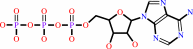 ATP
ATP
|
=
|
O-phospho-L-seryl-[protein]
Bound ligand (Het Group name = )
corresponds exactly
|
+
|
 ADP
ADP
|
+
|
H(+)
|
|
|
|
|
|
|
L-threonyl-[protein]
|
+
|
ATP
|
=
|
O-phospho-L-threonyl-[protein]
Bound ligand (Het Group name = )
corresponds exactly
|
+
|
ADP
|
+
|
H(+)
|
|
|
|
|
|
|
|
|
|
|
|
|
Molecule diagrams generated from .mol files obtained from the
KEGG ftp site
|
|
|
|
|
|
|
|
|
|
|
|
|
|
 |
|
|
|
|
|
|
| |
|
|
| |
|
DOI no:
|
EMBO J
25:3179-3190
(2006)
|
|
PubMed id:
|
|
|
|
|
|
| |
|
Trans-activation of the DNA-damage signalling protein kinase Chk2 by T-loop exchange.
|
|
A.W.Oliver,
A.Paul,
K.J.Boxall,
S.E.Barrie,
G.W.Aherne,
M.D.Garrett,
S.Mittnacht,
L.H.Pearl.
|
|
|
|
|
| |
ABSTRACT
|
|
|
|
| |
|
|
The protein kinase Chk2 (checkpoint kinase 2) is a major effector of the
replication checkpoint. Chk2 activation is initiated by phosphorylation of
Thr68, in the serine-glutamine/threonine-glutamine cluster domain (SCD), by ATM.
The phosphorylated SCD-segment binds to the FHA domain of a second Chk2
molecule, promoting dimerisation of the protein and triggering phosphorylation
of the activation segment/T-loop in the kinase domain. We have now determined
the structure of the kinase domain of human Chk2 in complexes with ADP and a
small-molecule inhibitor debromohymenialdisine. The structure reveals a
remarkable dimeric arrangement in which T-loops are exchanged between protomers,
to form an active kinase conformation in trans. Biochemical data suggest that
this dimer is the biologically active state promoted by ATM-phosphorylation, and
also suggests a mechanism for dimerisation-driven activation of Chk2 by
trans-phosphorylation.
|
|
|
|
|
|
| |
Selected figure(s)
|
|
|
|
| |
|
|

|
|

|
|
Figure 2.
Figure 2 Structure of Chk2 kinase domain. Secondary structure
cartoon of the binary complex of CHK2-KD with ADP. The
glycine-rich loop is coloured pink, the DFG and APE motifs red,
and the T-loop yellow. Secondary structure elements
corresponding to  -strands
are coloured blue and -strands
are coloured blue and  -helices
cyan. ADP is shown as a 'stick' model. The catalytic residue
Asp347, conserved residues Lys249 and Glu373, and
autophosphorylation sites Thr383 and Thr387 are also
highlighted. Molecular images in this and subsequent figures
were generated using PyMOL (www.pymol.org). -helices
cyan. ADP is shown as a 'stick' model. The catalytic residue
Asp347, conserved residues Lys249 and Glu373, and
autophosphorylation sites Thr383 and Thr387 are also
highlighted. Molecular images in this and subsequent figures
were generated using PyMOL (www.pymol.org).
|
|
Figure 7.
Figure 7 Chk2 T-loop autophosphorylation sites do not resemble
endogenous substrates. Alignment of endogenous Chk2 substrate
sequences (CDC25A, CDC25C, BRCA-1, E2F-1, PML) with an optimised
substrate sequence (Chk2-TIDE) and T-loop autophosphorylation
sites. For each sequence, the residue number of the first amino
acid is listed (res). The autophosphorylation sites of Chk2
overlap, as indicated by the underlined regions. The 'p' column
header indicates the phosphorylated amino acid.
|
|
|
|
|
|
| |
The above figures are
reprinted
from an Open Access publication published by Macmillan Publishers Ltd:
EMBO J
(2006,
25,
3179-3190)
copyright 2006.
|
|
| |
Figures were
selected
by an automated process.
|
|
|
|
|
|
|
|
|
|
|
|
|
|
|
|
 |
 |
 |
|
Literature references that cite this PDB file's key reference
|
|
|
| |
PubMed id
|
|
Reference
|
|
|
|
|
|
E.Sala,
L.Guasch,
J.Iwaszkiewicz,
M.Mulero,
M.J.Salvadó,
M.Pinent,
V.Zoete,
A.Grosdidier,
S.Garcia-Vallvé,
O.Michielin,
and
G.Pujadas
(2011).
Identification of human IKK-2 inhibitors of natural origin (part I): modeling of the IKK-2 kinase domain, virtual screening and activity assays.
|
| |
PLoS One,
6,
e16903.
|
|
|
|
|
|
|
M.M.Ali,
T.Bagratuni,
E.L.Davenport,
P.R.Nowak,
M.C.Silva-Santisteban,
A.Hardcastle,
C.McAndrews,
M.G.Rowlands,
G.J.Morgan,
W.Aherne,
I.Collins,
F.E.Davies,
and
L.H.Pearl
(2011).
Structure of the Ire1 autophosphorylation complex and implications for the unfolded protein response.
|
| |
EMBO J,
30,
894-905.
|
|
|
PDB code:
|
|
|
|
|
|
|
|
J.Eswaran,
and
S.Knapp
(2010).
Insights into protein kinase regulation and inhibition by large scale structural comparison.
|
| |
Biochim Biophys Acta,
1804,
429-432.
|
|
|
|
|
|
|
J.M.Steichen,
G.H.Iyer,
S.Li,
S.A.Saldanha,
M.S.Deal,
V.L.Woods,
and
S.S.Taylor
(2010).
Global consequences of activation loop phosphorylation on protein kinase A.
|
| |
J Biol Chem,
285,
3825-3832.
|
|
|
|
|
|
|
M.Rabiller,
M.Getlik,
S.Klüter,
A.Richters,
S.Tückmantel,
J.R.Simard,
and
D.Rauh
(2010).
Proteus in the world of proteins: conformational changes in protein kinases.
|
| |
Arch Pharm (Weinheim),
343,
193-206.
|
|
|
|
|
|
|
P.Barthe,
G.V.Mukamolova,
C.Roumestand,
and
M.Cohen-Gonsaud
(2010).
The structure of PknB extracellular PASTA domain from mycobacterium tuberculosis suggests a ligand-dependent kinase activation.
|
| |
Structure,
18,
606-615.
|
|
|
PDB codes:
|
|
|
|
|
|
|
|
T.Sunami,
N.Byrne,
R.E.Diehl,
K.Funabashi,
D.L.Hall,
M.Ikuta,
S.B.Patel,
J.M.Shipman,
R.F.Smith,
I.Takahashi,
J.Zugay-Murphy,
Y.Iwasawa,
K.J.Lumb,
S.K.Munshi,
and
S.Sharma
(2010).
Structural basis of human p70 ribosomal S6 kinase-1 regulation by activation loop phosphorylation.
|
| |
J Biol Chem,
285,
4587-4594.
|
|
|
PDB codes:
|
|
|
|
|
|
|
|
X.Guo,
M.D.Ward,
J.B.Tiedebohl,
Y.M.Oden,
J.O.Nyalwidhe,
and
O.J.Semmes
(2010).
Interdependent phosphorylation within the kinase domain T-loop Regulates CHK2 activity.
|
| |
J Biol Chem,
285,
33348-33357.
|
|
|
|
|
|
|
A.G.Jobson,
G.T.Lountos,
P.L.Lorenzi,
J.Llamas,
J.Connelly,
D.Cerna,
J.E.Tropea,
A.Onda,
G.Zoppoli,
S.Kondapaka,
G.Zhang,
N.J.Caplen,
J.H.Cardellina,
S.S.Yoo,
A.Monks,
C.Self,
D.S.Waugh,
R.H.Shoemaker,
and
Y.Pommier
(2009).
Cellular inhibition of checkpoint kinase 2 (Chk2) and potentiation of camptothecins and radiation by the novel Chk2 inhibitor PV1019 [7-nitro-1H-indole-2-carboxylic acid {4-[1-(guanidinohydrazone)-ethyl]-phenyl}-amide].
|
| |
J Pharmacol Exp Ther,
331,
816-826.
|
|
|
PDB code:
|
|
|
|
|
|
|
|
F.A.Pasha,
M.Muddassar,
and
S.Joo Cho
(2009).
Molecular docking and 3D QSAR studies of Chk2 inhibitors.
|
| |
Chem Biol Drug Des,
73,
292-300.
|
|
|
|
|
|
|
G.T.Lountos,
J.E.Tropea,
D.Zhang,
A.G.Jobson,
Y.Pommier,
R.H.Shoemaker,
and
D.S.Waugh
(2009).
Crystal structure of checkpoint kinase 2 in complex with NSC 109555, a potent and selective inhibitor.
|
| |
Protein Sci,
18,
92.
|
|
|
PDB code:
|
|
|
|
|
|
|
|
S.J.Lee,
M.H.Cobb,
and
E.J.Goldsmith
(2009).
Crystal structure of domain-swapped STE20 OSR1 kinase domain.
|
| |
Protein Sci,
18,
304-313.
|
|
|
PDB code:
|
|
|
|
|
|
|
|
Y.J.Xu,
and
T.J.Kelly
(2009).
Autoinhibition and autoactivation of the DNA replication checkpoint kinase cds1.
|
| |
J Biol Chem,
284,
16016-16027.
|
|
|
|
|
|
|
Y.Li,
and
A.G.Palmer
(2009).
Domain swapping in the kinase superfamily: OSR1 joins the mix.
|
| |
Protein Sci,
18,
678-681.
|
|
|
|
|
|
|
Z.Cai,
N.H.Chehab,
and
N.P.Pavletich
(2009).
Structure and activation mechanism of the CHK2 DNA damage checkpoint kinase.
|
| |
Mol Cell,
35,
818-829.
|
|
|
PDB codes:
|
|
|
|
|
|
|
|
A.C.Pike,
P.Rellos,
F.H.Niesen,
A.Turnbull,
A.W.Oliver,
S.A.Parker,
B.E.Turk,
L.H.Pearl,
and
S.Knapp
(2008).
Activation segment dimerization: a mechanism for kinase autophosphorylation of non-consensus sites.
|
| |
EMBO J,
27,
704-714.
|
|
|
PDB codes:
|
|
|
|
|
|
|
|
C.Mieczkowski,
A.T.Iavarone,
and
T.Alber
(2008).
Auto-activation mechanism of the Mycobacterium tuberculosis PknB receptor Ser/Thr kinase.
|
| |
EMBO J,
27,
3186-3197.
|
|
|
PDB codes:
|
|
|
|
|
|
|
|
F.Villa,
M.Deak,
D.R.Alessi,
and
D.M.van Aalten
(2008).
Structure of the OSR1 kinase, a hypertension drug target.
|
| |
Proteins,
73,
1082-1087.
|
|
|
PDB code:
|
|
|
|
|
|
|
|
J.Li,
I.A.Taylor,
J.Lloyd,
J.A.Clapperton,
S.Howell,
D.Macmillan,
and
S.J.Smerdon
(2008).
Chk2 Oligomerization Studied by Phosphopeptide Ligation: IMPLICATIONS FOR REGULATION AND PHOSPHODEPENDENT INTERACTIONS.
|
| |
J Biol Chem,
283,
36019-36030.
|
|
|
|
|
|
|
J.Wu,
W.Li,
B.P.Craddock,
K.W.Foreman,
M.J.Mulvihill,
Q.S.Ji,
W.T.Miller,
and
S.R.Hubbard
(2008).
Small-molecule inhibition and activation-loop trans-phosphorylation of the IGF1 receptor.
|
| |
EMBO J,
27,
1985-1994.
|
|
|
PDB code:
|
|
|
|
|
|
|
|
R.Jacamo,
J.Sinnett-Smith,
O.Rey,
R.T.Waldron,
and
E.Rozengurt
(2008).
Sequential protein kinase C (PKC)-dependent and PKC-independent protein kinase D catalytic activation via Gq-coupled receptors: differential regulation of activation loop Ser(744) and Ser(748) phosphorylation.
|
| |
J Biol Chem,
283,
12877-12887.
|
|
|
|
|
|
|
R.T.Nitta,
A.H.Chu,
and
A.J.Wong
(2008).
Constitutive Activity of JNK2{alpha}2 Is Dependent on a Unique Mechanism of MAPK Activation.
|
| |
J Biol Chem,
283,
34935-34945.
|
|
|
|
|
|
|
Z.Kleibl,
O.Havranek,
J.Novotny,
P.Kleiblova,
P.Soucek,
and
P.Pohlreich
(2008).
Analysis of CHEK2 FHA domain in Czech patients with sporadic breast cancer revealed distinct rare genetic alterations.
|
| |
Breast Cancer Res Treat,
112,
159-164.
|
|
|
|
|
|
|
A.W.Oliver,
S.Knapp,
and
L.H.Pearl
(2007).
Activation segment exchange: a common mechanism of kinase autophosphorylation?
|
| |
Trends Biochem Sci,
32,
351-356.
|
|
|
|
|
|
|
E.M.Kass,
J.Ahn,
T.Tanaka,
W.A.Freed-Pastor,
S.Keezer,
and
C.Prives
(2007).
Stability of checkpoint kinase 2 is regulated via phosphorylation at serine 456.
|
| |
J Biol Chem,
282,
30311-30321.
|
|
|
|
|
|
|
L.Antoni,
N.Sodha,
I.Collins,
and
M.D.Garrett
(2007).
CHK2 kinase: cancer susceptibility and cancer therapy - two sides of the same coin?
|
| |
Nat Rev Cancer,
7,
925-936.
|
|
|
|
|
|
|
O.Fedorov,
B.Marsden,
V.Pogacic,
P.Rellos,
S.Müller,
A.N.Bullock,
J.Schwaller,
M.Sundström,
and
S.Knapp
(2007).
A systematic interaction map of validated kinase inhibitors with Ser/Thr kinases.
|
| |
Proc Natl Acad Sci U S A,
104,
20523-20528.
|
|
|
PDB code:
|
|
|
|
|
|
|
|
S.K.Gupta,
X.Guo,
S.S.Durkin,
K.F.Fryrear,
M.D.Ward,
and
O.J.Semmes
(2007).
Human T-cell leukemia virus type 1 Tax oncoprotein prevents DNA damage-induced chromatin egress of hyperphosphorylated Chk2.
|
| |
J Biol Chem,
282,
29431-29440.
|
|
|
|
|
|
|
T.Usui,
and
J.H.Petrini
(2007).
The Saccharomyces cerevisiae 14-3-3 proteins Bmh1 and Bmh2 directly influence the DNA damage-dependent functions of Rad53.
|
| |
Proc Natl Acad Sci U S A,
104,
2797-2802.
|
|
|
|
|
|
|
G.Buscemi,
L.Carlessi,
L.Zannini,
S.Lisanti,
E.Fontanella,
S.Canevari,
and
D.Delia
(2006).
DNA damage-induced cell cycle regulation and function of novel Chk2 phosphoresidues.
|
| |
Mol Cell Biol,
26,
7832-7845.
|
|
|
|
|
|
The most recent references are shown first.
Citation data come partly from CiteXplore and partly
from an automated harvesting procedure. Note that this is likely to be
only a partial list as not all journals are covered by
either method. However, we are continually building up the citation data
so more and more references will be included with time.
Where a reference describes a PDB structure, the PDB
code is
shown on the right.
|
|


 Links
Links


