
|
|
|
|
|
 |
Contents |
 |
|
|
|
|
|
|
|
|
|
|
|


 229 a.a.
|
|
|
|
|
|
|
|
|
|
|

 1119 a.a.
|
|
|
|
|
|
|
|
|
|
|

 1392 a.a.
|
|
|
|
|
|
|
|
|
|
|

 95 a.a.
|
|
|
|
|
|
|
|
|
|
|

 345 a.a.
|
|
|
|
|
|
|
|
|
|
|
|
|
* Residue conservation analysis
|
|
|
|
|
|
PDB id:
|
|
|
|
| Name: |
|
Transferase
|
|
|
Title:
|
|
Crystal structure of the t. Thermophilus RNA polymerase holoenzyme in complex with inhibitor tagetitoxin
|
|
Structure:
|
|
DNA-directed RNA polymerase alpha chain. Chain: a, b, k, l. Synonym: rnap alpha subunit, transcriptase alpha chain, RNA polymerase alpha subunit. DNA-directed RNA polymerase beta chain. Chain: c, m. Synonym: rnap beta subunit, transcriptase beta chain, RNA polymerase beta subunit. DNA-directed RNA polymerase beta' chain.
|
|
Source:
|
|
Thermus thermophilus. Organism_taxid: 274. Organism_taxid: 274
|
|
Biol. unit:
|
|
 Hexamer (from
)
Hexamer (from
)
|
|
Resolution:
|
|
|
2.40Å
|
R-factor:
|
0.237
|
R-free:
|
0.274
|
|
|
Authors:
|
|
D.G.Vassylyev,V.Svetlov,M.N.Vassylyeva,A.Perederina,N.Igarashi, N.Matsugaki,S.Wakatsuki,I.Artsimovitch,Riken Structural Genomics/proteomics Initiative (Rsgi)
|
Key ref:

|
|
D.G.Vassylyev
et al.
(2005).
Structural basis for transcription inhibition by tagetitoxin.
Nat Struct Mol Biol,
12,
1086-1093.
PubMed id:
DOI:

|
|
|
Date:
|
|
|
22-Oct-05
|
Release date:
|
08-Nov-05
|
|
|
|
|
|
|
PROCHECK
|

|
|
|
|
|
Headers
|
|
|
|
References
|
|
|
|
|
|

|
|
Q5SHR6
(RPOA_THET8) -
DNA-directed RNA polymerase subunit alpha from Thermus thermophilus (strain ATCC 27634 / DSM 579 / HB8)
|
|
|
|
Seq:
Struc:
|
|
|
|
315 a.a.
229 a.a.
|
|

|

|

|
|
|
|
|
|
|
|
|
|
|
|

|
|
Q8RQE9
(RPOB_THET8) -
DNA-directed RNA polymerase subunit beta from Thermus thermophilus (strain ATCC 27634 / DSM 579 / HB8)
|
|
|
|
Seq:
Struc:
|
|
|
|
1119 a.a.
1119 a.a.
|
|
|

|
|
|
|
|
|
|
|
|
|
|
|
|

|
|
Q8RQE8
(RPOC_THET8) -
DNA-directed RNA polymerase subunit beta' from Thermus thermophilus (strain ATCC 27634 / DSM 579 / HB8)
|
|
|
|
Seq:
Struc:
|
|
|
|
1524 a.a.
1392 a.a.
|
|
|

|
|
|
|
|
|
|
|
|
|
|
|
|
|
|
|
|
|
Enzyme class:
|
|
Chains A, B, C, D, E, K, L, M, N, O:
E.C.2.7.7.6
- DNA-directed Rna polymerase.
|
|
|
|
|
|
|
Reaction:
|
|
RNA(n) + a ribonucleoside 5'-triphosphate = RNA(n+1) + diphosphate
|
|
|
|
|
|
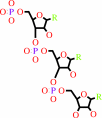 RNA(n)
|
+
|
ribonucleoside 5'-triphosphate
|
=
|
RNA(n+1)
|
+
|
 diphosphate
|
|
|
|
|
|
|
|
|
|
|
|
|
Molecule diagrams generated from .mol files obtained from the
KEGG ftp site
|
|
|
|
|
|
|
|
|
|
|
|
|
|
 |
|
|
|
|
|
|
| |
|
|
| |
|
DOI no:
|
Nat Struct Mol Biol
12:1086-1093
(2005)
|
|
PubMed id:
|
|
|
|
|
|
| |
|
Structural basis for transcription inhibition by tagetitoxin.
|
|
D.G.Vassylyev,
V.Svetlov,
M.N.Vassylyeva,
A.Perederina,
N.Igarashi,
N.Matsugaki,
S.Wakatsuki,
I.Artsimovitch.
|
|
|
|
|
| |
ABSTRACT
|
|
|
|
| |
|
|
Tagetitoxin (Tgt) inhibits transcription by an unknown mechanism. A structure at
a resolution of 2.4 A of the Thermus thermophilus RNA polymerase (RNAP)-Tgt
complex revealed that the Tgt-binding site within the RNAP secondary channel
overlaps that of the stringent control effector ppGpp, which partially protects
RNAP from Tgt inhibition. Tgt binding is mediated exclusively through polar
interactions with the beta and beta' residues whose substitutions confer
resistance to Tgt in vitro. Importantly, a Tgt phosphate, together with two
active site acidic residues, coordinates the third Mg(2+) ion, which is distinct
from the two catalytic metal ions. We show that Tgt inhibits all RNAP catalytic
reactions and propose a mechanism in which the Tgt-bound Mg(2+) ion has a key
role in stabilization of an inactive transcription intermediate. Remodeling of
the active site by metal ions could be a common theme in the regulation of
catalysis by nucleic acid enzymes.
|
|
|
|
|
|
| |
Selected figure(s)
|
|
|
|
| |
|
|

|
|

|
|
Figure 3.
Figure 3. Tgt and ppGpp bind to overlapping sites on RNAP.
(a) Superposition of the ttRNAP-Tgt and ttRNAP-ppGpp complexes.
The color scheme is the same as in Figures 1a and 2a. (b,c)
Structural determinants probably crucial for Tgt and ppGpp
binding. The RNAP-Tgt (b) and RNAP-ppGpp (c) complexes are shown
in the same orientation for better comparison. Residues that are
not identical between E. coli and T. thermophilus are marked by
their numbers only. RNAP residues (balls and sticks) that
interact with both Tgt and ppGpp are shown in green, whereas
those specific for Tgt and ppGpp are shown in light cyan and
light pink, respectively. (d) ppGpp and DksA compete with Tgt
for the inhibition of abortive transcription by the wild-type
ecRNAP from the T7A1 promoter. The assay was conducted as in
Figure 2d. ppGpp was added to 0.5 mM, DksA to 500 nM.
|
|
Figure 5.
Figure 5. Mechanism of Tgt action. (a-c) Models of the
substrates (light green) corresponding to the three postulated
consecutive steps during NTP loading to the RNAP active site are
superimposed on the RNAP-Tgt structure; the E site (a), the
preinsertion site (b) and the insertion site (c); the PDB
accession codes used in panels a, b and c were 1R9T, 1Y77 and
1R9S, respectively. The putative coordination bonds with tMG
and/or cMG2 of Tgt (cyan), the NTP in the preinsertion site and
the  -phosphate
(P )
of the NTP in the insertion site (light green) (b,c), as well as
of the NTP -phosphate
(P )
of the NTP in the insertion site (light green) (b,c), as well as
of the NTP  -phosphates
in the insertion site (c) in the 'catalytic' cP (yellow)
and 'inactive', tMG-bound tP (red)
configurations are shown by dashed lines. (d) Stabilization of
an inactive transcription intermediate by Tgt. -phosphates
in the insertion site (c) in the 'catalytic' cP (yellow)
and 'inactive', tMG-bound tP (red)
configurations are shown by dashed lines. (d) Stabilization of
an inactive transcription intermediate by Tgt.
|
|
|
|
|
|
| |
The above figures are
reprinted
by permission from Macmillan Publishers Ltd:
Nat Struct Mol Biol
(2005,
12,
1086-1093)
copyright 2005.
|
|
| |
Figures were
selected
by the author.
|
|
|
|
|
|
|
|
|
|
|
|
|
|
|
|
 |
 |
 |
|
Literature references that cite this PDB file's key reference
|
|
|
| |
PubMed id
|
|
Reference
|
|
|
|
|
|
J.Farlow,
M.A.Ichou,
J.Huggins,
and
S.Ibrahim
(2010).
Comparative whole genome sequence analysis of wild-type and cidofovir-resistant monkeypoxvirus.
|
| |
Virol J,
7,
110.
|
|
|
|
|
|
|
V.Epshtein,
D.Dutta,
J.Wade,
and
E.Nudler
(2010).
An allosteric mechanism of Rho-dependent transcription termination.
|
| |
Nature,
463,
245-249.
|
|
|
|
|
|
|
Y.Yuzenkova,
and
N.Zenkin
(2010).
Central role of the RNA polymerase trigger loop in intrinsic RNA hydrolysis.
|
| |
Proc Natl Acad Sci U S A,
107,
10878-10883.
|
|
|
|
|
|
|
D.G.Vassylyev
(2009).
Elongation by RNA polymerase: a race through roadblocks.
|
| |
Curr Opin Struct Biol,
19,
691-700.
|
|
|
|
|
|
|
E.Nudler
(2009).
RNA polymerase active center: the molecular engine of transcription.
|
| |
Annu Rev Biochem,
78,
335-361.
|
|
|
|
|
|
|
G.A.Belogurov,
M.N.Vassylyeva,
A.Sevostyanova,
J.R.Appleman,
A.X.Xiang,
R.Lira,
S.E.Webber,
S.Klyuyev,
E.Nudler,
I.Artsimovitch,
and
D.G.Vassylyev
(2009).
Transcription inactivation through local refolding of the RNA polymerase structure.
|
| |
Nature,
457,
332-335.
|
|
|
PDB code:
|
|
|
|
|
|
|
|
I.Artsimovitch,
and
T.M.Henkin
(2009).
In vitro approaches to analysis of transcription termination.
|
| |
Methods,
47,
37-43.
|
|
|
|
|
|
|
C.E.Vrentas,
T.Gaal,
M.B.Berkmen,
S.T.Rutherford,
S.P.Haugen,
D.G.Vassylyev,
W.Ross,
and
R.L.Gourse
(2008).
Still looking for the magic spot: the crystallographically defined binding site for ppGpp on RNA polymerase is unlikely to be responsible for rRNA transcription regulation.
|
| |
J Mol Biol,
377,
551-564.
|
|
|
|
|
|
|
D.Dutta,
J.Chalissery,
and
R.Sen
(2008).
Transcription termination factor rho prefers catalytically active elongation complexes for releasing RNA.
|
| |
J Biol Chem,
283,
20243-20251.
|
|
|
|
|
|
|
S.Borukhov,
and
E.Nudler
(2008).
RNA polymerase: the vehicle of transcription.
|
| |
Trends Microbiol,
16,
126-134.
|
|
|
|
|
|
|
V.Svetlov,
G.A.Belogurov,
E.Shabrova,
D.G.Vassylyev,
and
I.Artsimovitch
(2007).
Allosteric control of the RNA polymerase by the elongation factor RfaH.
|
| |
Nucleic Acids Res,
35,
5694-5705.
|
|
|
|
|
|
|
D.Wang,
D.A.Bushnell,
K.D.Westover,
C.D.Kaplan,
and
R.D.Kornberg
(2006).
Structural basis of transcription: role of the trigger loop in substrate specificity and catalysis.
|
| |
Cell,
127,
941-954.
|
|
|
PDB codes:
|
|
|
|
|
|
|
|
E.Kashkina,
M.Anikin,
T.H.Tahirov,
S.N.Kochetkov,
D.G.Vassylyev,
and
D.Temiakov
(2006).
Elongation complexes of Thermus thermophilus RNA polymerase that possess distinct translocation conformations.
|
| |
Nucleic Acids Res,
34,
4036-4045.
|
|
|
|
|
|
|
J.R.Plet,
and
M.J.Porter
(2006).
Synthesis of the bicyclic core of tagetitoxin.
|
| |
Chem Commun (Camb),
(),
1197-1199.
|
|
|
|
|
|
|
J.Symersky,
A.Perederina,
M.N.Vassylyeva,
V.Svetlov,
I.Artsimovitch,
and
D.G.Vassylyev
(2006).
Regulation through the RNA polymerase secondary channel. Structural and functional variability of the coiled-coil transcription factors.
|
| |
J Biol Chem,
281,
1309-1312.
|
|
|
PDB code:
|
|
|
|
|
|
|
The most recent references are shown first.
Citation data come partly from CiteXplore and partly
from an automated harvesting procedure. Note that this is likely to be
only a partial list as not all journals are covered by
either method. However, we are continually building up the citation data
so more and more references will be included with time.
Where a reference describes a PDB structure, the PDB
code is
shown on the right.
|

| |


 Links
Links









