|
|
|
|
|
 |
Contents |
 |
|
|
|
|
|
|
|
|
|
|
|
|
|
|
* Residue conservation analysis
|
|
|
|
|
|
|
|
|
|
Enzyme class 1:
|
|
Chains A, B:
E.C.2.7.7.-
- ?????
|
|
|
|
|
|
|
Enzyme class 2:
|
|
Chains A, B:
E.C.2.7.7.49
- RNA-directed Dna polymerase.
|
|
|
|
|
|
|
Reaction:
|
|
DNA(n) + a 2'-deoxyribonucleoside 5'-triphosphate = DNA(n+1) + diphosphate
|
|
|
|
|
|
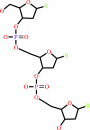 DNA(n)
|
+
|
2'-deoxyribonucleoside 5'-triphosphate
|
=
|
DNA(n+1)
|
+
|
 diphosphate
|
|
|
|
|
|
|
|
|
|
Enzyme class 3:
|
|
Chains A, B:
E.C.2.7.7.7
- DNA-directed Dna polymerase.
|
|
|
|
|
|
|
Reaction:
|
|
DNA(n) + a 2'-deoxyribonucleoside 5'-triphosphate = DNA(n+1) + diphosphate
|
|
|
|
|
|
DNA(n)
|
+
|
2'-deoxyribonucleoside 5'-triphosphate
|
=
|
DNA(n+1)
|
+
|
diphosphate
|
|
|
|
|
|
|
|
|
|
Enzyme class 4:
|
|
Chains A, B:
E.C.3.1.-.-
|
|
|
|
|
|
|
Enzyme class 5:
|
|
Chains A, B:
E.C.3.1.13.2
- exoribonuclease H.
|
|
|
|
|
|
|
Reaction:
|
|
Exonucleolytic cleavage to 5'-phosphomonoester oligonucleotides in both 5'- to 3'- and 3'- to 5'-directions.
|
|
|
|
|
|
Enzyme class 6:
|
|
Chains A, B:
E.C.3.1.26.13
- retroviral ribonuclease H.
|
|
|
|
|
|
|
Enzyme class 7:
|
|
Chains A, B:
E.C.3.4.23.16
- HIV-1 retropepsin.
|
|
|
|
|
|
|
Reaction:
|
|
Specific for a P1 residue that is hydrophobic, and P1' variable, but often Pro.
|
|
|
|
|
|
|
|
|
Note, where more than one E.C. class is given (as above), each may
correspond to a different protein domain or, in the case of polyprotein
precursors, to a different mature protein.
|
|
|
|
Molecule diagrams generated from .mol files obtained from the
KEGG ftp site
|
|
|
|
|
|
|
|
|
|
|
|
|
|
 |
|
|
|
|
|
|
| |
|
|
| |
|
DOI no:
|
J Mol Biol
365:77-89
(2007)
|
|
PubMed id:
|
|
|
|
|
|
| |
|
Crystal Structures of Clinically Relevant Lys103Asn/Tyr181Cys Double Mutant HIV-1 Reverse Transcriptase in Complexes with ATP and Non-nucleoside Inhibitor HBY 097.
|
|
K.Das,
S.G.Sarafianos,
A.D.Clark,
P.L.Boyer,
S.H.Hughes,
E.Arnold.
|
|
|
|
|
| |
ABSTRACT
|
|
|
|
| |
|
|
Lys103Asn and Tyr181Cys are the two mutations frequently observed in patients
exposed to various non-nucleoside reverse transcriptase inhibitor drugs
(NNRTIs). Human immunodeficiency virus (HIV) strains containing both reverse
transcriptase (RT) mutations are resistant to all of the approved NNRTI drugs.
We have determined crystal structures of Lys103Asn/Tyr181Cys mutant HIV-1 RT
with and without a bound non-nucleoside inhibitor (HBY 097,
(S)-4-isopropoxycarbonyl-6-methoxy-3-(methylthio-methyl)-3,4-dihydroquinoxalin-2(1H)-thione)
at 3.0 A and 2.5 A resolution, respectively. The structure of the double mutant
RT/HBY 097 complex shows a rearrangement of the isopropoxycarbonyl group of HBY
097 compared to its binding with wild-type RT. HBY 097 makes a hydrogen bond
with the thiol group of Cys181 that helps the drug retain potency against the
Tyr181Cys mutation. The structure of the unliganded double mutant HIV-1 RT
showed that Lys103Asn mutation facilitates coordination of a sodium ion with
Lys101 O, Asn103 N and O(delta1), Tyr188 O(eta), and two water molecules. The
formation of the binding pocket requires the removal of the sodium ion. Although
the RT alone and the RT/HBY 097 complex were crystallized in the presence of
ATP, only the RT has an ATP coordinated with two Mn(2+) at the polymerase active
site. The metal coordination mimics a reaction intermediate state in which
complete octahedral coordination was observed for both metal ions. Asp186
coordinates at an axial position whereas the carboxylates of Asp110 and Asp185
are in the planes of coordination of both metal ions. The structures provide
evidence that NNRTIs restrict the flexibility of the YMDD loop and prevent the
catalytic aspartate residues from adopting their metal-binding conformations.
|
|
|
|
|
|
| |
Selected figure(s)
|
|
|
|
| |
|
|

|
|

|
|
Figure 1.
Figure 1. Effects of the two mutations (Lys103Asn and
Tyr181Cys) on the structure of unliganded HIV-1 RT. (a) A stereo
view of the NNIBP region of the double mutant RT/ATP structure.
The composite simulated annealing omit map (2|F[o]|–|F[c]|)
electron density (cyan) contoured at 1.2σ defines the
coordination of a Na ion at the NNIBP region; OW1 and OW2 are
two water molecules. (b) The NNIBP region of the double mutant
(Lys103Asn/Tyr181Cys) HIV-1 RT. The mutated amino acids have
altered interactions with the surrounding amino acids. (c) The
NNIBP region of the wild type unliganded HIV-1 RT structure.^13
|
|
Figure 2.
Figure 2. Binding mode of HBY 097 to the
Lys103Asn/Tyr181Cys double mutant RT. (a) Stereo view of the
(2|F[o]|–|F[c]|) electron density (contoured at 1.2σ)
covering HBY 097 (cyan) and Cys181 (magenta). The dotted line
represents the hydrogen bond between the thiol group of Cys181
and HBY 097. Electrostatic potential surface^62 showing the
NNIBP region of (b) the double mutant RT/HBY 097 and (c)
wild-type RT/HBY 097^13 structures.
|
|
|
|
|
|
| |
The above figures are
reprinted
by permission from Elsevier:
J Mol Biol
(2007,
365,
77-89)
copyright 2007.
|
|
| |
Figures were
selected
by an automated process.
|
|
|
|
|
|
|
|
|
|
|
|
|
|
|
|
 |
 |
 |
|
Literature references that cite this PDB file's key reference
|
|
|
| |
PubMed id
|
|
Reference
|
|
|
|
|
|
A.Engelman,
and
P.Cherepanov
(2012).
The structural biology of HIV-1: mechanistic and therapeutic insights.
|
| |
Nat Rev Microbiol,
10,
279-290.
|
|
|
|
|
|
|
S.Ibe,
and
W.Sugiura
(2011).
Clinical significance of HIV reverse-transcriptase inhibitor-resistance mutations.
|
| |
Future Microbiol,
6,
295-315.
|
|
|
|
|
|
|
G.J.van Westen,
J.K.Wegner,
A.Bender,
A.P.Ijzerman,
and
H.W.van Vlijmen
(2010).
Mining protein dynamics from sets of crystal structures using "consensus structures".
|
| |
Protein Sci,
19,
742-752.
|
|
|
|
|
|
|
J.A.Brown,
K.A.Fiala,
J.D.Fowler,
S.M.Sherrer,
S.A.Newmister,
W.W.Duym,
and
Z.Suo
(2010).
A novel mechanism of sugar selection utilized by a human X-family DNA polymerase.
|
| |
J Mol Biol,
395,
282-290.
|
|
|
|
|
|
|
K.A.Delviks-Frankenberry,
G.N.Nikolenko,
and
V.K.Pathak
(2010).
The "Connection" Between HIV Drug Resistance and RNase H.
|
| |
Viruses,
2,
1476-1503.
|
|
|
|
|
|
|
K.Singh,
B.Marchand,
K.A.Kirby,
E.Michailidis,
and
S.G.Sarafianos
(2010).
Structural Aspects of Drug Resistance and Inhibition of HIV-1 Reverse Transcriptase.
|
| |
Viruses,
2,
606-638.
|
|
|
|
|
|
|
M.Götte,
J.W.Rausch,
B.Marchand,
S.Sarafianos,
and
S.F.Le Grice
(2010).
Reverse transcriptase in motion: conformational dynamics of enzyme-substrate interactions.
|
| |
Biochim Biophys Acta,
1804,
1202-1212.
|
|
|
|
|
|
|
M.Yokoyama,
H.Mori,
and
H.Sato
(2010).
Allosteric regulation of HIV-1 reverse transcriptase by ATP for nucleotide selection.
|
| |
PLoS One,
5,
e8867.
|
|
|
|
|
|
|
X.Tu,
K.Das,
Q.Han,
J.D.Bauman,
A.D.Clark,
X.Hou,
Y.V.Frenkel,
B.L.Gaffney,
R.A.Jones,
P.L.Boyer,
S.H.Hughes,
S.G.Sarafianos,
and
E.Arnold
(2010).
Structural basis of HIV-1 resistance to AZT by excision.
|
| |
Nat Struct Mol Biol,
17,
1202-1209.
|
|
|
PDB codes:
|
|
|
|
|
|
|
|
E.Skordalakes
(2009).
Telomerase structure paves the way for new cancer therapies.
|
| |
Future Oncol,
5,
163-167.
|
|
|
|
|
|
|
K.Das,
R.P.Bandwar,
K.L.White,
J.Y.Feng,
S.G.Sarafianos,
S.Tuske,
X.Tu,
A.D.Clark,
P.L.Boyer,
X.Hou,
B.L.Gaffney,
R.A.Jones,
M.D.Miller,
S.H.Hughes,
and
E.Arnold
(2009).
Structural basis for the role of the K65r mutation in HIV-1 reverse transcriptase polymerization, excision antagonism, and tenofovir resistance.
|
| |
J Biol Chem,
284,
35092-35100.
|
|
|
PDB codes:
|
|
|
|
|
|
|
|
S.G.Sarafianos,
B.Marchand,
K.Das,
D.M.Himmel,
M.A.Parniak,
S.H.Hughes,
and
E.Arnold
(2009).
Structure and function of HIV-1 reverse transcriptase: molecular mechanisms of polymerization and inhibition.
|
| |
J Mol Biol,
385,
693-713.
|
|
|
|
|
|
|
Z.K.Sweeney,
J.J.Kennedy-Smith,
J.Wu,
N.Arora,
J.R.Billedeau,
J.P.Davidson,
J.Fretland,
J.Q.Hang,
G.M.Heilek,
S.F.Harris,
D.Hirschfeld,
P.Inbar,
H.Javanbakht,
J.A.Jernelius,
Q.Jin,
Y.Li,
W.Liang,
R.Roetz,
K.Sarma,
M.Smith,
D.Stefanidis,
G.Su,
J.M.Suh,
A.G.Villaseñor,
M.Welch,
F.J.Zhang,
and
K.Klumpp
(2009).
Diphenyl ether non-nucleoside reverse transcriptase inhibitors with excellent potency against resistant mutant viruses and promising pharmacokinetic properties.
|
| |
ChemMedChem,
4,
88-99.
|
|
|
|
|
|
|
A.Hachiya,
E.N.Kodama,
S.G.Sarafianos,
M.M.Schuckmann,
Y.Sakagami,
M.Matsuoka,
M.Takiguchi,
H.Gatanaga,
and
S.Oka
(2008).
Amino acid mutation N348I in the connection subdomain of human immunodeficiency virus type 1 reverse transcriptase confers multiclass resistance to nucleoside and nonnucleoside reverse transcriptase inhibitors.
|
| |
J Virol,
82,
3261-3270.
|
|
|
|
|
|
|
A.J.Gillis,
A.P.Schuller,
and
E.Skordalakes
(2008).
Structure of the Tribolium castaneum telomerase catalytic subunit TERT.
|
| |
Nature,
455,
633-637.
|
|
|
PDB codes:
|
|
|
|
|
|
|
|
B.Sharma,
E.Crespan,
G.Villani,
and
G.Maga
(2008).
The balance between the rates of incorporation and pyrophosphorolytic removal influences the HIV-1 reverse transcriptase bypass of an abasic site with deoxy-, dideoxy-, and ribonucleotides.
|
| |
Proteins,
71,
715-727.
|
|
|
|
|
|
|
J.York,
D.Dai,
S.M.Amberg,
and
J.H.Nunberg
(2008).
pH-induced activation of arenavirus membrane fusion is antagonized by small-molecule inhibitors.
|
| |
J Virol,
82,
10932-10939.
|
|
|
|
|
|
|
K.Das,
J.D.Bauman,
A.D.Clark,
Y.V.Frenkel,
P.J.Lewi,
A.J.Shatkin,
S.H.Hughes,
and
E.Arnold
(2008).
High-resolution structures of HIV-1 reverse transcriptase/TMC278 complexes: strategic flexibility explains potency against resistance mutations.
|
| |
Proc Natl Acad Sci U S A,
105,
1466-1471.
|
|
|
PDB codes:
|
|
|
|
|
|
|
|
P.Srivab,
and
S.Hannongbua
(2008).
A study of the binding energies of efavirenz to wild-type and K103N/Y181C HIV-1 reverse transcriptase based on the ONIOM method.
|
| |
ChemMedChem,
3,
803-811.
|
|
|
|
|
|
The most recent references are shown first.
Citation data come partly from CiteXplore and partly
from an automated harvesting procedure. Note that this is likely to be
only a partial list as not all journals are covered by
either method. However, we are continually building up the citation data
so more and more references will be included with time.
Where a reference describes a PDB structure, the PDB
codes are
shown on the right.
|
 |


 Links
Links