 |
PDBsum entry 2dtu

|
|
|
|
|
|

|

|

|

|
|

|
|

|
|

|
|

|
|

|
|
|
 |

|

|
|
|
|
|
|
|
|
|
|
|
|
|
|
|
|
|
|
|
|
|
|
|
|
|
|
|
|
|
|
|
|
|
|
Transferase/DNA
|
PDB id
|
|
|
|
2dtu
|
|
|
|
|
|
|
|
|
|
|
|
|
|
|

|

|

|
|
|
|
|
|
|
|
 |
Contents |
 |
|
|
|
|
|
|
|
|
|
|
|
|
* Residue conservation analysis
|
|
|
|
|
|
PDB id:
|
|
|
|
| Name: |
|
Transferase/DNA
|
|
|
Title:
|
|
Crystal structure of the beta hairpin loop deletion variant of rb69 gp43 in complex with DNA containing an abasic site analog
|
|
Structure:
|
|
5'-d( Cp Gp (3Dr) p Cp Tp Tp Ap Tp Gp Ap Cp Ap Gp Cp Cp Gp Cp G)-3'. Chain: e, g, i, k. Engineered: yes. 5'-d( Gp Cp Gp Gp Cp Tp Gp Tp Cp Ap Tp Ap Ap Gp A)-3'. Chain: f, h, j, l. Engineered: yes. DNA polymerase. Chain: a, b, c, d.
|
|
Source:
|
|
Synthetic: yes. Enterobacteria phage rb69. Organism_taxid: 12353. Gene: 43. Expressed in: escherichia coli bl21(de3). Expression_system_taxid: 469008.
|
|
Biol. unit:
|
|
 Trimer (from
)
Trimer (from
)
|
|
Resolution:
|
|
|
2.37Å
|
R-factor:
|
0.223
|
R-free:
|
0.268
|
|
|
Authors:
|
|
P.Aller,M.Hogg,W.Konigsberg,S.S.Wallace,S.Doublie
|
Key ref:

|
|
M.Hogg
et al.
(2007).
Structural and biochemical investigation of the role in proofreading of a beta hairpin loop found in the exonuclease domain of a replicative DNA polymerase of the B family.
J Biol Chem,
282,
1432-1444.
PubMed id:
DOI:

|
|
|
Date:
|
|
|
15-Jul-06
|
Release date:
|
05-Dec-06
|
|
|
|
|
|
|
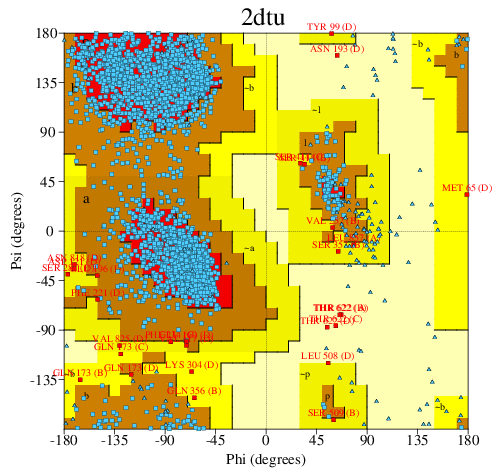
PROCHECK
|
|
|
|
|
|
Headers
|
|
|
|
References
|
|
|
|
|
|

|
|
Q38087
(DPOL_BPR69) -
DNA-directed DNA polymerase from Escherichia phage RB69
|
|
|
|
Seq:
Struc:
|
|
|
|
903 a.a.
896 a.a.*
|
|

|

|

|
|
|
|
|
|
|
|
|
|
|
Key: |
 |
PfamA domain |
|
|
 |
Secondary structure |
|
 |
CATH domain |
|
|
*
PDB and UniProt seqs differ
at 2 residue positions (black
crosses)
|
|
|
|
|
|
|
|

|
|
|
|
C-G-3DR-C-T-T-A-T-G-A-C-A-G-C-C-G-C-G
18 bases
|
|
|
|
G-C-G-G-C-T-G-T-C-A-T-A-A-G-A
15 bases
|
|
|
|
C-G-3DR-C-T-T-A-T-G-A-C-A-G-C-C-G-C-G
18 bases
|
|
|
|
G-C-G-G-C-T-G-T-C-A-T-A-A-G-A
15 bases
|
|
|
|
C-G-3DR-C-T-T-A-T-G-A-C-A-G-C-C-G-C-G
18 bases
|
|
|
|
G-C-G-G-C-T-G-T-C-A-T-A-A-G-A
15 bases
|
|
|
|
C-G-3DR-C-T-T-A-T-G-A-C-A-G-C-C-G-C-G
18 bases
|
|
|
|
G-C-G-G-C-T-G-T-C-A-T-A-A-G-A
15 bases
|
|
|
|
|
|
|
|
|
|
|
|
|
|
Enzyme class:
|
|
E.C.2.7.7.7
- DNA-directed Dna polymerase.
|
|
|
|
|
|
|
Reaction:
|
|
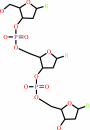
DNA(n) + a 2'-deoxyribonucleoside 5'-triphosphate = DNA(n+1) + diphosphate
|
|
|
|
|
|
 DNA(n)
|
+
|
2'-deoxyribonucleoside 5'-triphosphate
|
=
|
DNA(n+1)
|
+
|
 diphosphate
|
|
|
|
|
|
|
|
|
|
|
|
|
Molecule diagrams generated from .mol files obtained from the
KEGG ftp site
|
|
|
|
|
|
|
|
|
|
|
|
|
|
 |
|
|
|
|
|
|
| |
|
|
| |
|
DOI no:
|
J Biol Chem
282:1432-1444
(2007)
|
|
PubMed id:
|
|
|
|
|
|
| |
|
Structural and biochemical investigation of the role in proofreading of a beta hairpin loop found in the exonuclease domain of a replicative DNA polymerase of the B family.
|
|
M.Hogg,
P.Aller,
W.Konigsberg,
S.S.Wallace,
S.Doublié.
|
|
|
|
|
| |
ABSTRACT
|
|
|
|
| |
|
|
Replicative DNA polymerases, as exemplified by the B family polymerases from
bacteriophages T4 and RB69, not only replicate DNA but also have the ability to
proofread misincorporated nucleotides. Because the two activities reside in
separate protein domains, polymerases must employ a mechanism that allows for
efficient switching of the primer strand between the two active sites to achieve
fast and accurate replication. Prior mutational and structural studies suggested
that a beta hairpin structure located in the exonuclease domain of family B
polymerases might play an important role in active site switching in the event
of a nucleotide misincorporation. We show that deleting the beta hairpin loop in
RB69 gp43 affects neither polymerase nor exonuclease activities. Single binding
event studies with mismatched primer termini, however, show that the beta
hairpin plays a role in maintaining the stability of the polymerase/DNA
interactions during the binding of the primer DNA in the exonuclease active site
but not on the return of the corrected primer to the polymerase active site. In
addition, the deletion variant showed a more stable incorporation of a
nucleotide opposite an abasic site. Moreover, in the 2.4 A crystal structure of
the beta hairpin deletion variant incorporating an A opposite a templating
furan, all four molecules in the crystal asymmetric unit have DNA in the
polymerase active site, despite the presence of DNA distortions because of the
misincorporation, confirming that the primer strand is not stably bound within
the exonuclease active site in the absence of the beta hairpin loop.
|
|
|
|
|
|
| |
Selected figure(s)
|
|
|
|
| |
|
|

|
|

|
|
Figure 1.
FIGURE 1. Switching of the  hairpin loop in response
to nucleotide incorporation opposite a lesion. A, the closed
ternary complex of RB69 gp43 trapped with an incoming dTTP
opposite a templating A (PDB code 1IG9 (17)). The 5'-end of the
template DNA (gray) stacks against Trp-574 (gold), and the hairpin
is in an up position. B, an open binary complex of RB69 gp43
after successful incorporation of an A opposite a furan (PDB
code 1RV2, chain C (15)). In this structure the 5'-end of the
template is sandwiched between Phe-359 (purple) and the hairpin,
which is in a down position. hairpin loop in response
to nucleotide incorporation opposite a lesion. A, the closed
ternary complex of RB69 gp43 trapped with an incoming dTTP
opposite a templating A (PDB code 1IG9 (17)). The 5'-end of the
template DNA (gray) stacks against Trp-574 (gold), and the hairpin
is in an up position. B, an open binary complex of RB69 gp43
after successful incorporation of an A opposite a furan (PDB
code 1RV2, chain C (15)). In this structure the 5'-end of the
template is sandwiched between Phe-359 (purple) and the hairpin,
which is in a down position.
|
|
Figure 7.
FIGURE 7. In the crystal structure of the hairpin
deletion variant, all four molecules have DNA in the polymerase
active site. A and B, two of the four complexes found in the
asymmetric unit of the previously solved furan-dAMP binary
complex (PDB code 1RV2 (15)). One complex has DNA in the
exonuclease active center (molecule B) (A); the other has DNA in
the polymerase active site (molecule C) (B). C and D, the
equivalent complexes from the structure of the -variant
inserting an A opposite furan. In this structure none of the
four complexes within the asymmetric unit has DNA in the
exonuclease (exo) domain. The polymerase domains are colored red
for the palm, green for the thumb, blue for the fingers, cyan
for the exonuclease (with the hairpin in black), and
orange for the N-terminal domain. The primer strand is shown in
magenta and the template in dark blue. The tip of the hairpin
loop was disordered in A.
|
|
|
|
|
|
| |
The above figures are
reprinted
by permission from the ASBMB:
J Biol Chem
(2007,
282,
1432-1444)
copyright 2007.
|
|
| |
Figures were
selected
by the author.
|
|
|
|
|
|
|
|
|
|
|
|
|
|
|
|
 |
 |
 |
|
Literature references that cite this PDB file's key reference
|
|
|
| |
PubMed id
|
|
Reference
|
|
|
|
|
|
K.Szczepanowska,
and
F.Foury
(2010).
A cluster of pathogenic mutations in the 3'-5' exonuclease domain of DNA polymerase gamma defines a novel module coupling DNA synthesis and degradation.
|
| |
Hum Mol Genet,
19,
3516-3529.
|
|
|
|
|
|
|
M.Hogg,
J.Rudnicki,
J.Midkiff,
L.Reha-Krantz,
S.Doublié,
and
S.S.Wallace
(2010).
Kinetics of mismatch formation opposite lesions by the replicative DNA polymerase from bacteriophage RB69.
|
| |
Biochemistry,
49,
2317-2325.
|
|
|
PDB code:
|
|
|
|
|
|
|
|
P.Aller,
Y.Ye,
S.S.Wallace,
C.J.Burrows,
and
S.Doublié
(2010).
Crystal structure of a replicative DNA polymerase bound to the oxidized guanine lesion guanidinohydantoin.
|
| |
Biochemistry,
49,
2502-2509.
|
|
|
PDB code:
|
|
|
|
|
|
|
|
X.Meng,
Y.Zhou,
E.Y.Lee,
M.Y.Lee,
and
D.N.Frick
(2010).
The p12 subunit of human polymerase delta modulates the rate and fidelity of DNA synthesis.
|
| |
Biochemistry,
49,
3545-3554.
|
|
|
|
|
|
|
B.Ibarra,
Y.R.Chemla,
S.Plyasunov,
S.B.Smith,
J.M.Lázaro,
M.Salas,
and
C.Bustamante
(2009).
Proofreading dynamics of a processive DNA polymerase.
|
| |
EMBO J,
28,
2794-2802.
|
|
|
|
|
|
|
D.B.Gammon,
and
D.H.Evans
(2009).
The 3'-to-5' exonuclease activity of vaccinia virus DNA polymerase is essential and plays a role in promoting virus genetic recombination.
|
| |
J Virol,
83,
4236-4250.
|
|
|
|
|
|
|
F.Wang,
and
W.Yang
(2009).
Structural insight into translesion synthesis by DNA Pol II.
|
| |
Cell,
139,
1279-1289.
|
|
|
PDB codes:
|
|
|
|
|
|
|
|
M.K.Swan,
R.E.Johnson,
L.Prakash,
S.Prakash,
and
A.K.Aggarwal
(2009).
Structural basis of high-fidelity DNA synthesis by yeast DNA polymerase delta.
|
| |
Nat Struct Mol Biol,
16,
979-986.
|
|
|
PDB code:
|
|
|
|
|
|
|
|
R.Fazlieva,
C.S.Spittle,
D.Morrissey,
H.Hayashi,
H.Yan,
and
Y.Matsumoto
(2009).
Proofreading exonuclease activity of human DNA polymerase delta and its effects on lesion-bypass DNA synthesis.
|
| |
Nucleic Acids Res,
37,
2854-2866.
|
|
|
|
|
|
|
Y.Huang,
X.Huang,
H.Liu,
J.Gong,
Z.Ouyang,
H.Cui,
J.Cao,
Y.Zhao,
X.Wang,
Y.Jiang,
and
Q.Qin
(2009).
Complete sequence determination of a novel reptile iridovirus isolated from soft-shelled turtle and evolutionary analysis of Iridoviridae.
|
| |
BMC Genomics,
10,
224.
|
|
|
|
|
|
|
P.Kukreti,
K.Singh,
A.Ketkar,
and
M.J.Modak
(2008).
Identification of a new motif required for the 3'-5' exonuclease activity of Escherichia coli DNA polymerase I (Klenow fragment): the RRRY motif is necessary for the binding of single-stranded DNA substrate and the template strand of the mismatched duplex.
|
| |
J Biol Chem,
283,
17979-17990.
|
|
|
|
|
|
|
E.Fidalgo da Silva,
and
L.J.Reha-Krantz
(2007).
DNA polymerase proofreading: active site switching catalyzed by the bacteriophage T4 DNA polymerase.
|
| |
Nucleic Acids Res,
35,
5452-5463.
|
|
|
|
|
|
The most recent references are shown first.
Citation data come partly from CiteXplore and partly
from an automated harvesting procedure. Note that this is likely to be
only a partial list as not all journals are covered by
either method. However, we are continually building up the citation data
so more and more references will be included with time.
Where a reference describes a PDB structure, the PDB
code is
shown on the right.
|
|


 Links
Links


