 |
PDBsum entry 1vfg

|
|
|
|
|
|

|

|

|

|
|

|
|

|
|

|
|

|
|

|
|

|
|

|
|
|
 |

|

|
|
|
|
|
|
|
|
|
|
|
|
|
|
|
|
|
|
|
|
|
|
|
|
|
|
|
|
|
|
|
|
|
|
|
|
Transferase/RNA
|
PDB id
|
|
|
|
1vfg
|
|
|
|
|
|
|
|
|
|
|
|
|
|
|

|

|

|
|
|
|
|
|
|
|
 |
Contents |
 |
|
|
|
|
|
|
|
|
|
|
|
|
|
|
* Residue conservation analysis
|
|
|
|
|
|
PDB id:
|
|
|
|
| Name: |
|
Transferase/RNA
|
|
|
Title:
|
|
Crystal structure of tRNA nucleotidyltransferase complexed with a primer tRNA and an incoming atp analog
|
|
Structure:
|
|
RNA (75-mer). Chain: c, d. Engineered: yes. Poly a polymerase. Chain: a, b. Fragment: residues 1-390. Synonym: a-adding enzyme. Engineered: yes
|
|
Source:
|
|
Synthetic: yes. Other_details: RNA was prepared by in vitro transcription with t7 RNA polymerase in thermotoga maritima. Aquifex aeolicus. Organism_taxid: 63363. Expressed in: escherichia coli bl21(de3). Expression_system_taxid: 469008.
|
|
Biol. unit:
|
|
 Dimer (from
)
Dimer (from
)
|
|
Resolution:
|
|
|
2.80Å
|
R-factor:
|
0.230
|
R-free:
|
0.287
|
|
|
Authors:
|
|
K.Tomita,S.Fukai,R.Ishitani,T.Ueda,N.Takeuchi,D.G.Vassylyev,O.Nureki, Riken Structural Genomics/proteomics Initiative (Rsgi)
|
Key ref:

|
|
K.Tomita
et al.
(2004).
Structural basis for template-independent RNA polymerization.
Nature,
430,
700-704.
PubMed id:
DOI:

|
|
|
Date:
|
|
|
13-Apr-04
|
Release date:
|
10-Aug-04
|
|
|
|
|
|
|
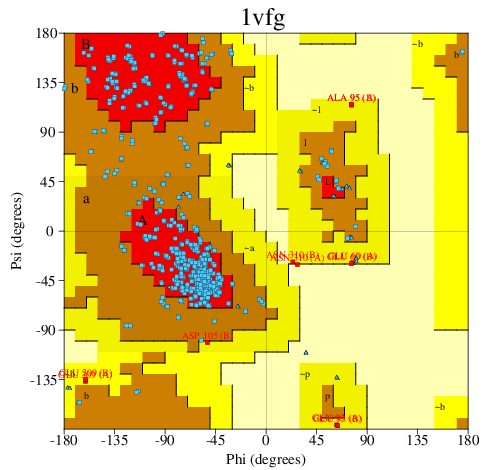
PROCHECK
|
|
|
|
|
|
Headers
|
|
|
|
References
|
|
|
|
|
|

|
|
O66728
(O66728_AQUAE) -
A-adding tRNA nucleotidyltransferase from Aquifex aeolicus (strain VF5)
|
|
|
|
Seq:
Struc:
|
|
|
|
824 a.a.
342 a.a.*
|
|

|

|

|
|
|
|
|
|
|
|
|
|
|
Key: |
 |
PfamA domain |
|
|
 |
Secondary structure |
|
 |
CATH domain |
|
|
*
PDB and UniProt seqs differ
at 1 residue position (black
cross)
|
|
|
|
|
|
|
|

|
|
|
|
G-G-C-C-A-G-G-G-G-C-G-G-U-U-C-G-A-U-U-C-C-G-C-C-C-C-U-G-G-C-C
31 bases
|
|
|
|
G-G-C-C-A-G-G-G-G-C-G-G-U-U-C-G-A-U-U-C-C-G-C-C-C-C-U-G-G-C-C-A-C-C
34 bases
|
|
|
|
|
|
|
|
|
|
|
|
|
|
|
|
|
|
 |
|
|
|
|
|
|
| |
|
DOI no:
|
Nature
430:700-704
(2004)
|
|
PubMed id:
|
|
|
|
|
|
| |
|
Structural basis for template-independent RNA polymerization.
|
|
K.Tomita,
S.Fukai,
R.Ishitani,
T.Ueda,
N.Takeuchi,
D.G.Vassylyev,
O.Nureki.
|
|
|
|
|
| |
ABSTRACT
|
|
|
|
| |
|
|
The 3'-terminal CCA nucleotide sequence (positions 74-76) of transfer RNA is
essential for amino acid attachment and interaction with the ribosome during
protein synthesis. The CCA sequence is synthesized de novo and/or repaired by a
template-independent RNA polymerase, 'CCA-adding enzyme', using CTP and ATP as
substrates. Despite structural and biochemical studies, the mechanism by which
the CCA-adding enzyme synthesizes the defined sequence without a nucleic acid
template remains elusive. Here we present the crystal structure of Aquifex
aeolicus CCA-adding enzyme, bound to a primer tRNA lacking the terminal
adenosine and an incoming ATP analogue, at 2.8 A resolution. The enzyme enfolds
the acceptor T helix of the tRNA molecule. In the catalytic pocket, C75 is
adjacent to ATP, and their base moieties are stacked. The complementary pocket
for recognizing C74-C75 of tRNA forms a 'protein template' for the penultimate
two nucleotides, mimicking the nucleotide template used by template-dependent
polymerases. These results are supported by systematic analyses of mutants. Our
structure represents the 'pre-insertion' stage of selecting the incoming
nucleotide and provides the structural basis for the mechanism underlying
template-independent RNA polymerization.
|
|
|
|
|
|
| |
Selected figure(s)
|
|
|
|
| |
|
|

|
|

|
|
Figure 2.
Figure 2: Stereoview of the primer C74-C75 and the incoming ATP.
a,  [A]-Weighted
simulated-annealing F[o] - F[c] omit maps contoured at 3.5 around
C74-C75 and AMPcPP. The carbon atoms of Aa.LC, tRNA and AMPcPP
are coloured white, pink and blue, respectively. b, Recognition
of the incoming ATP. Ball-and-stick representations of tRNA C75,
AMPcPP and the ATP-interacting residues are shown on the Aa.LC
head and neck domains. The colouring scheme is the same as in
Fig. 1. c, Recognition of the C74-C75 terminus. Ball-and-stick
representations of tRNA A73-C74-C75, AMPcPP and the
tRNA-interacting residues are shown. Phe 106 and the Asp105
-Arg155 pair, which are part of the 'stacking arc', are also
shown in ball-and-stick representation. In b and c, hydrogen
bonds are shown as dotted lines. [A]-Weighted
simulated-annealing F[o] - F[c] omit maps contoured at 3.5 around
C74-C75 and AMPcPP. The carbon atoms of Aa.LC, tRNA and AMPcPP
are coloured white, pink and blue, respectively. b, Recognition
of the incoming ATP. Ball-and-stick representations of tRNA C75,
AMPcPP and the ATP-interacting residues are shown on the Aa.LC
head and neck domains. The colouring scheme is the same as in
Fig. 1. c, Recognition of the C74-C75 terminus. Ball-and-stick
representations of tRNA A73-C74-C75, AMPcPP and the
tRNA-interacting residues are shown. Phe 106 and the Asp105
-Arg155 pair, which are part of the 'stacking arc', are also
shown in ball-and-stick representation. In b and c, hydrogen
bonds are shown as dotted lines.
|
|
Figure 4.
Figure 4: Comparison of template-independent and
template-dependent RNA polymerases. a, Ball-and-stick
representations of tRNA, AMPcPP, the catalytic carboxylates and
the ATP-interacting residues are shown on the Aa.LC head and
neck domains. The colouring scheme is the same as in Fig. 2,
except that the carbon atoms of Aa.LC are coloured orange. b,
Ball-and-stick representations of the primer RNA, the template
DNA, AMPcPP, the catalytic carboxylates and the ATP-interacting
residues are shown on the O helix in the T7 RNA polymerase
structure. In a and b, hydrogen bonds are shown as dotted lines.
|
|
|
|
|
|
| |
The above figures are
reprinted
by permission from Macmillan Publishers Ltd:
Nature
(2004,
430,
700-704)
copyright 2004.
|
|
| |
Figures were
selected
by an automated process.
|
|
|
|
|
|
|
|
|
|
|
|
|
|
|
|
 |
 |
 |
|
Literature references that cite this PDB file's key reference
|
|
|
| |
PubMed id
|
|
Reference
|
|
|
|
|
|
A.Hoffmeier,
H.Betat,
A.Bluschke,
R.Günther,
S.Junghanns,
H.J.Hofmann,
and
M.Mörl
(2010).
Unusual evolution of a catalytic core element in CCA-adding enzymes.
|
| |
Nucleic Acids Res,
38,
4436-4447.
|
|
|
|
|
|
|
B.Pan,
Y.Xiong,
and
T.A.Steitz
(2010).
How the CCA-adding enzyme selects adenine over cytosine at position 76 of tRNA.
|
| |
Science,
330,
937-940.
|
|
|
PDB codes:
|
|
|
|
|
|
|
|
H.Betat,
C.Rammelt,
and
M.Mörl
(2010).
tRNA nucleotidyltransferases: ancient catalysts with an unusual mechanism of polymerization.
|
| |
Cell Mol Life Sci,
67,
1447-1463.
|
|
|
|
|
|
|
Y.M.Hou
(2010).
CCA addition to tRNA: implications for tRNA quality control.
|
| |
IUBMB Life,
62,
251-260.
|
|
|
|
|
|
|
H.Nakayama,
M.Akiyama,
M.Taoka,
Y.Yamauchi,
Y.Nobe,
H.Ishikawa,
N.Takahashi,
and
T.Isobe
(2009).
Ariadne: a database search engine for identification and chemical analysis of RNA using tandem mass spectrometry data.
|
| |
Nucleic Acids Res,
37,
e47.
|
|
|
|
|
|
|
K.Kuchta,
L.Knizewski,
L.S.Wyrwicz,
L.Rychlewski,
and
K.Ginalski
(2009).
Comprehensive classification of nucleotidyltransferase fold proteins: identification of novel families and their representatives in human.
|
| |
Nucleic Acids Res,
37,
7701-7714.
|
|
|
|
|
|
|
S.Kim,
C.Liu,
K.Halkidis,
H.B.Gamper,
and
Y.M.Hou
(2009).
Distinct kinetic determinants for the stepwise CCA addition to tRNA.
|
| |
RNA,
15,
1827-1836.
|
|
|
|
|
|
|
Y.Toh,
D.Takeshita,
T.Numata,
S.Fukai,
O.Nureki,
and
K.Tomita
(2009).
Mechanism for the definition of elongation and termination by the class II CCA-adding enzyme.
|
| |
EMBO J,
28,
3353-3365.
|
|
|
PDB codes:
|
|
|
|
|
|
|
|
A.Just,
F.Butter,
M.Trenkmann,
T.Heitkam,
M.Mörl,
and
H.Betat
(2008).
A comparative analysis of two conserved motifs in bacterial poly(A) polymerase and CCA-adding enzyme.
|
| |
Nucleic Acids Res,
36,
5212-5220.
|
|
|
|
|
|
|
A.Neuenfeldt,
A.Just,
H.Betat,
and
M.Mörl
(2008).
Evolution of tRNA nucleotidyltransferases: a small deletion generated CC-adding enzymes.
|
| |
Proc Natl Acad Sci U S A,
105,
7953-7958.
|
|
|
|
|
|
|
G.Martin,
S.Doublié,
and
W.Keller
(2008).
Determinants of substrate specificity in RNA-dependent nucleotidyl transferases.
|
| |
Biochim Biophys Acta,
1779,
206-216.
|
|
|
|
|
|
|
M.Dupasquier,
S.Kim,
K.Halkidis,
H.Gamper,
and
Y.M.Hou
(2008).
tRNA integrity is a prerequisite for rapid CCA addition: implication for quality control.
|
| |
J Mol Biol,
379,
579-588.
|
|
|
|
|
|
|
X.Shan,
T.A.Russell,
S.M.Paul,
D.B.Kushner,
and
P.B.Joyce
(2008).
Characterization of a temperature-sensitive mutation that impairs the function of yeast tRNA nucleotidyltransferase.
|
| |
Yeast,
25,
219-233.
|
|
|
|
|
|
|
Y.Toh,
T.Numata,
K.Watanabe,
D.Takeshita,
O.Nureki,
and
K.Tomita
(2008).
Molecular basis for maintenance of fidelity during the CCA-adding reaction by a CCA-adding enzyme.
|
| |
EMBO J,
27,
1944-1952.
|
|
|
PDB codes:
|
|
|
|
|
|
|
|
G.Martin,
and
W.Keller
(2007).
RNA-specific ribonucleotidyl transferases.
|
| |
RNA,
13,
1834-1849.
|
|
|
|
|
|
|
H.D.Cho,
C.L.Verlinde,
and
A.M.Weiner
(2007).
Reengineering CCA-adding enzymes to function as (U,G)- or dCdCdA-adding enzymes or poly(C,A) and poly(U,G) polymerases.
|
| |
Proc Natl Acad Sci U S A,
104,
54-59.
|
|
|
|
|
|
|
J.Stagno,
I.Aphasizheva,
A.Rosengarth,
H.Luecke,
and
R.Aphasizhev
(2007).
UTP-bound and Apo structures of a minimal RNA uridylyltransferase.
|
| |
J Mol Biol,
366,
882-899.
|
|
|
PDB codes:
|
|
|
|
|
|
|
|
P.B.Balbo,
and
A.Bohm
(2007).
Mechanism of poly(A) polymerase: structure of the enzyme-MgATP-RNA ternary complex and kinetic analysis.
|
| |
Structure,
15,
1117-1131.
|
|
|
PDB code:
|
|
|
|
|
|
|
|
A.A.Tulub
(2006).
Molecular dynamics DFT:B3LYP study of guanosinetriphosphate conversion into guanosinemonophosphate upon Mg2+ chelation of alpha and beta phosphate oxygens of the triphosphate tail.
|
| |
Phys Chem Chem Phys,
8,
2187-2192.
|
|
|
|
|
|
|
H.D.Cho,
Y.Chen,
G.Varani,
and
A.M.Weiner
(2006).
A model for C74 addition by CCA-adding enzymes: C74 addition, like C75 and A76 addition, does not involve tRNA translocation.
|
| |
J Biol Chem,
281,
9801-9811.
|
|
|
|
|
|
|
H.Oshikane,
K.Sheppard,
S.Fukai,
Y.Nakamura,
R.Ishitani,
T.Numata,
R.L.Sherrer,
L.Feng,
E.Schmitt,
M.Panvert,
S.Blanquet,
Y.Mechulam,
D.Söll,
and
O.Nureki
(2006).
Structural basis of RNA-dependent recruitment of glutamine to the genetic code.
|
| |
Science,
312,
1950-1954.
|
|
|
PDB code:
|
|
|
|
|
|
|
|
K.Tomita,
R.Ishitani,
S.Fukai,
and
O.Nureki
(2006).
Complete crystallographic analysis of the dynamics of CCA sequence addition.
|
| |
Nature,
443,
956-960.
|
|
|
PDB codes:
|
|
|
|
|
|
|
|
C.Lehmann,
S.Pullalarevu,
W.Krajewski,
M.A.Willis,
A.Galkin,
A.Howard,
and
O.Herzberg
(2005).
Structure of HI0073 from Haemophilus influenzae, the nucleotide-binding domain of a two-protein nucleotidyl transferase.
|
| |
Proteins,
60,
807-811.
|
|
|
PDB code:
|
|
|
|
|
|
|
|
D.Temiakov,
N.Zenkin,
M.N.Vassylyeva,
A.Perederina,
T.H.Tahirov,
E.Kashkina,
M.Savkina,
S.Zorov,
V.Nikiforov,
N.Igarashi,
N.Matsugaki,
S.Wakatsuki,
K.Severinov,
and
D.G.Vassylyev
(2005).
Structural basis of transcription inhibition by antibiotic streptolydigin.
|
| |
Mol Cell,
19,
655-666.
|
|
|
PDB code:
|
|
|
|
|
|
|
|
H.D.Cho,
C.L.Verlinde,
and
A.M.Weiner
(2005).
Archaeal CCA-adding enzymes: central role of a highly conserved beta-turn motif in RNA polymerization without translocation.
|
| |
J Biol Chem,
280,
9555-9566.
|
|
|
|
|
|
|
J.Deng,
N.L.Ernst,
S.Turley,
K.D.Stuart,
and
W.G.Hol
(2005).
Structural basis for UTP specificity of RNA editing TUTases from Trypanosoma brucei.
|
| |
EMBO J,
24,
4007-4017.
|
|
|
PDB codes:
|
|
|
|
|
|
|
|
A.M.Weiner
(2004).
tRNA maturation: RNA polymerization without a nucleic acid template.
|
| |
Curr Biol,
14,
R883-R885.
|
|
|
|
|
|
|
P.Schimmel,
and
X.L.Yang
(2004).
Two classes give lessons about CCA.
|
| |
Nat Struct Mol Biol,
11,
807-808.
|
|
|
|
|
|
The most recent references are shown first.
Citation data come partly from CiteXplore and partly
from an automated harvesting procedure. Note that this is likely to be
only a partial list as not all journals are covered by
either method. However, we are continually building up the citation data
so more and more references will be included with time.
Where a reference describes a PDB structure, the PDB
codes are
shown on the right.
|
|


 Links
Links



