
|
|
|
|
|
 |
Contents |
 |
|
|
|
|
|
|
|
|
|
|
|
 1381 a.a.
|
|
|
|
|
|
|
|
|
|
|
 1097 a.a.
|
|
|
|
|
|
|
|
|
|
|
 266 a.a.
|
|
|
|
|
|
|
|
|
|
|
 214 a.a.
|
|
|
|
|
|
|
|
|
|
|
 84 a.a.
|
|
|
|
|
|
|
|
|
|
|
 133 a.a.
|
|
|
|
|
|
|
|
|
|
|
 119 a.a.
|
|
|
|
|
|
|
|
|
|
|
 65 a.a.
|
|
|
|
|
|
|
|
|
|
|
 114 a.a.
|
|
|
|
|
|
|
|
|
|
|
 46 a.a.
|
|
|
|
|
|
|
|
|
|
|
* Residue conservation analysis
|
|
|
|
|
|
PDB id:
|
|
|
|
| Name: |
|
Transcription/DNA-RNA hybrid
|
|
|
Title:
|
|
RNA polymerase ii elongation complex
|
|
Structure:
|
|
5'-d(p Ap Ap Ap Tp Gp Cp Cp Tp Gp Gp Tp Cp T)-3'. Chain: d. Engineered: yes. Other_details: template. 5'-r(p Gp Ap Cp Cp Ap Gp Gp Cp A)-3'. Chain: r. Engineered: yes. Other_details: transcript. DNA-directed RNA polymerase ii largest subunit.
|
|
Source:
|
|
Saccharomyces cerevisiae. Baker's yeast. Organism_taxid: 4932. Synthetic: yes. Other_details: the RNA was synthesized by the polymerase before the crystal was formed.. Strain: delta-rpb4. Strain: delta-rpb4
|
|
Biol. unit:
|
|
 24mer (from
)
24mer (from
)
|
|
Resolution:
|
|
|
3.30Å
|
R-factor:
|
0.250
|
R-free:
|
0.298
|
|
|
Authors:
|
|
A.L.Gnatt,P.Cramer,R.D.Kornberg
|
Key ref:

|
|
A.L.Gnatt
et al.
(2001).
Structural basis of transcription: an RNA polymerase II elongation complex at 3.3 A resolution.
Science,
292,
1876-1882.
PubMed id:
DOI:

|
|
|
Date:
|
|
|
02-Mar-01
|
Release date:
|
23-Apr-01
|
|
|
|
|
|
|
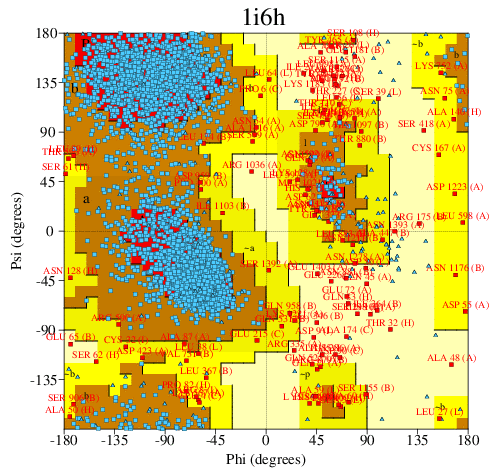
PROCHECK
|
|
|
|
|
|
Headers
|
|
|
|
References
|
|
|
|
|
|

|
|
P04050
(RPB1_YEAST) -
DNA-directed RNA polymerase II subunit RPB1 from Saccharomyces cerevisiae (strain ATCC 204508 / S288c)
|
|
|
|
Seq:
Struc:
|
|
|
|
1733 a.a.
1381 a.a.
|
|

|

|
|
|
|
|
|
|
|
|
|
|
|
|

|
|
P08518
(RPB2_YEAST) -
DNA-directed RNA polymerase II subunit RPB2 from Saccharomyces cerevisiae (strain ATCC 204508 / S288c)
|
|
|
|
Seq:
Struc:
|
|
|
|
1224 a.a.
1097 a.a.
|
|
|

|
|
|
|
|
|
|
|
|
|
|
|
|

|
|
P16370
(RPB3_YEAST) -
DNA-directed RNA polymerase II subunit RPB3 from Saccharomyces cerevisiae (strain ATCC 204508 / S288c)
|
|
|
|
Seq:
Struc:
|
|
|
|
318 a.a.
266 a.a.
|
|
|

|

|
|
|
|
|
|
|
|
|
|
|
|

|
|
P20434
(RPAB1_YEAST) -
DNA-directed RNA polymerases I, II, and III subunit RPABC1 from Saccharomyces cerevisiae (strain ATCC 204508 / S288c)
|
|
|
|
Seq:
Struc:
|
|
|
|
215 a.a.
214 a.a.
|
|
|

|
|
|
|
|
|
|
|
|
|
|
|
|

|
|
P20435
(RPAB2_YEAST) -
DNA-directed RNA polymerases I, II, and III subunit RPABC2 from Saccharomyces cerevisiae (strain ATCC 204508 / S288c)
|
|
|
|
Seq:
Struc:
|
|
|
|
155 a.a.
84 a.a.
|
|
|

|
|
|
|
|
|
|
|
|
|
|
|
|

|
|
P20436
(RPAB3_YEAST) -
DNA-directed RNA polymerases I, II, and III subunit RPABC3 from Saccharomyces cerevisiae (strain ATCC 204508 / S288c)
|
|
|
|
Seq:
Struc:
|
|
|
|
146 a.a.
133 a.a.
|
|
|

|
|
|
|
|
|
|
|
|
|
|
|
|

|
|
P27999
(RPB9_YEAST) -
DNA-directed RNA polymerase II subunit RPB9 from Saccharomyces cerevisiae (strain ATCC 204508 / S288c)
|
|
|
|
Seq:
Struc:
|
|
|
|
122 a.a.
119 a.a.
|
|
|

|
|
|
|
|
|
|
|
|
|
|
|
|

|
|
P22139
(RPAB5_YEAST) -
DNA-directed RNA polymerases I, II, and III subunit RPABC5 from Saccharomyces cerevisiae (strain ATCC 204508 / S288c)
|
|
|
|
Seq:
Struc:
|
|
|
|
70 a.a.
65 a.a.
|
|
|

|
|
|
|
|
|
|
|
|
|
|
|
|
|
|
|
|
|
Enzyme class:
|
|
Chains A, B, C, E, F, H, I, J, K, L:
E.C.2.7.7.6
- DNA-directed Rna polymerase.
|
|
|
|
|
|
|
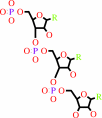
Reaction:
|
|
RNA(n) + a ribonucleoside 5'-triphosphate = RNA(n+1) + diphosphate
|
|
|
|
|
|
 RNA(n)
|
+
|
ribonucleoside 5'-triphosphate
|
=
|
RNA(n+1)
|
+
|
 diphosphate
|
|
|
|
|
|
|
|
|
|
|
|
|
Molecule diagrams generated from .mol files obtained from the
KEGG ftp site
|
|
|
|
|
|
|
|
|
|
|
|
|
|
 |
|
|
|
|
|
|
| |
|
|
| |
|
DOI no:
|
Science
292:1876-1882
(2001)
|
|
PubMed id:
|
|
|
|
|
|
| |
|
Structural basis of transcription: an RNA polymerase II elongation complex at 3.3 A resolution.
|
|
A.L.Gnatt,
P.Cramer,
J.Fu,
D.A.Bushnell,
R.D.Kornberg.
|
|
|
|
|
| |
ABSTRACT
|
|
|
|
| |
|
|
The crystal structure of RNA polymerase II in the act of transcription was
determined at 3.3 A resolution. Duplex DNA is seen entering the main cleft of
the enzyme and unwinding before the active site. Nine base pairs of DNA-RNA
hybrid extend from the active center at nearly right angles to the entering DNA,
with the 3' end of the RNA in the nucleotide addition site. The 3' end is
positioned above a pore, through which nucleotides may enter and through which
RNA may be extruded during back-tracking. The 5'-most residue of the RNA is
close to the point of entry to an exit groove. Changes in protein structure
between the transcribing complex and free enzyme include closure of a clamp over
the DNA and RNA and ordering of a series of "switches" at the base of
the clamp to create a binding site complementary to the DNA-RNA hybrid.
Protein-nucleic acid contacts help explain DNA and RNA strand separation, the
specificity of RNA synthesis, "abortive cycling" during transcription
initiation, and RNA and DNA translocation during transcription elongation.
|
|
|
|
|
|
| |
Selected figure(s)
|
|
|
|
| |
|
|

|
|

|
|
Figure 5.
Fig. 5. DNA-RNA hybrid conformation. The view is similar to
that in Fig. 2C. The conformation of the DNA-RNA hybrid is
intermediary between canonical A- and B-DNA. DNA, blue; RNA,
red.
|
|
Figure 6.
Fig. 6. Proposed transcription cycle and translocation
mechanism. (A) Schematic representation of the nucleotide
addition cycle. The nucleotide triphosphate (NTP) fills the open
substrate site (top) and forms a phosphodiester bond at the
active site ("Synthesis"). This results in the state of the
transcribing complex seen in the crystal structure (middle). We
speculate that "Translocation" of the nucleic acids with respect
to the active site (marked by a pink dot for metal A) involves a
change of the bridge helix from a straight (silver circle) to a
bent conformation (violet circle, bottom). Relaxation of the
bridge helix back to a straight conformation without movement of
the nucleic acids would result in an open substrate site one
nucleotide downstream and would complete the cycle. (B)
Different conformations of the bridge helix in pol II and
bacterial RNA polymerase structures. The view is the same as in
Fig. 2C. The bacterial RNA polymerase structure (2) was
superimposed on the pol II transcribing complex by fitting
residues around the active site. The resulting fit of the bridge
helices of pol II (silver) and the bacterial polymerase (violet)
is shown. The bend in the bridge helix in the bacterial
polymerase structure causes a clash of amino acid side chains
(extending from the backbone shown here) with the hybrid base
pair at position +1.
|
|
|
|
|
|
| |
The above figures are
reprinted
by permission from the AAAs:
Science
(2001,
292,
1876-1882)
copyright 2001.
|
|
| |
Figures were
selected
by an automated process.
|
|
|
|
|
|
|
|
|
|
|
|
|
|
|
|
 |
 |
 |
|
Literature references that cite this PDB file's key reference
|
|
|
| |
PubMed id
|
|
Reference
|
|
|
|
|
|
A.C.Cheung,
and
P.Cramer
(2011).
Structural basis of RNA polymerase II backtracking, arrest and reactivation.
|
| |
Nature,
471,
249-253.
|
|
|
PDB codes:
|
|
|
|
|
|
|
|
B.J.Klein,
D.Bose,
K.J.Baker,
Z.M.Yusoff,
X.Zhang,
and
K.S.Murakami
(2011).
RNA polymerase and transcription elongation factor Spt4/5 complex structure.
|
| |
Proc Natl Acad Sci U S A,
108,
546-550.
|
|
|
PDB code:
|
|
|
|
|
|
|
|
F.A.Rey,
and
W.I.Sundquist
(2011).
Macromolecular assemblages.
|
| |
Curr Opin Struct Biol,
21,
221-222.
|
|
|
|
|
|
|
F.Werner,
and
D.Grohmann
(2011).
Evolution of multisubunit RNA polymerases in the three domains of life.
|
| |
Nat Rev Microbiol,
9,
85-98.
|
|
|
|
|
|
|
L.Bintu,
M.Kopaczynska,
C.Hodges,
L.Lubkowska,
M.Kashlev,
and
C.Bustamante
(2011).
The elongation rate of RNA polymerase determines the fate of transcribed nucleosomes.
|
| |
Nat Struct Mol Biol,
18,
1394-1399.
|
|
|
|
|
|
|
M.M.Jore,
M.Lundgren,
E.van Duijn,
J.B.Bultema,
E.R.Westra,
S.P.Waghmare,
B.Wiedenheft,
U.Pul,
R.Wurm,
R.Wagner,
M.R.Beijer,
A.Barendregt,
K.Zhou,
A.P.Snijders,
M.J.Dickman,
J.A.Doudna,
E.J.Boekema,
A.J.Heck,
J.van der Oost,
and
S.J.Brouns
(2011).
Structural basis for CRISPR RNA-guided DNA recognition by Cascade.
|
| |
Nat Struct Mol Biol,
18,
529-536.
|
|
|
|
|
|
|
S.H.Jun,
M.J.Reichlen,
M.Tajiri,
and
K.S.Murakami
(2011).
Archaeal RNA polymerase and transcription regulation.
|
| |
Crit Rev Biochem Mol Biol,
46,
27-40.
|
|
|
|
|
|
|
S.R.Kennedy,
and
D.A.Erie
(2011).
Templated nucleoside triphosphate binding to a noncatalytic site on RNA polymerase regulates transcription.
|
| |
Proc Natl Acad Sci U S A,
108,
6079-6084.
|
|
|
|
|
|
|
A.A.Golosov,
J.J.Warren,
L.S.Beese,
and
M.Karplus
(2010).
The mechanism of the translocation step in DNA replication by DNA polymerase I: a computer simulation analysis.
|
| |
Structure,
18,
83-93.
|
|
|
PDB codes:
|
|
|
|
|
|
|
|
A.Hirtreiter,
D.Grohmann,
and
F.Werner
(2010).
Molecular mechanisms of RNA polymerase--the F/E (RPB4/7) complex is required for high processivity in vitro.
|
| |
Nucleic Acids Res,
38,
585-596.
|
|
|
|
|
|
|
D.F.Kelly,
D.Dukovski,
and
T.Walz
(2010).
Strategy for the use of affinity grids to prepare non-His-tagged macromolecular complexes for single-particle electron microscopy.
|
| |
J Mol Biol,
400,
675-681.
|
|
|
|
|
|
|
D.Grohmann,
and
F.Werner
(2010).
Hold on!: RNA polymerase interactions with the nascent RNA modulate transcription elongation and termination.
|
| |
RNA Biol,
7,
310-315.
|
|
|
|
|
|
|
D.Pupov,
N.Miropolskaya,
A.Sevostyanova,
I.Bass,
I.Artsimovitch,
and
A.Kulbachinskiy
(2010).
Multiple roles of the RNA polymerase {beta}' SW2 region in transcription initiation, promoter escape, and RNA elongation.
|
| |
Nucleic Acids Res,
38,
5784-5796.
|
|
|
|
|
|
|
G.A.Kassavetis,
P.Prakash,
and
E.Shim
(2010).
The C53/C37 subcomplex of RNA polymerase III lies near the active site and participates in promoter opening.
|
| |
J Biol Chem,
285,
2695-2706.
|
|
|
|
|
|
|
M.Rusu,
and
S.Birmanns
(2010).
Evolutionary tabu search strategies for the simultaneous registration of multiple atomic structures in cryo-EM reconstructions.
|
| |
J Struct Biol,
170,
164-171.
|
|
|
|
|
|
|
M.Shatsky,
R.J.Hall,
E.Nogales,
J.Malik,
and
S.E.Brenner
(2010).
Automated multi-model reconstruction from single-particle electron microscopy data.
|
| |
J Struct Biol,
170,
98.
|
|
|
|
|
|
|
P.Cramer
(2010).
Towards molecular systems biology of gene transcription and regulation.
|
| |
Biol Chem,
391,
731-735.
|
|
|
|
|
|
|
P.P.Hein,
and
R.Landick
(2010).
The bridge helix coordinates movements of modules in RNA polymerase.
|
| |
BMC Biol,
8,
141.
|
|
|
|
|
|
|
R.O.Weinzierl
(2010).
The nucleotide addition cycle of RNA polymerase is controlled by two molecular hinges in the Bridge Helix domain.
|
| |
BMC Biol,
8,
134.
|
|
|
|
|
|
|
S.Grünberg,
C.Reich,
M.E.Zeller,
M.S.Bartlett,
and
M.Thomm
(2010).
Rearrangement of the RNA polymerase subunit H and the lower jaw in archaeal elongation complexes.
|
| |
Nucleic Acids Res,
38,
1950-1963.
|
|
|
|
|
|
|
S.Tagami,
S.Sekine,
T.Kumarevel,
N.Hino,
Y.Murayama,
S.Kamegamori,
M.Yamamoto,
K.Sakamoto,
and
S.Yokoyama
(2010).
Crystal structure of bacterial RNA polymerase bound with a transcription inhibitor protein.
|
| |
Nature,
468,
978-982.
|
|
|
PDB codes:
|
|
|
|
|
|
|
|
S.Y.Hong,
and
P.J.Chen
(2010).
Phosphorylation of serine 177 of the small hepatitis delta antigen regulates viral antigenomic RNA replication by interacting with the processive RNA polymerase II.
|
| |
J Virol,
84,
1430-1438.
|
|
|
|
|
|
|
W.J.Lane,
and
S.A.Darst
(2010).
Molecular evolution of multisubunit RNA polymerases: structural analysis.
|
| |
J Mol Biol,
395,
686-704.
|
|
|
|
|
|
|
W.J.Lane,
and
S.A.Darst
(2010).
Molecular evolution of multisubunit RNA polymerases: sequence analysis.
|
| |
J Mol Biol,
395,
671-685.
|
|
|
|
|
|
|
X.Huang,
D.Wang,
D.R.Weiss,
D.A.Bushnell,
R.D.Kornberg,
and
M.Levitt
(2010).
RNA polymerase II trigger loop residues stabilize and position the incoming nucleotide triphosphate in transcription.
|
| |
Proc Natl Acad Sci U S A,
107,
15745-15750.
|
|
|
|
|
|
|
X.Liu,
D.A.Bushnell,
D.Wang,
G.Calero,
and
R.D.Kornberg
(2010).
Structure of an RNA polymerase II-TFIIB complex and the transcription initiation mechanism.
|
| |
Science,
327,
206-209.
|
|
|
PDB code:
|
|
|
|
|
|
|
|
Y.Yuzenkova,
and
N.Zenkin
(2010).
Central role of the RNA polymerase trigger loop in intrinsic RNA hydrolysis.
|
| |
Proc Natl Acad Sci U S A,
107,
10878-10883.
|
|
|
|
|
|
|
A.C.Rhee,
B.H.Somerlot,
N.Parimi,
and
J.M.Gott
(2009).
Distinct roles for sequences upstream of and downstream from Physarum editing sites.
|
| |
RNA,
15,
1753-1765.
|
|
|
|
|
|
|
B.J.Venters,
and
B.F.Pugh
(2009).
A canonical promoter organization of the transcription machinery and its regulators in the Saccharomyces genome.
|
| |
Genome Res,
19,
360-371.
|
|
|
|
|
|
|
C.W.Carter
(2009).
E pluribus tres: the 2009 nobel prize in chemistry.
|
| |
Structure,
17,
1558-1561.
|
|
|
|
|
|
|
C.Walmacq,
M.L.Kireeva,
J.Irvin,
Y.Nedialkov,
L.Lubkowska,
F.Malagon,
J.N.Strathern,
and
M.Kashlev
(2009).
Rpb9 subunit controls transcription fidelity by delaying NTP sequestration in RNA polymerase II.
|
| |
J Biol Chem,
284,
19601-19612.
|
|
|
|
|
|
|
C.Y.Chen,
C.C.Chang,
C.F.Yen,
M.T.Chiu,
and
W.H.Chang
(2009).
Mapping RNA exit channel on transcribing RNA polymerase II by FRET analysis.
|
| |
Proc Natl Acad Sci U S A,
106,
127-132.
|
|
|
|
|
|
|
D.G.Vassylyev
(2009).
Elongation by RNA polymerase: a race through roadblocks.
|
| |
Curr Opin Struct Biol,
19,
691-700.
|
|
|
|
|
|
|
D.Kostrewa,
M.E.Zeller,
K.J.Armache,
M.Seizl,
K.Leike,
M.Thomm,
and
P.Cramer
(2009).
RNA polymerase II-TFIIB structure and mechanism of transcription initiation.
|
| |
Nature,
462,
323-330.
|
|
|
PDB code:
|
|
|
|
|
|
|
|
D.Wang,
D.A.Bushnell,
X.Huang,
K.D.Westover,
M.Levitt,
and
R.D.Kornberg
(2009).
Structural basis of transcription: backtracked RNA polymerase II at 3.4 angstrom resolution.
|
| |
Science,
324,
1203-1206.
|
|
|
PDB codes:
|
|
|
|
|
|
|
|
E.Nudler
(2009).
RNA polymerase active center: the molecular engine of transcription.
|
| |
Annu Rev Biochem,
78,
335-361.
|
|
|
|
|
|
|
F.Brueckner,
J.Ortiz,
and
P.Cramer
(2009).
A movie of the RNA polymerase nucleotide addition cycle.
|
| |
Curr Opin Struct Biol,
19,
294-299.
|
|
|
|
|
|
|
F.Brueckner,
K.J.Armache,
A.Cheung,
G.E.Damsma,
H.Kettenberger,
E.Lehmann,
J.Sydow,
and
P.Cramer
(2009).
Structure-function studies of the RNA polymerase II elongation complex.
|
| |
Acta Crystallogr D Biol Crystallogr,
65,
112-120.
|
|
|
|
|
|
|
G.A.Belogurov,
M.N.Vassylyeva,
A.Sevostyanova,
J.R.Appleman,
A.X.Xiang,
R.Lira,
S.E.Webber,
S.Klyuyev,
E.Nudler,
I.Artsimovitch,
and
D.G.Vassylyev
(2009).
Transcription inactivation through local refolding of the RNA polymerase structure.
|
| |
Nature,
457,
332-335.
|
|
|
PDB code:
|
|
|
|
|
|
|
|
H.Saeki,
and
J.Q.Svejstrup
(2009).
Stability, flexibility, and dynamic interactions of colliding RNA polymerase II elongation complexes.
|
| |
Mol Cell,
35,
191-205.
|
|
|
|
|
|
|
H.Spåhr,
G.Calero,
D.A.Bushnell,
and
R.D.Kornberg
(2009).
Schizosacharomyces pombe RNA polymerase II at 3.6-A resolution.
|
| |
Proc Natl Acad Sci U S A,
106,
9185-9190.
|
|
|
PDB code:
|
|
|
|
|
|
|
|
H.Wong,
P.J.Winn,
and
J.Mozziconacci
(2009).
A molecular model of chromatin organisation and transcription: how a multi-RNA polymerase II machine transcribes and remodels the beta-globin locus during development.
|
| |
Bioessays,
31,
1357-1366.
|
|
|
|
|
|
|
J.Andrecka,
B.Treutlein,
M.A.Arcusa,
A.Muschielok,
R.Lewis,
A.C.Cheung,
P.Cramer,
and
J.Michaelis
(2009).
Nano positioning system reveals the course of upstream and nontemplate DNA within the RNA polymerase II elongation complex.
|
| |
Nucleic Acids Res,
37,
5803-5809.
|
|
|
|
|
|
|
J.R.Haag,
O.Pontes,
and
C.S.Pikaard
(2009).
Metal A and metal B sites of nuclear RNA polymerases Pol IV and Pol V are required for siRNA-dependent DNA methylation and gene silencing.
|
| |
PLoS ONE,
4,
e4110.
|
|
|
|
|
|
|
K.Gärtner,
T.Wiktorowicz,
J.Park,
A.Mergia,
A.Rethwilm,
and
C.Scheller
(2009).
Accuracy estimation of foamy virus genome copying.
|
| |
Retrovirology,
6,
32.
|
|
|
|
|
|
|
M.X.Ho,
B.P.Hudson,
K.Das,
E.Arnold,
and
R.H.Ebright
(2009).
Structures of RNA polymerase-antibiotic complexes.
|
| |
Curr Opin Struct Biol,
19,
715-723.
|
|
|
|
|
|
|
O.I.Kulaeva,
D.A.Gaykalova,
N.A.Pestov,
V.V.Golovastov,
D.G.Vassylyev,
I.Artsimovitch,
and
V.M.Studitsky
(2009).
Mechanism of chromatin remodeling and recovery during passage of RNA polymerase II.
|
| |
Nat Struct Mol Biol,
16,
1272-1278.
|
|
|
|
|
|
|
P.A.Meyer,
P.Ye,
M.H.Suh,
M.Zhang,
and
J.Fu
(2009).
Structure of the 12-subunit RNA polymerase II refined with the aid of anomalous diffraction data.
|
| |
J Biol Chem,
284,
12933-12939.
|
|
|
PDB code:
|
|
|
|
|
|
|
|
P.C.Blainey,
G.Luo,
S.C.Kou,
W.F.Mangel,
G.L.Verdine,
B.Bagchi,
and
X.S.Xie
(2009).
Nonspecifically bound proteins spin while diffusing along DNA.
|
| |
Nat Struct Mol Biol,
16,
1224-1229.
|
|
|
|
|
|
|
S.Lahmy,
D.Pontier,
E.Cavel,
D.Vega,
M.El-Shami,
T.Kanno,
and
T.Lagrange
(2009).
PolV(PolIVb) function in RNA-directed DNA methylation requires the conserved active site and an additional plant-specific subunit.
|
| |
Proc Natl Acad Sci U S A,
106,
941-946.
|
|
|
|
|
|
|
S.T.Rutherford,
C.L.Villers,
J.H.Lee,
W.Ross,
and
R.L.Gourse
(2009).
Allosteric control of Escherichia coli rRNA promoter complexes by DksA.
|
| |
Genes Dev,
23,
236-248.
|
|
|
|
|
|
|
T.S.Ream,
J.R.Haag,
A.T.Wierzbicki,
C.D.Nicora,
A.D.Norbeck,
J.K.Zhu,
G.Hagen,
T.J.Guilfoyle,
L.Pasa-Tolić,
and
C.S.Pikaard
(2009).
Subunit compositions of the RNA-silencing enzymes Pol IV and Pol V reveal their origins as specialized forms of RNA polymerase II.
|
| |
Mol Cell,
33,
192-203.
|
|
|
|
|
|
|
V.K.Gangaraju,
P.Prasad,
A.Srour,
M.N.Kagalwala,
and
B.Bartholomew
(2009).
Conformational changes associated with template commitment in ATP-dependent chromatin remodeling by ISW2.
|
| |
Mol Cell,
35,
58-69.
|
|
|
|
|
|
|
W.N.Price,
Y.Chen,
S.K.Handelman,
H.Neely,
P.Manor,
R.Karlin,
R.Nair,
J.Liu,
M.Baran,
J.Everett,
S.N.Tong,
F.Forouhar,
S.S.Swaminathan,
T.Acton,
R.Xiao,
J.R.Luft,
A.Lauricella,
G.T.DeTitta,
B.Rost,
G.T.Montelione,
and
J.F.Hunt
(2009).
Understanding the physical properties that control protein crystallization by analysis of large-scale experimental data.
|
| |
Nat Biotechnol,
27,
51-57.
|
|
|
|
|
|
|
Y.Korkhin,
U.M.Unligil,
O.Littlefield,
P.J.Nelson,
D.I.Stuart,
P.B.Sigler,
S.D.Bell,
and
N.G.Abrescia
(2009).
Evolution of Complex RNA Polymerases: The Complete Archaeal RNA Polymerase Structure.
|
| |
PLoS Biol,
7,
e102.
|
|
|
PDB codes:
|
|
|
|
|
|
|
|
A.Bashan,
and
A.Yonath
(2008).
The linkage between ribosomal crystallography, metal ions, heteropolytungstates and functional flexibility.
|
| |
J Mol Struct,
890,
289-294.
|
|
|
|
|
|
|
A.Dimitri,
A.K.Goodenough,
F.P.Guengerich,
S.Broyde,
and
D.A.Scicchitano
(2008).
Transcription processing at 1,N2-ethenoguanine by human RNA polymerase II and bacteriophage T7 RNA polymerase.
|
| |
J Mol Biol,
375,
353-366.
|
|
|
|
|
|
|
A.Dimitri,
L.Jia,
V.Shafirovich,
N.E.Geacintov,
S.Broyde,
and
D.A.Scicchitano
(2008).
Transcription of DNA containing the 5-guanidino-4-nitroimidazole lesion by human RNA polymerase II and bacteriophage T7 RNA polymerase.
|
| |
DNA Repair (Amst),
7,
1276-1288.
|
|
|
|
|
|
|
B.A.Knutson,
and
S.S.Broyles
(2008).
Expansion of poxvirus RNA polymerase subunits sharing homology with corresponding subunits of RNA polymerase II.
|
| |
Virus Genes,
36,
307-311.
|
|
|
|
|
|
|
C.D.Kaplan,
K.M.Larsson,
and
R.D.Kornberg
(2008).
The RNA polymerase II trigger loop functions in substrate selection and is directly targeted by alpha-amanitin.
|
| |
Mol Cell,
30,
547-556.
|
|
|
PDB code:
|
|
|
|
|
|
|
|
C.D.Kaplan,
and
R.D.Kornberg
(2008).
A bridge to transcription by RNA polymerase.
|
| |
J Biol,
7,
39.
|
|
|
|
|
|
|
C.Lee,
X.Li,
A.Hechmer,
M.Eisen,
M.D.Biggin,
B.J.Venters,
C.Jiang,
J.Li,
B.F.Pugh,
and
D.S.Gilmour
(2008).
NELF and GAGA factor are linked to promoter-proximal pausing at many genes in Drosophila.
|
| |
Mol Cell Biol,
28,
3290-3300.
|
|
|
|
|
|
|
F.Brueckner,
and
P.Cramer
(2008).
Structural basis of transcription inhibition by alpha-amanitin and implications for RNA polymerase II translocation.
|
| |
Nat Struct Mol Biol,
15,
811-818.
|
|
|
PDB code:
|
|
|
|
|
|
|
|
G.Candiano,
L.Santucci,
A.Petretto,
B.Pavone,
P.Del Boccio,
L.Musante,
M.Bruschi,
G.Federici,
R.Gusmano,
A.Urbani,
and
G.M.Ghiggeri
(2008).
High-resolution 2-DE for resolving proteins, protein adducts and complexes in plasma.
|
| |
Electrophoresis,
29,
682-694.
|
|
|
|
|
|
|
J.Andrecka,
R.Lewis,
F.Brückner,
E.Lehmann,
P.Cramer,
and
J.Michaelis
(2008).
Single-molecule tracking of mRNA exiting from RNA polymerase II.
|
| |
Proc Natl Acad Sci U S A,
105,
135-140.
|
|
|
|
|
|
|
J.Bockhorn,
B.Balar,
D.He,
E.Seitomer,
P.R.Copeland,
and
T.G.Kinzy
(2008).
Genome-wide screen of Saccharomyces cerevisiae null allele strains identifies genes involved in selenomethionine resistance.
|
| |
Proc Natl Acad Sci U S A,
105,
17682-17687.
|
|
|
|
|
|
|
J.Mukhopadhyay,
K.Das,
S.Ismail,
D.Koppstein,
M.Jang,
B.Hudson,
S.Sarafianos,
S.Tuske,
J.Patel,
R.Jansen,
H.Irschik,
E.Arnold,
and
R.H.Ebright
(2008).
The RNA polymerase "switch region" is a target for inhibitors.
|
| |
Cell,
135,
295-307.
|
|
|
PDB code:
|
|
|
|
|
|
|
|
K.M.Herbert,
W.J.Greenleaf,
and
S.M.Block
(2008).
Single-molecule studies of RNA polymerase: motoring along.
|
| |
Annu Rev Biochem,
77,
149-176.
|
|
|
|
|
|
|
L.A.Christen,
S.Piacente,
M.R.Mohamed,
and
E.G.Niles
(2008).
Vaccinia virus early gene transcription termination factors VTF and Rap94 interact with the U9 termination motif in the nascent RNA in a transcription ternary complex.
|
| |
Virology,
376,
225-235.
|
|
|
|
|
|
|
L.Tan,
S.Wiesler,
D.Trzaska,
H.C.Carney,
and
R.O.Weinzierl
(2008).
Bridge helix and trigger loop perturbations generate superactive RNA polymerases.
|
| |
J Biol,
7,
40.
|
|
|
|
|
|
|
M.H.Larson,
W.J.Greenleaf,
R.Landick,
and
S.M.Block
(2008).
Applied force reveals mechanistic and energetic details of transcription termination.
|
| |
Cell,
132,
971-982.
|
|
|
|
|
|
|
M.Kwapisz,
M.Wery,
D.Després,
Y.Ghavi-Helm,
J.Soutourina,
P.Thuriaux,
and
F.Lacroute
(2008).
Mutations of RNA polymerase II activate key genes of the nucleoside triphosphate biosynthetic pathways.
|
| |
EMBO J,
27,
2411-2421.
|
|
|
|
|
|
|
M.L.Kireeva,
Y.A.Nedialkov,
G.H.Cremona,
Y.A.Purtov,
L.Lubkowska,
F.Malagon,
Z.F.Burton,
J.N.Strathern,
and
M.Kashlev
(2008).
Transient reversal of RNA polymerase II active site closing controls fidelity of transcription elongation.
|
| |
Mol Cell,
30,
557-566.
|
|
|
|
|
|
|
M.Naito,
K.Bomsztyk,
and
R.A.Zager
(2008).
Endotoxin mediates recruitment of RNA polymerase II to target genes in acute renal failure.
|
| |
J Am Soc Nephrol,
19,
1321-1330.
|
|
|
|
|
|
|
P.Cramer,
K.J.Armache,
S.Baumli,
S.Benkert,
F.Brueckner,
C.Buchen,
G.E.Damsma,
S.Dengl,
S.R.Geiger,
A.J.Jasiak,
A.Jawhari,
S.Jennebach,
T.Kamenski,
H.Kettenberger,
C.D.Kuhn,
E.Lehmann,
K.Leike,
J.F.Sydow,
and
A.Vannini
(2008).
Structure of eukaryotic RNA polymerases.
|
| |
Annu Rev Biophys,
37,
337-352.
|
|
|
|
|
|
|
R.Sousa
(2008).
Tie me up, tie me down: inhibiting RNA polymerase.
|
| |
Cell,
135,
205-207.
|
|
|
|
|
|
|
S.Borukhov,
and
E.Nudler
(2008).
RNA polymerase: the vehicle of transcription.
|
| |
Trends Microbiol,
16,
126-134.
|
|
|
|
|
|
|
S.Naji,
M.G.Bertero,
P.Spitalny,
P.Cramer,
and
M.Thomm
(2008).
Structure-function analysis of the RNA polymerase cleft loops elucidates initial transcription, DNA unwinding and RNA displacement.
|
| |
Nucleic Acids Res,
36,
676-687.
|
|
|
|
|
|
|
S.Nottebaum,
L.Tan,
D.Trzaska,
H.C.Carney,
and
R.O.Weinzierl
(2008).
The RNA polymerase factory: a robotic in vitro assembly platform for high-throughput production of recombinant protein complexes.
|
| |
Nucleic Acids Res,
36,
245-252.
|
|
|
|
|
|
|
T.N.Mavrich,
C.Jiang,
I.P.Ioshikhes,
X.Li,
B.J.Venters,
S.J.Zanton,
L.P.Tomsho,
J.Qi,
R.L.Glaser,
S.C.Schuster,
D.S.Gilmour,
I.Albert,
and
B.F.Pugh
(2008).
Nucleosome organization in the Drosophila genome.
|
| |
Nature,
453,
358-362.
|
|
|
|
|
|
|
Y.X.Mejia,
H.Mao,
N.R.Forde,
and
C.Bustamante
(2008).
Thermal probing of E. coli RNA polymerase off-pathway mechanisms.
|
| |
J Mol Biol,
382,
628-637.
|
|
|
|
|
|
|
A.J.Berman,
S.Kamtekar,
J.L.Goodman,
J.M.Lázaro,
M.de Vega,
L.Blanco,
M.Salas,
and
T.A.Steitz
(2007).
Structures of phi29 DNA polymerase complexed with substrate: the mechanism of translocation in B-family polymerases.
|
| |
EMBO J,
26,
3494-3505.
|
|
|
PDB codes:
|
|
|
|
|
|
|
|
A.Kawaguchi,
and
K.Nagata
(2007).
De novo replication of the influenza virus RNA genome is regulated by DNA replicative helicase, MCM.
|
| |
EMBO J,
26,
4566-4575.
|
|
|
|
|
|
|
A.M.Burroughs,
S.Balaji,
L.M.Iyer,
and
L.Aravind
(2007).
Small but versatile: the extraordinary functional and structural diversity of the beta-grasp fold.
|
| |
Biol Direct,
2,
18.
|
|
|
|
|
|
|
B.P.Somesh,
S.Sigurdsson,
H.Saeki,
H.Erdjument-Bromage,
P.Tempst,
and
J.Q.Svejstrup
(2007).
Communication between distant sites in RNA polymerase II through ubiquitylation factors and the polymerase CTD.
|
| |
Cell,
129,
57-68.
|
|
|
|
|
|
|
B.Tamames,
S.F.Sousa,
J.Tamames,
P.A.Fernandes,
and
M.J.Ramos
(2007).
Analysis of zinc-ligand bond lengths in metalloproteins: trends and patterns.
|
| |
Proteins,
69,
466-475.
|
|
|
|
|
|
|
C.Marietta,
and
P.J.Brooks
(2007).
Transcriptional bypass of bulky DNA lesions causes new mutant RNA transcripts in human cells.
|
| |
EMBO Rep,
8,
388-393.
|
|
|
|
|
|
|
C.Zaros,
J.F.Briand,
Y.Boulard,
S.Labarre-Mariotte,
M.C.Garcia-Lopez,
P.Thuriaux,
and
F.Navarro
(2007).
Functional organization of the Rpb5 subunit shared by the three yeast RNA polymerases.
|
| |
Nucleic Acids Res,
35,
634-647.
|
|
|
|
|
|
|
D.G.Vassylyev,
M.N.Vassylyeva,
A.Perederina,
T.H.Tahirov,
and
I.Artsimovitch
(2007).
Structural basis for transcription elongation by bacterial RNA polymerase.
|
| |
Nature,
448,
157-162.
|
|
|
PDB code:
|
|
|
|
|
|
|
|
D.G.Vassylyev,
M.N.Vassylyeva,
J.Zhang,
M.Palangat,
I.Artsimovitch,
and
R.Landick
(2007).
Structural basis for substrate loading in bacterial RNA polymerase.
|
| |
Nature,
448,
163-168.
|
|
|
PDB codes:
|
|
|
|
|
|
|
|
E.A.Kashkina,
M.V.Anikin,
W.T.McAllister,
N.Kochetkov,
and
D.E.Temyakov
(2007).
Determination of the melting site of the DNA duplex in the active center of bacterial RNA-polymerase by fluorescence quenching technique.
|
| |
Dokl Biochem Biophys,
416,
285-289.
|
|
|
|
|
|
|
E.Lehmann,
F.Brueckner,
and
P.Cramer
(2007).
Molecular basis of RNA-dependent RNA polymerase II activity.
|
| |
Nature,
450,
445-449.
|
|
|
PDB codes:
|
|
|
|
|
|
|
|
E.Zamora-Sillero,
A.V.Shapovalov,
and
F.J.Esteban
(2007).
Formation, control, and dynamics of N localized structures in the Peyrard-Bishop model.
|
| |
Phys Rev E Stat Nonlin Soft Matter Phys,
76,
066603.
|
|
|
|
|
|
|
G.E.Damsma,
A.Alt,
F.Brueckner,
T.Carell,
and
P.Cramer
(2007).
Mechanism of transcriptional stalling at cisplatin-damaged DNA.
|
| |
Nat Struct Mol Biol,
14,
1127-1133.
|
|
|
PDB code:
|
|
|
|
|
|
|
|
G.Melino,
P.Nicotera,
and
G.Macino
(2007).
In the beginning there was RNA, then came transcription regulation: the Nobel Prize Lectures 2006.
|
| |
Cell Death Differ,
14,
1975-1976.
|
|
|
|
|
|
|
H.Tjong,
and
H.X.Zhou
(2007).
DISPLAR: an accurate method for predicting DNA-binding sites on protein surfaces.
|
| |
Nucleic Acids Res,
35,
1465-1477.
|
|
|
|
|
|
|
I.Toulokhonov,
J.Zhang,
M.Palangat,
and
R.Landick
(2007).
A central role of the RNA polymerase trigger loop in active-site rearrangement during transcriptional pausing.
|
| |
Mol Cell,
27,
406-419.
|
|
|
|
|
|
|
J.Luo,
and
B.D.Hall
(2007).
A multistep process gave rise to RNA polymerase IV of land plants.
|
| |
J Mol Evol,
64,
101-112.
|
|
|
|
|
|
|
J.R.Haag,
and
C.S.Pikaard
(2007).
RNA polymerase I: a multifunctional molecular machine.
|
| |
Cell,
131,
1224-1225.
|
|
|
|
|
|
|
M.T.Sykes,
and
M.Levitt
(2007).
Simulations of RNA base pairs in a nanodroplet reveal solvation-dependent stability.
|
| |
Proc Natl Acad Sci U S A,
104,
12336-12340.
|
|
|
|
|
|
|
M.W.Lee,
B.J.Kim,
H.K.Choi,
M.J.Ryu,
S.B.Kim,
K.M.Kang,
E.J.Cho,
H.D.Youn,
W.K.Huh,
and
S.T.Kim
(2007).
Global protein expression profiling of budding yeast in response to DNA damage.
|
| |
Yeast,
24,
145-154.
|
|
|
|
|
|
|
N.S.Yee,
W.Gong,
Y.Huang,
K.Lorent,
A.C.Dolan,
R.J.Maraia,
and
M.Pack
(2007).
Mutation of RNA Pol III subunit rpc2/polr3b Leads to Deficiency of Subunit Rpc11 and disrupts zebrafish digestive development.
|
| |
PLoS Biol,
5,
e312.
|
|
|
|
|
|
|
O.I.Kulaeva,
D.A.Gaykalova,
and
V.M.Studitsky
(2007).
Transcription through chromatin by RNA polymerase II: histone displacement and exchange.
|
| |
Mutat Res,
618,
116-129.
|
|
|
|
|
|
|
O.Schiemann,
and
T.F.Prisner
(2007).
Long-range distance determinations in biomacromolecules by EPR spectroscopy.
|
| |
Q Rev Biophys,
40,
1.
|
|
|
|
|
|
|
P.Cramer
(2007).
Gene transcription: extending the message.
|
| |
Nature,
448,
142-143.
|
|
|
|
|
|
|
R.D.Kornberg
(2007).
The molecular basis of eukaryotic transcription.
|
| |
Proc Natl Acad Sci U S A,
104,
12955-12961.
|
|
|
|
|
|
|
R.I.Kraeva,
D.B.Krastev,
A.Roguev,
A.Ivanova,
M.N.Nedelcheva-Veleva,
and
S.S.Stoynov
(2007).
Stability of mRNA/DNA and DNA/DNA duplexes affects mRNA transcription.
|
| |
PLoS ONE,
2,
e290.
|
|
|
|
|
|
|
R.S.Turingan,
C.Liu,
M.E.Hawkins,
and
C.T.Martin
(2007).
Structural confirmation of a bent and open model for the initiation complex of T7 RNA polymerase.
|
| |
Biochemistry,
46,
1714-1723.
|
|
|
|
|
|
|
S.G.Cresawn,
and
R.C.Condit
(2007).
A targeted approach to identification of vaccinia virus postreplicative transcription elongation factors: genetic evidence for a role of the H5R gene in vaccinia transcription.
|
| |
Virology,
363,
333-341.
|
|
|
|
|
|
|
V.Epshtein,
C.J.Cardinale,
A.E.Ruckenstein,
S.Borukhov,
and
E.Nudler
(2007).
An allosteric path to transcription termination.
|
| |
Mol Cell,
28,
991.
|
|
|
|
|
|
|
X.Chen,
C.Ruggiero,
and
S.Li
(2007).
Yeast Rpb9 plays an important role in ubiquitylation and degradation of Rpb1 in response to UV-induced DNA damage.
|
| |
Mol Cell Biol,
27,
4617-4625.
|
|
|
|
|
|
|
Y.Lin,
and
J.H.Wilson
(2007).
Transcription-induced CAG repeat contraction in human cells is mediated in part by transcription-coupled nucleotide excision repair.
|
| |
Mol Cell Biol,
27,
6209-6217.
|
|
|
|
|
|
|
A.J.Jasiak,
K.J.Armache,
B.Martens,
R.P.Jansen,
and
P.Cramer
(2006).
Structural biology of RNA polymerase III: subcomplex C17/25 X-ray structure and 11 subunit enzyme model.
|
| |
Mol Cell,
23,
71-81.
|
|
|
PDB code:
|
|
|
|
|
|
|
|
A.M.Deaconescu,
A.L.Chambers,
A.J.Smith,
B.E.Nickels,
A.Hochschild,
N.J.Savery,
and
S.A.Darst
(2006).
Structural basis for bacterial transcription-coupled DNA repair.
|
| |
Cell,
124,
507-520.
|
|
|
PDB code:
|
|
|
|
|
|
|
|
A.Ujvári,
and
D.S.Luse
(2006).
RNA emerging from the active site of RNA polymerase II interacts with the Rpb7 subunit.
|
| |
Nat Struct Mol Biol,
13,
49-54.
|
|
|
|
|
|
|
C.S.Pikaard
(2006).
Cell biology of the Arabidopsis nuclear siRNA pathway for RNA-directed chromatin modification.
|
| |
Cold Spring Harb Symp Quant Biol,
71,
473-480.
|
|
|
|
|
|
|
D.Wang,
D.A.Bushnell,
K.D.Westover,
C.D.Kaplan,
and
R.D.Kornberg
(2006).
Structural basis of transcription: role of the trigger loop in substrate specificity and catalysis.
|
| |
Cell,
127,
941-954.
|
|
|
PDB codes:
|
|
|
|
|
|
|
|
E.Kashkina,
M.Anikin,
F.Brueckner,
R.T.Pomerantz,
W.T.McAllister,
P.Cramer,
and
D.Temiakov
(2006).
Template misalignment in multisubunit RNA polymerases and transcription fidelity.
|
| |
Mol Cell,
24,
257-266.
|
|
|
|
|
|
|
F.Malagon,
M.L.Kireeva,
B.K.Shafer,
L.Lubkowska,
M.Kashlev,
and
J.N.Strathern
(2006).
Mutations in the Saccharomyces cerevisiae RPB1 gene conferring hypersensitivity to 6-azauracil.
|
| |
Genetics,
172,
2201-2209.
|
|
|
|
|
|
|
J.Zlatanova,
W.T.McAllister,
S.Borukhov,
and
S.H.Leuba
(2006).
Single-molecule approaches reveal the idiosyncrasies of RNA polymerases.
|
| |
Structure,
14,
953-966.
|
|
|
|
|
|
|
K.I.Panov,
T.B.Panova,
O.Gadal,
K.Nishiyama,
T.Saito,
J.Russell,
and
J.C.Zomerdijk
(2006).
RNA polymerase I-specific subunit CAST/hPAF49 has a role in the activation of transcription by upstream binding factor.
|
| |
Mol Cell Biol,
26,
5436-5448.
|
|
|
|
|
|
|
L.M.Hsu,
I.M.Cobb,
J.R.Ozmore,
M.Khoo,
G.Nahm,
L.Xia,
Y.Bao,
and
C.Ahn
(2006).
Initial transcribed sequence mutations specifically affect promoter escape properties.
|
| |
Biochemistry,
45,
8841-8854.
|
|
|
|
|
|
|
M.Hampsey
(2006).
The Pol II initiation complex: finding a place to start.
|
| |
Nat Struct Mol Biol,
13,
564-566.
|
|
|
|
|
|
|
N.K.Nesser,
D.O.Peterson,
and
D.K.Hawley
(2006).
RNA polymerase II subunit Rpb9 is important for transcriptional fidelity in vivo.
|
| |
Proc Natl Acad Sci U S A,
103,
3268-3273.
|
|
|
|
|
|
|
P.A.Meyer,
P.Ye,
M.Zhang,
M.H.Suh,
and
J.Fu
(2006).
Phasing RNA polymerase II using intrinsically bound Zn atoms: an updated structural model.
|
| |
Structure,
14,
973-982.
|
|
|
PDB code:
|
|
|
|
|
|
|
|
P.Cramer
(2006).
Deciphering the RNA polymerase II structure: a personal perspective.
|
| |
Nat Struct Mol Biol,
13,
1042-1044.
|
|
|
|
|
|
|
P.S.Salgado,
M.R.Koivunen,
E.V.Makeyev,
D.H.Bamford,
D.I.Stuart,
and
J.M.Grimes
(2006).
The structure of an RNAi polymerase links RNA silencing and transcription.
|
| |
PLoS Biol,
4,
e434.
|
|
|
PDB codes:
|
|
|
|
|
|
|
|
R.Landick,
and
R.Kornberg
(2006).
A long time in the making--the Nobel Prize for RNA polymerase.
|
| |
Cell,
127,
1087-1090.
|
|
|
|
|
|
|
R.N.Fish,
M.L.Ammerman,
J.K.Davie,
B.F.Lu,
C.Pham,
L.Howe,
A.S.Ponticelli,
and
C.M.Kane
(2006).
Genetic interactions between TFIIF and TFIIS.
|
| |
Genetics,
173,
1871-1884.
|
|
|
|
|
|
|
R.V.Dalal,
M.H.Larson,
K.C.Neuman,
J.Gelles,
R.Landick,
and
S.M.Block
(2006).
Pulling on the nascent RNA during transcription does not alter kinetics of elongation or ubiquitous pausing.
|
| |
Mol Cell,
23,
231-239.
|
|
|
|
|
|
|
S.A.Kostek,
P.Grob,
S.De Carlo,
J.S.Lipscomb,
F.Garczarek,
and
E.Nogales
(2006).
Molecular architecture and conformational flexibility of human RNA polymerase II.
|
| |
Structure,
14,
1691-1700.
|
|
|
|
|
|
|
T.A.Steitz
(2006).
Visualizing polynucleotide polymerase machines at work.
|
| |
EMBO J,
25,
3458-3468.
|
|
|
|
|
|
|
V.R.Tadigotla,
D.O Maoiléidigh,
A.M.Sengupta,
V.Epshtein,
R.H.Ebright,
E.Nudler,
and
A.E.Ruckenstein
(2006).
Thermodynamic and kinetic modeling of transcriptional pausing.
|
| |
Proc Natl Acad Sci U S A,
103,
4439-4444.
|
|
|
|
|
|
|
V.Trinh,
M.F.Langelier,
J.Archambault,
and
B.Coulombe
(2006).
Structural perspective on mutations affecting the function of multisubunit RNA polymerases.
|
| |
Microbiol Mol Biol Rev,
70,
12-36.
|
|
|
|
|
|
|
W.S.Dynan,
Y.Takeda,
and
S.Li
(2006).
Modifying the function of DNA repair nanomachines for therapeutic benefit.
|
| |
Nanomedicine,
2,
74-81.
|
|
|
|
|
|
|
X.Hu,
S.Malik,
C.C.Negroiu,
K.Hubbard,
C.N.Velalar,
B.Hampton,
D.Grosu,
J.Catalano,
R.G.Roeder,
and
A.Gnatt
(2006).
A Mediator-responsive form of metazoan RNA polymerase II.
|
| |
Proc Natl Acad Sci U S A,
103,
9506-9511.
|
|
|
|
|
|
|
A.H.Sarker,
S.E.Tsutakawa,
S.Kostek,
C.Ng,
D.S.Shin,
M.Peris,
E.Campeau,
J.A.Tainer,
E.Nogales,
and
P.K.Cooper
(2005).
Recognition of RNA polymerase II and transcription bubbles by XPG, CSB, and TFIIH: insights for transcription-coupled repair and Cockayne Syndrome.
|
| |
Mol Cell,
20,
187-198.
|
|
|
|
|
|
|
B.Coulombe,
and
M.F.Langelier
(2005).
Functional dissection of the catalytic mechanism of mammalian RNA polymerase II.
|
| |
Biochem Cell Biol,
83,
497-504.
|
|
|
|
|
|
|
C.Zhang,
K.L.Zobeck,
and
Z.F.Burton
(2005).
Human RNA polymerase II elongation in slow motion: role of the TFIIF RAP74 alpha1 helix in nucleoside triphosphate-driven translocation.
|
| |
Mol Cell Biol,
25,
3583-3595.
|
|
|
|
|
|
|
D.Pontier,
G.Yahubyan,
D.Vega,
A.Bulski,
J.Saez-Vasquez,
M.A.Hakimi,
S.Lerbs-Mache,
V.Colot,
and
T.Lagrange
(2005).
Reinforcement of silencing at transposons and highly repeated sequences requires the concerted action of two distinct RNA polymerases IV in Arabidopsis.
|
| |
Genes Dev,
19,
2030-2040.
|
|
|
|
|
|
|
F.Werner,
and
R.O.Weinzierl
(2005).
Direct modulation of RNA polymerase core functions by basal transcription factors.
|
| |
Mol Cell Biol,
25,
8344-8355.
|
|
|
|
|
|
|
G.Bar-Nahum,
V.Epshtein,
A.E.Ruckenstein,
R.Rafikov,
A.Mustaev,
and
E.Nudler
(2005).
A ratchet mechanism of transcription elongation and its control.
|
| |
Cell,
120,
183-193.
|
|
|
|
|
|
|
J.L.Knight,
V.Mekler,
J.Mukhopadhyay,
R.H.Ebright,
and
R.M.Levy
(2005).
Distance-restrained docking of rifampicin and rifamycin SV to RNA polymerase using systematic FRET measurements: developing benchmarks of model quality and reliability.
|
| |
Biophys J,
88,
925-938.
|
|
|
|
|
|
|
K.Hayashi,
T.Watanabe,
A.Tanaka,
T.Furumoto,
C.Sato-Tsuchiya,
M.Kimura,
M.Yokoi,
A.Ishihama,
F.Hanaoka,
and
Y.Ohkuma
(2005).
Studies of Schizosaccharomyces pombe TFIIE indicate conformational and functional changes in RNA polymerase II at transcription initiation.
|
| |
Genes Cells,
10,
207-224.
|
|
|
|
|
|
|
M.A.Freire-Picos,
S.Krishnamurthy,
Z.W.Sun,
and
M.Hampsey
(2005).
Evidence that the Tfg1/Tfg2 dimer interface of TFIIF lies near the active center of the RNA polymerase II initiation complex.
|
| |
Nucleic Acids Res,
33,
5045-5052.
|
|
|
|
|
|
|
M.F.Langelier,
D.Baali,
V.Trinh,
J.Greenblatt,
J.Archambault,
and
B.Coulombe
(2005).
The highly conserved glutamic acid 791 of Rpb2 is involved in the binding of NTP and Mg(B) in the active center of human RNA polymerase II.
|
| |
Nucleic Acids Res,
33,
2629-2639.
|
|
|
|
|
|
|
M.H.Suh,
P.Ye,
M.Zhang,
S.Hausmann,
S.Shuman,
A.L.Gnatt,
and
J.Fu
(2005).
Fcp1 directly recognizes the C-terminal domain (CTD) and interacts with a site on RNA polymerase II distinct from the CTD.
|
| |
Proc Natl Acad Sci U S A,
102,
17314-17319.
|
|
|
|
|
|
|
M.Pal,
A.S.Ponticelli,
and
D.S.Luse
(2005).
The role of the transcription bubble and TFIIB in promoter clearance by RNA polymerase II.
|
| |
Mol Cell,
19,
101-110.
|
|
|
|
|
|
|
M.Palangat,
D.B.Renner,
D.H.Price,
and
R.Landick
(2005).
A negative elongation factor for human RNA polymerase II inhibits the anti-arrest transcript-cleavage factor TFIIS.
|
| |
Proc Natl Acad Sci U S A,
102,
15036-15041.
|
|
|
|
|
|
|
M.S.Bartlett
(2005).
Determinants of transcription initiation by archaeal RNA polymerase.
|
| |
Curr Opin Microbiol,
8,
677-684.
|
|
|
|
|
|
|
R.Sousa
(2005).
Machinations of a maxwellian demon.
|
| |
Cell,
120,
155-156.
|
|
|
|
|
|
|
S.J.Greive,
and
P.H.von Hippel
(2005).
Thinking quantitatively about transcriptional regulation.
|
| |
Nat Rev Mol Cell Biol,
6,
221-232.
|
|
|
|
|
|
|
S.Kyzer,
J.Zhang,
and
R.Landick
(2005).
Inhibition of RNA polymerase by streptolydigin: no cycling allowed.
|
| |
Cell,
122,
494-496.
|
|
|
|
|
|
|
S.O.Gudima,
J.Chang,
and
J.M.Taylor
(2005).
Reconstitution in cultured cells of replicating HDV RNA from pairs of less than full-length RNAs.
|
| |
RNA,
11,
90-98.
|
|
|
|
|
|
|
S.Tuske,
S.G.Sarafianos,
X.Wang,
B.Hudson,
E.Sineva,
J.Mukhopadhyay,
J.J.Birktoft,
O.Leroy,
S.Ismail,
A.D.Clark,
C.Dharia,
A.Napoli,
O.Laptenko,
J.Lee,
S.Borukhov,
R.H.Ebright,
and
E.Arnold
(2005).
Inhibition of bacterial RNA polymerase by streptolydigin: stabilization of a straight-bridge-helix active-center conformation.
|
| |
Cell,
122,
541-552.
|
|
|
PDB codes:
|
|
|
|
|
|
|
|
V.Sosunov,
S.Zorov,
E.Sosunova,
A.Nikolaev,
I.Zakeyeva,
I.Bass,
A.Goldfarb,
V.Nikiforov,
K.Severinov,
and
A.Mustaev
(2005).
The involvement of the aspartate triad of the active center in all catalytic activities of multisubunit RNA polymerase.
|
| |
Nucleic Acids Res,
33,
4202-4211.
|
|
|
|
|
|
|
Z.F.Burton,
M.Feig,
X.Q.Gong,
C.Zhang,
Y.A.Nedialkov,
and
Y.Xiong
(2005).
NTP-driven translocation and regulation of downstream template opening by multi-subunit RNA polymerases.
|
| |
Biochem Cell Biol,
83,
486-496.
|
|
|
|
|
|
|
A.Kulbachinskiy,
A.Feklistov,
I.Krasheninnikov,
A.Goldfarb,
and
V.Nikiforov
(2004).
Aptamers to Escherichia coli core RNA polymerase that sense its interaction with rifampicin, sigma-subunit and GreB.
|
| |
Eur J Biochem,
271,
4921-4931.
|
|
|
|
|
|
|
B.S.Chen,
and
M.Hampsey
(2004).
Functional interaction between TFIIB and the Rpb2 subunit of RNA polymerase II: implications for the mechanism of transcription initiation.
|
| |
Mol Cell Biol,
24,
3983-3991.
|
|
|
|
|
|
|
C.Jeronimo,
M.F.Langelier,
M.Zeghouf,
M.Cojocaru,
D.Bergeron,
D.Baali,
D.Forget,
S.Mnaimneh,
A.P.Davierwala,
J.Pootoolal,
M.Chandy,
V.Canadien,
B.K.Beattie,
D.P.Richards,
J.L.Workman,
T.R.Hughes,
J.Greenblatt,
and
B.Coulombe
(2004).
RPAP1, a novel human RNA polymerase II-associated protein affinity purified with recombinant wild-type and mutated polymerase subunits.
|
| |
Mol Cell Biol,
24,
7043-7058.
|
|
|
|
|
|
|
D.Forget,
M.F.Langelier,
C.Thérien,
V.Trinh,
and
B.Coulombe
(2004).
Photo-cross-linking of a purified preinitiation complex reveals central roles for the RNA polymerase II mobile clamp and TFIIE in initiation mechanisms.
|
| |
Mol Cell Biol,
24,
1122-1131.
|
|
|
|
|
|
|
D.Temiakov,
V.Patlan,
M.Anikin,
W.T.McAllister,
S.Yokoyama,
and
D.G.Vassylyev
(2004).
Structural basis for substrate selection by t7 RNA polymerase.
|
| |
Cell,
116,
381-391.
|
|
|
PDB code:
|
|
|
|
|
|
|
|
F.J.Asturias
(2004).
Another piece in the transcription initiation puzzle.
|
| |
Nat Struct Mol Biol,
11,
1031-1033.
|
|
|
|
|
|
|
F.J.Asturias
(2004).
RNA polymerase II structure, and organization of the preinitiation complex.
|
| |
Curr Opin Struct Biol,
14,
121-129.
|
|
|
|
|
|
|
H.Kettenberger,
K.J.Armache,
and
P.Cramer
(2004).
Complete RNA polymerase II elongation complex structure and its interactions with NTP and TFIIS.
|
| |
Mol Cell,
16,
955-965.
|
|
|
PDB codes:
|
|
|
|
|
|
|
|
H.T.Chen,
and
S.Hahn
(2004).
Mapping the location of TFIIB within the RNA polymerase II transcription preinitiation complex: a model for the structure of the PIC.
|
| |
Cell,
119,
169-180.
|
|
|
|
|
|
|
I.Artsimovitch,
V.Patlan,
S.Sekine,
M.N.Vassylyeva,
T.Hosaka,
K.Ochi,
S.Yokoyama,
and
D.G.Vassylyev
(2004).
Structural basis for transcription regulation by alarmone ppGpp.
|
| |
Cell,
117,
299-310.
|
|
|
PDB codes:
|
|
|
|
|
|
|
|
J.Mukhopadhyay,
E.Sineva,
J.Knight,
R.M.Levy,
and
R.H.Ebright
(2004).
Antibacterial peptide microcin J25 inhibits transcription by binding within and obstructing the RNA polymerase secondary channel.
|
| |
Mol Cell,
14,
739-751.
|
|
|
|
|
|
|
K.D.Westover,
D.A.Bushnell,
and
R.D.Kornberg
(2004).
Structural basis of transcription: nucleotide selection by rotation in the RNA polymerase II active center.
|
| |
Cell,
119,
481-489.
|
|
|
PDB codes:
|
|
|
|
|
|
|
|
M.L.Duquette,
P.Handa,
J.A.Vincent,
A.F.Taylor,
and
N.Maizels
(2004).
Intracellular transcription of G-rich DNAs induces formation of G-loops, novel structures containing G4 DNA.
|
| |
Genes Dev,
18,
1618-1629.
|
|
|
|
|
|
|
N.N.Batada,
K.D.Westover,
D.A.Bushnell,
M.Levitt,
and
R.D.Kornberg
(2004).
Diffusion of nucleoside triphosphates and role of the entry site to the RNA polymerase II active center.
|
| |
Proc Natl Acad Sci U S A,
101,
17361-17364.
|
|
|
|
|
|
|
P.Cramer
(2004).
RNA polymerase II structure: from core to functional complexes.
|
| |
Curr Opin Genet Dev,
14,
218-226.
|
|
|
|
|
|
|
R.A.Crowther,
and
B.V.Prasad
(2004).
Macromolecular assemblages - putting the pieces together.
|
| |
Curr Opin Struct Biol,
14,
117-120.
|
|
|
|
|
|
|
R.Landick
(2004).
Active-site dynamics in RNA polymerases.
|
| |
Cell,
116,
351-353.
|
|
|
|
|
|
|
S.A.Martomo,
W.W.Yang,
and
P.J.Gearhart
(2004).
A role for Msh6 but not Msh3 in somatic hypermutation and class switch recombination.
|
| |
J Exp Med,
200,
61-68.
|
|
|
|
|
|
|
S.Hahn
(2004).
Structure and mechanism of the RNA polymerase II transcription machinery.
|
| |
Nat Struct Mol Biol,
11,
394-403.
|
|
|
|
|
|
|
S.S.Mandal,
C.Chu,
T.Wada,
H.Handa,
A.J.Shatkin,
and
D.Reinberg
(2004).
Functional interactions of RNA-capping enzyme with factors that positively and negatively regulate promoter escape by RNA polymerase II.
|
| |
Proc Natl Acad Sci U S A,
101,
7572-7577.
|
|
|
|
|
|
|
T.A.Steitz
(2004).
The structural basis of the transition from initiation to elongation phases of transcription, as well as translocation and strand separation, by T7 RNA polymerase.
|
| |
Curr Opin Struct Biol,
14,
4-9.
|
|
|
|
|
|
|
U.Lange,
and
W.Hausner
(2004).
Transcriptional fidelity and proofreading in Archaea and implications for the mechanism of TFS-induced RNA cleavage.
|
| |
Mol Microbiol,
52,
1133-1143.
|
|
|
|
|
|
|
Y.W.Yin,
and
T.A.Steitz
(2004).
The structural mechanism of translocation and helicase activity in T7 RNA polymerase.
|
| |
Cell,
116,
393-404.
|
|
|
PDB codes:
|
|
|
|
|
|
|
|
A.C.Gavin,
and
G.Superti-Furga
(2003).
Protein complexes and proteome organization from yeast to man.
|
| |
Curr Opin Chem Biol,
7,
21-27.
|
|
|
|
|
|
|
A.Shilatifard,
R.C.Conaway,
and
J.W.Conaway
(2003).
The RNA polymerase II elongation complex.
|
| |
Annu Rev Biochem,
72,
693-715.
|
|
|
|
|
|
|
D.A.Bushnell,
and
R.D.Kornberg
(2003).
Complete, 12-subunit RNA polymerase II at 4.1-A resolution: implications for the initiation of transcription.
|
| |
Proc Natl Acad Sci U S A,
100,
6969-6973.
|
|
|
PDB code:
|
|
|
|
|
|
|
|
E.J.Steinmetz,
and
D.A.Brow
(2003).
Ssu72 protein mediates both poly(A)-coupled and poly(A)-independent termination of RNA polymerase II transcription.
|
| |
Mol Cell Biol,
23,
6339-6349.
|
|
|
|
|
|
|
E.Sosunova,
V.Sosunov,
M.Kozlov,
V.Nikiforov,
A.Goldfarb,
and
A.Mustaev
(2003).
Donation of catalytic residues to RNA polymerase active center by transcription factor Gre.
|
| |
Proc Natl Acad Sci U S A,
100,
15469-15474.
|
|
|
|
|
|
|
F.J.Asturias,
and
J.L.Craighead
(2003).
RNA polymerase II at initiation.
|
| |
Proc Natl Acad Sci U S A,
100,
6893-6895.
|
|
|
|
|
|
|
G.A.Hartzog
(2003).
Transcription elongation by RNA polymerase II.
|
| |
Curr Opin Genet Dev,
13,
119-126.
|
|
|
|
|
|
|
G.T.Cantin,
J.L.Stevens,
and
A.J.Berk
(2003).
Activation domain-mediator interactions promote transcription preinitiation complex assembly on promoter DNA.
|
| |
Proc Natl Acad Sci U S A,
100,
12003-12008.
|
|
|
|
|
|
|
H.Chen,
M.Hewison,
B.Hu,
and
J.S.Adams
(2003).
Heterogeneous nuclear ribonucleoprotein (hnRNP) binding to hormone response elements: a cause of vitamin D resistance.
|
| |
Proc Natl Acad Sci U S A,
100,
6109-6114.
|
|
|
|
|
|
|
H.Kettenberger,
K.J.Armache,
and
P.Cramer
(2003).
Architecture of the RNA polymerase II-TFIIS complex and implications for mRNA cleavage.
|
| |
Cell,
114,
347-357.
|
|
|
PDB code:
|
|
|
|
|
|
|
|
H.Meka,
G.Daoust,
K.B.Arnvig,
F.Werner,
P.Brick,
and
S.Onesti
(2003).
Structural and functional homology between the RNAP(I) subunits A14/A43 and the archaeal RNAP subunits E/F.
|
| |
Nucleic Acids Res,
31,
4391-4400.
|
|
|
|
|
|
|
H.T.Chen,
and
S.Hahn
(2003).
Binding of TFIIB to RNA polymerase II: Mapping the binding site for the TFIIB zinc ribbon domain within the preinitiation complex.
|
| |
Mol Cell,
12,
437-447.
|
|
|
|
|
|
|
I.Toulokhonov,
and
R.Landick
(2003).
The flap domain is required for pause RNA hairpin inhibition of catalysis by RNA polymerase and can modulate intrinsic termination.
|
| |
Mol Cell,
12,
1125-1136.
|
|
|
|
|
|
|
K.J.Armache,
H.Kettenberger,
and
P.Cramer
(2003).
Architecture of initiation-competent 12-subunit RNA polymerase II.
|
| |
Proc Natl Acad Sci U S A,
100,
6964-6968.
|
|
|
PDB code:
|
|
|
|
|
|
|
|
K.S.Murakami,
and
S.A.Darst
(2003).
Bacterial RNA polymerases: the wholo story.
|
| |
Curr Opin Struct Biol,
13,
31-39.
|
|
|
|
|
|
|
L.M.Iyer,
E.V.Koonin,
and
L.Aravind
(2003).
Evolutionary connection between the catalytic subunits of DNA-dependent RNA polymerases and eukaryotic RNA-dependent RNA polymerases and the origin of RNA polymerases.
|
| |
BMC Struct Biol,
3,
1.
|
|
|
|
|
|
|
M.A.Seeliger,
S.E.Breward,
A.Friedler,
O.Schon,
and
L.S.Itzhaki
(2003).
Cooperative organization in a macromolecular complex.
|
| |
Nat Struct Biol,
10,
718-724.
|
|
|
|
|
|
|
M.Kato,
T.Ito,
G.Wagner,
C.C.Richardson,
and
T.Ellenberger
(2003).
Modular architecture of the bacteriophage T7 primase couples RNA primer synthesis to DNA synthesis.
|
| |
Mol Cell,
11,
1349-1360.
|
|
|
PDB code:
|
|
|
|
|
|
|
|
M.Pal,
and
D.S.Luse
(2003).
The initiation-elongation transition: lateral mobility of RNA in RNA polymerase II complexes is greatly reduced at +8/+9 and absent by +23.
|
| |
Proc Natl Acad Sci U S A,
100,
5700-5705.
|
|
|
|
|
|
|
N.Opalka,
M.Chlenov,
P.Chacon,
W.J.Rice,
W.Wriggers,
and
S.A.Darst
(2003).
Structure and function of the transcription elongation factor GreB bound to bacterial RNA polymerase.
|
| |
Cell,
114,
335-345.
|
|
|
|
|
|
|
Q.Tan,
M.H.Prysak,
and
N.A.Woychik
(2003).
Loss of the Rpb4/Rpb7 subcomplex in a mutant form of the Rpb6 subunit shared by RNA polymerases I, II, and III.
|
| |
Mol Cell Biol,
23,
3329-3338.
|
|
|
|
|
|
|
S.Borukhov,
and
E.Nudler
(2003).
RNA polymerase holoenzyme: structure, function and biological implications.
|
| |
Curr Opin Microbiol,
6,
93.
|
|
|
|
|
|
|
T.J.Santangelo,
R.A.Mooney,
R.Landick,
and
J.W.Roberts
(2003).
RNA polymerase mutations that impair conversion to a termination-resistant complex by Q antiterminator proteins.
|
| |
Genes Dev,
17,
1281-1292.
|
|
|
|
|
|
|
T.M.Schinecker,
R.A.Perlow,
S.Broyde,
N.E.Geacintov,
and
D.A.Scicchitano
(2003).
Human RNA polymerase II is partially blocked by DNA adducts derived from tumorigenic benzo[c]phenanthrene diol epoxides: relating biological consequences to conformational preferences.
|
| |
Nucleic Acids Res,
31,
6004-6015.
|
|
|
|
|
|
|
T.Naryshkina,
A.Bruning,
O.Gadal,
and
K.Severinov
(2003).
Role of second-largest RNA polymerase I subunit Zn-binding domain in enzyme assembly.
|
| |
Eukaryot Cell,
2,
1046-1052.
|
|
|
|
|
|
|
V.Epshtein,
F.Toulmé,
A.R.Rahmouni,
S.Borukhov,
and
E.Nudler
(2003).
Transcription through the roadblocks: the role of RNA polymerase cooperation.
|
| |
EMBO J,
22,
4719-4727.
|
|
|
|
|
|
|
V.Sosunov,
E.Sosunova,
A.Mustaev,
I.Bass,
V.Nikiforov,
and
A.Goldfarb
(2003).
Unified two-metal mechanism of RNA synthesis and degradation by RNA polymerase.
|
| |
EMBO J,
22,
2234-2244.
|
|
|
|
|
|
|
W.H.Chung,
J.L.Craighead,
W.H.Chang,
C.Ezeokonkwo,
A.Bareket-Samish,
R.D.Kornberg,
and
F.J.Asturias
(2003).
RNA polymerase II/TFIIF structure and conserved organization of the initiation complex.
|
| |
Mol Cell,
12,
1003-1013.
|
|
|
|
|
|
|
A.Grove,
M.S.Adessa,
E.P.Geiduschek,
and
G.A.Kassavetis
(2002).
Marking the start site of RNA polymerase III transcription: the role of constraint, compaction and continuity of the transcribed DNA strand.
|
| |
EMBO J,
21,
704-714.
|
|
|
|
|
|
|
A.J.Warren
(2002).
Eukaryotic transcription factors.
|
| |
Curr Opin Struct Biol,
12,
107-114.
|
|
|
|
|
|
|
A.M.Edwards,
B.Kus,
R.Jansen,
D.Greenbaum,
J.Greenblatt,
and
M.Gerstein
(2002).
Bridging structural biology and genomics: assessing protein interaction data with known complexes.
|
| |
Trends Genet,
18,
529-536.
|
|
|
|
|
|
|
B.A.Young,
T.M.Gruber,
and
C.A.Gross
(2002).
Views of transcription initiation.
|
| |
Cell,
109,
417-420.
|
|
|
|
|
|
|
D.A.Bushnell,
P.Cramer,
and
R.D.Kornberg
(2002).
Structural basis of transcription: alpha-amanitin-RNA polymerase II cocrystal at 2.8 A resolution.
|
| |
Proc Natl Acad Sci U S A,
99,
1218-1222.
|
|
|
PDB code:
|
|
|
|
|
|
|
|
D.G.Vassylyev,
S.Sekine,
O.Laptenko,
J.Lee,
M.N.Vassylyeva,
S.Borukhov,
and
S.Yokoyama
(2002).
Crystal structure of a bacterial RNA polymerase holoenzyme at 2.6 A resolution.
|
| |
Nature,
417,
712-719.
|
|
|
PDB code:
|
|
|
|
|
|
|
|
D.Y.Zhang,
D.J.Carson,
and
J.Ma
(2002).
The role of TFIIB-RNA polymerase II interaction in start site selection in yeast cells.
|
| |
Nucleic Acids Res,
30,
3078-3085.
|
|
|
|
|
|
|
E.Ejkova,
and
W.P.Tansey
(2002).
Old dogs and new tricks: meeting on mechanisms of eukaryotic transcription.
|
| |
EMBO Rep,
3,
219-223.
|
|
|
|
|
|
|
E.Nudler,
and
M.E.Gottesman
(2002).
Transcription termination and anti-termination in E. coli.
|
| |
Genes Cells,
7,
755-768.
|
|
|
|
|
|
|
E.S.Kandel,
and
E.Nudler
(2002).
Template switching by RNA polymerase II in vivo. Evidence and implications from a retroviral system.
|
| |
Mol Cell,
10,
1495-1502.
|
|
|
|
|
|
|
F.Iseni,
F.Baudin,
D.Garcin,
J.B.Marq,
R.W.Ruigrok,
and
D.Kolakofsky
(2002).
Chemical modification of nucleotide bases and mRNA editing depend on hexamer or nucleoprotein phase in Sendai virus nucleocapsids.
|
| |
RNA,
8,
1056-1067.
|
|
|
|
|
|
|
F.J.Iborra,
and
P.R.Cook
(2002).
The interdependence of nuclear structure and function.
|
| |
Curr Opin Cell Biol,
14,
780-785.
|
|
|
|
|
|
|
G.A.Kassavetis,
A.Grove,
and
E.P.Geiduschek
(2002).
Effects of DNA strand breaks on transcription by RNA polymerase III: insights into the role of TFIIIB and the polarity of promoter opening.
|
| |
EMBO J,
21,
5508-5515.
|
|
|
|
|
|
|
I.Artsimovitch,
and
R.Landick
(2002).
The transcriptional regulator RfaH stimulates RNA chain synthesis after recruitment to elongation complexes by the exposed nontemplate DNA strand.
|
| |
Cell,
109,
193-203.
|
|
|
|
|
|
|
J.F.Kugel,
and
J.A.Goodrich
(2002).
Translocation after synthesis of a four-nucleotide RNA commits RNA polymerase II to promoter escape.
|
| |
Mol Cell Biol,
22,
762-773.
|
|
|
|
|
|
|
J.Frank
(2002).
A cold look at transcription.
|
| |
Structure,
10,
1156-1157.
|
|
|
|
|
|
|
J.L.Craighead,
W.H.Chang,
and
F.J.Asturias
(2002).
Structure of yeast RNA polymerase II in solution: implications for enzyme regulation and interaction with promoter DNA.
|
| |
Structure,
10,
1117-1125.
|
|
|
|
|
|
|
J.S.Park,
M.T.Marr,
and
J.W.Roberts
(2002).
E. coli Transcription repair coupling factor (Mfd protein) rescues arrested complexes by promoting forward translocation.
|
| |
Cell,
109,
757-767.
|
|
|
|
|
|
|
K.Adelman,
A.La Porta,
T.J.Santangelo,
J.T.Lis,
J.W.Roberts,
and
M.D.Wang
(2002).
Single molecule analysis of RNA polymerase elongation reveals uniform kinetic behavior.
|
| |
Proc Natl Acad Sci U S A,
99,
13538-13543.
|
|
|
|
|
|
|
K.Kuznedelov,
N.Korzheva,
A.Mustaev,
and
K.Severinov
(2002).
Structure-based analysis of RNA polymerase function: the largest subunit's rudder contributes critically to elongation complex stability and is not involved in the maintenance of RNA-DNA hybrid length.
|
| |
EMBO J,
21,
1369-1378.
|
|
|
|
|
|
|
L.M.Hsu
(2002).
Open season on RNA polymerase.
|
| |
Nat Struct Biol,
9,
502-504.
|
|
|
|
|
|
|
M.Pal,
and
D.S.Luse
(2002).
Strong natural pausing by RNA polymerase II within 10 bases of transcription start may result in repeated slippage and reextension of the nascent RNA.
|
| |
Mol Cell Biol,
22,
30-40.
|
|
|
|
|
|
|
N.Bischler,
L.Brino,
C.Carles,
M.Riva,
H.Tschochner,
V.Mallouh,
and
P.Schultz
(2002).
Localization of the yeast RNA polymerase I-specific subunits.
|
| |
EMBO J,
21,
4136-4144.
|
|
|
|
|
|
|
N.Komissarova,
J.Becker,
S.Solter,
M.Kireeva,
and
M.Kashlev
(2002).
Shortening of RNA:DNA hybrid in the elongation complex of RNA polymerase is a prerequisite for transcription termination.
|
| |
Mol Cell,
10,
1151-1162.
|
|
|
|
|
|
|
P.Cramer
(2002).
Common structural features of nucleic acid polymerases.
|
| |
Bioessays,
24,
724-729.
|
|
|
|
|
|
|
P.Cramer
(2002).
Multisubunit RNA polymerases.
|
| |
Curr Opin Struct Biol,
12,
89-97.
|
|
|
|
|
|
|
R.Sijbrandi,
U.Fiedler,
and
H.T.Timmers
(2002).
RNA polymerase II complexes in the very early phase of transcription are not susceptible to TFIIS-induced exonucleolytic cleavage.
|
| |
Nucleic Acids Res,
30,
2290-2298.
|
|
|
|
|
|
|
S.A.Darst,
N.Opalka,
P.Chacon,
A.Polyakov,
C.Richter,
G.Zhang,
and
W.Wriggers
(2002).
Conformational flexibility of bacterial RNA polymerase.
|
| |
Proc Natl Acad Sci U S A,
99,
4296-4301.
|
|
|
|
|
|
|
S.K.Burley,
and
K.Kamada
(2002).
Transcription factor complexes.
|
| |
Curr Opin Struct Biol,
12,
225-230.
|
|
|
|
|
|
|
S.Li,
and
M.J.Smerdon
(2002).
Rpb4 and Rpb9 mediate subpathways of transcription-coupled DNA repair in Saccharomyces cerevisiae.
|
| |
EMBO J,
21,
5921-5929.
|
|
|
|
|
|
|
S.S.Mandal,
H.Cho,
S.Kim,
K.Cabane,
and
D.Reinberg
(2002).
FCP1, a phosphatase specific for the heptapeptide repeat of the largest subunit of RNA polymerase II, stimulates transcription elongation.
|
| |
Mol Cell Biol,
22,
7543-7552.
|
|
|
|
|
|
|
T.H.Tahirov,
D.Temiakov,
M.Anikin,
V.Patlan,
W.T.McAllister,
D.G.Vassylyev,
and
S.Yokoyama
(2002).
Structure of a T7 RNA polymerase elongation complex at 2.9 A resolution.
|
| |
Nature,
420,
43-50.
|
|
|
PDB code:
|
|
|
|
|
|
|
|
T.Honjo,
K.Kinoshita,
and
M.Muramatsu
(2002).
Molecular mechanism of class switch recombination: linkage with somatic hypermutation.
|
| |
Annu Rev Immunol,
20,
165-196.
|
|
|
|
|
|
|
Y.K.Kim,
C.F.Bourgeois,
C.Isel,
M.J.Churcher,
and
J.Karn
(2002).
Phosphorylation of the RNA polymerase II carboxyl-terminal domain by CDK9 is directly responsible for human immunodeficiency virus type 1 Tat-activated transcriptional elongation.
|
| |
Mol Cell Biol,
22,
4622-4637.
|
|
|
|
|
|
|
D.P.Tran,
S.J.Kim,
N.J.Park,
T.M.Jew,
and
H.G.Martinson
(2001).
Mechanism of poly(A) signal transduction to RNA polymerase II in vitro.
|
| |
Mol Cell Biol,
21,
7495-7508.
|
|
|
|
|
|
|
F.Todone,
P.Brick,
F.Werner,
R.O.Weinzierl,
and
S.Onesti
(2001).
Structure of an archaeal homolog of the eukaryotic RNA polymerase II RPB4/RPB7 complex.
|
| |
Mol Cell,
8,
1137-1143.
|
|
|
PDB code:
|
|
|
|
|
|
|
|
R.D.Kornberg
(2001).
The eukaryotic gene transcription machinery.
|
| |
Biol Chem,
382,
1103-1107.
|
|
|
|
|
|
|
R.Sousa
(2001).
A new level of regulation in transcription elongation?
|
| |
Trends Biochem Sci,
26,
695-697.
|
|
|
|
|
|
The most recent references are shown first.
Citation data come partly from CiteXplore and partly
from an automated harvesting procedure. Note that this is likely to be
only a partial list as not all journals are covered by
either method. However, we are continually building up the citation data
so more and more references will be included with time.
Where a reference describes a PDB structure, the PDB
codes are
shown on the right.
|

| |


 Links
Links


