
|
|
|
|
|
 |
Contents |
 |
|
|
|
|
|
|
|
|
|
|
* Residue conservation analysis
|
|
|
|
|
|
PDB id:
|
|
|
|
| Name: |
|
Hydrolase/transferase
|
|
|
Title:
|
|
Crystal structure of HIV-1 reverse transcriptase in complex with pett- 2 (pett130a94)
|
|
Structure:
|
|
HIV-1 rt a-chain. Chain: a. Fragment: p66. Engineered: yes. HIV-1 rt b-chain. Chain: b. Fragment: p51. Engineered: yes
|
|
Source:
|
|
Human immunodeficiency virus 1. Organism_taxid: 11676. Expressed in: bacteria. Expression_system_taxid: 2. Expression_system_taxid: 2
|
|
Biol. unit:
|
|
Dimer (from
)
|
|
Resolution:
|
|
|
3.00Å
|
R-factor:
|
0.199
|
R-free:
|
0.276
|
|
|
Authors:
|
|
J.Ren,J.Diprose,J.Warren,R.M.Esnouf,L.E.Bird,S.Ikemizu,M.Slater, J.Milton,J.Balzarini,D.I.Stuart,D.K.Stammers
|
Key ref:

|
|
J.Ren
et al.
(2000).
Phenylethylthiazolylthiourea (PETT) non-nucleoside inhibitors of HIV-1 and HIV-2 reverse transcriptases. Structural and biochemical analyses.
J Biol Chem,
275,
5633-5639.
PubMed id:
DOI:

|
|
|
Date:
|
|
|
13-Jan-00
|
Release date:
|
02-Apr-00
|
|
|
|
|
|
|
PROCHECK
|

|
|
|
|
|
Headers
|
|
|
|
References
|
|
|
|
|
|
|
|
|
|
|
|
Enzyme class 1:
|
|
Chains A, B:
E.C.2.7.7.-
- ?????
|
|
|
|
|
|
|
Enzyme class 2:
|
|
Chains A, B:
E.C.2.7.7.49
- RNA-directed Dna polymerase.
|
|
|
|
|
|
|
Reaction:
|
|
DNA(n) + a 2'-deoxyribonucleoside 5'-triphosphate = DNA(n+1) + diphosphate
|
|
|
|
|
|
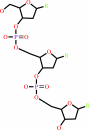 DNA(n)
|
+
|
2'-deoxyribonucleoside 5'-triphosphate
|
=
|
DNA(n+1)
|
+
|
 diphosphate
|
|
|
|
|
|
|
|
|
|
Enzyme class 3:
|
|
Chains A, B:
E.C.2.7.7.7
- DNA-directed Dna polymerase.
|
|
|
|
|
|
|
Reaction:
|
|
DNA(n) + a 2'-deoxyribonucleoside 5'-triphosphate = DNA(n+1) + diphosphate
|
|
|
|
|
|
DNA(n)
|
+
|
2'-deoxyribonucleoside 5'-triphosphate
|
=
|
DNA(n+1)
|
+
|
diphosphate
|
|
|
|
|
|
|
|
|
|
Enzyme class 4:
|
|
Chains A, B:
E.C.3.1.-.-
|
|
|
|
|
|
|
Enzyme class 5:
|
|
Chains A, B:
E.C.3.1.13.2
- exoribonuclease H.
|
|
|
|
|
|
|
Reaction:
|
|
Exonucleolytic cleavage to 5'-phosphomonoester oligonucleotides in both 5'- to 3'- and 3'- to 5'-directions.
|
|
|
|
|
|
Enzyme class 6:
|
|
Chains A, B:
E.C.3.1.26.13
- retroviral ribonuclease H.
|
|
|
|
|
|
|
Enzyme class 7:
|
|
Chains A, B:
E.C.3.4.23.16
- HIV-1 retropepsin.
|
|
|
|
|
|
|
Reaction:
|
|
Specific for a P1 residue that is hydrophobic, and P1' variable, but often Pro.
|
|
|
|
|
|
|
|
|
Note, where more than one E.C. class is given (as above), each may
correspond to a different protein domain or, in the case of polyprotein
precursors, to a different mature protein.
|
|
|
|
Molecule diagrams generated from .mol files obtained from the
KEGG ftp site
|
|
|
|
|
|
|
|
|
|
|
|
|
|
 |
|
|
|
|
|
|
| |
|
|
| |
|
DOI no:
|
J Biol Chem
275:5633-5639
(2000)
|
|
PubMed id:
|
|
|
|
|
|
| |
|
Phenylethylthiazolylthiourea (PETT) non-nucleoside inhibitors of HIV-1 and HIV-2 reverse transcriptases. Structural and biochemical analyses.
|
|
J.Ren,
J.Diprose,
J.Warren,
R.M.Esnouf,
L.E.Bird,
S.Ikemizu,
M.Slater,
J.Milton,
J.Balzarini,
D.I.Stuart,
D.K.Stammers.
|
|
|
|
|
| |
ABSTRACT
|
|
|
|
| |
|
|
Most non-nucleoside reverse transcriptase (RT) inhibitors are specific for HIV-1
RT and demonstrate minimal inhibition of HIV-2 RT. However, we report that
members of the phenylethylthiazolylthiourea (PETT) series of non-nucleoside
reverse transcriptase inhibitors showing high potency against HIV-1 RT have
varying abilities to inhibit HIV-2 RT. Thus, PETT-1 inhibits HIV-1 RT with an
IC(50) of 6 nM but shows only weak inhibition of HIV-2 RT, whereas PETT-2
retains similar potency against HIV-1 RT (IC(50) of 5 nM) and also inhibits
HIV-2 RT (IC(50) of 2.2 microM). X-ray crystallographic structure determinations
of PETT-1 and PETT-2 in complexes with HIV-1 RT reveal the compounds bind in an
overall similar conformation albeit with some differences in their interactions
with the protein. To investigate whether PETT-2 could be acting at a different
site on HIV-2 RT (e.g. the dNTP or template primer binding site), we compared
modes of inhibition for PETT-2 against HIV-1 and HIV-2 RT. PETT-2 was a
noncompetitive inhibitor with respect to the dGTP substrate for both HIV-1 and
HIV-2 RTs. PETT-2 was also a noncompetitive inhibitor with respect to a
poly(rC).(dG) template primer for HIV-2 RT. These results are consistent with
PETT-2 binding in corresponding pockets in both HIV-1 and HIV-2 RT with amino
acid sequence differences in HIV-2 RT affecting the binding of PETT-2 compared
with PETT-1.
|
|
|
|
|
|
| |
Selected figure(s)
|
|
|
|
| |
|
|

|
|

|
|
Figure 1.
Fig. 1. Simulated annealing omit electron density maps
showing the bound inhibitors at the NNRTI pocket of HIV-1 RT. a,
PETT-1; b, PETT-2. The maps are contoured at 4  . .
|
|
Figure 4.
Fig. 4. . Schematic diagrams showing the intermolecular
interactions between PETT inhibitors (in red) and the
surrounding residues of HIV-1 RT for (a) PETT-1 and (b) PETT-2.
Residues that contact the NNRTI with a minimum inter-atomic
distance of  3.6 Å
are shown in green, whereas other residues lining the binding
pocket are shown in blue. The individual distances between the
NNRTI and the protein atoms are shown as dashed lines (distances
3.3 Å
in pink, 3.3 Å < distances 3.6 Å
in light blue). Hydrogen bonds together with their distances are
shown in black. 3.6 Å
are shown in green, whereas other residues lining the binding
pocket are shown in blue. The individual distances between the
NNRTI and the protein atoms are shown as dashed lines (distances
3.3 Å
in pink, 3.3 Å < distances 3.6 Å
in light blue). Hydrogen bonds together with their distances are
shown in black.
|
|
|
|
|
|
| |
The above figures are
reprinted
by permission from the ASBMB:
J Biol Chem
(2000,
275,
5633-5639)
copyright 2000.
|
|
| |
Figures were
selected
by an automated process.
|
|
|
|
|
|
|
|
|
|
|
|
|
|
|
|
 |
 |
 |
|
Literature references that cite this PDB file's key reference
|
|
|
| |
PubMed id
|
|
Reference
|
|
|
|
|
|
A.Herschhorn,
and
A.Hizi
(2010).
Retroviral reverse transcriptases.
|
| |
Cell Mol Life Sci,
67,
2717-2747.
|
|
|
|
|
|
|
Z.Xiaohe,
Q.Yu,
Y.Hong,
S.Xiuqing,
and
Z.Rugang
(2010).
Synthesis, biological evaluation and molecular modeling studies of N-aryl-2-arylthioacetamides as non-nucleoside HIV-1 reverse transcriptase inhibitors.
|
| |
Chem Biol Drug Des,
76,
330-339.
|
|
|
|
|
|
|
N.Sluis-Cremer,
and
G.Tachedjian
(2008).
Mechanisms of inhibition of HIV replication by non-nucleoside reverse transcriptase inhibitors.
|
| |
Virus Res,
134,
147-156.
|
|
|
|
|
|
|
R.Hunter,
Y.Younis,
C.I.Muhanji,
T.L.Curtin,
K.J.Naidoo,
M.Petersen,
C.M.Bailey,
A.Basavapathruni,
and
K.S.Anderson
(2008).
C-2-aryl O-substituted HI-236 derivatives as non-nucleoside HIV-1 reverse-transcriptase inhibitors.
|
| |
Bioorg Med Chem,
16,
10270-10280.
|
|
|
|
|
|
|
G.Barreiro,
C.R.Guimarães,
I.Tubert-Brohman,
T.M.Lyons,
J.Tirado-Rives,
and
W.L.Jorgensen
(2007).
Search for non-nucleoside inhibitors of HIV-1 reverse transcriptase using chemical similarity, molecular docking, and MM-GB/SA scoring.
|
| |
J Chem Inf Model,
47,
2416-2428.
|
|
|
|
|
|
|
J.Ren,
C.E.Nichols,
A.Stamp,
P.P.Chamberlain,
R.Ferris,
K.L.Weaver,
S.A.Short,
and
D.K.Stammers
(2006).
Structural insights into mechanisms of non-nucleoside drug resistance for HIV-1 reverse transcriptases mutated at codons 101 or 138.
|
| |
FEBS J,
273,
3850-3860.
|
|
|
PDB codes:
|
|
|
|
|
|
|
|
J.L.Medina-Franco,
A.Golbraikh,
S.Oloff,
R.Castillo,
and
A.Tropsha
(2005).
Quantitative structure-activity relationship analysis of pyridinone HIV-1 reverse transcriptase inhibitors using the k nearest neighbor method and QSAR-based database mining.
|
| |
J Comput Aided Mol Des,
19,
229-242.
|
|
|
|
|
|
|
F.Daeyaert,
M.de Jonge,
J.Heeres,
L.Koymans,
P.Lewi,
M.H.Vinkers,
and
P.A.Janssen
(2004).
A pharmacophore docking algorithm and its application to the cross-docking of 18 HIV-NNRTI's in their binding pockets.
|
| |
Proteins,
54,
526-533.
|
|
|
|
|
|
|
J.Auwerx,
M.Stevens,
A.R.Van Rompay,
L.E.Bird,
J.Ren,
E.De Clercq,
B.Oberg,
D.K.Stammers,
A.Karlsson,
and
J.Balzarini
(2004).
The phenylmethylthiazolylthiourea nonnucleoside reverse transcriptase (RT) inhibitor MSK-076 selects for a resistance mutation in the active site of human immunodeficiency virus type 2 RT.
|
| |
J Virol,
78,
7427-7437.
|
|
|
|
|
|
|
J.D.Pata,
W.G.Stirtan,
S.W.Goldstein,
and
T.A.Steitz
(2004).
Structure of HIV-1 reverse transcriptase bound to an inhibitor active against mutant reverse transcriptases resistant to other nonnucleoside inhibitors.
|
| |
Proc Natl Acad Sci U S A,
101,
10548-10553.
|
|
|
PDB code:
|
|
|
|
|
|
|
|
M.Barbany,
H.Gutiérrez-de-Terán,
F.Sanz,
and
J.Villà-Freixa
(2004).
Towards a MIP-based alignment and docking in computer-aided drug design.
|
| |
Proteins,
56,
585-594.
|
|
|
|
|
|
|
N.Sluis-Cremer,
N.A.Temiz,
and
I.Bahar
(2004).
Conformational changes in HIV-1 reverse transcriptase induced by nonnucleoside reverse transcriptase inhibitor binding.
|
| |
Curr HIV Res,
2,
323-332.
|
|
|
|
|
|
|
O.J.D'Cruz,
P.Samuel,
and
F.M.Uckun
(2004).
PHI-443: a novel noncontraceptive broad-spectrum anti-human immunodeficiency virus microbicide.
|
| |
Biol Reprod,
71,
2037-2047.
|
|
|
|
|
|
|
K.Post,
J.Guo,
K.J.Howard,
M.D.Powell,
J.T.Miller,
A.Hizi,
S.F.Le Grice,
and
J.G.Levin
(2003).
Human immunodeficiency virus type 2 reverse transcriptase activity in model systems that mimic steps in reverse transcription.
|
| |
J Virol,
77,
7623-7634.
|
|
|
|
|
|
|
J.Ren,
L.E.Bird,
P.P.Chamberlain,
G.B.Stewart-Jones,
D.I.Stuart,
and
D.K.Stammers
(2002).
Structure of HIV-2 reverse transcriptase at 2.35-A resolution and the mechanism of resistance to non-nucleoside inhibitors.
|
| |
Proc Natl Acad Sci U S A,
99,
14410-14415.
|
|
|
PDB code:
|
|
|
|
|
|
|
|
S.C.Houston,
L.J.Miedzinski,
and
L.D.Mashinter
(2002).
Rapid progression of CD4 cell decline and subsequent response to salvage therapy in HIV-2 infection.
|
| |
AIDS,
16,
1189-1191.
|
|
|
|
|
|
|
J.Ren,
J.Milton,
K.L.Weaver,
S.A.Short,
D.I.Stuart,
and
D.K.Stammers
(2000).
Structural basis for the resilience of efavirenz (DMP-266) to drug resistance mutations in HIV-1 reverse transcriptase.
|
| |
Structure,
8,
1089-1094.
|
|
|
PDB codes:
|
|
|
|
|
|
|
The most recent references are shown first.
Citation data come partly from CiteXplore and partly
from an automated harvesting procedure. Note that this is likely to be
only a partial list as not all journals are covered by
either method. However, we are continually building up the citation data
so more and more references will be included with time.
Where a reference describes a PDB structure, the PDB
codes are
shown on the right.
|
 |


 Links
Links


