Ditrans,polycis-undecaprenyl-diphosphate synthase [(2E,6E)-farnesyl-diphosphate specific]
Undecaprenyl diphosphate synthases catalyse the sequential condensation of isopentyl diphosphate (IPP) with allylic disphosphates. The reaction generates linear prenyl diphosphates within the biosynthetic pathway of isoprenoid compounds; components which are essential to cell machinery such as cholesterol, carotenoids and dolichols. This reactions proceed through very similar mechanisms, although the enzymes differ with respect to the stereochemistry and chain length of their products. The enzyme in question is an example of the cis subclass.
Reference Protein and Structure
- Sequence
-
O82827
 (2.5.1.31)
 (Sequence Homologues)
(PDB Homologues)
(Sequence Homologues)
(PDB Homologues)
- Biological species
-
Micrococcus luteus (Bacteria)
- PDB
-
1f75
- CRYSTAL STRUCTURE OF UNDECAPRENYL DIPHOSPHATE SYNTHASE FROM MICROCOCCUS LUTEUS B-P 26
(2.2 Å)



- Catalytic CATH Domains
-
3.40.1180.10
 (see all for 1f75)
- Cofactors
- Magnesium(2+) (2)
Enzyme Reaction (EC:2.5.1.31)




Enzyme Mechanism
Introduction
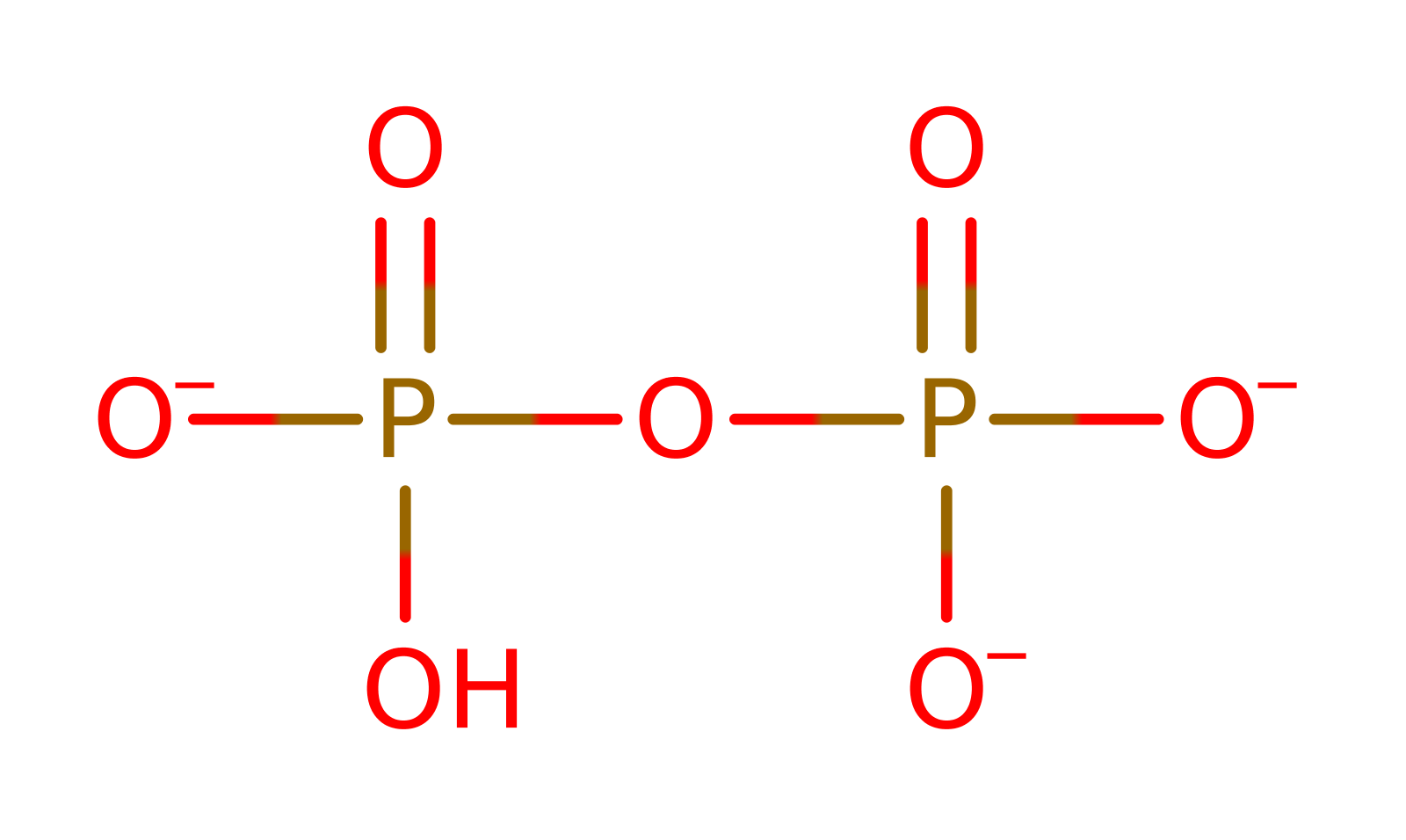
The Mg dependent reaction begins with the elimination of a diphosphate ion from an allylic diphosphate to form an allylic cation at the C1 position. This cation is then attacked by the pi electrons at the C4' of the IPP with the formation of a new C-C bond between C1 and C4'. Several residues are involved in orientating the substrate molecule the direction necessary for stereospecific condensation with IPP to occur. It is still undecided whether the reaction proceeds via an ionization condensation elimination mechanism, where the carbocation is formed first, or by a concerted SN2 like mechanism where the abstraction of a proton from the C2 of IPP initiates the reaction. The residues implicated in an SN2 mechanism have been included in this annotation, although information on the alternative pathway can be found in the appended references. The crystal structure does not include the Mg metal or residues 74 to 85, and so Asn77, acting as a general base to IPP and Trp78, which orientates the diphosphate towards stereospecific condensation with IPP cannot be included in the annotation. The metal enhances the reactivity of the farnesyl pyrophosphate by polarising the O1-C'1 bond. The metal also acts to stabilise the resulting anion.
Catalytic Residues Roles
| UniProt | PDB* (1f75) | ||
| Leu140 | Leu140A | Important for determining chain length of the product. | |
| Asp29 | Asp29A | The residue facilitates the migration of the catalytically necessary Mg divalent cation from IPP to the farnesyl diphosphate. Without Asp26, the metal remains bound to IPP where it cannot facilitate the loss of diphosphate from FPP. | electrostatic stabiliser |
| His46 | His46A | The residue is thought to act as a temporary proton carrier from the solvent to the diphosphate. Its importance is identified by mutagenesis studies, which show the reaction rate to be decreased by over 1000 fold when His46 is replaced by Ala. | proton shuttle (general acid/base) |
Chemical Components
References
- Guo RT et al. (2005), J Biol Chem, 280, 20762-20774. Crystal Structures of Undecaprenyl Pyrophosphate Synthase in Complex with Magnesium, Isopentenyl Pyrophosphate, and Farnesyl Thiopyrophosphate: ROLES OF THE METAL ION AND CONSERVED RESIDUES IN CATALYSIS. DOI:10.1074/jbc.m502121200. PMID:15788389.
- Sinko W et al. (2011), Chem Biol Drug Des, 77, 412-420. Applying molecular dynamics simulations to identify rarely sampled ligand-bound conformational states of undecaprenyl pyrophosphate synthase, an antibacterial target. DOI:10.1111/j.1747-0285.2011.01101.x. PMID:21294851.
- Lu YP et al. (2010), Biochem Biophys Res Commun, 400, 758-762. Mechanism of cis-prenyltransferase reaction probed by substrate analogues. DOI:10.1016/j.bbrc.2010.09.001. PMID:20828539.
- Chang SY et al. (2004), Protein Sci, 13, 971-978. Substrate binding mode and reaction mechanism of undecaprenyl pyrophosphate synthase deduced from crystallographic studies. DOI:10.1110/ps.03519904. PMID:15044730.
- Chang SY et al. (2003), J Biol Chem, 278, 29298-29307. Catalytic mechanism revealed by the crystal structure of undecaprenyl pyrophosphate synthase in complex with sulfate, magnesium, and triton. DOI:10.1074/jbc.M302687200. PMID:12756244.
- Kharel Y et al. (2001), J Biol Chem, 276, 28459-28464. Identification of Significant Residues for Homoallylic Substrate Binding of Micrococcus luteus B-P 26 Undecaprenyl Diphosphate Synthase. DOI:10.1074/jbc.m102057200. PMID:11346651.
- Ko TP et al. (2001), J Biol Chem, 276, 47474-47482. Mechanism of product chain length determination and the role of a flexible loop in Escherichia coli undecaprenyl-pyrophosphate synthase catalysis. DOI:10.1074/jbc.M106747200. PMID:11581264.
- Fujihashi M et al. (2001), Proc Natl Acad Sci U S A, 98, 4337-4342. Crystal structure of cis-prenyl chain elongating enzyme, undecaprenyl diphosphate synthase. DOI:10.1073/pnas.071514398. PMID:11287651.
- Fujikura K et al. (2000), J Biochem, 128, 917-922. Significance of Asn-77 and Trp-78 in the Catalytic Function of Undecaprenyl Diphosphate Synthase of Micrococcus luteus B-P 26. DOI:10.1093/oxfordjournals.jbchem.a022842. PMID:11098133.
- Pan JJ et al. (2000), Biochemistry, 39, 13856-13861. Effect of site-directed mutagenesis of the conserved aspartate and glutamate on E. coli undecaprenyl pyrophosphate synthase catalysis. PMID:11076526.

Catalytic Residues Roles
| Residue | Roles |
|---|---|
| Asp29A | electrostatic stabiliser |
| His46A | proton shuttle (general acid/base) |