Trichodiene synthase
trichodiene synthase (TS) is a member of the Isoprenoid Synthase Type I superfamily. The formation of trichodiene is the first committed step in the biosynthesis of trichothecenes produced by fungi. Trichothecenes are sesquiterpenoid toxins that act by inhibiting protein biosynthesis.
Reference Protein and Structure
- Sequence
-
P13513
 (4.2.3.6)
 (Sequence Homologues)
(PDB Homologues)
(Sequence Homologues)
(PDB Homologues)
- Biological species
-
Fusarium sporotrichioides (Fungus)
- PDB
-
1jfg
- TRICHODIENE SYNTHASE FROM FUSARIUM SPOROTRICHIOIDES COMPLEXED WITH DIPHOSPHATE
(2.5 Å)



- Catalytic CATH Domains
-
1.10.600.10
 (see all for 1jfg)
- Cofactors
- Magnesium(2+) (3) Metal MACiE
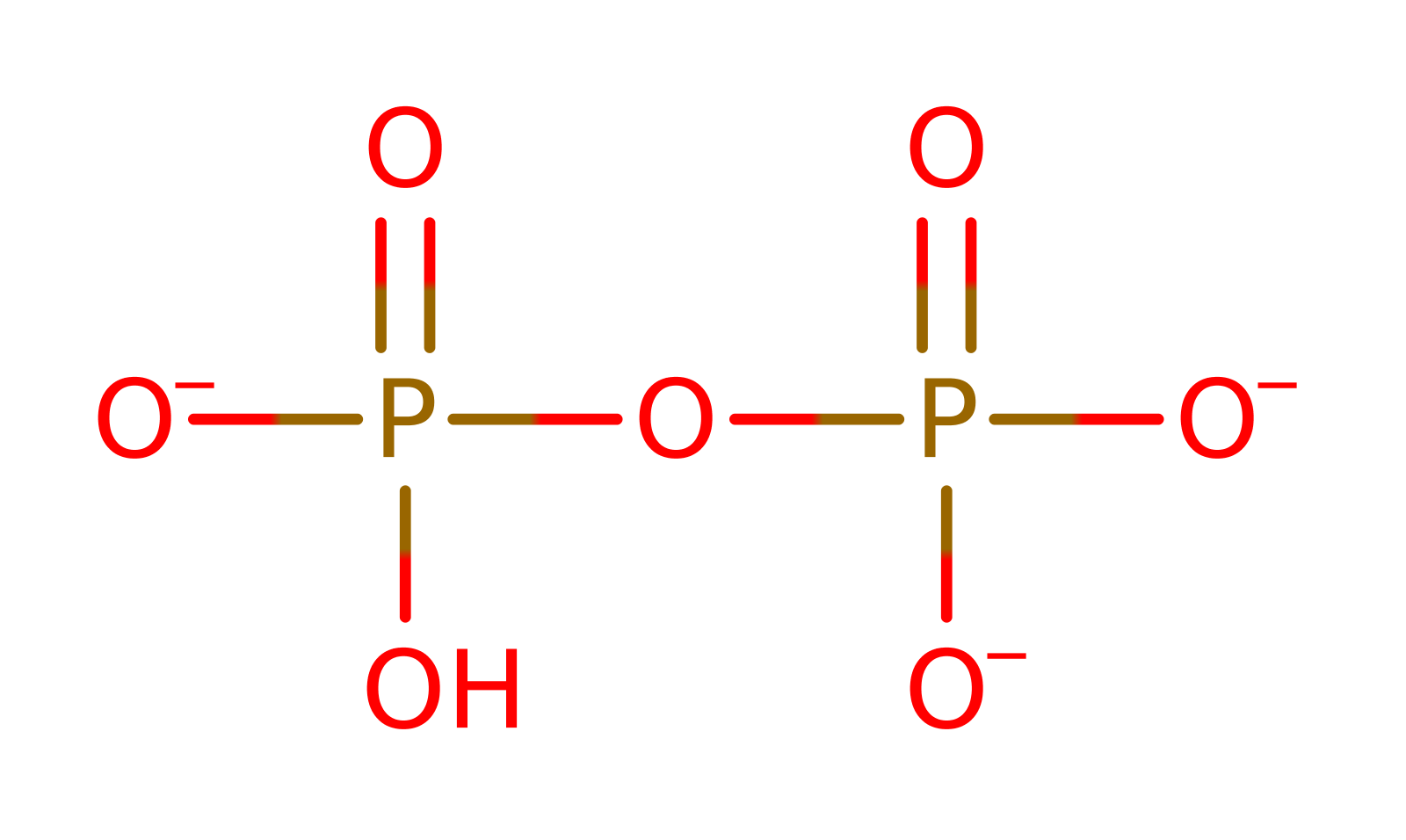
Enzyme Reaction (EC:4.2.3.6)




Enzyme Mechanism
Introduction
The active site contour is complementary in both shape and hyrdophobicity to the productive conformer of the farnesyl substrate [PMID:11698643]. The three magnesium ions are bound to the enzyme in the presence of the substrate, the binding of which triggers a protein conformational change. The purpose of the protein conformational change is proposed to facilitate the departure of the pyrophosphate group of the substrate. The pyrophosphate attacks the C3 cationic carbon in a nucleophilic addition reaction followed by an intramolecular elimination of the pyrophosphate. Intramolecular electrophilic addition across the C1-C6 bond to form the six-membered ring. Intramolecular electrophilic addition across the C10-C7 bond to form the five-membered ring. The Pyrophosphate deprotonates the substrate, which initiates the first methyl migration, followed by a second methyl migration and finally a 1,4-hydride shift.
Catalytic Residues Roles
| UniProt | PDB* (1jfg) | ||
| Thr96 | Thr96A | Sterically directs the C12 to C7 methyl migration. | van der waals interaction, steric role |
| Leu97 | Leu97A | Appears to sterically hinder to potentially competing C12 or C13 methyl migrations. | van der waals interaction, steric role |
| Tyr93 | Tyr93A | Stabilises positive charge on C7 of substrate via cation-pi interaction. | van der waals interaction, electrostatic stabiliser, polar/non-polar interaction |
| Arg304 | Arg304A | Forms salt bridge with D101 that facilitates active site closure; Interacts with substrate diphosphate to trigger substrate ionisation. | increase nucleophilicity, promote heterolysis, hydrogen bond donor, electrostatic stabiliser |
| Arg182, Lys232, Tyr305 | Arg182A, Lys232A, Tyr305A | Interacts with substrate diphosphate to trigger substrate ionisation. | increase nucleophilicity, promote heterolysis, hydrogen bond donor, electrostatic stabiliser |
| Asp100 | Asp100A | Forms part of both Mg1 and Mg2 binding site. | metal ligand, electrostatic stabiliser |
Chemical Components
intramolecular elimination, charge delocalisation, dephosphorylation, intermediate formation, overall reactant used, bimolecular nucleophilic addition, intramolecular electrophilic addition, cyclisation, proton transfer, intramolecular rearrangement, intermediate terminated, overall product formed, native state of enzyme regeneratedReferences
- Rynkiewicz MJ et al. (2001), Proc Natl Acad Sci U S A, 98, 13543-13548. Structure of trichodiene synthase from Fusarium sporotrichioides provides mechanistic inferences on the terpene cyclization cascade. DOI:10.1073/pnas.231313098. PMID:11698643.
- Burkhardt I et al. (2018), Chem Commun (Camb), 54, 3540-3542. The absolute configuration of isochamigrene: new insights into the cyclisation mechanism of trichodiene synthase. DOI:10.1039/c8cc01744a. PMID:29565430.
- Vedula LS et al. (2008), Arch Biochem Biophys, 469, 184-194. Structural and mechanistic analysis of trichodiene synthase using site-directed mutagenesis: Probing the catalytic function of tyrosine-295 and the asparagine-225/serine-229/glutamate-233–
- Hong YJ et al. (2006), Org Lett, 8, 4601-4604. Which Is More Likely in Trichodiene Biosynthesis: Hydride or Proton Transfer? DOI:10.1021/ol061884f. PMID:16986960.
- Vedula LS et al. (2005), Biochemistry, 44, 12719-12727. Role of Arginine-304 in the Diphosphate-Triggered Active Site Closure Mechanism of Trichodiene Synthase†,‡. DOI:10.1021/bi0510476. PMID:16171386.
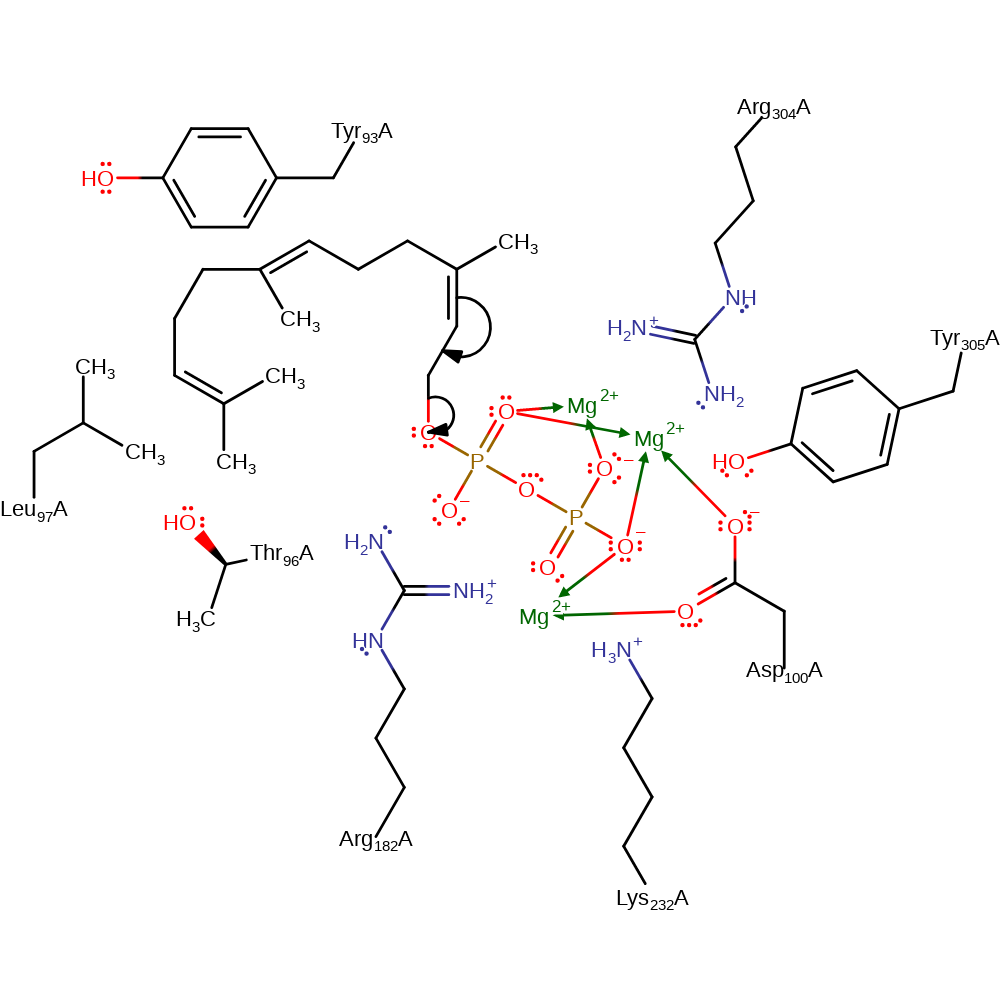
Step 1. The binding of the substrate causes a conformation change in the active site, which promotes the elimination of the pyrophosphate. The substrate is ionised by the dipohsphate interactions with the Mg(II) ions, Arg304, Lys232, Arg182 and Tyr305. Positive charge of carbo cation delocalised over the three terminal carbon atoms.
Download: Image, Marvin FileCatalytic Residues Roles
| Residue | Roles |
|---|---|
| Arg182A | electrostatic stabiliser, promote heterolysis, hydrogen bond donor |
| Arg304A | electrostatic stabiliser, promote heterolysis, hydrogen bond donor |
| Tyr93A | van der waals interaction |
| Leu97A | van der waals interaction |
| Asp100A | metal ligand, electrostatic stabiliser |
| Lys232A | electrostatic stabiliser, promote heterolysis, hydrogen bond donor |
| Tyr305A | promote heterolysis, electrostatic stabiliser, hydrogen bond donor |
| Thr96A | van der waals interaction |
Chemical Components
ingold: intramolecular elimination, charge delocalisation, dephosphorylation, intermediate formation, overall reactant used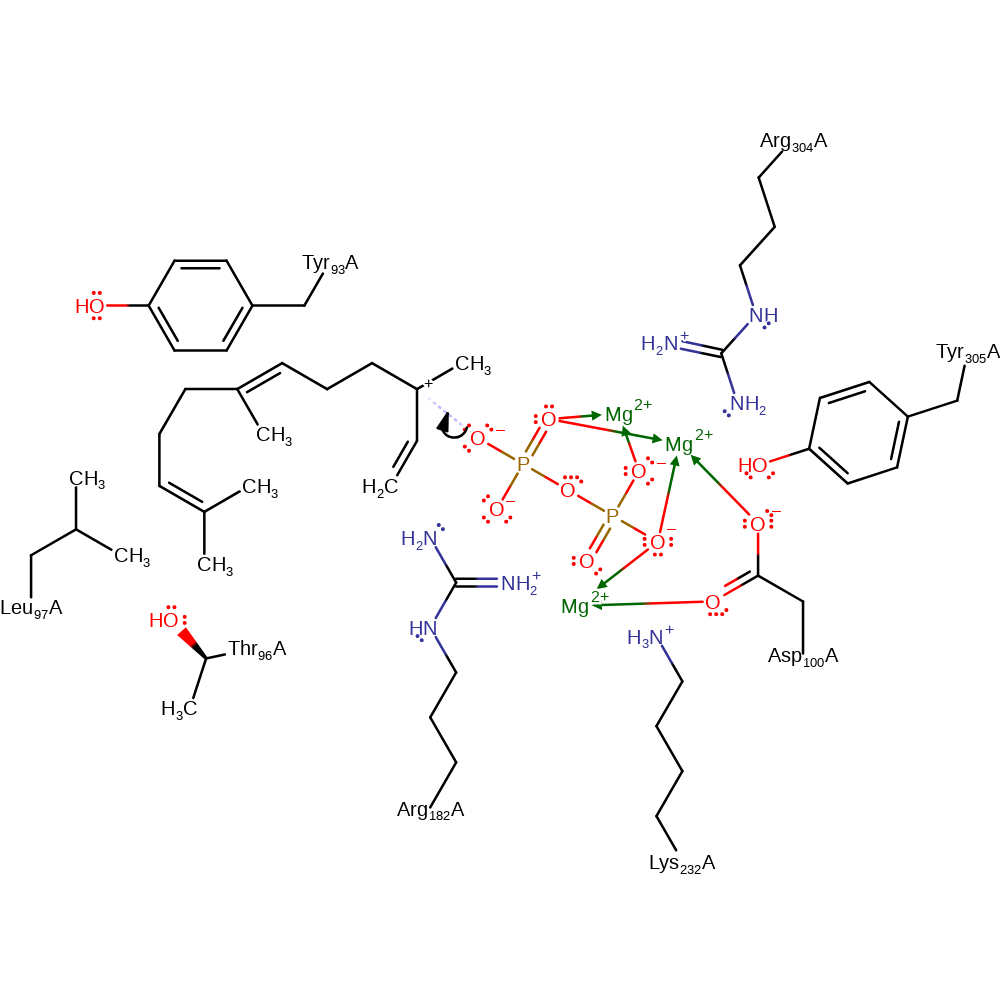
Step 2. Recapture of one of the alpha-phosphate oxygens by the C3 cation results in formation of (3R)-nerolidyl diphosphate [PMID:11698643] in a nucleophilic addition reaction.
Download: Image, Marvin FileCatalytic Residues Roles
| Residue | Roles |
|---|---|
| Tyr93A | van der waals interaction |
| Leu97A | van der waals interaction |
| Thr96A | van der waals interaction |
| Asp100A | metal ligand, electrostatic stabiliser |
| Arg182A | electrostatic stabiliser, increase nucleophilicity, hydrogen bond donor |
| Lys232A | electrostatic stabiliser, increase nucleophilicity, hydrogen bond donor |
| Arg304A | electrostatic stabiliser, increase nucleophilicity, hydrogen bond donor |
| Tyr305A | increase nucleophilicity, electrostatic stabiliser, hydrogen bond donor |
Chemical Components
ingold: bimolecular nucleophilic addition, charge delocalisation, intermediate formation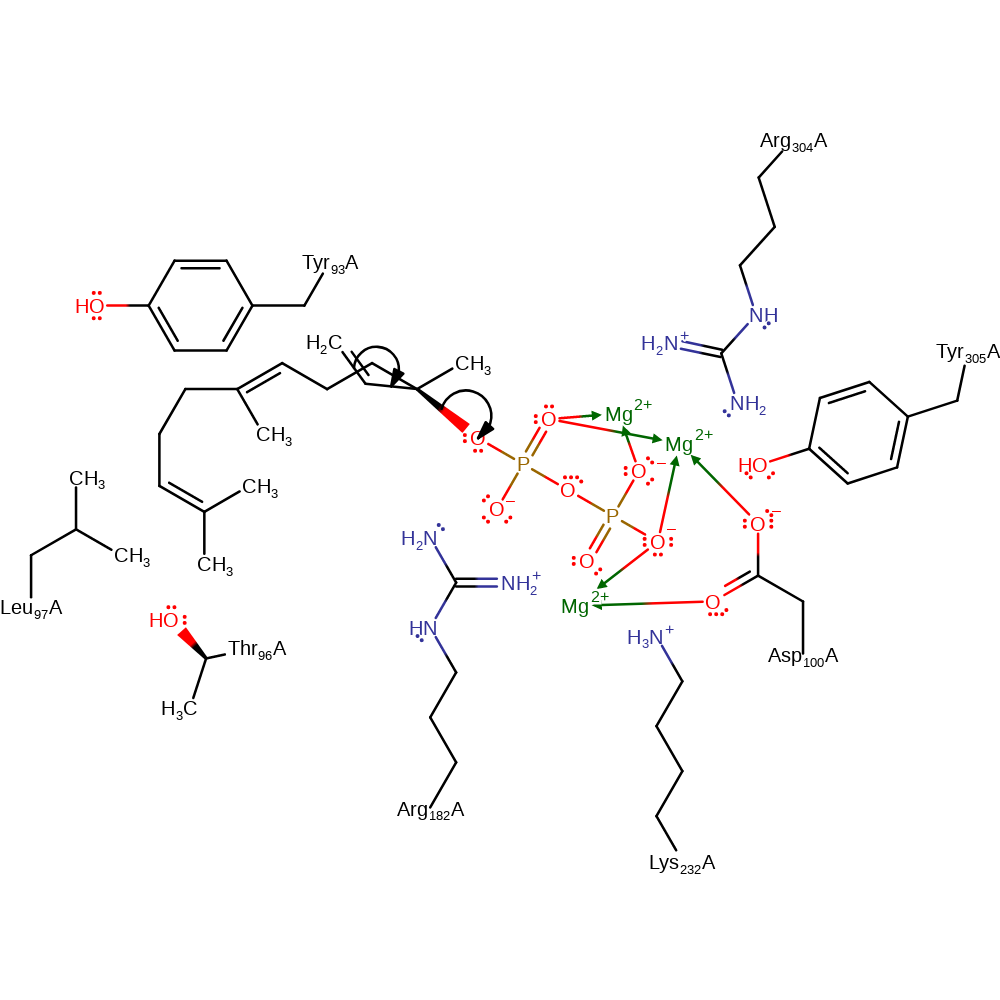
Step 3. Intramolecular elimination of the pyrophosphate. Free rotation about the C2-C3 bond from the transoid to cisoid conformation orientates the empty p orbital of C1 in the cation towards the C6-C7 pi orbital to facilitate the C1-C6 bond formation. It is currently unclear is this is concomitant with, or prior to the dipohsphate departure [PMID:11698643]. The positive charge of carbo cation delocalised over the three terminal carbon atoms. It is likely that the phosphate remains bound and aids in electrostatic stabilisation of the reaction intermediates [PMID:11698643].
Download: Image, Marvin FileCatalytic Residues Roles
| Residue | Roles |
|---|---|
| Tyr93A | van der waals interaction |
| Leu97A | van der waals interaction |
| Thr96A | van der waals interaction |
| Asp100A | metal ligand, electrostatic stabiliser |
| Arg182A | electrostatic stabiliser, promote heterolysis, hydrogen bond donor |
| Lys232A | electrostatic stabiliser, promote heterolysis, hydrogen bond donor |
| Arg304A | electrostatic stabiliser, promote heterolysis, hydrogen bond donor |
| Tyr305A | promote heterolysis, electrostatic stabiliser, hydrogen bond donor |
Chemical Components
ingold: intramolecular elimination, charge delocalisation, intermediate formation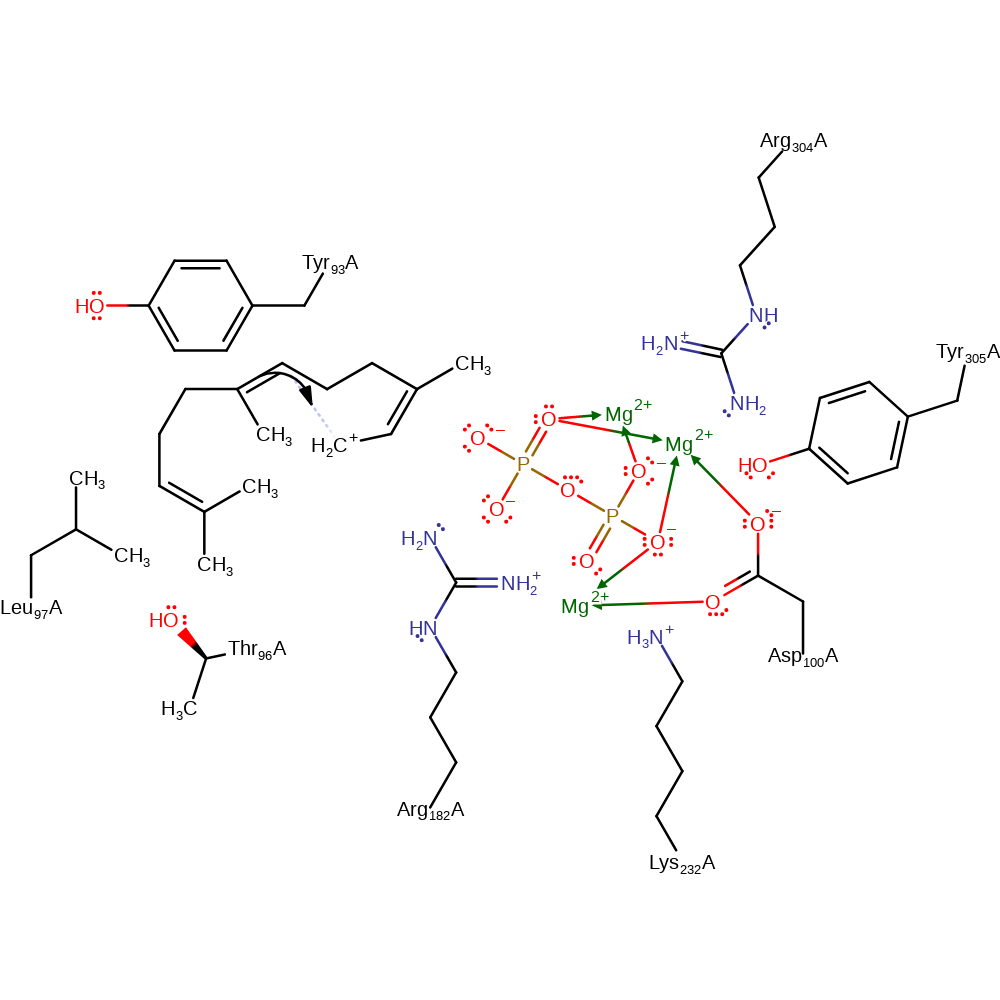
Step 4. Intramolecular electrophilic addition across the C1-C6 bond to form the six-membered ring. Positive charge on the C7 may be stabilised by the cation-pi interaction with the side chain of Tyr93.
Download: Image, Marvin FileCatalytic Residues Roles
| Residue | Roles |
|---|---|
| Tyr93A | polar/non-polar interaction, electrostatic stabiliser |
| Leu97A | van der waals interaction |
| Thr96A | van der waals interaction |
| Asp100A | metal ligand, electrostatic stabiliser |
| Arg182A | electrostatic stabiliser, hydrogen bond donor |
| Lys232A | electrostatic stabiliser, hydrogen bond donor |
| Arg304A | electrostatic stabiliser, hydrogen bond donor |
| Tyr305A | electrostatic stabiliser, hydrogen bond donor |
Chemical Components
ingold: intramolecular electrophilic addition, charge delocalisation, cyclisation, intermediate formation
Step 5. Intramolecular electrophilic addition across the C10-C7 bond to form the five-membered ring. The C10 carbocation is stabilised through long range electrostatic interactions with Asp100 and the pyrophosphate [PMID:11698643].
Download: Image, Marvin FileCatalytic Residues Roles
| Residue | Roles |
|---|---|
| Tyr93A | polar/non-polar interaction, electrostatic stabiliser |
| Leu97A | van der waals interaction, steric role |
| Thr96A | van der waals interaction, steric role |
| Asp100A | metal ligand, electrostatic stabiliser |
| Arg182A | electrostatic stabiliser, hydrogen bond donor |
| Lys232A | electrostatic stabiliser, hydrogen bond donor |
| Arg304A | electrostatic stabiliser, hydrogen bond donor |
| Tyr305A | electrostatic stabiliser, hydrogen bond donor |
Chemical Components
ingold: intramolecular electrophilic addition, intermediate formation, cyclisation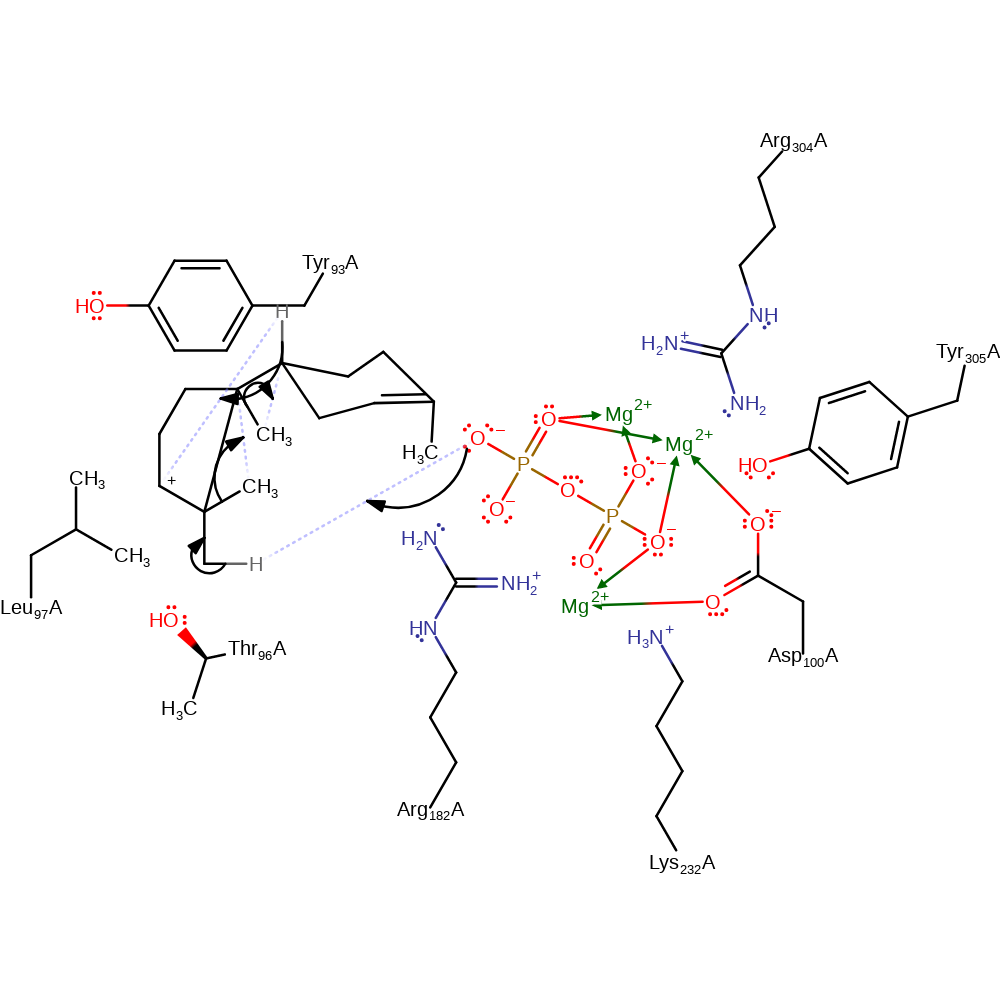
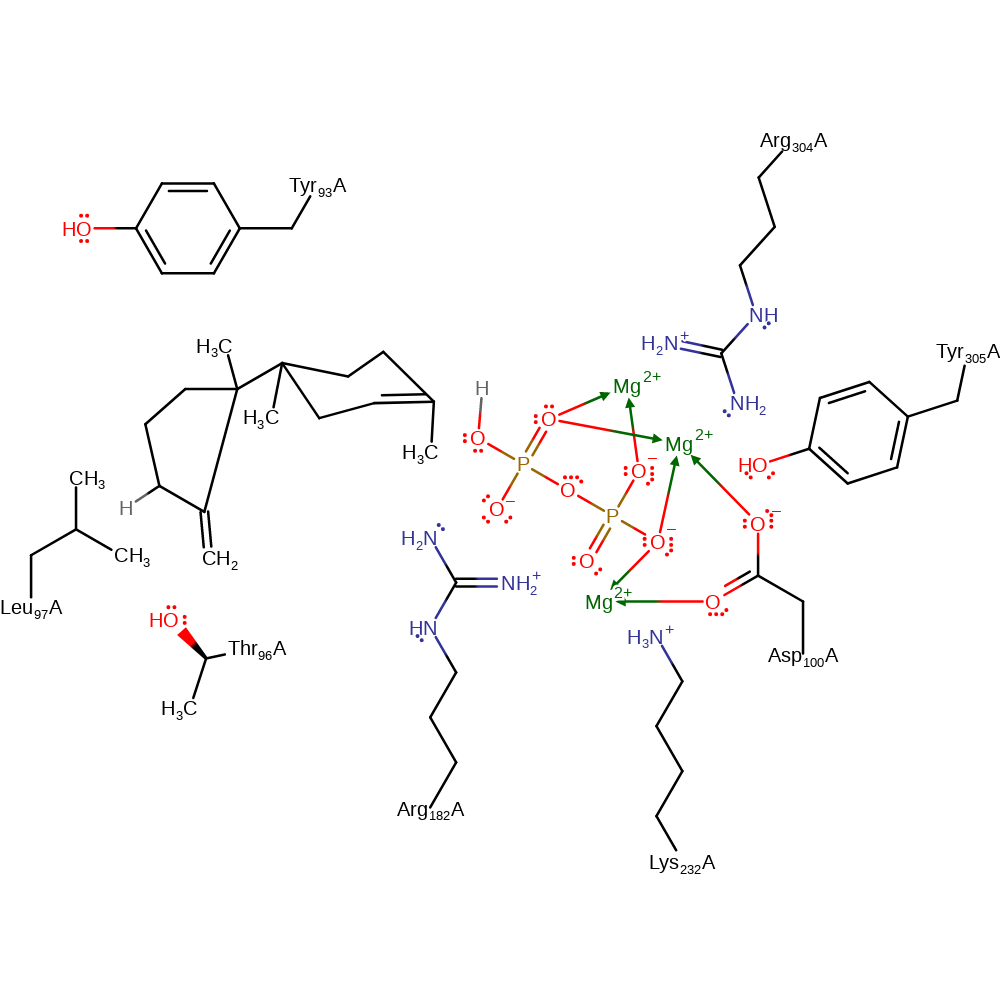
Step 6. This final carbocation is quenched by proton elimination from C12, mediated by the pyrophosphate. This proton abstraction initiates the first methyl migration, followed by a second methyl migration and finally a 1,4-hydride shift.
Download: Image, Marvin FileCatalytic Residues Roles
| Residue | Roles |
|---|---|
| Tyr93A | van der waals interaction |
| Leu97A | van der waals interaction, steric role |
| Thr96A | van der waals interaction, steric role |
| Asp100A | metal ligand, electrostatic stabiliser |
| Arg182A | electrostatic stabiliser, hydrogen bond donor |
| Lys232A | electrostatic stabiliser, hydrogen bond donor |
| Arg304A | electrostatic stabiliser, hydrogen bond donor |
| Tyr305A | electrostatic stabiliser, hydrogen bond donor |
 Download: