 |
PDBsum entry 6y5d

|
|
|
|
|
|

|

|

|

|
|

|
|

|
|

|
|

|
|

|
|

|
|

|
|
|
 |

|

|
|
|
|
|
|
|
|
|
|
|
|
|
|
|
|
|
|
|
|
|
|
|
|
|
|
|
|
|
|
|
|
|
|
|
|
Immune system
|
PDB id
|
|
|
|
6y5d
|
|
|
|
|
|
|
|
|
|
|
|
|
|
|

|

|

|
|
|
|
|
|
|
|
 |
Contents |
 |
|
|
|
|
|
|
|
|
|
|
|


 96 a.a.
|
|
|
|
|
|
|
|
|
|
|


 81 a.a.
|
|
|
|
|
|
|
|
|
|
|


 107 a.a.
|
|
|
|
|
|
|
|
|
|
|


 93 a.a.
|
|
|
|
|
|
|
|
|
|
|

 362 a.a.
|
|
|
|
|
|
|
|
|
|
|
 77 a.a.
|
|
|
|
|
|
|
|
|
|
|
|
|
|
|
|
|
PDB id:
|
|
|
|
| Name: |
|
Immune system
|
|
|
Title:
|
|
Structure of human cgas (k394e) bound to the nucleosome
|
|
Structure:
|
|
Histone h3.2. Chain: a, e, m, q. Synonym: histone h3/m,histone h3/o. Engineered: yes. Histone h4. Chain: b, f, n, r. Engineered: yes. Histone h2a type 2-a. Chain: c, g, o, s.
|
|
Source:
|
|
Homo sapiens. Human. Organism_taxid: 9606. Gene: hist2h3a, hist2h3c, h3f2, h3fm, hist2h3d. Expressed in: escherichia coli k-12. Expression_system_taxid: 83333. Gene: hist1h4a, h4/a, h4fa, hist1h4b, h4/i, h4fi, hist1h4c, h4/g, h4fg, hist1h4d, h4/b, h4fb, hist1h4e, h4/j, h4fj, hist1h4f, h4/c, h4fc, hist1h4h, h4/h, h4fh, hist1h4i, h4/m, h4fm, hist1h4j, h4/e,
|
|
Authors:
|
|
G.R.Pathare,S.Cavadini,G.Kempf,N.H.Thoma
|
|
Key ref:
|
|
G.R.Pathare
et al.
(2020).
Structural mechanism of cGAS inhibition by the nucleosome.
Nature,
587,
668-672.
PubMed id:
DOI:
|
|
|
Date:
|
|
|
25-Feb-20
|
Release date:
|
23-Sep-20
|
|
|
|
|
|
|
PROCHECK
|

|
|
|
|
|
Headers
|
|
|
|
References
|
|
|
|
|
|

|
|
Q71DI3
(H32_HUMAN) -
Histone H3.2 from Homo sapiens
|
|
|
|
Seq:
Struc:
|
|
|
|
136 a.a.
96 a.a.*
|
|

|

|
|
|
|
|
|
|
|
|
|
|
|
|

|
|
P62805
(H4_HUMAN) -
Histone H4 from Homo sapiens
|
|
|
|
Seq:
Struc:
|
|
|
|
103 a.a.
81 a.a.
|
|
|

|
|
|
|
|
|
|
|
|
|
|
|
|

|
|
Q6FI13
(H2A2A_HUMAN) -
Histone H2A type 2-A from Homo sapiens
|
|
|
|
Seq:
Struc:
|
|
|
|
130 a.a.
107 a.a.
|
|
|

|
|
|
|
|
|
|
|
|
|
|
|
|

|
|
O60814
(H2B1K_HUMAN) -
Histone H2B type 1-K from Homo sapiens
|
|
|
|
Seq:
Struc:
|
|
|
|
126 a.a.
93 a.a.
|
|
|

|
|
|
|
|
|
|
|
|
|
|
|
|
|
|
|
|
|
Enzyme class:
|
|
Chains K, L:
E.C.2.7.7.86
- cyclic GMP-AMP synthase.
|
|
|
|
|
|
|
Reaction:
|
|
GTP + ATP = 2',3'-cGAMP + 2 diphosphate
|
|
|
|
|
|
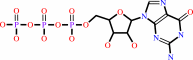 GTP
GTP
|
+
|
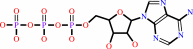 ATP
ATP
|
=
|
2',3'-cGAMP
|
+
|
 2
×
diphosphate
2
×
diphosphate
|
|
|
|
|
|
|
|
|
|
|
|
|
Molecule diagrams generated from .mol files obtained from the
KEGG ftp site
|
|
|
|
|
|
|
|
|
|
|
|
|
|
 |
|
|
|
|
|
|
| |
|
|
| |
|
DOI no:
|
Nature
587:668-672
(2020)
|
|
PubMed id:
|
|
|
|
|
|
| |
|
Structural mechanism of cGAS inhibition by the nucleosome.
|
|
G.R.Pathare,
A.Decout,
S.Glück,
S.Cavadini,
K.Makasheva,
R.Hovius,
G.Kempf,
J.Weiss,
Z.Kozicka,
B.Guey,
P.Melenec,
B.Fierz,
N.H.Thomä,
A.Ablasser.
|
|
|
|
|
| |
ABSTRACT
|
|
|
|
| |
|
|
The DNA sensor cyclic GMP-AMP synthase (cGAS) initiates innate immune responses
following microbial infection, cellular stress and cancer1. Upon
activation by double-stranded DNA, cytosolic cGAS produces 2'3' cGMP-AMP, which
triggers the induction of inflammatory cytokines and type I
interferons 2-7. cGAS is also present inside the cell nucleus, which
is replete with genomic DNA8, where chromatin has been implicated in
restricting its enzymatic activity9. However, the structural basis
for inhibition of cGAS by chromatin remains unknown. Here we present the
cryo-electron microscopy structure of human cGAS bound to nucleosomes. cGAS
makes extensive contacts with both the acidic patch of the histone H2A-H2B
heterodimer and nucleosomal DNA. The structural and complementary biochemical
analysis also find cGAS engaged to a second nucleosome in trans.
Mechanistically, binding of the nucleosome locks cGAS into a monomeric state, in
which steric hindrance suppresses spurious activation by genomic DNA. We find
that mutations to the cGAS-acidic patch interface are sufficient to abolish the
inhibitory effect of nucleosomes in vitro and to unleash the activity of cGAS
on genomic DNA in living cells. Our work uncovers the structural basis of the
interaction between cGAS and chromatin and details a mechanism that permits
self-non-self discrimination of genomic DNA by cGAS.
|
|
|
|
|
|
|
|
|
|
|
|
|
|
|
|
|
|
 |
 |
 |
| | |


 Links
Links


