 |
PDBsum entry 3gi4

|
|
|
|
|
|

|

|

|

|
|

|
|

|
|

|
|

|
|

|
|
|
 |

|

|
|
|
|
|
|
|
|
|
|
|
|
|
|
|
|
|
|
|
|
|
|
|
|
|
|
|
|
|
|
|
|
|
|
Hydrolase/hydrolase inhibitor
|
PDB id
|
|
|
|
3gi4
|
|
|
|
|
|
|
|
|
|
|
|
|
|
|

|

|

|
|
|
|
|
|
|
|
 |
Contents |
 |
|
|
|
|
|
|
|
|
|
|
|
|
* Residue conservation analysis
|
|
|
|
|
|
|
|
|
|
|
Enzyme class 1:
|
|
E.C.2.7.7.-
- ?????
|
|
|
|
|
|
|
Enzyme class 2:
|
|
E.C.2.7.7.49
- RNA-directed Dna polymerase.
|
|
|
|
|
|
|
Reaction:
|
|
DNA(n) + a 2'-deoxyribonucleoside 5'-triphosphate = DNA(n+1) + diphosphate
|
|
|
|
|
|
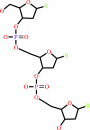 DNA(n)
|
+
|
2'-deoxyribonucleoside 5'-triphosphate
|
=
|
DNA(n+1)
Bound ligand (Het Group name = )
matches with 55.56% similarity
|
+
|
 diphosphate
|
|
|
|
|
|
|
|
|
|
Enzyme class 3:
|
|
E.C.2.7.7.7
- DNA-directed Dna polymerase.
|
|
|
|
|
|
|
Reaction:
|
|
DNA(n) + a 2'-deoxyribonucleoside 5'-triphosphate = DNA(n+1) + diphosphate
|
|
|
|
|
|
DNA(n)
|
+
|
2'-deoxyribonucleoside 5'-triphosphate
|
=
|
DNA(n+1)
Bound ligand (Het Group name = )
matches with 55.56% similarity
|
+
|
diphosphate
|
|
|
|
|
|
|
|
|
|
Enzyme class 4:
|
|
E.C.3.1.-.-
|
|
|
|
|
|
|
Enzyme class 5:
|
|
E.C.3.1.13.2
- exoribonuclease H.
|
|
|
|
|
|
|
Reaction:
|
|
Exonucleolytic cleavage to 5'-phosphomonoester oligonucleotides in both 5'- to 3'- and 3'- to 5'-directions.
|
|
|
|
|
|
Enzyme class 6:
|
|
E.C.3.1.26.13
- retroviral ribonuclease H.
|
|
|
|
|
|
|
Enzyme class 7:
|
|
E.C.3.4.23.16
- HIV-1 retropepsin.
|
|
|
|
|
|
|
Reaction:
|
|
Specific for a P1 residue that is hydrophobic, and P1' variable, but often Pro.
|
|
|
|
|
|
|
|
|
Note, where more than one E.C. class is given (as above), each may
correspond to a different protein domain or, in the case of polyprotein
precursors, to a different mature protein.
|
|
|
|
Molecule diagrams generated from .mol files obtained from the
KEGG ftp site
|
|
|
|
|
|
|
|
|
|
|
|
|
|
 |
|
|
|
|
|
|
| |
|
|
| |
|
|
J Virol
84:5368-5378
(2010)
|
|
PubMed id:
|
|
|
|
|
|
| |
|
Evaluating the substrate-envelope hypothesis: structural analysis of novel HIV-1 protease inhibitors designed to be robust against drug resistance.
|
|
M.N.Nalam,
A.Ali,
M.D.Altman,
G.S.Reddy,
S.Chellappan,
V.Kairys,
A.Ozen,
H.Cao,
M.K.Gilson,
B.Tidor,
T.M.Rana,
C.A.Schiffer.
|
|
|
|
|
| |
ABSTRACT
|
|
|
|
| |
|
|
Drug resistance mutations in HIV-1 protease selectively alter inhibitor binding
without significantly affecting substrate recognition and cleavage. This
alteration in molecular recognition led us to develop the substrate-envelope
hypothesis which predicts that HIV-1 protease inhibitors that fit within the
overlapping consensus volume of the substrates are less likely to be susceptible
to drug-resistant mutations, as a mutation impacting such inhibitors would
simultaneously impact the processing of substrates. To evaluate this hypothesis,
over 130 HIV-1 protease inhibitors were designed and synthesized using three
different approaches with and without substrate-envelope constraints. A subset
of 16 representative inhibitors with binding affinities to wild-type protease
ranging from 58 nM to 0.8 pM was chosen for crystallographic analysis. The
inhibitor-protease complexes revealed that tightly binding inhibitors (at the
picomolar level of affinity) appear to "lock" into the protease active site by
forming hydrogen bonds to particular active-site residues. Both this hydrogen
bonding pattern and subtle variations in protein-ligand van der Waals
interactions distinguish nanomolar from picomolar inhibitors. In general,
inhibitors that fit within the substrate envelope, regardless of whether they
are picomolar or nanomolar, have flatter profiles with respect to drug-resistant
protease variants than inhibitors that protrude beyond the substrate envelope;
this provides a strong rationale for incorporating substrate-envelope
constraints into structure-based design strategies to develop new HIV-1 protease
inhibitors.
|
|
|
|
|
|
|
|
|
|
|
|
|
|
|
|
|
|
 |
 |
 |
|
Literature references that cite this PDB file's key reference
|
|
|
| |
PubMed id
|
|
Reference
|
|
|
|
|
|
Z.Liu,
Y.Wang,
J.Brunzelle,
I.A.Kovari,
and
L.C.Kovari
(2011).
Nine crystal structures determine the substrate envelope of the MDR HIV-1 protease.
|
| |
Protein J,
30,
173-183.
|
|
|
PDB codes:
|
|
|
|
|
|
|
|
B.Y.Chen,
and
B.Honig
(2010).
VASP: a volumetric analysis of surface properties yields insights into protein-ligand binding specificity.
|
| |
PLoS Comput Biol,
6,
0.
|
|
|
|
|
|
|
K.P.Romano,
A.Ali,
W.E.Royer,
and
C.A.Schiffer
(2010).
Drug resistance against HCV NS3/4A inhibitors is defined by the balance of substrate recognition versus inhibitor binding.
|
| |
Proc Natl Acad Sci U S A,
107,
20986-20991.
|
|
|
PDB codes:
|
|
|
|
|
|
|
The most recent references are shown first.
Citation data come partly from CiteXplore and partly
from an automated harvesting procedure. Note that this is likely to be
only a partial list as not all journals are covered by
either method. However, we are continually building up the citation data
so more and more references will be included with time.
Where a reference describes a PDB structure, the PDB
codes are
shown on the right.
|
|


 Links
Links


