 |
PDBsum entry 3e2e

|
|
|
|
|
|

|

|

|

|
|

|
|

|
|

|
|

|
|

|
|
|
 |

|

|
|
|
|
|
|
|
|
|
|
|
|
|
|
|
|
|
|
|
|
|
|
|
|
|
|
|
|
|
|
|
|
|
|
Transferase/RNA/DNA
|
PDB id
|
|
|
|
3e2e
|
|
|
|
|
|
|
|
|
|
|
|
|
|
|

|

|

|
|
|
|
|
|
|
|
 |
Contents |
 |
|
|
|
|
|
|
|
|
|
|
|
|
* Residue conservation analysis
|
|
|
|
|
|
|
|
|
|
|
Enzyme class:
|
|
E.C.2.7.7.6
- DNA-directed Rna polymerase.
|
|
|
|
|
|
|
Reaction:
|
|
RNA(n) + a ribonucleoside 5'-triphosphate = RNA(n+1) + diphosphate
|
|
|
|
|
|
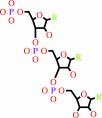 RNA(n)
|
+
|
ribonucleoside 5'-triphosphate
|
=
|
RNA(n+1)
|
+
|
 diphosphate
|
|
|
|
|
|
|
|
|
|
|
|
|
Molecule diagrams generated from .mol files obtained from the
KEGG ftp site
|
|
|
|
|
|
|
|
|
|
|
|
|
|
 |
|
|
|
|
|
|
| |
|
|
| |
|
DOI no:
|
Science
322:553-557
(2008)
|
|
PubMed id:
|
|
|
|
|
|
| |
|
The structure of a transcribing t7 RNA polymerase in transition from initiation to elongation.
|
|
K.J.Durniak,
S.Bailey,
T.A.Steitz.
|
|
|
|
|
| |
ABSTRACT
|
|
|
|
| |
|
|
Structural studies of the T7 bacteriophage DNA-dependent RNA polymerase (T7
RNAP) have shown that the conformation of the amino-terminal domain changes
substantially between the initiation and elongation phases of transcription, but
how this transition is achieved remains unclear. We report crystal structures of
T7 RNAP bound to promoter DNA containing either a 7- or an 8-nucleotide (nt) RNA
transcript that illuminate intermediate states along the transition pathway. The
amino-terminal domain comprises the C-helix subdomain and the promoter binding
domain (PBD), which consists of two segments separated by subdomain H. The
structures of the intermediate complex reveal that the PBD and the bound
promoter rotate by approximately 45 degrees upon synthesis of an 8-nt RNA
transcript. This allows the promoter contacts to be maintained while the active
site is expanded to accommodate a growing heteroduplex. The C-helix subdomain
moves modestly toward its elongation conformation, whereas subdomain H remains
in its initiation- rather than its elongation-phase location, more than 70
angstroms away.
|
|
|
|
|
|
| |
Selected figure(s)
|
|
|
|
| |
|
|

|
|

|
|
Figure 1.
Fig. 1. A Comparison of the structures of T7 RNAP initiation,
intermediate, and elongation complexes. The molecules have been
similarly oriented by superposition of their palm domains. The
C-terminal domain is shown as a surface with the thumb domain
removed to allow views of the DNA and RNA. The nontemplate
strand is shown in light green, the template in blue, and the
RNA transcript in red. Subdomains of the N-terminal domain are
colored yellow (C-helix), green (subdomain H), and purple (PBD).
(A) The initiation complex bound to the promoter has a 3-nt
transcript with its 5' end in contact with the PBD. (B) The
elongation complex exhibits a 220° right-hand rotation of
the PBD, a refolding of subdomain H onto the top of the
polymerase, and the formation of an elongated C-helix subdomain,
when compared to the initiation complex. (C) (Top) The T7 RNAP
in the 7-nt RNA intermediate complex is bound to both promoter
and downstream DNA. The PBD has rotated by 40° away from the
C-terminal domain, avoiding a steric clash with the transcript
and allowing for 7 bp of heteroduplex to form in the active
site. (Bottom) A schematic drawing of the sequences constituting
the subdomains of the N-terminal domain.
|
|
Figure 5.
Fig. 5. Arrangement of the downstream DNA. (A) The downstream
duplex is rotated by 30° toward the N-terminal domain
compared to its position in the elongation complex (shown in
gray). (B) The angle between the upstream and downstream duplex
DNA is about 40°, bringing the phosphate backbones within 6
Å of each other. (C) The refolded subdomain H from the
structure of the elongation complex (gray) creates a clash with
the position of the downstream DNA as observed in the
intermediate complex. Residues involved in the clash are shown
as spheres. (D) A close-up view of the 5' end of the 7-nt RNA
reveals that a modeled extension of the RNA by three additional
nucleotides would clash with the specificity loop in the
position observed in the intermediate complex.
|
|
|
|
|
|
| |
The above figures are
reprinted
by permission from the AAAs:
Science
(2008,
322,
553-557)
copyright 2008.
|
|
| |
Figures were
selected
by an automated process.
|
|
|
|
|
|
|
|
|
|
|
|
|
|
|
|
 |
 |
 |
|
Literature references that cite this PDB file's key reference
|
|
|
| |
PubMed id
|
|
Reference
|
|
|
|
|
|
R.Ringel,
M.Sologub,
Y.I.Morozov,
D.Litonin,
P.Cramer,
and
D.Temiakov
(2011).
Structure of human mitochondrial RNA polymerase.
|
| |
Nature,
478,
269-273.
|
|
|
PDB code:
|
|
|
|
|
|
|
|
G.Stengel,
M.Urban,
B.W.Purse,
and
R.D.Kuchta
(2010).
Incorporation of the fluorescent ribonucleotide analogue tCTP by T7 RNA polymerase.
|
| |
Anal Chem,
82,
1082-1089.
|
|
|
|
|
|
|
J.Conde,
J.M.de la Fuente,
and
P.V.Baptista
(2010).
In vitro transcription and translation inhibition via DNA functionalized gold nanoparticles.
|
| |
Nanotechnology,
21,
505101.
|
|
|
|
|
|
|
S.Grünberg,
C.Reich,
M.E.Zeller,
M.S.Bartlett,
and
M.Thomm
(2010).
Rearrangement of the RNA polymerase subunit H and the lower jaw in archaeal elongation complexes.
|
| |
Nucleic Acids Res,
38,
1950-1963.
|
|
|
|
|
|
|
D.Nayak,
Q.Guo,
and
R.Sousa
(2009).
A promoter recognition mechanism common to yeast mitochondrial and phage t7 RNA polymerases.
|
| |
J Biol Chem,
284,
13641-13647.
|
|
|
|
|
|
|
G.Q.Tang,
R.Roy,
R.P.Bandwar,
T.Ha,
and
S.S.Patel
(2009).
Real-time observation of the transition from transcription initiation to elongation of the RNA polymerase.
|
| |
Proc Natl Acad Sci U S A,
106,
22175-22180.
|
|
|
|
|
|
|
M.Sorokina,
H.R.Koh,
S.S.Patel,
and
T.Ha
(2009).
Fluorescent lifetime trajectories of a single fluorophore reveal reaction intermediates during transcription initiation.
|
| |
J Am Chem Soc,
131,
9630-9631.
|
|
|
|
|
|
The most recent references are shown first.
Citation data come partly from CiteXplore and partly
from an automated harvesting procedure. Note that this is likely to be
only a partial list as not all journals are covered by
either method. However, we are continually building up the citation data
so more and more references will be included with time.
Where a reference describes a PDB structure, the PDB
code is
shown on the right.
|
|


 Links
Links


