 |
PDBsum entry 1cli

|
|
|
|
|
 |
Contents |
 |
|
|
|
|
|
|
|
|
|
|
|
|
* Residue conservation analysis
|
|
|
|
|
|
PDB id:
|
|
|
|
| Name: |
|
Ligase
|
|
|
Title:
|
|
X-ray crystal structure of aminoimidazole ribonucleotide synthetase (purm), from the e. Coli purine biosynthetic pathway, at 2.5 a resolution
|
|
Structure:
|
|
Protein (phosphoribosyl-aminoimidazole synthetase). Chain: a, b, c, d. Engineered: yes. Other_details: sulfate bindng
|
|
Source:
|
|
Escherichia coli. Organism_taxid: 562. Cellular_location: cytoplasm. Gene: purm. Expressed in: escherichia coli bl21. Expression_system_taxid: 511693. Expression_system_cell_line: bl21. Expression_system_cell: bl21. Other_details: cloned gene
|
|
Biol. unit:
|
|
Tetramer (from
)
|
|
Resolution:
|
|
|
2.50Å
|
R-factor:
|
0.192
|
R-free:
|
0.264
|
|
|
Authors:
|
|
C.Li,T.J.Kappock,J.Stubbe,T.M.Weaver,S.E.Ealick
|
Key ref:

|
|
C.Li
et al.
(1999).
X-ray crystal structure of aminoimidazole ribonucleotide synthetase (PurM), from the Escherichia coli purine biosynthetic pathway at 2.5 A resolution.
Structure,
7,
1155-1166.
PubMed id:
DOI:

|
|
|
Date:
|
|
|
28-Apr-99
|
Release date:
|
06-Oct-99
|
|
|
|
|
|
|
PROCHECK
|

|
|
|
|
|
Headers
|
|
|
|
References
|
|
|
|
|
|

|
|
P08178
(PUR5_ECOLI) -
Phosphoribosylformylglycinamidine cyclo-ligase from Escherichia coli (strain K12)
|
|
|
|
Seq:
Struc:
|
|
|
|
345 a.a.
341 a.a.
|
|

|

|

|
|
|
|
|
|
|
|
|
|
|
Key: |
 |
PfamA domain |
|
|
 |
Secondary structure |
|
 |
CATH domain |
|
|
|
|
|
|
|
|
|
|
|
|
|
Enzyme class:
|
|
E.C.6.3.3.1
- phosphoribosylformylglycinamidine cyclo-ligase.
|
|
|
|
|
|
|
Pathway:
|
|
Purine Biosynthesis (early stages)
|
|
|
|
|
|
Reaction:
|
|
2-formamido-N1-(5-O-phospho-beta-D-ribosyl)acetamidine + ATP = 5-amino- 1-(5-phospho-beta-D-ribosyl)imidazole + ADP + phosphate + H+
|
|
|
|
|
|
2-formamido-N(1)-(5-O-phospho-beta-D-ribosyl)acetamidine
|
+
|
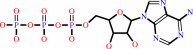 ATP
ATP
|
=
|
5-amino- 1-(5-phospho-beta-D-ribosyl)imidazole
|
+
|
 ADP
ADP
|
+
|
 phosphate
|
+
|
H(+)
|
|
|
|
|
|
|
|
|
|
Cofactor:
|
|
Magnesium
|
|
|
|
|
|
|
|
|
Molecule diagrams generated from .mol files obtained from the
KEGG ftp site
|
|
|
|
|
|
|
|
|
|
|
|
|
|
 |
|
|
|
|
|
|
| |
|
|
| |
|
DOI no:
|
Structure
7:1155-1166
(1999)
|
|
PubMed id:
|
|
|
|
|
|
| |
|
X-ray crystal structure of aminoimidazole ribonucleotide synthetase (PurM), from the Escherichia coli purine biosynthetic pathway at 2.5 A resolution.
|
|
C.Li,
T.J.Kappock,
J.Stubbe,
T.M.Weaver,
S.E.Ealick.
|
|
|
|
|
| |
ABSTRACT
|
|
|
|
| |
|
|
BACKGROUND: The purine biosynthetic pathway in procaryotes enlists eleven
enzymes, six of which use ATP. Enzymes 5 and 6 of this pathway,
formylglycinamide ribonucleotide (FGAR) amidotransferase (PurL) and
aminoimidazole ribonucleotide (AIR) synthetase (PurM) utilize ATP to activate
the oxygen of an amide within their substrate toward nucleophilic attack by a
nitrogen. AIR synthetase uses the product of PurL, formylglycinamidine
ribonucleotide (FGAM) and ATP to make AIR, ADP and P(i). RESULTS: The structure
of a hexahistidine-tagged PurM has been solved by multiwavelength anomalous
diffraction phasing techniques using protein containing 28 selenomethionines per
asymmetric unit. The final model of PurM consists of two crystallographically
independent dimers and four sulfates. The overall R factor at 2.5 A resolution
is 19.2%, with an R(free) of 26.4%. The active site, identified in part by
conserved residues, is proposed to be a long groove generated by the interaction
of two monomers. A search of the sequence databases suggests that the
ATP-binding sites between PurM and PurL may be structurally conserved.
CONCLUSIONS: The first structure of a new class of ATP-binding enzyme, PurM, has
been solved and a model for the active site has been proposed. The structure is
unprecedented, with an extensive and unusual sheet-mediated intersubunit
interaction defining the active-site grooves. Sequence searches suggest that two
successive enzymes in the purine biosynthetic pathway, proposed to use similar
chemistries, will have similar ATP-binding domains.
|
|
|
|
|
|
| |
Selected figure(s)
|
|
|
|
| |
|
|

|
|
Figure 4.
Figure 4. Structure of the PurM dimer. Ribbon diagram
viewed down the twofold axis. Major structural features and the
strands of the central b barrel, which form most of the dimer
interface, are labeled. For subunit 1, the domain-A ribbon is
highlighted in gold, the domain-B ribbon is highlighted in
silver and the linker is shown in red. For subunit 2, the ribbon
is highlighted in light blue.
|
|
|
|
|
|
| |
The above figure is
reprinted
by permission from Cell Press:
Structure
(1999,
7,
1155-1166)
copyright 1999.
|
|
| |
Figure was
selected
by an automated process.
|
|
|
|
|
|
|
|
|
|
|
|
|
|
|
|
 |
 |
 |
|
Literature references that cite this PDB file's key reference
|
|
|
| |
PubMed id
|
|
Reference
|
|
|
|
|
|
H.Xu
(2010).
Enhancing MAD F(A) data for substructure determination.
|
| |
Acta Crystallogr D Biol Crystallogr,
66,
945-949.
|
|
|
|
|
|
|
M.J.Gray,
and
J.C.Escalante-Semerena
(2010).
A new pathway for the synthesis of α-ribazole-phosphate in Listeria innocua.
|
| |
Mol Microbiol,
77,
1429-1438.
|
|
|
|
|
|
|
M.Welin,
J.G.Grossmann,
S.Flodin,
T.Nyman,
P.Stenmark,
L.Trésaugues,
T.Kotenyova,
I.Johansson,
P.Nordlund,
and
L.Lehtiö
(2010).
Structural studies of tri-functional human GART.
|
| |
Nucleic Acids Res,
38,
7308-7319.
|
|
|
PDB codes:
|
|
|
|
|
|
|
|
A.J.Knox,
C.Graham,
J.Bleskan,
G.Brodsky,
and
D.Patterson
(2009).
Mutations in the Chinese hamster ovary cell GART gene of de novo purine synthesis.
|
| |
Gene,
429,
23-30.
|
|
|
|
|
|
|
E.Matsumoto,
S.I.Sekine,
R.Akasaka,
Y.Otta,
K.Katsura,
M.Inoue,
T.Kaminishi,
T.Terada,
M.Shirouzu,
and
S.Yokoyama
(2008).
Structure of an N-terminally truncated selenophosphate synthetase from Aquifex aeolicus.
|
| |
Acta Crystallogr Sect F Struct Biol Cryst Commun,
64,
453-458.
|
|
|
PDB code:
|
|
|
|
|
|
|
|
E.S.Rangarajan,
A.Asinas,
A.Proteau,
C.Munger,
J.Baardsnes,
P.Iannuzzi,
A.Matte,
and
M.Cygler
(2008).
Structure of [NiFe] hydrogenase maturation protein HypE from Escherichia coli and its interaction with HypF.
|
| |
J Bacteriol,
190,
1447-1458.
|
|
|
PDB codes:
|
|
|
|
|
|
|
|
H.Xu,
and
C.M.Weeks
(2008).
Rapid and automated substructure solution by Shake-and-Bake.
|
| |
Acta Crystallogr D Biol Crystallogr,
64,
172-177.
|
|
|
|
|
|
|
Y.Zhang,
M.Morar,
and
S.E.Ealick
(2008).
Structural biology of the purine biosynthetic pathway.
|
| |
Cell Mol Life Sci,
65,
3699-3724.
|
|
|
|
|
|
|
Y.Zhang,
R.H.White,
and
S.E.Ealick
(2008).
Crystal structure and function of 5-formaminoimidazole-4-carboxamide ribonucleotide synthetase from Methanocaldococcus jannaschii.
|
| |
Biochemistry,
47,
205-217.
|
|
|
PDB codes:
|
|
|
|
|
|
|
|
S.Watanabe,
R.Matsumi,
T.Arai,
H.Atomi,
T.Imanaka,
and
K.Miki
(2007).
Crystal structures of [NiFe] hydrogenase maturation proteins HypC, HypD, and HypE: insights into cyanation reaction by thiol redox signaling.
|
| |
Mol Cell,
27,
29-40.
|
|
|
PDB codes:
|
|
|
|
|
|
|
|
I.I.Mathews,
S.S.Krishna,
R.Schwarzenbacher,
D.McMullan,
P.Abdubek,
E.Ambing,
J.M.Canaves,
H.J.Chiu,
A.M.Deacon,
M.DiDonato,
M.A.Elsliger,
A.Godzik,
C.Grittini,
S.K.Grzechnik,
J.Hale,
E.Hampton,
G.W.Han,
J.Haugen,
L.Jaroszewski,
H.E.Klock,
E.Koesema,
A.Kreusch,
P.Kuhn,
S.A.Lesley,
I.Levin,
M.D.Miller,
K.Moy,
E.Nigoghossian,
J.Paulsen,
K.Quijano,
R.Reyes,
G.Spraggon,
R.C.Stevens,
H.van den Bedem,
J.Velasquez,
A.White,
G.Wolf,
Q.Xu,
K.O.Hodgson,
J.Wooley,
and
I.A.Wilson
(2006).
Crystal structure of phosphoribosylformylglycinamidine synthase II (smPurL) from Thermotoga maritima at 2.15 A resolution.
|
| |
Proteins,
63,
1106-1111.
|
|
|
PDB code:
|
|
|
|
|
|
|
|
M.Morar,
R.Anand,
A.A.Hoskins,
J.Stubbe,
and
S.E.Ealick
(2006).
Complexed structures of formylglycinamide ribonucleotide amidotransferase from Thermotoga maritima describe a novel ATP binding protein superfamily.
|
| |
Biochemistry,
45,
14880-14895.
|
|
|
PDB codes:
|
|
|
|
|
|
|
|
H.Xu,
C.M.Weeks,
and
H.A.Hauptman
(2005).
Optimizing statistical Shake-and-Bake for Se-atom substructure determination.
|
| |
Acta Crystallogr D Biol Crystallogr,
61,
976-981.
|
|
|
|
|
|
|
Y.Qi,
and
N.V.Grishin
(2005).
Structural classification of thioredoxin-like fold proteins.
|
| |
Proteins,
58,
376-388.
|
|
|
|
|
|
|
L.I.Leichert,
and
U.Jakob
(2004).
Protein thiol modifications visualized in vivo.
|
| |
PLoS Biol,
2,
e333.
|
|
|
|
|
|
|
M.Blokesch,
A.Paschos,
A.Bauer,
S.Reissmann,
N.Drapal,
and
A.Böck
(2004).
Analysis of the transcarbamoylation-dehydration reaction catalyzed by the hydrogenase maturation proteins HypF and HypE.
|
| |
Eur J Biochem,
271,
3428-3436.
|
|
|
|
|
|
|
K.Matsuda,
T.Nishioka,
K.Kinoshita,
T.Kawabata,
and
N.Go
(2003).
Finding evolutionary relations beyond superfamilies: fold-based superfamilies.
|
| |
Protein Sci,
12,
2239-2251.
|
|
|
|
|
|
|
S.Reissmann,
E.Hochleitner,
H.Wang,
A.Paschos,
F.Lottspeich,
R.S.Glass,
and
A.Böck
(2003).
Taming of a poison: biosynthesis of the NiFe-hydrogenase cyanide ligands.
|
| |
Science,
299,
1067-1070.
|
|
|
|
|
|
|
A.Paschos,
A.Bauer,
A.Zimmermann,
E.Zehelein,
and
A.Böck
(2002).
HypF, a carbamoyl phosphate-converting enzyme involved in [NiFe] hydrogenase maturation.
|
| |
J Biol Chem,
277,
49945-49951.
|
|
|
|
|
|
|
J.L.Zilles,
T.J.Kappock,
J.Stubbe,
and
D.M.Downs
(2001).
Altered pathway routing in a class of Salmonella enterica serovar Typhimurium mutants defective in aminoimidazole ribonucleotide synthetase.
|
| |
J Bacteriol,
183,
2234-2240.
|
|
|
|
|
|
|
S.E.Ealick
(2000).
Advances in multiple wavelength anomalous diffraction crystallography.
|
| |
Curr Opin Chem Biol,
4,
495-499.
|
|
|
|
|
|
|
T.J.Kappock,
S.E.Ealick,
and
J.Stubbe
(2000).
Modular evolution of the purine biosynthetic pathway.
|
| |
Curr Opin Chem Biol,
4,
567-572.
|
|
|
|
|
|
The most recent references are shown first.
Citation data come partly from CiteXplore and partly
from an automated harvesting procedure. Note that this is likely to be
only a partial list as not all journals are covered by
either method. However, we are continually building up the citation data
so more and more references will be included with time.
Where a reference describes a PDB structure, the PDB
codes are
shown on the right.
|
|


 Links
Links


