
|
|
|
|
|
 |
Contents |
 |
|
|
|
|
|
|
|
|
|
|
|
 285 a.a.
|
|
|
|
|
|
|
|
|
|
|
 252 a.a.
|
|
|
|
|
|
|
|
|
|
|
 238 a.a.
|
|
|
|
|
|
|
|
|
|
|
 29 a.a.
|
|
|
|
|
|
|
|
|
|
|
|
|
* Residue conservation analysis
|
|
|
|
|
|
PDB id:
|
|
|
|
| Name: |
|
Virus
|
|
|
Title:
|
|
Human rhinovirus 16 coat protein at high resolution
|
|
Structure:
|
|
Human rhinovirus 16 coat protein. Chain: 1. Synonym: hrv16. Engineered: yes. Mutation: yes. Human rhinovirus 16 coat protein. Chain: 2. Synonym: hrv16. Engineered: yes.
|
|
Source:
|
|
Human rhinovirus sp.. Organism_taxid: 169066. Strain: serotype 16. Cell_line: hela. Expressed in: homo sapiens. Expression_system_taxid: 9606. Expression_system_taxid: 9606
|
|
Resolution:
|
|
|
2.15Å
|
R-factor:
|
0.230
|
R-free:
|
0.233
|
|
|
Authors:
|
|
A.T.Hadfield,M.G.Rossmann
|
Key ref:

|
|
A.T.Hadfield
et al.
(1997).
The refined structure of human rhinovirus 16 at 2.15 A resolution: implications for the viral life cycle.
Structure,
5,
427-441.
PubMed id:
DOI:

|
|
|
Date:
|
|
|
06-Nov-97
|
Release date:
|
21-Jan-98
|
|
|
|
|
|
|
PROCHECK
|

|
|
|
|
|
Headers
|
|
|
|
References
|
|
|
|
|
|

|
|
Q82122
(POLG_HRV16) -
Genome polyprotein from Human rhinovirus 16
|
|
|
|
Seq:
Struc:
|
|
|
|
2153 a.a.
285 a.a.
|
|

|

|
|
|
|
|
|
|
|
|
|
|
|
|

|
|
Q82122
(POLG_HRV16) -
Genome polyprotein from Human rhinovirus 16
|
|
|
|
Seq:
Struc:
|
|
|
|
2153 a.a.
252 a.a.
|
|
|

|
|
|
|
|
|
|
|
|
|
|
|
|
|
|
|
|
|
Enzyme class 2:
|
|
Chains 1, 2, 3, 4:
E.C.2.7.7.48
- RNA-directed Rna polymerase.
|
|
|
|
|
|
|
Reaction:
|
|
RNA(n) + a ribonucleoside 5'-triphosphate = RNA(n+1) + diphosphate
|
|
|
|
|
|
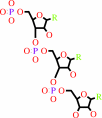 RNA(n)
|
+
|
ribonucleoside 5'-triphosphate
|
=
|
RNA(n+1)
|
+
|
 diphosphate
|
|
|
|
|
|
|
|
|
|
Enzyme class 3:
|
|
Chains 1, 2, 3, 4:
E.C.3.4.22.28
- picornain 3C.
|
|
|
|
|
|
|
Reaction:
|
|
Selective cleavage of Gln-|-Gly bond in the poliovirus polyprotein. In other picornavirus reactions Glu may be substituted for Gln, and Ser or Thr for Gly.
|
|
|
|
|
|
Enzyme class 4:
|
|
Chains 1, 2, 3, 4:
E.C.3.4.22.29
- picornain 2A.
|
|
|
|
|
|
|
Reaction:
|
|
Selective cleavage of Tyr-|-Gly bond in the picornavirus polyprotein. In other picornavirus reactions Glu may be substituted for Gln, and Ser or Thr for Gly.
|
|
|
|
|
|
Enzyme class 5:
|
|
Chains 1, 2, 3, 4:
E.C.3.6.1.15
- nucleoside-triphosphate phosphatase.
|
|
|
|
|
|
|
Reaction:
|
|
a ribonucleoside 5'-triphosphate + H2O = a ribonucleoside 5'-diphosphate + phosphate + H+
|
|
|
|
|
|
ribonucleoside 5'-triphosphate
|
+
|
H2O
|
=
|
ribonucleoside 5'-diphosphate
|
+
|
 phosphate
|
+
|
H(+)
|
|
|
|
|
|
|
|
|
|
|
|
|
Note, where more than one E.C. class is given (as above), each may
correspond to a different protein domain or, in the case of polyprotein
precursors, to a different mature protein.
|
|
|
|
Molecule diagrams generated from .mol files obtained from the
KEGG ftp site
|
|
|
|
|
|
|
|
|
|
|
|
|
|
 |
|
|
|
|
|
|
| |
|
|
| |
|
DOI no:
|
Structure
5:427-441
(1997)
|
|
PubMed id:
|
|
|
|
|
|
| |
|
The refined structure of human rhinovirus 16 at 2.15 A resolution: implications for the viral life cycle.
|
|
A.T.Hadfield,
W.Lee,
R.Zhao,
M.A.Oliveira,
I.Minor,
R.R.Rueckert,
M.G.Rossmann.
|
|
|
|
|
| |
ABSTRACT
|
|
|
|
| |
|
|
BACKGROUND: Rhinoviruses belong to the picornavirus family and are small,
icosahedral, non-enveloped viruses containing one positive RNA strand. Human
rhinovirus 16 (HRV16) belongs to the major receptor group of rhinoviruses, for
which the cellular receptor is intercellular adhesion molecule-1 (ICAM-1). In
many rhinoviruses, one of the viral coat proteins (VP1) contains a hydrophobic
pocket which is occupied by a fatty acid-like molecule, or so-called 'pocket
factor'. Antiviral agents have been shown to bind to the hydrophobic pocket in
VP1, replacing the pocket factor. The presence of the antiviral compound blocks
uncoating of the virus and in some cases inhibits receptor attachment. A
refined, high-resolution structure would be expected to provide further
information on the nature of the pocket factor and other features previously not
clearly identified. RESULTS: The structure of native HRV16 has been refined to a
resolution of 2.15 A. The hydrophobic pocket in VP1 is observed in two
alternative conformations. In one of these, the pocket is filled by a pocket
factor and the protein structure is similar to virus-antiviral compound
complexes. In the other conformation, the hydrophobic pocket is collapsed and
empty. RNA bases stack against both a tryptophan and a phenylalanine residue on
the internal surface of the viral capsid. Site-directed mutagenesis of the
tryptophan, which is conserved across the picornaviruses, to nonconservative
residues results in non-viable virus. Five symmetry-related N termini of coat
protein VP4 form a ten-stranded, antiparallel beta barrel around the base of the
icosahedral fivefold axis. The N termini of VP1 are amphipathic alpha helices,
which stack on the outside of this beta barrel. The N termini of VP1 and VP4
have not been observed previously in rhinovirus structures. CONCLUSIONS: The
observation of a partially occupied hydrophobic pocket in HRV16 forms a missing
link between HRV14, which is always observed with no pocket factor in the native
form, and rhinovirus 1A and other picornaviruses (e.g. poliovirus,
coxsackievirus) which contain pocket factors. The pocket factor molecules
probably regulate viral entry, uncoating and assembly. Picornavirus assembly is
known to proceed via pentamers, therefore, the interaction of RNA with the
conserved tryptophan residues across twofold axes between pentamers may play a
role in picornavirus assembly. The positioning of a cation on the icosahedral
fivefold axes and the structure of the N termini of VP4 and VP1 around these
axes suggest a mechanism for the uncoating of rhinoviruses.
|
|
|
|
|
|
| |
Selected figure(s)
|
|
|
|
| |
|
|

|
|
Figure 6.
Figure 6. A schematic diagram representing VP1 of HRV16,
showing the binding site of the pocket factor (shown in
ball-and-stick representation) and the WIN antiviral compounds
(shown in pale blue). A cation on the fivefold axis is shown in
yellow. The N termini of VP1, VP3 and VP4 also interact around
the fivefold axis. One copy of each of VP1 and the N termini of
VP3 and VP4 are shown as blue, red and green ribbon diagrams,
respectively. The myristylated N terminus of VP4 is labelled
(MYR). (The diagram was created using MOLSCRIPT [64].)
|
|
|
|
|
|
| |
The above figure is
reprinted
by permission from Cell Press:
Structure
(1997,
5,
427-441)
copyright 1997.
|
|
| |
Figure was
selected
by an automated process.
|
|
|
|
|
|
|
|
|
|
|
|
|
|
|
|
 |
 |
 |
|
Literature references that cite this PDB file's key reference
|
|
|
| |
PubMed id
|
|
Reference
|
|
|
|
|
|
A.Janner
(2011).
Form, symmetry and packing of biomacromolecules. III. Antigenic, receptor and contact binding sites in picornaviruses.
|
| |
Acta Crystallogr A,
67,
174-189.
|
|
|
|
|
|
|
J.M.Rollinger,
and
M.Schmidtke
(2011).
The human rhinovirus: human-pathological impact, mechanisms of antirhinoviral agents, and strategies for their discovery.
|
| |
Med Res Rev,
31,
42-92.
|
|
|
|
|
|
|
A.Janner
(2010).
Form, symmetry and packing of biomacromolecules. II. Serotypes of human rhinovirus.
|
| |
Acta Crystallogr A,
66,
312-326.
|
|
|
|
|
|
|
H.C.Levy,
M.Bostina,
D.J.Filman,
and
J.M.Hogle
(2010).
Catching a virus in the act of RNA release: a novel poliovirus uncoating intermediate characterized by cryo-electron microscopy.
|
| |
J Virol,
84,
4426-4441.
|
|
|
PDB codes:
|
|
|
|
|
|
|
|
T.J.Tuthill,
E.Groppelli,
J.M.Hogle,
and
D.J.Rowlands
(2010).
Picornaviruses.
|
| |
Curr Top Microbiol Immunol,
343,
43-89.
|
|
|
|
|
|
|
W.C.Van Voorhis,
W.G.Hol,
P.J.Myler,
and
L.J.Stewart
(2009).
The role of medical structural genomics in discovering new drugs for infectious diseases.
|
| |
PLoS Comput Biol,
5,
e1000530.
|
|
|
PDB codes:
|
|
|
|
|
|
|
|
M.A.Dolan,
M.Keil,
and
D.S.Baker
(2008).
Comparison of composer and ORCHESTRAR.
|
| |
Proteins,
72,
1243-1258.
|
|
|
|
|
|
|
R.P.Bahadur,
and
J.Janin
(2008).
Residue conservation in viral capsid assembly.
|
| |
Proteins,
71,
407-414.
|
|
|
|
|
|
|
S.Venkataraman,
S.P.Reddy,
J.Loo,
N.Idamakanti,
P.L.Hallenbeck,
and
V.S.Reddy
(2008).
Crystallization and preliminary X-ray diffraction studies of Seneca Valley virus-001, a new member of the Picornaviridae family.
|
| |
Acta Crystallogr Sect F Struct Biol Cryst Commun,
64,
293-296.
|
|
|
|
|
|
|
S.Venkataraman,
S.P.Reddy,
J.Loo,
N.Idamakanti,
P.L.Hallenbeck,
and
V.S.Reddy
(2008).
Structure of Seneca Valley Virus-001: an oncolytic picornavirus representing a new genus.
|
| |
Structure,
16,
1555-1561.
|
|
|
PDB code:
|
|
|
|
|
|
|
|
D.Zhu,
G.E.Fox,
and
S.Chakravarty
(2007).
RECOVIR: an application package to automatically identify some single stranded RNA viruses using capsid protein residues that uniquely distinguish among these viruses.
|
| |
BMC Bioinformatics,
8,
379.
|
|
|
|
|
|
|
M.Luo,
T.J.Green,
X.Zhang,
J.Tsao,
and
S.Qiu
(2007).
Structural comparisons of the nucleoprotein from three negative strand RNA virus families.
|
| |
Virol J,
4,
72.
|
|
|
|
|
|
|
D.Garriga,
J.Querol-Audí,
F.Abaitua,
I.Saugar,
J.Pous,
N.Verdaguer,
J.R.Castón,
and
J.F.Rodriguez
(2006).
The 2.6-Angstrom structure of infectious bursal disease virus-derived T=1 particles reveals new stabilizing elements of the virus capsid.
|
| |
J Virol,
80,
6895-6905.
|
|
|
PDB code:
|
|
|
|
|
|
|
|
D.C.Pevear,
F.G.Hayden,
T.M.Demenczuk,
L.R.Barone,
M.A.McKinlay,
and
M.S.Collett
(2005).
Relationship of pleconaril susceptibility and clinical outcomes in treatment of common colds caused by rhinoviruses.
|
| |
Antimicrob Agents Chemother,
49,
4492-4499.
|
|
|
|
|
|
|
C.Xiao,
T.J.Tuthill,
C.M.Bator Kelly,
L.J.Challinor,
P.R.Chipman,
R.A.Killington,
D.J.Rowlands,
A.Craig,
and
M.G.Rossmann
(2004).
Discrimination among rhinovirus serotypes for a variant ICAM-1 receptor molecule.
|
| |
J Virol,
78,
10034-10044.
|
|
|
|
|
|
|
E.A.Hewat,
and
D.Blaas
(2004).
Cryoelectron microscopy analysis of the structural changes associated with human rhinovirus type 14 uncoating.
|
| |
J Virol,
78,
2935-2942.
|
|
|
|
|
|
|
M.Chambon,
C.Archimbaud,
J.L.Bailly,
J.M.Gourgand,
F.Charbonné,
and
H.Peigue-Lafeuille
(2004).
Virucidal efficacy of glutaraldehyde against enteroviruses is related to the location of lysine residues in exposed structures of the VP1 capsid protein.
|
| |
Appl Environ Microbiol,
70,
1717-1722.
|
|
|
|
|
|
|
E.E.Fry,
N.J.Knowles,
J.W.Newman,
G.Wilsden,
Z.Rao,
A.M.King,
and
D.I.Stuart
(2003).
Crystal structure of Swine vesicular disease virus and implications for host adaptation.
|
| |
J Virol,
77,
5475-5486.
|
|
|
PDB code:
|
|
|
|
|
|
|
|
E.Neumann,
R.Moser,
L.Snyers,
D.Blaas,
and
E.A.Hewat
(2003).
A cellular receptor of human rhinovirus type 2, the very-low-density lipoprotein receptor, binds to two neighboring proteins of the viral capsid.
|
| |
J Virol,
77,
8504-8511.
|
|
|
|
|
|
|
L.Xing,
J.M.Casasnovas,
and
R.H.Cheng
(2003).
Structural analysis of human rhinovirus complexed with ICAM-1 reveals the dynamics of receptor-mediated virus uncoating.
|
| |
J Virol,
77,
6101-6107.
|
|
|
|
|
|
|
W.M.Lee,
and
W.Wang
(2003).
Human rhinovirus type 16: mutant V1210A requires capsid-binding drug for assembly of pentamers to form virions during morphogenesis.
|
| |
J Virol,
77,
6235-6244.
|
|
|
|
|
|
|
E.A.Hewat,
E.Neumann,
and
D.Blaas
(2002).
The concerted conformational changes during human rhinovirus 2 uncoating.
|
| |
Mol Cell,
10,
317-326.
|
|
|
|
|
|
|
J.Ding,
A.D.Smith,
S.C.Geisler,
X.Ma,
G.F.Arnold,
and
E.Arnold
(2002).
Crystal structure of a human rhinovirus that displays part of the HIV-1 V3 loop and induces neutralizing antibodies against HIV-1.
|
| |
Structure,
10,
999.
|
|
|
PDB code:
|
|
|
|
|
|
|
|
J.M.Hogle
(2002).
Poliovirus cell entry: common structural themes in viral cell entry pathways.
|
| |
Annu Rev Microbiol,
56,
677-702.
|
|
|
|
|
|
|
M.S.Smyth,
and
J.H.Martin
(2002).
Picornavirus uncoating.
|
| |
Mol Pathol,
55,
214-219.
|
|
|
|
|
|
|
A.Airaksinen,
M.Roivainen,
and
T.Hovi
(2001).
Coxsackievirus A9 VP1 mutants with enhanced or hindered A particle formation and decreased infectivity.
|
| |
J Virol,
75,
952-960.
|
|
|
|
|
|
|
C.Xiao,
C.M.Bator,
V.D.Bowman,
E.Rieder,
Y.He,
B.Hébert,
J.Bella,
T.S.Baker,
E.Wimmer,
R.J.Kuhn,
and
M.G.Rossmann
(2001).
Interaction of coxsackievirus A21 with its cellular receptor, ICAM-1.
|
| |
J Virol,
75,
2444-2451.
|
|
|
|
|
|
|
J.R.Romero
(2001).
Pleconaril: a novel antipicornaviral drug.
|
| |
Expert Opin Investig Drugs,
10,
369-379.
|
|
|
|
|
|
|
D.M.Belnap,
D.J.Filman,
B.L.Trus,
N.Cheng,
F.P.Booy,
J.F.Conway,
S.Curry,
C.N.Hiremath,
S.K.Tsang,
A.C.Steven,
and
J.M.Hogle
(2000).
Molecular tectonic model of virus structural transitions: the putative cell entry states of poliovirus.
|
| |
J Virol,
74,
1342-1354.
|
|
|
|
|
|
|
E.A.Hewat,
E.Neumann,
J.F.Conway,
R.Moser,
B.Ronacher,
T.C.Marlovits,
and
D.Blaas
(2000).
The cellular receptor to human rhinovirus 2 binds around the 5-fold axis and not in the canyon: a structural view.
|
| |
EMBO J,
19,
6317-6325.
|
|
|
|
|
|
|
S.Hertzler,
M.Luo,
and
H.L.Lipton
(2000).
Mutation of predicted virion pit residues alters binding of Theiler's murine encephalomyelitis virus to BHK-21 cells.
|
| |
J Virol,
74,
1994-2004.
|
|
|
|
|
|
|
A.T.Hadfield,
G.D.Diana,
and
M.G.Rossmann
(1999).
Analysis of three structurally related antiviral compounds in complex with human rhinovirus 16.
|
| |
Proc Natl Acad Sci U S A,
96,
14730-14735.
|
|
|
PDB codes:
|
|
|
|
|
|
|
|
D.C.Pevear,
T.M.Tull,
M.E.Seipel,
and
J.M.Groarke
(1999).
Activity of pleconaril against enteroviruses.
|
| |
Antimicrob Agents Chemother,
43,
2109-2115.
|
|
|
|
|
|
|
E.Hendry,
H.Hatanaka,
E.Fry,
M.Smyth,
J.Tate,
G.Stanway,
J.Santti,
M.Maaronen,
T.Hyypiä,
and
D.Stuart
(1999).
The crystal structure of coxsackievirus A9: new insights into the uncoating mechanisms of enteroviruses.
|
| |
Structure,
7,
1527-1538.
|
|
|
PDB code:
|
|
|
|
|
|
|
|
L.Liljas
(1999).
Virus assembly.
|
| |
Curr Opin Struct Biol,
9,
129-134.
|
|
|
|
|
|
|
P.R.Kolatkar,
J.Bella,
N.H.Olson,
C.M.Bator,
T.S.Baker,
and
M.G.Rossmann
(1999).
Structural studies of two rhinovirus serotypes complexed with fragments of their cellular receptor.
|
| |
EMBO J,
18,
6249-6259.
|
|
|
PDB codes:
|
|
|
|
|
|
|
|
E.A.Hewat,
T.C.Marlovits,
and
D.Blaas
(1998).
Structure of a neutralizing antibody bound monovalently to human rhinovirus 2.
|
| |
J Virol,
72,
4396-4402.
|
|
|
|
|
|
|
J.J.Rux,
and
R.M.Burnett
(1998).
Spherical viruses.
|
| |
Curr Opin Struct Biol,
8,
142-149.
|
|
|
|
|
|
|
M.Agbandje-McKenna,
A.L.Llamas-Saiz,
F.Wang,
P.Tattersall,
and
M.G.Rossmann
(1998).
Functional implications of the structure of the murine parvovirus, minute virus of mice.
|
| |
Structure,
6,
1369-1381.
|
|
|
|
|
|
|
W.Wang,
W.M.Lee,
A.G.Mosser,
and
R.R.Rueckert
(1998).
WIN 52035-dependent human rhinovirus 16: assembly deficiency caused by mutations near the canyon surface.
|
| |
J Virol,
72,
1210-1218.
|
|
|
|
|
|
|
K.Moffat,
and
Z.Ren
(1997).
Synchrotron radiation applications to macromolecular crystallography.
|
| |
Curr Opin Struct Biol,
7,
689-696.
|
|
|
|
|
|
|
K.N.Lentz,
A.D.Smith,
S.C.Geisler,
S.Cox,
P.Buontempo,
A.Skelton,
J.DeMartino,
E.Rozhon,
J.Schwartz,
V.Girijavallabhan,
J.O'Connell,
and
E.Arnold
(1997).
Structure of poliovirus type 2 Lansing complexed with antiviral agent SCH48973: comparison of the structural and biological properties of three poliovirus serotypes.
|
| |
Structure,
5,
961-978.
|
|
|
PDB code:
|
|
|
|
|
|
|
The most recent references are shown first.
Citation data come partly from CiteXplore and partly
from an automated harvesting procedure. Note that this is likely to be
only a partial list as not all journals are covered by
either method. However, we are continually building up the citation data
so more and more references will be included with time.
Where a reference describes a PDB structure, the PDB
codes are
shown on the right.
|

| |


 Links
Links


