 |
PDBsum entry 6tca

|
|
|
|
|
|

|

|

|

|
|

|
|

|
|

|
|

|
|

|
|
|
 |

|

|
|
|
|
|
|
|
|
|
|
|
|
|
|
|
|
|
|
|
|
|
|
|
|
|
|
|
|
|
|
|
|
|
|
Signaling protein
|
PDB id
|
|
|
|
6tca
|
|
|
|
|
|
|
|
|
|
|
|
|
|
|

|

|

|
|
|
|
|
|
|
|
 |
Contents |
 |
|
|
|
|
|
|
|
|
|
|
|
 345 a.a.
|
|
|
|
|
|
|
|
|
|
|


 346 a.a.
|
|
|
|
|
|
|
|
|
|
|


 326 a.a.
|
|
|
|
|
|
|
|
|
|
|
|
|
PDB id:
|
|
|
|
| Name: |
|
Signaling protein
|
|
|
Title:
|
|
Phosphorylated p38 and mapkapk2 complex with inhibitor
|
|
Structure:
|
|
Map kinase-activated protein kinase 2. Chain: a, c, e, g. Synonym: mk2. Engineered: yes. Mitogen-activated protein kinase 14. Chain: b, d, f, h. Synonym: mapk 14,cytokine suppressive anti-inflammatory drug-binding protein,csbp,map kinase mxi2,max-interacting protein 2,mitogen- activated protein kinase p38 alpha,map kinase p38 alpha,stress-
|
|
Source:
|
|
Homo sapiens. Human. Organism_taxid: 9606. Gene: mapkapk2. Expressed in: escherichia coli. Expression_system_taxid: 562. Gene: mapk14, csbp, csbp1, csbp2, cspb1, mxi2, sapk2a. Expression_system_taxid: 562
|
|
Resolution:
|
|
|
3.70Å
|
R-factor:
|
0.254
|
R-free:
|
0.297
|
|
|
Authors:
|
|
P.Sok,A.Remenyi
|
|
Key ref:
|
|
P.Sok
et al.
(2020).
MAP Kinase-Mediated Activation of RSK1 and MK2 Substrate Kinases.
Structure,
28,
1101.
PubMed id:
DOI:
|
|
|
Date:
|
|
|
05-Nov-19
|
Release date:
|
22-Jul-20
|
|
|
|
|
|
|
PROCHECK
|

|
|
|
|
|
Headers
|
|
|
|
References
|
|
|
|
|
|

|
|
P49137
(MAPK2_HUMAN) -
MAP kinase-activated protein kinase 2 from Homo sapiens
|
|
|
|
Seq:
Struc:
|
|
|
|
400 a.a.
345 a.a.
|
|

|

|

|
|
|
|
|
|
|
|
|
|
|
|
|
|
|
|
|
Enzyme class 1:
|
|
Chains A, C, E, G:
E.C.2.7.11.1
- non-specific serine/threonine protein kinase.
|
|
|
|
|
|
|
Reaction:
|
|
|
1.
|
L-seryl-[protein] + ATP = O-phospho-L-seryl-[protein] + ADP + H+
|
|
2.
|
L-threonyl-[protein] + ATP = O-phospho-L-threonyl-[protein] + ADP + H+
|
|
|
|
|
|
|
L-seryl-[protein]
|
+
|
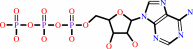 ATP
ATP
|
=
|
O-phospho-L-seryl-[protein]
|
+
|
 ADP
ADP
|
+
|
H(+)
|
|
|
|
|
|
|
L-threonyl-[protein]
|
+
|
ATP
|
=
|
O-phospho-L-threonyl-[protein]
|
+
|
ADP
|
+
|
H(+)
|
|
|
|
|
|
|
|
|
|
Enzyme class 2:
|
|
Chains B, D, F, H:
E.C.2.7.11.24
- mitogen-activated protein kinase.
|
|
|
|
|
|
|
Reaction:
|
|
|
1.
|
L-seryl-[protein] + ATP = O-phospho-L-seryl-[protein] + ADP + H+
|
|
2.
|
L-threonyl-[protein] + ATP = O-phospho-L-threonyl-[protein] + ADP + H+
|
|
|
|
|
|
|
L-seryl-[protein]
|
+
|
ATP
|
=
|
O-phospho-L-seryl-[protein]
|
+
|
ADP
|
+
|
H(+)
|
|
|
|
|
|
|
L-threonyl-[protein]
|
+
|
ATP
|
=
|
O-phospho-L-threonyl-[protein]
|
+
|
ADP
|
+
|
H(+)
|
|
|
|
|
|
|
|
|
|
|
|
|
Note, where more than one E.C. class is given (as above), each may
correspond to a different protein domain or, in the case of polyprotein
precursors, to a different mature protein.
|
|
|
|
Molecule diagrams generated from .mol files obtained from the
KEGG ftp site
|
|
|
|
|
|
|
|
|
|
|
|
|
|
 |
|
|
|
|
|
|
| |
|
|
| |
|
DOI no:
|
Structure
28:1101
(2020)
|
|
PubMed id:
|
|
|
|
|
|
| |
|
MAP Kinase-Mediated Activation of RSK1 and MK2 Substrate Kinases.
|
|
P.Sok,
G.Gógl,
G.S.Kumar,
A.Alexa,
N.Singh,
K.Kirsch,
A.Sebő,
L.Drahos,
Z.Gáspári,
W.Peti,
A.Reményi.
|
|
|
|
|
| |
ABSTRACT
|
|
|
|
| |
|
|
Mitogen-activated protein kinases (MAPKs) control essential eukaryotic signaling
pathways. While much has been learned about MAPK activation, much less is known
about substrate recruitment and specificity. MAPK substrates may be other
kinases that are crucial to promote a further diversification of the signaling
outcomes. Here, we used a variety of molecular and cellular tools to investigate
the recruitment of two substrate kinases, RSK1 and MK2, to three MAPKs (ERK2,
p38α, and ERK5). Unexpectedly, we identified that kinase heterodimers form
structurally and functionally distinct complexes depending on the activation
state of the MAPK. These may be incompatible with downstream signaling, but
naturally they may also form structures that are compatible with the
phosphorylation of the downstream kinase at the activation loop, or
alternatively at other allosteric sites. Furthermore, we show that
small-molecule inhibitors may affect the quaternary arrangement of kinase
heterodimers and thus influence downstream signaling in a specific manner.
|
|
|
|
|
|
|
|
|
|
|
|
|
|
|
|
|
|
 |
 |
 |
|
| |


 Links
Links


