 |
PDBsum entry 2c8c

|
|
|
|
|
 |
Contents |
 |
|
|
|
|
|
|
|
|
|
|
* Residue conservation analysis
|
|
|
|
|
|
PDB id:
|
|
|
|
| Name: |
|
Transferase
|
|
|
Title:
|
|
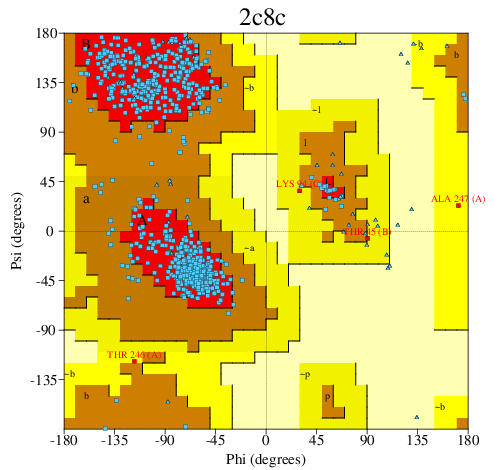
Structure of the artt motif q212a mutant c3bot1 exoenzyme (NAD-bound state, crystal form i)
|
|
Structure:
|
|
Mono-adp-ribosyltransferase c3. Chain: a, b, c, d. Synonym: exoenzyme c3. Engineered: yes. Mutation: yes
|
|
Source:
|
|
Clostridium botulinum. Organism_taxid: 1491. Expressed in: escherichia coli. Expression_system_taxid: 511693.
|
|
Resolution:
|
|
|
2.70Å
|
R-factor:
|
0.243
|
R-free:
|
0.283
|
|
|
Authors:
|
|
E.A.Stura,J.Menetrey,G.Flatau,P.Boquet,A.Menez
|
|
Key ref:
|
|
J.Ménétrey
et al.
(2008).
Structural basis for the NAD-hydrolysis mechanism and the ARTT-loop plasticity of C3 exoenzymes.
Protein Sci,
17,
878-886.
PubMed id:
|
|
|
Date:
|
|
|
03-Dec-05
|
Release date:
|
27-Feb-07
|
|
|
|
|
|
|
PROCHECK
|
|
|
|
|
|
Headers
|
|
|
|
References
|
|
|
|
|
|

|
|
Q7M0L1
(Q7M0L1_CLOBO) -
Exoenzyme C3 (Fragment) from Clostridium botulinum
|
|
|
|
Seq:
Struc:
|
|
|
|
22 a.a.
205 a.a.*
|
|

|

|
|
|
|
|
|
|
|
|
|
|
|
Key: |
|
 |
Secondary structure |
|
 |
CATH domain |
|
|
*
PDB and UniProt seqs differ
at 1 residue position (black
cross)
|
|
|
|
|
|
|
|
|
|
|
|
|
|
|
|
|
 |
|
|
|
|
|
|
| |
|
|
Protein Sci
17:878-886
(2008)
|
|
PubMed id:
|
|
|
|
|
|
| |
|
Structural basis for the NAD-hydrolysis mechanism and the ARTT-loop plasticity of C3 exoenzymes.
|
|
J.Ménétrey,
G.Flatau,
P.Boquet,
A.Ménez,
E.A.Stura.
|
|
|
|
|
| |
ABSTRACT
|
|
|
|
| |
|
|
C3-like exoenzymes are ADP-ribosyltransferases that specifically modify some Rho
GTPase proteins, leading to their sequestration in the cytoplasm, and thus
inhibiting their regulatory activity on the actin cytoskeleton. This
modification process goes through three sequential steps involving
NAD-hydrolysis, Rho recognition, and binding, leading to Rho ADP-ribosylation.
Independently, three distinct residues within the ARTT loop of the C3 exoenzymes
are critical for each of these steps. Supporting the critical role of the ARTT
loop, we have shown previously that it adopts a distinct conformation upon NAD
binding. Here, we present seven wild-type and ARTT loop-mutant structures of C3
exoenzyme of Clostridium botulinum free and bound to its true substrate, NAD,
and to its NAD-hydrolysis product, nicotinamide. Altogether, these structures
expand our understanding of the conformational diversity of the C3 exoenzyme,
mainly within the ARTT loop.
|
|
|
|
|
|
|
|
|
|
|
|
|
|
|
|
|
|
 |
 |
 |
|
Literature references that cite this PDB file's key reference
|
|
|
| |
PubMed id
|
|
Reference
|
|
|
|
|
|
I.Just,
A.Rohrbeck,
S.C.Huelsenbeck,
and
M.Hoeltje
(2011).
Therapeutic effects of Clostridium botulinum C3 exoenzyme.
|
| |
Naunyn Schmiedebergs Arch Pharmacol,
383,
247-252.
|
|
|
|
|
|
|
R.J.Fieldhouse,
Z.Turgeon,
D.White,
and
A.R.Merrill
(2010).
Cholera- and anthrax-like toxins are among several new ADP-ribosyltransferases.
|
| |
PLoS Comput Biol,
6,
e1001029.
|
|
|
|
|
|
|
M.R.Popoff,
and
P.Bouvet
(2009).
Clostridial toxins.
|
| |
Future Microbiol,
4,
1021-1064.
|
|
|
|
|
|
The most recent references are shown first.
Citation data come partly from CiteXplore and partly
from an automated harvesting procedure. Note that this is likely to be
only a partial list as not all journals are covered by
either method. However, we are continually building up the citation data
so more and more references will be included with time.
|
|


 Links
Links


