|
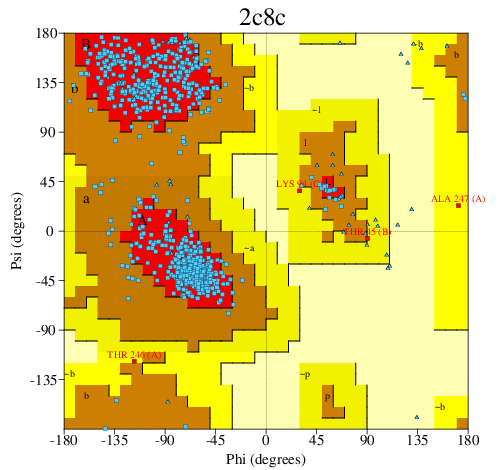
PDBsum entry 2c8c
|
|
|
|
References listed in PDB file
|
 |
|
Key reference
|
|
|
Title
|
|
Structural basis for the NAD-Hydrolysis mechanism and the artt-Loop plasticity of c3 exoenzymes.
|
|
|
Authors
|
|
J.Ménétrey,
G.Flatau,
P.Boquet,
A.Ménez,
E.A.Stura.
|
|
|
Ref.
|
|
Protein Sci, 2008,
17,
878-886.
|
|
|
PubMed id
|
|
|
|
|
|
Abstract
|
|
|
C3-like exoenzymes are ADP-ribosyltransferases that specifically modify some Rho
GTPase proteins, leading to their sequestration in the cytoplasm, and thus
inhibiting their regulatory activity on the actin cytoskeleton. This
modification process goes through three sequential steps involving
NAD-hydrolysis, Rho recognition, and binding, leading to Rho ADP-ribosylation.
Independently, three distinct residues within the ARTT loop of the C3 exoenzymes
are critical for each of these steps. Supporting the critical role of the ARTT
loop, we have shown previously that it adopts a distinct conformation upon NAD
binding. Here, we present seven wild-type and ARTT loop-mutant structures of C3
exoenzyme of Clostridium botulinum free and bound to its true substrate, NAD,
and to its NAD-hydrolysis product, nicotinamide. Altogether, these structures
expand our understanding of the conformational diversity of the C3 exoenzyme,
mainly within the ARTT loop.
|
|
|
Secondary reference #1
|
|
|
Title
|
|
Nad binding induces conformational changes in rho ADP-Ribosylating clostridium botulinum c3 exoenzyme.
|
|
|
Authors
|
|
J.Ménétrey,
G.Flatau,
E.A.Stura,
J.B.Charbonnier,
F.Gas,
J.M.Teulon,
M.H.Le du,
P.Boquet,
A.Menez.
|
|
|
Ref.
|
|
J Biol Chem, 2002,
277,
30950-30957.
[DOI no: ]
|
|
|
PubMed id
|
|
|
|
|
|
|
|
|
|

|
|

|
|
Figure 2.
Fig. 2. Crystal-packing contacts of the constraint ARTT
loop conformation. Stereo-view of the constraint ARTT loop
conformation from molecule B with its crystal-packing contacts
shown in dark and light green, respectively. The NAD-induced
ARTT loop conformation from molecule A, superimposed on molecule
B is shown in blue. Color code and orientation are the same as
in Fig. 1. The side chains of the residues that are involved in
steric hindrance are shown as ball-and-stick representations.
|
|
Figure 5.
Fig. 5. Crab-claw movement. The overall structure of
C3-NAD (molecule A) is shown in a curved line with a
ball-and-stick representation of NAD. Superimposition of the
crab-claw subdomains is shown with the NAD-bound molecule A in
blue, the unbound molecule A in cream, and the ADP-bound
molecule D in red. The color code is the same as in the previous
figures.
|
|
|
|
|
|
The above figures are
reproduced from the cited reference
with permission from the ASBMB
|
|
|
|
|
|
|