 |
PDBsum entry 2avs

|
|
|
|
|
 |
Contents |
 |
|
|
|
|
|
|
|
|
|
|
|
|
* Residue conservation analysis
|
|
|
|
|
|
PDB id:
|
|
|
|
| Name: |
|
Hydrolase
|
|
|
Title:
|
|
Kinetics, stability, and structural changes in high resolution crystal structures of HIV-1 protease with drug resistant mutations l24i, i50v, and g73s
|
|
Structure:
|
|
Pol polyprotein. Chain: a, b. Fragment: retropepsin. Synonym: HIV-1 protease. Engineered: yes. Other_details: complexed with indinavir
|
|
Source:
|
|
Human immunodeficiency virus 1. Organism_taxid: 11676. Gene: gag-pol. Expressed in: escherichia coli. Expression_system_taxid: 562.
|
|
Biol. unit:
|
|
Dimer (from
)
|
|
Resolution:
|
|
|
1.10Å
|
R-factor:
|
0.109
|
R-free:
|
0.186
|
|
|
Authors:
|
|
F.Liu,P.I.Boross,Y.F.Wang,J.Tozser,J.M.Louis,R.W.Harrison,I.T.Weber
|
Key ref:

|
|
F.Liu
et al.
(2005).
Kinetic, stability, and structural changes in high-resolution crystal structures of HIV-1 protease with drug-resistant mutations L24I, I50V, and G73S.
J Mol Biol,
354,
789-800.
PubMed id:
DOI:

|
|
|
Date:
|
|
|
30-Aug-05
|
Release date:
|
24-Jan-06
|
|
|
|
|
|
|
PROCHECK
|

|
|
|
|
|
Headers
|
|
|
|
References
|
|
|
|
|
|

|
|
P04587
(POL_HV1B5) -
Gag-Pol polyprotein from Human immunodeficiency virus type 1 group M subtype B (isolate BH5)
|
|
|
|
Seq:
Struc:
|
|
|
|
1447 a.a.
99 a.a.*
|
|

|

|

|
|
|
|
|
|
|
|
|
|
|
Key: |
|
 |
Secondary structure |
|
 |
CATH domain |
|
|
*
PDB and UniProt seqs differ
at 6 residue positions (black
crosses)
|
|
|
|
|
|
|
|
|
|
|
|
|
Enzyme class 1:
|
|
E.C.2.7.7.-
- ?????
|
|
|
|
|
|
|
Enzyme class 2:
|
|
E.C.2.7.7.49
- RNA-directed Dna polymerase.
|
|
|
|
|
|
|
Reaction:
|
|
DNA(n) + a 2'-deoxyribonucleoside 5'-triphosphate = DNA(n+1) + diphosphate
|
|
|
|
|
|
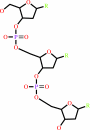 DNA(n)
|
+
|
2'-deoxyribonucleoside 5'-triphosphate
|
=
|
DNA(n+1)
Bound ligand (Het Group name = )
matches with 55.56% similarity
|
+
|
 diphosphate
|
|
|
|
|
|
|
|
|
|
Enzyme class 3:
|
|
E.C.2.7.7.7
- DNA-directed Dna polymerase.
|
|
|
|
|
|
|
Reaction:
|
|
DNA(n) + a 2'-deoxyribonucleoside 5'-triphosphate = DNA(n+1) + diphosphate
|
|
|
|
|
|
DNA(n)
|
+
|
2'-deoxyribonucleoside 5'-triphosphate
|
=
|
DNA(n+1)
|
+
|
diphosphate
|
|
|
|
|
|
|
|
|
|
Enzyme class 4:
|
|
E.C.3.1.-.-
|
|
|
|
|
|
|
Enzyme class 5:
|
|
E.C.3.1.13.2
- exoribonuclease H.
|
|
|
|
|
|
|
Reaction:
|
|
Exonucleolytic cleavage to 5'-phosphomonoester oligonucleotides in both 5'- to 3'- and 3'- to 5'-directions.
|
|
|
|
|
|
Enzyme class 6:
|
|
E.C.3.1.26.13
- retroviral ribonuclease H.
|
|
|
|
|
|
|
Enzyme class 7:
|
|
E.C.3.4.23.16
- HIV-1 retropepsin.
|
|
|
|
|
|
|
Reaction:
|
|
Specific for a P1 residue that is hydrophobic, and P1' variable, but often Pro.
|
|
|
|
|
|
|
|
|
Note, where more than one E.C. class is given (as above), each may
correspond to a different protein domain or, in the case of polyprotein
precursors, to a different mature protein.
|
|
|
|
Molecule diagrams generated from .mol files obtained from the
KEGG ftp site
|
|
|
|
|
|
|
|
|
|
|
|
|
|
 |
|
|
|
|
|
|
| |
|
|
| |
|
DOI no:
|
J Mol Biol
354:789-800
(2005)
|
|
PubMed id:
|
|
|
|
|
|
| |
|
Kinetic, stability, and structural changes in high-resolution crystal structures of HIV-1 protease with drug-resistant mutations L24I, I50V, and G73S.
|
|
F.Liu,
P.I.Boross,
Y.F.Wang,
J.Tozser,
J.M.Louis,
R.W.Harrison,
I.T.Weber.
|
|
|
|
|
| |
ABSTRACT
|
|
|
|
| |
|
|
The crystal structures, dimer stabilities, and kinetics have been analyzed for
wild-type human immunodeficiency virus type 1 (HIV-1) protease (PR) and
resistant mutants PR(L24I), PR(I50V), and PR(G73S) to gain insight into the
molecular basis of drug resistance. The mutations lie in different structural
regions. Mutation I50V alters a residue in the flexible flap that interacts with
the inhibitor, L24I alters a residue adjacent to the catalytic Asp25, and G73S
lies at the protein surface far from the inhibitor-binding site. PR(L24I) and
PR(I50V), showed a 4% and 18% lower k(cat)/K(m), respectively, relative to PR.
The relative k(cat)/K(m) of PR(G73S) varied from 14% to 400% when assayed using
different substrates. Inhibition constants (K(i)) of the antiviral drug
indinavir for the reaction catalyzed by the mutant enzymes were about threefold
and 50-fold higher for PR(L24I) and PR(I50V), respectively, relative to PR and
PR(G73S). The dimer dissociation constant (K(d)) was estimated to be
approximately 20 nM for both PR(L24I) and PR(I50V), and below 5 nM for PR(G73S)
and PR. Crystal structures of the mutants PR(L24I), PR(I50V) and PR(G73S) were
determined in complexes with indinavir, or the p2/NC substrate analog at
resolutions of 1.10-1.50 Angstrom. Each mutant revealed distinct structural
changes relative to PR. The mutated residues in PR(L24I) and PR(I50V) had
reduced intersubunit contacts, consistent with the increased K(d) for dimer
dissociation. Relative to PR, PR(I50V) had fewer interactions of Val50 with
inhibitors, in agreement with the dramatically increased K(i). The distal
mutation G73S introduced new hydrogen bond interactions that can transmit
changes to the substrate-binding site and alter catalytic activity. Therefore,
the structural alterations observed for drug-resistant mutations were in
agreement with kinetic and stability changes.
|
|
|
|
|
|
| |
Selected figure(s)
|
|
|
|
| |
|
|

|
|

|
|
Figure 1.
Figure 1. PR dimer structure (green ribbons) with indinavir
(red bonds). The sites of mutation are indicated by black
spheres for Leu24, Ile50 and Gly73. Only one subunit is labeled.
|
|
Figure 6.
Figure 6. Protease-inhibitor interactions. Only the
residues involved in hydrogen bond interactions are shown. Water
molecules are represented as spheres. Hydrogen bonds are
indicated by broken lines. (a) PR[L24I] hydrogen bond
interactions with indinavir. Water molecules are labeled A-D.
(b) Interactions of Arg8' with the pyridyl group of indinavir in
PR[I50V]-IDV. The omit map is contoured at 3.5s. (c) PR[L24I]
interactions with p2/NC. Water molecules are labeled 1-8. Arg8
and Arg8' are omitted for clarity. (d) Selected interactions of
the side-chains of Ile/Leu50 and 50' with indinavir in the
PR[I50V] and PR indinavir complexes. PR-IDV is in green and
PR[I50V]-IDV is red. Only the central portion of indinavir is
shown with van der Waals contacts indicated by dotted lines with
distances in Å.
|
|
|
|
|
|
| |
The above figures are
reprinted
from an Open Access publication published by Elsevier:
J Mol Biol
(2005,
354,
789-800)
copyright 2005.
|
|
| |
Figures were
selected
by an automated process.
|
|
|
|
|
|
|
|
|
|
|
|
|
|
|
|
 |
 |
 |
|
Literature references that cite this PDB file's key reference
|
|
|
| |
PubMed id
|
|
Reference
|
|
|
|
|
|
M.K.Singh,
K.Streu,
A.J.McCrone,
and
B.N.Dominy
(2011).
The Evolution of Catalytic Function in the HIV-1 Protease.
|
| |
J Mol Biol,
408,
792-805.
|
|
|
|
|
|
|
C.H.Shen,
Y.F.Wang,
A.Y.Kovalevsky,
R.W.Harrison,
and
I.T.Weber
(2010).
Amprenavir complexes with HIV-1 protease and its drug-resistant mutants altering hydrophobic clusters.
|
| |
FEBS J,
277,
3699-3714.
|
|
|
PDB codes:
|
|
|
|
|
|
|
|
J.Zhang,
T.Hou,
W.Wang,
and
J.S.Liu
(2010).
Detecting and understanding combinatorial mutation patterns responsible for HIV drug resistance.
|
| |
Proc Natl Acad Sci U S A,
107,
1321-1326.
|
|
|
|
|
|
|
E.Lefebvre,
and
C.A.Schiffer
(2008).
Resilience to resistance of HIV-1 protease inhibitors: profile of darunavir.
|
| |
AIDS Rev,
10,
131-142.
|
|
|
|
|
|
|
F.Liu,
A.Y.Kovalevsky,
Y.Tie,
A.K.Ghosh,
R.W.Harrison,
and
I.T.Weber
(2008).
Effect of flap mutations on structure of HIV-1 protease and inhibition by saquinavir and darunavir.
|
| |
J Mol Biol,
381,
102-115.
|
|
|
PDB codes:
|
|
|
|
|
|
|
|
J.M.Sayer,
F.Liu,
R.Ishima,
I.T.Weber,
and
J.M.Louis
(2008).
Effect of the active site D25N mutation on the structure, stability, and ligand binding of the mature HIV-1 protease.
|
| |
J Biol Chem,
283,
13459-13470.
|
|
|
PDB codes:
|
|
|
|
|
|
|
|
K.G.Sasková,
M.Kozísek,
M.Lepsík,
J.Brynda,
P.Rezácová,
J.Václavíková,
R.M.Kagan,
L.Machala,
and
J.Konvalinka
(2008).
Enzymatic and structural analysis of the I47A mutation contributing to the reduced susceptibility to HIV protease inhibitor lopinavir.
|
| |
Protein Sci,
17,
1555-1564.
|
|
|
PDB code:
|
|
|
|
|
|
|
|
M.J.Giffin,
H.Heaslet,
A.Brik,
Y.C.Lin,
G.Cauvi,
C.H.Wong,
D.E.McRee,
J.H.Elder,
C.D.Stout,
and
B.E.Torbett
(2008).
A copper(I)-catalyzed 1,2,3-triazole azide-alkyne click compound is a potent inhibitor of a multidrug-resistant HIV-1 protease variant.
|
| |
J Med Chem,
51,
6263-6270.
|
|
|
|
|
|
|
R.M.Kelly,
H.Leemhuis,
L.Gätjen,
and
L.Dijkhuizen
(2008).
Evolution toward small molecule inhibitor resistance affects native enzyme function and stability, generating acarbose-insensitive cyclodextrin glucanotransferase variants.
|
| |
J Biol Chem,
283,
10727-10734.
|
|
|
|
|
|
|
S.Zhang,
A.H.Kaplan,
and
A.Tropsha
(2008).
HIV-1 protease function and structure studies with the simplicial neighborhood analysis of protein packing method.
|
| |
Proteins,
73,
742-753.
|
|
|
|
|
|
|
A.Y.Kovalevsky,
A.A.Chumanevich,
F.Liu,
J.M.Louis,
and
I.T.Weber
(2007).
Caught in the Act: the 1.5 A resolution crystal structures of the HIV-1 protease and the I54V mutant reveal a tetrahedral reaction intermediate.
|
| |
Biochemistry,
46,
14854-14864.
|
|
|
PDB codes:
|
|
|
|
|
|
|
|
H.Mo,
N.Parkin,
K.D.Stewart,
L.Lu,
T.Dekhtyar,
D.J.Kempf,
and
A.Molla
(2007).
Identification and structural characterization of I84C and I84A mutations that are associated with high-level resistance to human immunodeficiency virus protease inhibitors and impair viral replication.
|
| |
Antimicrob Agents Chemother,
51,
732-735.
|
|
|
|
|
|
|
Y.Tie,
A.Y.Kovalevsky,
P.Boross,
Y.F.Wang,
A.K.Ghosh,
J.Tozser,
R.W.Harrison,
and
I.T.Weber
(2007).
Atomic resolution crystal structures of HIV-1 protease and mutants V82A and I84V with saquinavir.
|
| |
Proteins,
67,
232-242.
|
|
|
PDB codes:
|
|
|
|
|
|
|
The most recent references are shown first.
Citation data come partly from CiteXplore and partly
from an automated harvesting procedure. Note that this is likely to be
only a partial list as not all journals are covered by
either method. However, we are continually building up the citation data
so more and more references will be included with time.
Where a reference describes a PDB structure, the PDB
codes are
shown on the right.
|
|


 Links
Links


