|
PDBsum entry 1vj1

|
|
|
|
|
|

|

|

|

|
|

|
|

|
|

|
|

|
|
|
 |

|

|
|
|
|
|
|
|
|
|
|
|
|
|
|
|
|
|
|
|
|
|
|
|
|
|
|
|
|
|
|
|
|
|
Unknown function
|
PDB id
|
|
|
|
1vj1
|
|
|
|
|
|
|
|
|
|
|
|
|
|
|

|

|

|
|
|
|
|
|
|
|
 |
Contents |
 |
|
|
|
|
|
|
|
|
|
|
* Residue conservation analysis
|
|
|
|
|
|
|
|
|
|
|
Enzyme class:
|
|
E.C.1.3.1.48
- 15-oxoprostaglandin 13-reductase.
|
|
|
|
|
|
|
Reaction:
|
|
|
1.
|
13,14-dihydro-15-oxo-prostaglandin E2 + NADP+ = 15-oxoprostaglandin E2 + NADPH + H+
|
|
2.
|
13,14-dihydro-15-oxo-prostaglandin E2 + NAD+ = 15-oxoprostaglandin E2 + NADH + H+
|
|
|
|
|
|
|
13,14-dihydro-15-oxo-prostaglandin E2
|
+
|
 NADP(+)
|
=
|
15-oxoprostaglandin E2
|
+
|
 NADPH
NADPH
|
+
|
H(+)
|
|
|
|
|
|
|
13,14-dihydro-15-oxo-prostaglandin E2
|
+
|
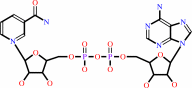 NAD(+)
|
=
|
15-oxoprostaglandin E2
|
+
|
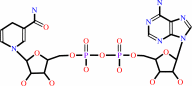 NADH
NADH
|
+
|
H(+)
|
|
|
|
|
|
|
|
|
|
|
|
|
Molecule diagrams generated from .mol files obtained from the
KEGG ftp site
|
|
|
|
|
|
|
|
|
|
|
|
|
|
 |
|
|
|
|
|
|
| |
|
|
| |
|
DOI no:
|
Proteins
56:629-633
(2004)
|
|
PubMed id:
|
|
|
|
|
|
| |
|
Crystal structure of a putative NADPH-dependent oxidoreductase (GI: 18204011) from mouse at 2.10 A resolution.
|
|
I.Levin,
R.Schwarzenbacher,
D.McMullan,
P.Abdubek,
E.Ambing,
T.Biorac,
J.Cambell,
J.M.Canaves,
H.J.Chiu,
X.Dai,
A.M.Deacon,
M.DiDonato,
M.A.Elsliger,
A.Godzik,
C.Grittini,
S.K.Grzechnik,
E.Hampton,
L.Jaroszewski,
C.Karlak,
H.E.Klock,
E.Koesema,
A.Kreusch,
P.Kuhn,
S.A.Lesley,
T.M.McPhillips,
M.D.Miller,
A.Morse,
K.Moy,
J.Ouyang,
R.Page,
K.Quijano,
R.Reyes,
A.Robb,
E.Sims,
G.Spraggon,
R.C.Stevens,
H.van den Bedem,
J.Velasquez,
J.Vincent,
F.von Delft,
X.Wang,
B.West,
G.Wolf,
Q.Xu,
K.O.Hodgson,
J.Wooley,
I.A.Wilson.
|
|
|
|
|
| |
ABSTRACT
|
|
|
|
| |
|
|
|
|
| |
Selected figure(s)
|
|
|
|
| |
|
|

|
|

|
|
Figure 1.
Figure 1. Crystal structure of 18204011. A: Stereo ribbon
diagram of mouse 18204011 color-coded from N-terminus (blue) to
C-terminus (red) showing the domain organization and location of
the putative active site (arrow). Helices H1-H17, and  -strands
( 1-
15)
as well as -sheets
A, B, C and beginning (C253) and end (P266) of the disordered
loop are indicated. B: Diagram showing the secondary structure
elements in 18204011 superimposed on its primary sequence. The
strands in each -sheet
are indicated by a red A, B, and C. -hairpins
are depicted as red loops. Disordered regions are depicted by a
dashed line with the corresponding sequence in brackets. -bulges
are marked by ; -strands
( 1-
15)
as well as -sheets
A, B, C and beginning (C253) and end (P266) of the disordered
loop are indicated. B: Diagram showing the secondary structure
elements in 18204011 superimposed on its primary sequence. The
strands in each -sheet
are indicated by a red A, B, and C. -hairpins
are depicted as red loops. Disordered regions are depicted by a
dashed line with the corresponding sequence in brackets. -bulges
are marked by ;
 -turns
are marked by . -turns
are marked by .
|
|
Figure 2.
Figure 2. A: Ribbon diagram of a superposition of 18204011
(mouse) and quinone oxidoreductase from E. coli (PDB: 1qor)
grey. The structures were superimposed on their
nucleotide-binding domains. The NADPH molecule bound to quinone
oxidoreductase is shown in cpk mode. B: Close up view of the
active site. The NADPH molecule and the sulfate bound to the
active site of quinone oxidoreductase are shown in ball and
stick. The active site tyrosine (Y52) as observed in quinone
oxidoreductase from E. coli and its potential counterpart (Y64)
in 18204011 (the Y64 side-chain has been modeled here due to
disorder in the crystal structure) are shown in ball and stick.
|
|
|
|
|
|
| |
The above figures are
reprinted
by permission from John Wiley & Sons, Inc.:
Proteins
(2004,
56,
629-633)
copyright 2004.
|
|
|
|
|
|
|
|
|
|
|
|
|
|
 |
 |
 |
|
Literature references that cite this PDB file's key reference
|
|
|
| |
PubMed id
|
|
Reference
|
|
|
|
|
|
A.J.Bordner
(2008).
Predicting small ligand binding sites in proteins using backbone structure.
|
| |
Bioinformatics,
24,
2865-2871.
|
|
|
|
|
|
|
Y.H.Wu,
T.P.Ko,
R.T.Guo,
S.M.Hu,
L.M.Chuang,
and
A.H.Wang
(2008).
Structural basis for catalytic and inhibitory mechanisms of human prostaglandin reductase PTGR2.
|
| |
Structure,
16,
1714-1723.
|
|
|
PDB codes:
|
|
|
|
|
|
|
|
B.Youn,
R.Camacho,
S.G.Moinuddin,
C.Lee,
L.B.Davin,
N.G.Lewis,
and
C.Kang
(2006).
Crystal structures and catalytic mechanism of the Arabidopsis cinnamyl alcohol dehydrogenases AtCAD5 and AtCAD4.
|
| |
Org Biomol Chem,
4,
1687-1697.
|
|
|
PDB codes:
|
|
|
|
|
|
|
|
B.Youn,
S.J.Kim,
S.G.Moinuddin,
C.Lee,
D.L.Bedgar,
A.R.Harper,
L.B.Davin,
N.G.Lewis,
and
C.Kang
(2006).
Mechanistic and structural studies of apoform, binary, and ternary complexes of the Arabidopsis alkenal double bond reductase At5g16970.
|
| |
J Biol Chem,
281,
40076-40088.
|
|
|
PDB codes:
|
|
|
|
|
|
|
|
D.McMullan,
J.M.Canaves,
K.Quijano,
P.Abdubek,
E.Nigoghossian,
J.Haugen,
H.E.Klock,
J.Vincent,
J.Hale,
J.Paulsen,
and
S.A.Lesley
(2005).
High-throughput protein production for X-ray crystallography and use of size exclusion chromatography to validate or refute computational biological unit predictions.
|
| |
J Struct Funct Genomics,
6,
135-141.
|
|
|
|
|
|
|
R.Page,
A.M.Deacon,
S.A.Lesley,
and
R.C.Stevens
(2005).
Shotgun crystallization strategy for structural genomics II: crystallization conditions that produce high resolution structures for T. maritima proteins.
|
| |
J Struct Funct Genomics,
6,
209-217.
|
|
|
|
|
|
The most recent references are shown first.
Citation data come partly from CiteXplore and partly
from an automated harvesting procedure. Note that this is likely to be
only a partial list as not all journals are covered by
either method. However, we are continually building up the citation data
so more and more references will be included with time.
Where a reference describes a PDB structure, the PDB
codes are
shown on the right.
|
|


 Links
Links