
|
|
|
|
|
 |
Contents |
 |
|
|
|
|
|
|
|
|
|
|
* Residue conservation analysis
|
|
|
|
|
|
|
|
|
|
Enzyme class:
|
|
Chain A:
E.C.2.7.10.1
- receptor protein-tyrosine kinase.
|
|
|
|
|
|
|
Reaction:
|
|
L-tyrosyl-[protein] + ATP = O-phospho-L-tyrosyl-[protein] + ADP + H+
|
|
|
|
|
|
L-tyrosyl-[protein]
|
+
|
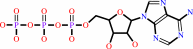 ATP
ATP
|
=
|
O-phospho-L-tyrosyl-[protein]
|
+
|
ADP
Bound ligand (Het Group name = )
matches with 41.38% similarity
|
+
|
H(+)
|
|
|
|
|
|
|
|
|
|
|
|
|
Molecule diagrams generated from .mol files obtained from the
KEGG ftp site
|
|
|
|
|
|
|
|
|
|
|
|
|
|
 |
|
|
|
|
|
|
| |
|
|
| |
|
DOI no:
|
Mol Cell
11:507-517
(2003)
|
|
PubMed id:
|
|
|
|
|
|
| |
|
EGF activates its receptor by removing interactions that autoinhibit ectodomain dimerization.
|
|
K.M.Ferguson,
M.B.Berger,
J.M.Mendrola,
H.S.Cho,
D.J.Leahy,
M.A.Lemmon.
|
|
|
|
|
| |
ABSTRACT
|
|
|
|
| |
|
|
Epidermal growth factor (EGF) receptor is the prototype of the ErbB (HER) family
receptor tyrosine kinases (RTKs), which regulate cell growth and differentiation
and are implicated in many human cancers. EGF activates its receptor by inducing
dimerization of the 621 amino acid EGF receptor extracellular region. We
describe the 2.8 A resolution crystal structure of this entire extracellular
region (sEGFR) in an unactivated state. The structure reveals an autoinhibited
configuration, where the dimerization interface recently identified in activated
sEGFR structures is completely occluded by intramolecular interactions. To
activate the receptor, EGF binding must promote a large domain rearrangement
that exposes this dimerization interface. This contrasts starkly with other RTK
activation mechanisms and suggests new approaches for designing ErbB receptor
antagonists.
|
|
|
|
|
|
| |
Selected figure(s)
|
|
|
|
| |
|
|

|
|

|
|
Figure 2.
Figure 2. Space-Filling Representation of sEGFR with Domain
I-Bound EGFsEGFR is shown in CPK representation, with subdomains
colored as in Figure 1. Bound EGF is magenta. EGF is intimately
associated with domain I (blue) but does not come closer than 4
Å away from domain III. The side chain of Y14 (projecting
from the left-hand side of EGF) is too distant from domain III
to participate in hydrogen bonding.
|
|
Figure 6.
Figure 6. Different Domain Orientations in Autoinhibited
Structures of sEGFR and sErbB3The structures of autoinhibited
sEGFR and sErbB3 (Cho and Leahy, 2002) were overlaid by
superimposition of domains III and IV.(A) The sEGFR/sErbB3
overlay is shown in the orientation used for sEGFR in Figure 1A.
sEGFR is gray; sErbB3 is magenta.(B) The same sEGFR/sErbB3
overlay is shown in an orthogonal view to illustrate the
different orientation of the domain I/II fragment in the two
structures. The difference is approximated by a 60° rotation
about the axis marked with a black circle.
|
|
|
|
|
|
| |
The above figures are
reprinted
by permission from Cell Press:
Mol Cell
(2003,
11,
507-517)
copyright 2003.
|
|
| |
Figures were
selected
by an automated process.
|
|
|
|
|
|
|
|
|
|
|
|
|
|
|
|
 |
 |
 |
|
Literature references that cite this PDB file's key reference
|
|
|
| |
PubMed id
|
|
Reference
|
|
|
|
|
|
Y.Yarden,
and
G.Pines
(2012).
The ERBB network: at last, cancer therapy meets systems biology.
|
| |
Nat Rev Cancer,
12,
553-563.
|
|
|
|
|
|
|
H.Tsujioka,
F.Yotsumoto,
S.Hikita,
T.Ueda,
M.Kuroki,
and
S.Miyamoto
(2011).
Targeting the heparin-binding epidermal growth factor-like growth factor in ovarian cancer therapy.
|
| |
Curr Opin Obstet Gynecol,
23,
24-30.
|
|
|
|
|
|
|
J.Biarc,
R.J.Chalkley,
A.L.Burlingame,
and
R.A.Bradshaw
(2011).
Receptor tyrosine kinase signaling - a proteomic perspective.
|
| |
Adv Enzyme Regul,
51,
293-305.
|
|
|
|
|
|
|
J.H.Cho,
V.Muralidharan,
M.Vila-Perello,
D.P.Raleigh,
T.W.Muir,
and
A.G.Palmer
(2011).
Tuning protein autoinhibition by domain destabilization.
|
| |
Nat Struct Mol Biol,
18,
550-555.
|
|
|
|
|
|
|
J.H.Hurley,
and
H.Stenmark
(2011).
Molecular mechanisms of ubiquitin-dependent membrane traffic.
|
| |
Annu Rev Biophys,
40,
119-142.
|
|
|
|
|
|
|
S.T.Low-Nam,
K.A.Lidke,
P.J.Cutler,
R.C.Roovers,
P.M.van Bergen en Henegouwen,
B.S.Wilson,
and
D.S.Lidke
(2011).
ErbB1 dimerization is promoted by domain co-confinement and stabilized by ligand binding.
|
| |
Nat Struct Mol Biol,
18,
1244-1249.
|
|
|
|
|
|
|
Z.Wang,
P.A.Longo,
M.K.Tarrant,
K.Kim,
S.Head,
D.J.Leahy,
and
P.A.Cole
(2011).
Mechanistic insights into the activation of oncogenic forms of EGF receptor.
|
| |
Nat Struct Mol Biol,
18,
1388-1393.
|
|
|
|
|
|
|
D.Alvarado,
D.E.Klein,
and
M.A.Lemmon
(2010).
Structural basis for negative cooperativity in growth factor binding to an EGF receptor.
|
| |
Cell,
142,
568-579.
|
|
|
PDB codes:
|
|
|
|
|
|
|
|
F.J.Esteva,
D.Yu,
M.C.Hung,
and
G.N.Hortobagyi
(2010).
Molecular predictors of response to trastuzumab and lapatinib in breast cancer.
|
| |
Nat Rev Clin Oncol,
7,
98.
|
|
|
|
|
|
|
J.B.Spangler,
J.R.Neil,
S.Abramovitch,
Y.Yarden,
F.M.White,
D.A.Lauffenburger,
and
K.D.Wittrup
(2010).
Combination antibody treatment down-regulates epidermal growth factor receptor by inhibiting endosomal recycling.
|
| |
Proc Natl Acad Sci U S A,
107,
13252-13257.
|
|
|
|
|
|
|
J.H.Bae,
and
J.Schlessinger
(2010).
Asymmetric tyrosine kinase arrangements in activation or autophosphorylation of receptor tyrosine kinases.
|
| |
Mol Cells,
29,
443-448.
|
|
|
|
|
|
|
L.Chen,
J.Placone,
L.Novicky,
and
K.Hristova
(2010).
The extracellular domain of fibroblast growth factor receptor 3 inhibits ligand-independent dimerization.
|
| |
Sci Signal,
3,
ra86.
|
|
|
|
|
|
|
S.Collins,
M.Stamatakis,
and
D.G.Vlachos
(2010).
Adaptive coarse-grained Monte Carlo simulation of reaction and diffusion dynamics in heterogeneous plasma membranes.
|
| |
BMC Bioinformatics,
11,
218.
|
|
|
|
|
|
|
C.Qiu,
M.K.Tarrant,
T.Boronina,
P.A.Longo,
J.M.Kavran,
R.N.Cole,
P.A.Cole,
and
D.J.Leahy
(2009).
In vitro enzymatic characterization of near full length EGFR in activated and inhibited states.
|
| |
Biochemistry,
48,
6624-6632.
|
|
|
|
|
|
|
D.Alvarado,
D.E.Klein,
and
M.A.Lemmon
(2009).
ErbB2 resembles an autoinhibited invertebrate epidermal growth factor receptor.
|
| |
Nature,
461,
287-291.
|
|
|
PDB code:
|
|
|
|
|
|
|
|
E.A.Hopper-Borge,
R.E.Nasto,
V.Ratushny,
L.M.Weiner,
E.A.Golemis,
and
I.Astsaturov
(2009).
Mechanisms of tumor resistance to EGFR-targeted therapies.
|
| |
Expert Opin Ther Targets,
13,
339-362.
|
|
|
|
|
|
|
J.Baselga,
and
S.M.Swain
(2009).
Novel anticancer targets: revisiting ERBB2 and discovering ERBB3.
|
| |
Nat Rev Cancer,
9,
463-475.
|
|
|
|
|
|
|
J.Kalinina,
S.A.Byron,
H.P.Makarenkova,
S.K.Olsen,
A.V.Eliseenkova,
W.J.Larochelle,
M.Dhanabal,
S.Blais,
D.M.Ornitz,
L.A.Day,
T.A.Neubert,
P.M.Pollock,
and
M.Mohammadi
(2009).
Homodimerization controls the fibroblast growth factor 9 subfamily's receptor binding and heparan sulfate-dependent diffusion in the extracellular matrix.
|
| |
Mol Cell Biol,
29,
4663-4678.
|
|
|
PDB code:
|
|
|
|
|
|
|
|
J.L.Macdonald-Obermann,
and
L.J.Pike
(2009).
The intracellular juxtamembrane domain of the epidermal growth factor (EGF) receptor is responsible for the allosteric regulation of EGF binding.
|
| |
J Biol Chem,
284,
13570-13576.
|
|
|
|
|
|
|
J.L.Macdonald-Obermann,
and
L.J.Pike
(2009).
Palmitoylation of the EGF receptor impairs signal transduction and abolishes high-affinity ligand binding.
|
| |
Biochemistry,
48,
2505-2513.
|
|
|
|
|
|
|
K.Farin,
A.Di Segni,
A.Mor,
and
R.Pinkas-Kramarski
(2009).
Structure-function analysis of nucleolin and ErbB receptors interactions.
|
| |
PLoS One,
4,
e6128.
|
|
|
|
|
|
|
K.R.Schmitz,
and
K.M.Ferguson
(2009).
Interaction of antibodies with ErbB receptor extracellular regions.
|
| |
Exp Cell Res,
315,
659-670.
|
|
|
|
|
|
|
K.S.Yang,
M.X.Ilagan,
D.Piwnica-Worms,
and
L.J.Pike
(2009).
Luciferase fragment complementation imaging of conformational changes in the epidermal growth factor receptor.
|
| |
J Biol Chem,
284,
7474-7482.
|
|
|
|
|
|
|
M.A.Lemmon
(2009).
Ligand-induced ErbB receptor dimerization.
|
| |
Exp Cell Res,
315,
638-648.
|
|
|
|
|
|
|
M.Rebaï,
I.Kallel,
F.Hamza,
S.Charfeddine,
R.Kaffel,
F.Guermazi,
and
A.Rebaï
(2009).
Association of EGFR and HER2 polymorphisms with risk and clinical features of thyroid cancer.
|
| |
Genet Test Mol Biomarkers,
13,
779-784.
|
|
|
|
|
|
|
M.Yamauchi,
and
N.Gotoh
(2009).
Theme: oncology--molecular mechanisms determining the efficacy of EGF receptor-specific tyrosine kinase inhibitors help to identify biomarker candidates.
|
| |
Biomark Med,
3,
139-151.
|
|
|
|
|
|
|
N.Jura,
N.F.Endres,
K.Engel,
S.Deindl,
R.Das,
M.H.Lamers,
D.E.Wemmer,
X.Zhang,
and
J.Kuriyan
(2009).
Mechanism for activation of the EGF receptor catalytic domain by the juxtamembrane segment.
|
| |
Cell,
137,
1293-1307.
|
|
|
PDB code:
|
|
|
|
|
|
|
|
P.Jin,
J.Zhang,
M.Beryt,
L.Turin,
C.Brdlik,
Y.Feng,
X.Bai,
J.Liu,
B.Jorgensen,
and
H.M.Shepard
(2009).
Rational optimization of a bispecific ligand trap targeting EGF receptor family ligands.
|
| |
Mol Med,
15,
11-20.
|
|
|
|
|
|
|
R.Bose,
and
X.Zhang
(2009).
The ErbB kinase domain: structural perspectives into kinase activation and inhibition.
|
| |
Exp Cell Res,
315,
649-658.
|
|
|
|
|
|
|
S.E.Telesco,
and
R.Radhakrishnan
(2009).
Atomistic insights into regulatory mechanisms of the HER2 tyrosine kinase domain: a molecular dynamics study.
|
| |
Biophys J,
96,
2321-2334.
|
|
|
|
|
|
|
S.O'Connor,
E.Li,
B.S.Majors,
L.He,
J.Placone,
D.Baycin,
M.J.Betenbaugh,
and
K.Hristova
(2009).
Increased expression of the integral membrane protein ErbB2 in Chinese hamster ovary cells expressing the anti-apoptotic gene Bcl-xL.
|
| |
Protein Expr Purif,
67,
41-47.
|
|
|
|
|
|
|
T.P.Garrett,
A.W.Burgess,
H.K.Gan,
R.B.Luwor,
G.Cartwright,
F.Walker,
S.G.Orchard,
A.H.Clayton,
E.C.Nice,
J.Rothacker,
B.Catimel,
W.K.Cavenee,
L.J.Old,
E.Stockert,
G.Ritter,
T.E.Adams,
P.A.Hoyne,
D.Wittrup,
G.Chao,
J.R.Cochran,
C.Luo,
M.Lou,
T.Huyton,
Y.Xu,
W.D.Fairlie,
S.Yao,
A.M.Scott,
and
T.G.Johns
(2009).
Antibodies specifically targeting a locally misfolded region of tumor associated EGFR.
|
| |
Proc Natl Acad Sci U S A,
106,
5082-5087.
|
|
|
PDB codes:
|
|
|
|
|
|
|
|
A.Whitty,
and
T.V.Riera
(2008).
New ways to target old receptors.
|
| |
Curr Opin Chem Biol,
12,
427-433.
|
|
|
|
|
|
|
C.Boucher,
G.St-Laurent,
M.Loignon,
M.Jolicoeur,
G.De Crescenzo,
and
Y.Durocher
(2008).
The bioactivity and receptor affinity of recombinant tagged EGF designed for tissue engineering applications is defined by the nature and position of the tags.
|
| |
Tissue Eng Part A,
14,
2069-2077.
|
|
|
|
|
|
|
C.Qiu,
M.K.Tarrant,
S.H.Choi,
A.Sathyamurthy,
R.Bose,
S.Banjade,
A.Pal,
W.G.Bornmann,
M.A.Lemmon,
P.A.Cole,
and
D.J.Leahy
(2008).
Mechanism of activation and inhibition of the HER4/ErbB4 kinase.
|
| |
Structure,
16,
460-467.
|
|
|
PDB codes:
|
|
|
|
|
|
|
|
I.Iloro,
D.Narváez,
N.Guillén,
C.M.Camacho,
L.Guillén,
E.Cora,
and
B.Pastrana-Ríos
(2008).
The kinetics of the hydrogen/deuterium exchange of epidermal growth factor receptor ligands.
|
| |
Biophys J,
94,
4041-4055.
|
|
|
|
|
|
|
J.J.Lammerts van Bueren,
W.K.Bleeker,
A.Brännström,
A.von Euler,
M.Jansson,
M.Peipp,
T.Schneider-Merck,
T.Valerius,
J.G.van de Winkel,
and
P.W.Parren
(2008).
The antibody zalutumumab inhibits epidermal growth factor receptor signaling by limiting intra- and intermolecular flexibility.
|
| |
Proc Natl Acad Sci U S A,
105,
6109-6114.
|
|
|
|
|
|
|
J.L.Macdonald,
and
L.J.Pike
(2008).
Heterogeneity in EGF-binding affinities arises from negative cooperativity in an aggregating system.
|
| |
Proc Natl Acad Sci U S A,
105,
112-117.
|
|
|
|
|
|
|
J.Schmiedel,
A.Blaukat,
S.Li,
T.Knöchel,
and
K.M.Ferguson
(2008).
Matuzumab binding to EGFR prevents the conformational rearrangement required for dimerization.
|
| |
Cancer Cell,
13,
365-373.
|
|
|
PDB codes:
|
|
|
|
|
|
|
|
K.M.Ferguson
(2008).
Structure-based view of epidermal growth factor receptor regulation.
|
| |
Annu Rev Biophys,
37,
353-373.
|
|
|
|
|
|
|
K.Roepstorff,
L.Grøvdal,
M.Grandal,
M.Lerdrup,
and
B.van Deurs
(2008).
Endocytic downregulation of ErbB receptors: mechanisms and relevance in cancer.
|
| |
Histochem Cell Biol,
129,
563-578.
|
|
|
|
|
|
|
L.Z.Mi,
M.J.Grey,
N.Nishida,
T.Walz,
C.Lu,
and
T.A.Springer
(2008).
Functional and structural stability of the epidermal growth factor receptor in detergent micelles and phospholipid nanodiscs.
|
| |
Biochemistry,
47,
10314-10323.
|
|
|
|
|
|
|
M.Landau,
and
N.Ben-Tal
(2008).
Dynamic equilibrium between multiple active and inactive conformations explains regulation and oncogenic mutations in ErbB receptors.
|
| |
Biochim Biophys Acta,
1785,
12-31.
|
|
|
|
|
|
|
O.Polgar,
R.W.Robey,
and
S.E.Bates
(2008).
ABCG2: structure, function and role in drug response.
|
| |
Expert Opin Drug Metab Toxicol,
4,
1.
|
|
|
|
|
|
|
O.Samna Soumana,
N.Garnier,
and
M.Genest
(2008).
Insight into the recognition patterns of the ErbB receptor family transmembrane domains: heterodimerization models through molecular dynamics search.
|
| |
Eur Biophys J,
37,
851-864.
|
|
|
|
|
|
|
S.E.Webb,
S.K.Roberts,
S.R.Needham,
C.J.Tynan,
D.J.Rolfe,
M.D.Winn,
D.T.Clarke,
R.Barraclough,
and
M.L.Martin-Fernandez
(2008).
Single-molecule imaging and fluorescence lifetime imaging microscopy show different structures for high- and low-affinity epidermal growth factor receptors in A431 cells.
|
| |
Biophys J,
94,
803-819.
|
|
|
|
|
|
|
S.Li,
P.Kussie,
and
K.M.Ferguson
(2008).
Structural basis for EGF receptor inhibition by the therapeutic antibody IMC-11F8.
|
| |
Structure,
16,
216-227.
|
|
|
PDB codes:
|
|
|
|
|
|
|
|
S.R.Ruuls,
J.J.Lammerts van Bueren,
J.G.van de Winkel,
and
P.W.Parren
(2008).
Novel human antibody therapeutics: the age of the Umabs.
|
| |
Biotechnol J,
3,
1157-1171.
|
|
|
|
|
|
|
X.Li,
Y.Huang,
J.Jiang,
and
S.J.Frank
(2008).
ERK-dependent threonine phosphorylation of EGF receptor modulates receptor downregulation and signaling.
|
| |
Cell Signal,
20,
2145-2155.
|
|
|
|
|
|
|
Z.Cai,
G.Zhang,
Z.Zhou,
K.Bembas,
J.A.Drebin,
M.I.Greene,
and
H.Zhang
(2008).
Differential binding patterns of monoclonal antibody 2C4 to the ErbB3-p185her2/neu and the EGFR-p185her2/neu complexes.
|
| |
Oncogene,
27,
3870-3874.
|
|
|
|
|
|
|
C.Jia,
Z.Zhou,
R.Liu,
S.Chen,
and
R.Xia
(2007).
EGF receptor clustering is induced by a 0.4 mT power frequency magnetic field and blocked by the EGF receptor tyrosine kinase inhibitor PD153035.
|
| |
Bioelectromagnetics,
28,
197-207.
|
|
|
|
|
|
|
C.W.Ward,
M.C.Lawrence,
V.A.Streltsov,
T.E.Adams,
and
N.M.McKern
(2007).
The insulin and EGF receptor structures: new insights into ligand-induced receptor activation.
|
| |
Trends Biochem Sci,
32,
129-137.
|
|
|
|
|
|
|
D.J.Leahy
(2007).
A monkey wrench in the kinase machine.
|
| |
Nat Struct Mol Biol,
14,
1120-1121.
|
|
|
|
|
|
|
D.J.Riese,
R.M.Gallo,
and
J.Settleman
(2007).
Mutational activation of ErbB family receptor tyrosine kinases: insights into mechanisms of signal transduction and tumorigenesis.
|
| |
Bioessays,
29,
558-565.
|
|
|
|
|
|
|
J.P.Dawson,
Z.Bu,
and
M.A.Lemmon
(2007).
Ligand-induced structural transitions in ErbB receptor extracellular domains.
|
| |
Structure,
15,
942-954.
|
|
|
|
|
|
|
L.Rittié,
S.Kansra,
S.W.Stoll,
Y.Li,
J.E.Gudjonsson,
Y.Shao,
L.E.Michael,
G.J.Fisher,
T.M.Johnson,
and
J.T.Elder
(2007).
Differential ErbB1 signaling in squamous cell versus basal cell carcinoma of the skin.
|
| |
Am J Pathol,
170,
2089-2099.
|
|
|
|
|
|
|
P.Liu,
T.Sudhaharan,
R.M.Koh,
L.C.Hwang,
S.Ahmed,
I.N.Maruyama,
and
T.Wohland
(2007).
Investigation of the dimerization of proteins from the epidermal growth factor receptor family by single wavelength fluorescence cross-correlation spectroscopy.
|
| |
Biophys J,
93,
684-698.
|
|
|
|
|
|
|
R.Bianco,
T.Gelardi,
V.Damiano,
F.Ciardiello,
and
G.Tortora
(2007).
Rational bases for the development of EGFR inhibitors for cancer treatment.
|
| |
Int J Biochem Cell Biol,
39,
1416-1431.
|
|
|
|
|
|
|
R.Landgraf
(2007).
HER2 therapy. HER2 (ERBB2): functional diversity from structurally conserved building blocks.
|
| |
Breast Cancer Res,
9,
202.
|
|
|
|
|
|
|
S.H.Choi,
J.M.Mendrola,
and
M.A.Lemmon
(2007).
EGF-independent activation of cell-surface EGF receptors harboring mutations found in gefitinib-sensitive lung cancer.
|
| |
Oncogene,
26,
1567-1576.
|
|
|
|
|
|
|
S.R.Hubbard,
and
W.T.Miller
(2007).
Receptor tyrosine kinases: mechanisms of activation and signaling.
|
| |
Curr Opin Cell Biol,
19,
117-123.
|
|
|
|
|
|
|
S.Saffarian,
Y.Li,
E.L.Elson,
and
L.J.Pike
(2007).
Oligomerization of the EGF receptor investigated by live cell fluorescence intensity distribution analysis.
|
| |
Biophys J,
93,
1021-1031.
|
|
|
|
|
|
|
Y.Liu,
J.Purvis,
A.Shih,
J.Weinstein,
N.Agrawal,
and
R.Radhakrishnan
(2007).
A multiscale computational approach to dissect early events in the Erb family receptor mediated activation, differential signaling, and relevance to oncogenic transformations.
|
| |
Ann Biomed Eng,
35,
1012-1025.
|
|
|
|
|
|
|
A.Sivasubramanian,
G.Chao,
H.M.Pressler,
K.D.Wittrup,
and
J.J.Gray
(2006).
Structural model of the mAb 806-EGFR complex using computational docking followed by computational and experimental mutagenesis.
|
| |
Structure,
14,
401-414.
|
|
|
PDB codes:
|
|
|
|
|
|
|
|
A.Yasmeen,
T.A.Bismar,
and
A.E.Al Moustafa
(2006).
ErbB receptors and epithelial-cadherin-catenin complex in human carcinomas.
|
| |
Future Oncol,
2,
765-781.
|
|
|
|
|
|
|
C.M.Warren,
K.Kani,
and
R.Landgraf
(2006).
The N-terminal domains of neuregulin 1 confer signal attenuation.
|
| |
J Biol Chem,
281,
27306-27316.
|
|
|
|
|
|
|
F.Ozcan,
P.Klein,
M.A.Lemmon,
I.Lax,
and
J.Schlessinger
(2006).
On the nature of low- and high-affinity EGF receptors on living cells.
|
| |
Proc Natl Acad Sci U S A,
103,
5735-5740.
|
|
|
|
|
|
|
J.Macdonald,
Z.Li,
W.Su,
and
L.J.Pike
(2006).
The membrane proximal disulfides of the EGF receptor extracellular domain are required for high affinity binding and signal transduction but do not play a role in the localization of the receptor to lipid rafts.
|
| |
Biochim Biophys Acta,
1763,
870-878.
|
|
|
|
|
|
|
J.N.Contessa,
A.Abell,
R.B.Mikkelsen,
K.Valerie,
and
R.K.Schmidt-Ullrich
(2006).
Compensatory ErbB3/c-Src signaling enhances carcinoma cell survival to ionizing radiation.
|
| |
Breast Cancer Res Treat,
95,
17-27.
|
|
|
|
|
|
|
R.A.Stein,
and
J.V.Staros
(2006).
Insights into the evolution of the ErbB receptor family and their ligands from sequence analysis.
|
| |
BMC Evol Biol,
6,
79.
|
|
|
|
|
|
|
S.Kamath,
and
J.K.Buolamwini
(2006).
Targeting EGFR and HER-2 receptor tyrosine kinases for cancer drug discovery and development.
|
| |
Med Res Rev,
26,
569-594.
|
|
|
|
|
|
|
S.Meierjohann,
T.Mueller,
M.Schartl,
and
M.Buehner
(2006).
A structural model of the extracellular domain of the oncogenic EGFR variant Xmrk.
|
| |
Zebrafish,
3,
359-369.
|
|
|
|
|
|
|
X.Zhang,
J.Gureasko,
K.Shen,
P.A.Cole,
and
J.Kuriyan
(2006).
An allosteric mechanism for activation of the kinase domain of epidermal growth factor receptor.
|
| |
Cell,
125,
1137-1149.
|
|
|
PDB codes:
|
|
|
|
|
|
|
|
Y.S.Kim,
R.Bhandari,
J.R.Cochran,
J.Kuriyan,
and
K.D.Wittrup
(2006).
Directed evolution of the epidermal growth factor receptor extracellular domain for expression in yeast.
|
| |
Proteins,
62,
1026-1035.
|
|
|
|
|
|
|
Y.Teramura,
J.Ichinose,
H.Takagi,
K.Nishida,
T.Yanagida,
and
Y.Sako
(2006).
Single-molecule analysis of epidermal growth factor binding on the surface of living cells.
|
| |
EMBO J,
25,
4215-4222.
|
|
|
|
|
|
|
A.H.Clayton,
F.Walker,
S.G.Orchard,
C.Henderson,
D.Fuchs,
J.Rothacker,
E.C.Nice,
and
A.W.Burgess
(2005).
Ligand-induced dimer-tetramer transition during the activation of the cell surface epidermal growth factor receptor-A multidimensional microscopy analysis.
|
| |
J Biol Chem,
280,
30392-30399.
|
|
|
|
|
|
|
C.Luo,
L.Xu,
S.Zheng,
X.Luo,
J.Shen,
H.Jiang,
X.Liu,
and
M.Zhou
(2005).
Computational analysis of molecular basis of 1:1 interactions of NRG-1beta wild-type and variants with ErbB3 and ErbB4.
|
| |
Proteins,
59,
742-756.
|
|
|
|
|
|
|
C.P.Blobel
(2005).
ADAMs: key components in EGFR signalling and development.
|
| |
Nat Rev Mol Cell Biol,
6,
32-43.
|
|
|
|
|
|
|
D.Arjona,
M.J.Bello,
M.E.Alonso,
C.Aminoso,
A.Isla,
J.M.De Campos,
J.L.Sarasa,
M.Gutierrez,
A.Villalobo,
and
J.A.Rey
(2005).
Molecular analysis of the EGFR gene in astrocytic gliomas: mRNA expression, quantitative-PCR analysis of non-homogeneous gene amplification and DNA sequence alterations.
|
| |
Neuropathol Appl Neurobiol,
31,
384-394.
|
|
|
|
|
|
|
D.M.Engelman
(2005).
Membranes are more mosaic than fluid.
|
| |
Nature,
438,
578-580.
|
|
|
|
|
|
|
G.Vert,
J.L.Nemhauser,
N.Geldner,
F.Hong,
and
J.Chory
(2005).
Molecular mechanisms of steroid hormone signaling in plants.
|
| |
Annu Rev Cell Dev Biol,
21,
177-201.
|
|
|
|
|
|
|
H.Sihto,
M.Puputti,
L.Pulli,
O.Tynninen,
W.Koskinen,
L.M.Aaltonen,
M.Tanner,
T.Böhling,
T.Visakorpi,
R.Bützow,
A.Knuuttila,
N.N.Nupponen,
and
H.Joensuu
(2005).
Epidermal growth factor receptor domain II, IV, and kinase domain mutations in human solid tumors.
|
| |
J Mol Med,
83,
976-983.
|
|
|
|
|
|
|
J.P.Dawson,
M.B.Berger,
C.C.Lin,
J.Schlessinger,
M.A.Lemmon,
and
K.M.Ferguson
(2005).
Epidermal growth factor receptor dimerization and activation require ligand-induced conformational changes in the dimer interface.
|
| |
Mol Cell Biol,
25,
7734-7742.
|
|
|
|
|
|
|
K.Choowongkomon,
C.R.Carlin,
and
F.D.Sönnichsen
(2005).
A structural model for the membrane-bound form of the juxtamembrane domain of the epidermal growth factor receptor.
|
| |
J Biol Chem,
280,
24043-24052.
|
|
|
PDB code:
|
|
|
|
|
|
|
|
K.Kani,
C.M.Warren,
C.S.Kaddis,
J.A.Loo,
and
R.Landgraf
(2005).
Oligomers of ERBB3 have two distinct interfaces that differ in their sensitivity to disruption by heregulin.
|
| |
J Biol Chem,
280,
8238-8247.
|
|
|
|
|
|
|
N.E.Hynes,
and
H.A.Lane
(2005).
ERBB receptors and cancer: the complexity of targeted inhibitors.
|
| |
Nat Rev Cancer,
5,
341-354.
|
|
|
|
|
|
|
P.Aller,
L.Voiry,
N.Garnier,
and
M.Genest
(2005).
Molecular dynamics (MD) investigations of preformed structures of the transmembrane domain of the oncogenic Neu receptor dimer in a DMPC bilayer.
|
| |
Biopolymers,
77,
184-197.
|
|
|
|
|
|
|
P.Bagossi,
G.Horváth,
G.Vereb,
J.Szöllösi,
and
J.Tözsér
(2005).
Molecular modeling of nearly full-length ErbB2 receptor.
|
| |
Biophys J,
88,
1354-1363.
|
|
|
|
|
|
|
R.L.Rich,
and
D.G.Myszka
(2005).
Survey of the year 2003 commercial optical biosensor literature.
|
| |
J Mol Recognit,
18,
1.
|
|
|
|
|
|
|
S.Bouyain,
P.A.Longo,
S.Li,
K.M.Ferguson,
and
D.J.Leahy
(2005).
The extracellular region of ErbB4 adopts a tethered conformation in the absence of ligand.
|
| |
Proc Natl Acad Sci U S A,
102,
15024-15029.
|
|
|
PDB code:
|
|
|
|
|
|
|
|
S.Li,
K.R.Schmitz,
P.D.Jeffrey,
J.J.Wiltzius,
P.Kussie,
and
K.M.Ferguson
(2005).
Structural basis for inhibition of the epidermal growth factor receptor by cetuximab.
|
| |
Cancer Cell,
7,
301-311.
|
|
|
PDB codes:
|
|
|
|
|
|
|
|
S.McLaughlin,
S.O.Smith,
M.J.Hayman,
and
D.Murray
(2005).
An electrostatic engine model for autoinhibition and activation of the epidermal growth factor receptor (EGFR/ErbB) family.
|
| |
J Gen Physiol,
126,
41-53.
|
|
|
|
|
|
|
S.S.Hobbs,
R.M.Gallo,
and
D.J.Riese
(2005).
Phe45 of NRG2beta is critical for the affinity of NRG2beta for ErbB4 and for potent stimulation of ErbB4 signaling by NRG2beta*.
|
| |
Growth Factors,
23,
273-283.
|
|
|
|
|
|
|
C.Marshall,
and
W.Müller-Esterl
(2004).
Spotlight on cellular signaling.
|
| |
Mol Cell,
15,
849-852.
|
|
|
|
|
|
|
D.Alvarado,
A.H.Rice,
and
J.B.Duffy
(2004).
Bipartite inhibition of Drosophila epidermal growth factor receptor by the extracellular and transmembrane domains of Kekkon1.
|
| |
Genetics,
167,
187-202.
|
|
|
|
|
|
|
D.E.Klein,
V.M.Nappi,
G.T.Reeves,
S.Y.Shvartsman,
and
M.A.Lemmon
(2004).
Argos inhibits epidermal growth factor receptor signalling by ligand sequestration.
|
| |
Nature,
430,
1040-1044.
|
|
|
|
|
|
|
D.Mattoon,
P.Klein,
M.A.Lemmon,
I.Lax,
and
J.Schlessinger
(2004).
The tethered configuration of the EGF receptor extracellular domain exerts only a limited control of receptor function.
|
| |
Proc Natl Acad Sci U S A,
101,
923-928.
|
|
|
|
|
|
|
F.Walker,
S.G.Orchard,
R.N.Jorissen,
N.E.Hall,
H.H.Zhang,
P.A.Hoyne,
T.E.Adams,
T.G.Johns,
C.Ward,
T.P.Garrett,
H.J.Zhu,
M.Nerrie,
A.M.Scott,
E.C.Nice,
and
A.W.Burgess
(2004).
CR1/CR2 interactions modulate the functions of the cell surface epidermal growth factor receptor.
|
| |
J Biol Chem,
279,
22387-22398.
|
|
|
|
|
|
|
J.Kniazeff,
A.S.Bessis,
D.Maurel,
H.Ansanay,
L.Prézeau,
and
J.P.Pin
(2004).
Closed state of both binding domains of homodimeric mGlu receptors is required for full activity.
|
| |
Nat Struct Mol Biol,
11,
706-713.
|
|
|
|
|
|
|
K.MacRae Dell,
R.Nemo,
W.E.Sweeney,
and
E.D.Avner
(2004).
EGF-related growth factors in the pathogenesis of murine ARPKD.
|
| |
Kidney Int,
65,
2018-2029.
|
|
|
|
|
|
|
M.C.Franklin,
K.D.Carey,
F.F.Vajdos,
D.J.Leahy,
A.M.de Vos,
and
M.X.Sliwkowski
(2004).
Insights into ErbB signaling from the structure of the ErbB2-pertuzumab complex.
|
| |
Cancer Cell,
5,
317-328.
|
|
|
PDB code:
|
|
|
|
|
|
|
|
M.Landau,
S.J.Fleishman,
and
N.Ben-Tal
(2004).
A putative mechanism for downregulation of the catalytic activity of the EGF receptor via direct contact between its kinase and C-terminal domains.
|
| |
Structure,
12,
2265-2275.
|
|
|
|
|
|
|
P.Klein,
D.Mattoon,
M.A.Lemmon,
and
J.Schlessinger
(2004).
A structure-based model for ligand binding and dimerization of EGF receptors.
|
| |
Proc Natl Acad Sci U S A,
101,
929-934.
|
|
|
|
|
|
|
R.Takazaki,
Y.Shishido,
R.Iwamoto,
and
E.Mekada
(2004).
Suppression of the biological activities of the epidermal growth factor (EGF)-like domain by the heparin-binding domain of heparin-binding EGF-like Growth Factor.
|
| |
J Biol Chem,
279,
47335-47343.
|
|
|
|
|
|
|
T.Donaldson,
S.H.Wang,
T.L.Jacobsen,
B.Schnepp,
J.Price,
and
A.Simcox
(2004).
Regulation of the Drosophila epidermal growth factor-ligand vein is mediated by multiple domains.
|
| |
Genetics,
167,
687-698.
|
|
|
|
|
|
|
T.G.Johns,
T.E.Adams,
J.R.Cochran,
N.E.Hall,
P.A.Hoyne,
M.J.Olsen,
Y.S.Kim,
J.Rothacker,
E.C.Nice,
F.Walker,
G.Ritter,
A.A.Jungbluth,
L.J.Old,
C.W.Ward,
A.W.Burgess,
K.D.Wittrup,
and
A.M.Scott
(2004).
Identification of the epitope for the epidermal growth factor receptor-specific monoclonal antibody 806 reveals that it preferentially recognizes an untethered form of the receptor.
|
| |
J Biol Chem,
279,
30375-30384.
|
|
|
|
|
|
|
T.Holbro,
and
N.E.Hynes
(2004).
ErbB receptors: directing key signaling networks throughout life.
|
| |
Annu Rev Pharmacol Toxicol,
44,
195-217.
|
|
|
|
|
|
|
Y.X.Fan,
L.Wong,
T.B.Deb,
and
G.R.Johnson
(2004).
Ligand regulates epidermal growth factor receptor kinase specificity: activation increases preference for GAB1 and SHC versus autophosphorylation sites.
|
| |
J Biol Chem,
279,
38143-38150.
|
|
|
|
|
|
|
A.W.Burgess,
H.S.Cho,
C.Eigenbrot,
K.M.Ferguson,
T.P.Garrett,
D.J.Leahy,
M.A.Lemmon,
M.X.Sliwkowski,
C.W.Ward,
and
S.Yokoyama
(2003).
An open-and-shut case? Recent insights into the activation of EGF/ErbB receptors.
|
| |
Mol Cell,
12,
541-552.
|
|
|
|
|
|
|
C.J.Witton
(2003).
Structure of HER receptors and intracellular localisation of downstream effector elements gives insight into mechanism of tumour growth promotion.
|
| |
Breast Cancer Res,
5,
206-207.
|
|
|
|
|
|
|
E.J.Westover,
D.F.Covey,
H.L.Brockman,
R.E.Brown,
and
L.J.Pike
(2003).
Cholesterol depletion results in site-specific increases in epidermal growth factor receptor phosphorylation due to membrane level effects. Studies with cholesterol enantiomers.
|
| |
J Biol Chem,
278,
51125-51133.
|
|
|
|
|
|
|
J.Schlessinger
(2003).
Signal transduction. Autoinhibition control.
|
| |
Science,
300,
750-752.
|
|
|
|
|
|
|
T.C.Hwang,
R.E.Koeppe,
and
O.S.Andersen
(2003).
Genistein can modulate channel function by a phosphorylation-independent mechanism: importance of hydrophobic mismatch and bilayer mechanics.
|
| |
Biochemistry,
42,
13646-13658.
|
|
|
|
|
|
|
T.P.Garrett,
N.M.McKern,
M.Lou,
T.C.Elleman,
T.E.Adams,
G.O.Lovrecz,
M.Kofler,
R.N.Jorissen,
E.C.Nice,
A.W.Burgess,
and
C.W.Ward
(2003).
The crystal structure of a truncated ErbB2 ectodomain reveals an active conformation, poised to interact with other ErbB receptors.
|
| |
Mol Cell,
11,
495-505.
|
|
|
PDB code:
|
|
|
|
|
|
|
|
W.S.Hlavacek,
J.R.Faeder,
M.L.Blinov,
A.S.Perelson,
and
B.Goldstein
(2003).
The complexity of complexes in signal transduction.
|
| |
Biotechnol Bioeng,
84,
783-794.
|
|
|
|
|
|
The most recent references are shown first.
Citation data come partly from CiteXplore and partly
from an automated harvesting procedure. Note that this is likely to be
only a partial list as not all journals are covered by
either method. However, we are continually building up the citation data
so more and more references will be included with time.
Where a reference describes a PDB structure, the PDB
codes are
shown on the right.
|
 |


 Links
Links


