 |
PDBsum entry 1khf

|
|
|
|
|
 |
Contents |
 |
|
|
|
|
|
|
|
|
|
|
|
|
|
|
* Residue conservation analysis
|
|
|
|
|
|
PDB id:
|
|
|
|
| Name: |
|
Lyase
|
|
|
Title:
|
|
Pepck complex with pep
|
|
Structure:
|
|
Phosphoenolpyruvate carboxykinase, cytosolic (gtp). Chain: a. Synonym: phosphoenolpyruvate carboxylase, pepck, pepck-c. Engineered: yes
|
|
Source:
|
|
Homo sapiens. Human. Organism_taxid: 9606. Gene: pck1. Expressed in: escherichia coli. Expression_system_taxid: 562
|
|
Resolution:
|
|
|
2.02Å
|
R-factor:
|
0.186
|
R-free:
|
0.244
|
|
|
Authors:
|
|
P.Dunten,C.Belunis,R.Crowther,K.Hollfelder,U.Kammlott,W.Levin, H.Michel,G.B.Ramsey,A.Swain,D.Weber,S.J.Wertheimer
|
Key ref:

|
|
P.Dunten
et al.
(2002).
Crystal structure of human cytosolic phosphoenolpyruvate carboxykinase reveals a new GTP-binding site.
J Mol Biol,
316,
257-264.
PubMed id:
DOI:

|
|
|
Date:
|
|
|
29-Nov-01
|
Release date:
|
27-Feb-02
|
|
|
|
|
|
|
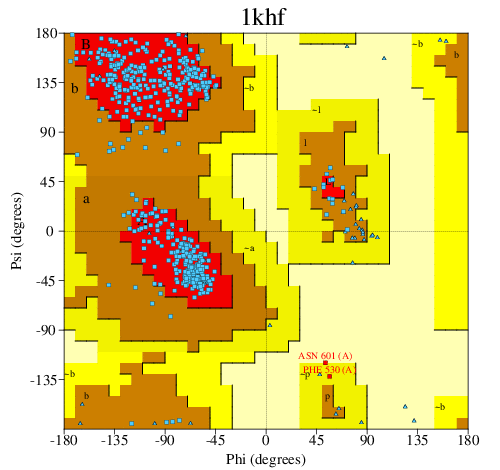
PROCHECK
|
|
|
|
|
|
Headers
|
|
|
|
References
|
|
|
|
|
|

|
|
P35558
(PCKGC_HUMAN) -
Phosphoenolpyruvate carboxykinase, cytosolic [GTP] from Homo sapiens
|
|
|
|
Seq:
Struc:
|
|
|
|
622 a.a.
603 a.a.*
|
|

|

|
|
|
|
|
|
|
|
|
|
|
|
Key: |
 |
PfamA domain |
|
|
 |
Secondary structure |
|
 |
CATH domain |
|
|
*
PDB and UniProt seqs differ
at 4 residue positions (black
crosses)
|
|
|
|
|
|
|
|
|
|
|
|
|
Enzyme class 2:
|
|
E.C.2.7.11.-
- ?????
|
|
|
|
|
|
|
Enzyme class 3:
|
|
E.C.4.1.1.32
- phosphoenolpyruvate carboxykinase (GTP).
|
|
|
|
|
|
|
Reaction:
|
|
oxaloacetate + GTP = phosphoenolpyruvate + GDP + CO2
|
|
|
|
|
|
 oxaloacetate
|
+
|
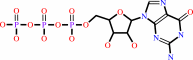 GTP
GTP
|
=
|
phosphoenolpyruvate
Bound ligand (Het Group name = )
matches with 40.00% similarity
|
+
|
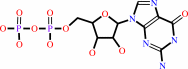 GDP
GDP
|
+
|
CO2
Bound ligand (Het Group name = )
corresponds exactly
|
|
|
|
|
|
|
|
|
|
|
|
|
Note, where more than one E.C. class is given (as above), each may
correspond to a different protein domain or, in the case of polyprotein
precursors, to a different mature protein.
|
|
|
|
Molecule diagrams generated from .mol files obtained from the
KEGG ftp site
|
|
|
|
|
|
|
|
|
|
|
|
|
|
 |
|
|
|
|
|
|
| |
|
|
| |
|
DOI no:
|
J Mol Biol
316:257-264
(2002)
|
|
PubMed id:
|
|
|
|
|
|
| |
|
Crystal structure of human cytosolic phosphoenolpyruvate carboxykinase reveals a new GTP-binding site.
|
|
P.Dunten,
C.Belunis,
R.Crowther,
K.Hollfelder,
U.Kammlott,
W.Levin,
H.Michel,
G.B.Ramsey,
A.Swain,
D.Weber,
S.J.Wertheimer.
|
|
|
|
|
| |
ABSTRACT
|
|
|
|
| |
|
|
We report crystal structures of the human enzyme phosphoenolpyruvate
carboxykinase (PEPCK) with and without bound substrates. These structures are
the first to be determined for a GTP-dependent PEPCK, and provide the first view
of a novel GTP-binding site unique to the GTP-dependent PEPCK family. Three
phenylalanine residues form the walls of the guanine-binding pocket on the
enzyme's surface and, most surprisingly, one of the phenylalanine side-chains
contributes to the enzyme's specificity for GTP. PEPCK catalyzes the
rate-limiting step in the metabolic pathway that produces glucose from lactate
and other precursors derived from the citric acid cycle. Because the
gluconeogenic pathway contributes to the fasting hyperglycemia of type II
diabetes, inhibitors of PEPCK may be useful in the treatment of diabetes.
|
|
|
|
|
|
| |
Selected figure(s)
|
|
|
|
| |
|
|

|
|

|
|
Figure 2.
Figure 2. Interactions between the base and sugar of the
non-hydrolyzable GTP analog and the enzyme. The two water
molecules mediating hydrogen bonds to the protein are shown as
red spheres.
|
|
Figure 3.
Figure 3. Comparison of the GTP-dependent and ATP-dependent
PEPCK structures. (a) Ribbon representation of the human enzyme
with metal ions and non-hydrolyzable GTP shown in ball-and-stick
form. (b) The E. coli enzyme with bound metal ions and ATP shown
in the same orientation to highlight the similarity of the fold.
(c) The active site of the human enzyme with bound
non-hydrolyzable GTP. The Mg and Mn ions are shown as purple
spheres and water molecules are shown as red spheres. (d)
Corresponding view of the active site of the E. coli enzyme
complexed with ATP taken from the Protein Data Bank, entry
1aq2[6]. A bound molecule of pyruvate marks the location of the
PEP site. The indicated torsion angle (O4'-C1'-N9-C4) is 57°
(syn) for bound ATP, versus 236° (anti) for the GTP bound to
the human enzyme. Atoms in the Figures are colored by type, with
C, N, O, S, and P atoms in green, dark blue, red, yellow, and
light blue, respectively.
|
|
|
|
|
|
| |
The above figures are
reprinted
by permission from Elsevier:
J Mol Biol
(2002,
316,
257-264)
copyright 2002.
|
|
| |
Figures were
selected
by an automated process.
|
|
|
|
|
|
|
|
|
|
|
|
|
|
|
|
 |
 |
 |
|
Literature references that cite this PDB file's key reference
|
|
|
| |
PubMed id
|
|
Reference
|
|
|
|
|
|
E.Pérez,
and
E.Cardemil
(2010).
Saccharomyces cerevisiae phosphoenolpyruvate carboxykinase: the relevance of Glu299 and Leu460 for nucleotide binding.
|
| |
Protein J,
29,
299-305.
|
|
|
|
|
|
|
T.Shakya,
and
G.D.Wright
(2010).
Nucleotide selectivity of antibiotic kinases.
|
| |
Antimicrob Agents Chemother,
54,
1909-1913.
|
|
|
|
|
|
|
Z.Xia,
L.B.Chibnik,
B.I.Glanz,
M.Liguori,
J.M.Shulman,
D.Tran,
S.J.Khoury,
T.Chitnis,
T.Holyoak,
H.L.Weiner,
C.R.Guttmann,
and
P.L.De Jager
(2010).
A putative Alzheimer's disease risk allele in PCK1 influences brain atrophy in multiple sclerosis.
|
| |
PLoS One,
5,
e14169.
|
|
|
|
|
|
|
G.M.Carlson,
and
T.Holyoak
(2009).
Structural insights into the mechanism of phosphoenolpyruvate carboxykinase catalysis.
|
| |
J Biol Chem,
284,
27037-27041.
|
|
|
|
|
|
|
R.W.Hanson
(2009).
Thematic minireview series: a perspective on the biology of phosphoenolpyruvate carboxykinase 55 years after its discovery.
|
| |
J Biol Chem,
284,
27021-27023.
|
|
|
|
|
|
|
I.Tobar,
F.D.González-Nilo,
A.M.Jabalquinto,
and
E.Cardemil
(2008).
Relevance of Arg457 for the nucleotide affinity of Saccharomyces cerevisiae phosphoenolpyruvate carboxykinase.
|
| |
Int J Biochem Cell Biol,
40,
1883-1889.
|
|
|
|
|
|
|
L.Dharmarajan,
C.L.Case,
P.Dunten,
and
B.Mukhopadhyay
(2008).
Tyr235 of human cytosolic phosphoenolpyruvate carboxykinase influences catalysis through an anion-quadrupole interaction with phosphoenolpyruvate carboxylate.
|
| |
FEBS J,
275,
5810-5819.
|
|
|
|
|
|
|
S.M.Sullivan,
and
T.Holyoak
(2008).
Enzymes with lid-gated active sites must operate by an induced fit mechanism instead of conformational selection.
|
| |
Proc Natl Acad Sci U S A,
105,
13829-13834.
|
|
|
PDB codes:
|
|
|
|
|
|
|
|
A.Yévenes,
F.D.González-Nilo,
and
E.Cardemil
(2007).
Relevance of phenylalanine 216 in the affinity of Saccharomyces cerevisiae phosphoenolpyruvate carboxykinase for Mn(II).
|
| |
Protein J,
26,
135-141.
|
|
|
|
|
|
|
S.Aich,
and
L.T.Delbaere
(2007).
Phylogenetic Study of the Evolution of PEP-Carboxykinase.
|
| |
Evol Bioinform Online,
3,
333-340.
|
|
|
|
|
|
|
C.L.Case,
E.M.Concar,
K.L.Boswell,
and
B.Mukhopadhyay
(2006).
Roles of Asp75, Asp78, and Glu83 of GTP-dependent phosphoenolpyruvate carboxykinase from Mycobacterium smegmatis.
|
| |
J Biol Chem,
281,
39262-39272.
|
|
|
|
|
|
|
M.Sugahara,
N.Ohshima,
Y.Ukita,
M.Sugahara,
and
N.Kunishima
(2005).
Structure of ATP-dependent phosphoenolpyruvate carboxykinase from Thermus thermophilus HB8 showing the structural basis of induced fit and thermostability.
|
| |
Acta Crystallogr D Biol Crystallogr,
61,
1500-1507.
|
|
|
PDB codes:
|
|
|
|
|
|
|
|
U.Sauer,
and
B.J.Eikmanns
(2005).
The PEP-pyruvate-oxaloacetate node as the switch point for carbon flux distribution in bacteria.
|
| |
FEMS Microbiol Rev,
29,
765-794.
|
|
|
|
|
|
|
Y.A.Leduc,
L.Prasad,
M.Laivenieks,
J.G.Zeikus,
and
L.T.Delbaere
(2005).
Structure of PEP carboxykinase from the succinate-producing Actinobacillus succinogenes: a new conserved active-site motif.
|
| |
Acta Crystallogr D Biol Crystallogr,
61,
903-912.
|
|
|
PDB codes:
|
|
|
|
|
|
|
|
C.Bueno,
F.D.González-Nilo,
M.Victoria Encinas,
and
E.Cardemil
(2004).
Substrate binding to fluorescent labeled wild type, Lys213Arg, and HIS233Gln Saccharomyces cerevisiae phosphoenolpyruvate carboxykinases.
|
| |
Int J Biochem Cell Biol,
36,
861-869.
|
|
|
|
|
|
|
W.Fukuda,
T.Fukui,
H.Atomi,
and
T.Imanaka
(2004).
First characterization of an archaeal GTP-dependent phosphoenolpyruvate carboxykinase from the hyperthermophilic archaeon Thermococcus kodakaraensis KOD1.
|
| |
J Bacteriol,
186,
4620-4627.
|
|
|
|
|
|
|
L.Yim,
M.Martínez-Vicente,
M.Villarroya,
C.Aguado,
E.Knecht,
and
M.E.Armengod
(2003).
The GTPase activity and C-terminal cysteine of the Escherichia coli MnmE protein are essential for its tRNA modifying function.
|
| |
J Biol Chem,
278,
28378-28387.
|
|
|
|
|
|
|
S.Aich,
F.Imabayashi,
and
L.T.Delbaere
(2003).
Crystallization and preliminary X-ray crystallographic studies of phosphoenolpyruvate carboxykinase from Corynebacterium glutamicum.
|
| |
Acta Crystallogr D Biol Crystallogr,
59,
1640-1641.
|
|
|
|
|
|
|
M.V.Encinas,
F.D.González-Nilo,
H.Goldie,
and
E.Cardemil
(2002).
Ligand interactions and protein conformational changes of phosphopyridoxyl-labeled Escherichia coli phosphoenolpyruvate carboxykinase determined by fluorescence spectroscopy.
|
| |
Eur J Biochem,
269,
4960-4968.
|
|
|
|
|
|
The most recent references are shown first.
Citation data come partly from CiteXplore and partly
from an automated harvesting procedure. Note that this is likely to be
only a partial list as not all journals are covered by
either method. However, we are continually building up the citation data
so more and more references will be included with time.
Where a reference describes a PDB structure, the PDB
codes are
shown on the right.
|
|


 Links
Links


