 |
PDBsum entry 1gss

|
|
|
|
|
|

|

|

|

|
|

|
|

|
|

|
|

|
|

|
|

|
|

|
|
|
 |

|

|
|
|
|
|
|
|
|
|
|
|
|
|
|
|
|
|
|
|
|
|
|
|
|
|
|
|
|
|
|
|
|
|
|
|
|
Transferase/transferase inhibitor
|
PDB id
|
|
|
|
1gss
|
|
|
|
|
|
|
|
|
|
|
|
|
|
|

|

|

|
|
|
|
|
|
|
|
 |
Contents |
 |
|
|
|
|
|
|
|
|
|
|
|
|
* Residue conservation analysis
|
|
|
|
|
|
|
|
|
|
|
Enzyme class:
|
|
E.C.2.5.1.18
- glutathione transferase.
|
|
|
|
|
|
|
Reaction:
|
|
RX + glutathione = an S-substituted glutathione + a halide anion + H+
|
|
|
|
|
|
RX
Bound ligand (Het Group name = )
matches with 76.92% similarity
|
+
|
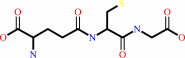 glutathione
|
=
|
S-substituted glutathione
|
+
|
halide anion
|
+
|
H(+)
|
|
|
|
|
|
|
|
|
|
|
|
|
Molecule diagrams generated from .mol files obtained from the
KEGG ftp site
|
|
|
|
|
|
|
|
|
|
|
|
|
|
 |
|
|
|
|
|
|
| |
|
|
| |
|
DOI no:
|
J Mol Biol
227:214-226
(1992)
|
|
PubMed id:
|
|
|
|
|
|
| |
|
Three-dimensional structure of class pi glutathione S-transferase from human placenta in complex with S-hexylglutathione at 2.8 A resolution.
|
|
P.Reinemer,
H.W.Dirr,
R.Ladenstein,
R.Huber,
M.Lo Bello,
G.Federici,
M.W.Parker.
|
|
|
|
|
| |
ABSTRACT
|
|
|
|
| |
|
|
The three-dimensional structure of human class pi glutathione S-transferase from
placenta (hGSTP1-1), a homodimeric enzyme, has been solved by Patterson search
methods and refined at 2.8 A resolution to a final crystallographic R-factor of
19.6% (8.0 to 2.8 A resolution). Subunit folding topology, subunit overall
structure and subunit association closely resembles the structure of porcine
class pi glutathione S-transferase. The binding site of a competitive inhibitor,
S-hexylglutathione, is analyzed and the locations of the binding regions for
glutathione (G-site) and electrophilic substrates (H-site) are determined. The
specific interactions between protein and the inhibitor's glutathione peptide
are the same as those observed between glutathione sulfonate and the porcine
isozyme. The H-site is located adjacent to the G-site, with the hexyl moiety
lying above a segment (residues 8 to 10) connecting strand beta 1 and helix
alpha A where it is in hydrophobic contact with Tyr7, Phe8, Val10, Val35 and
Tyr106. Catalytic models are discussed on the basis of the molecular structure.
|
|
|
|
|
|
| |
Selected figure(s)
|
|
|
|
| |
|
|

|
|

|
|
Figure 8.
Figure 8. Conolly dot surface of the op region of human class x glutathione S-transferase showing both active sites
occupied by S-hexyllutathione. View is along the local dyad. Also shown is the cavity formed between the 2 subunits.
|
|
Figure 9.
Figure 9. Model o inhibitor S-hexylglutathione and its next neighbors at the active site of human
-transferase.
|
|
|
|
|
|
| |
The above figures are
reprinted
by permission from Elsevier:
J Mol Biol
(1992,
227,
214-226)
copyright 1992.
|
|
| |
Figures were
selected
by an automated process.
|
|
|
|
|
|
|
|
|
|
|
|
|
|
|
|
 |
 |
 |
|
Literature references that cite this PDB file's key reference
|
|
|
| |
PubMed id
|
|
Reference
|
|
|
|
|
|
A.J.Ketterman,
C.Saisawang,
and
J.Wongsantichon
(2011).
Insect glutathione transferases.
|
| |
Drug Metab Rev,
43,
253-265.
|
|
|
|
|
|
|
A.Oakley
(2011).
Glutathione transferases: a structural perspective.
|
| |
Drug Metab Rev,
43,
138-151.
|
|
|
|
|
|
|
I.Quesada-Soriano,
L.J.Parker,
A.Primavera,
J.Wielens,
J.K.Holien,
J.M.Casas-Solvas,
A.Vargas-Berenguel,
A.M.Aguilera,
M.Nuccetelli,
A.P.Mazzetti,
M.L.Bello,
M.W.Parker,
and
L.García-Fuentes
(2011).
Diuretic drug binding to human glutathione transferase P1-1: potential role of Cys-101 revealed in the double mutant C47S/Y108V.
|
| |
J Mol Recognit,
24,
220-234.
|
|
|
PDB codes:
|
|
|
|
|
|
|
|
K.D.Tew,
and
D.M.Townsend
(2011).
Regulatory functions of glutathione S-transferase P1-1 unrelated to detoxification.
|
| |
Drug Metab Rev,
43,
179-193.
|
|
|
|
|
|
|
I.Quesada-Soriano,
L.J.Parker,
A.Primavera,
J.M.Casas-Solvas,
A.Vargas-Berenguel,
C.Barón,
C.J.Morton,
A.Paola Mazzetti,
M.Lo Bello,
M.W.Parker,
and
L.García-Fuentes
(2009).
Influence of the H-site residue 108 on human glutathione transferase P1-1 ligand binding: Structure-thermodynamic relationships and thermal stability.
|
| |
Protein Sci,
18,
2454-2470.
|
|
|
PDB codes:
|
|
|
|
|
|
|
|
L.M.Balogh,
A.G.Roberts,
L.M.Shireman,
R.J.Greene,
and
W.M.Atkins
(2008).
The stereochemical course of 4-hydroxy-2-nonenal metabolism by glutathione S-transferases.
|
| |
J Biol Chem,
283,
16702-16710.
|
|
|
|
|
|
|
Y.C.Huang,
S.Misquitta,
S.Y.Blond,
E.Adams,
and
R.F.Colman
(2008).
Catalytically Active Monomer of Glutathione S-Transferase {pi} and Key Residues Involved in the Electrostatic Interaction between Subunits.
|
| |
J Biol Chem,
283,
32880-32888.
|
|
|
|
|
|
|
B.Blanchette,
X.Feng,
and
B.R.Singh
(2007).
Marine glutathione S-transferases.
|
| |
Mar Biotechnol (NY),
9,
513-542.
|
|
|
|
|
|
|
Y.Wu,
J.Shen,
and
Z.Yin
(2007).
Expression, purification and functional analysis of hexahistidine-tagged human glutathione S-transferase P1-1 and its cysteinyl mutants.
|
| |
Protein J,
26,
359-370.
|
|
|
|
|
|
|
C.Lu,
M.R.Spitz,
H.Zhao,
Q.Dong,
M.Truong,
J.Y.Chang,
G.R.Blumenschein,
W.K.Hong,
and
X.Wu
(2006).
Association between glutathione S-transferase pi polymorphisms and survival in patients with advanced nonsmall cell lung carcinoma.
|
| |
Cancer,
106,
441-447.
|
|
|
|
|
|
|
R.Téllez-Sanz,
E.Cesareo,
M.Nuccetelli,
A.M.Aguilera,
C.Barón,
L.J.Parker,
J.J.Adams,
C.J.Morton,
M.Lo Bello,
M.W.Parker,
and
L.García-Fuentes
(2006).
Calorimetric and structural studies of the nitric oxide carrier S-nitrosoglutathione bound to human glutathione transferase P1-1.
|
| |
Protein Sci,
15,
1093-1105.
|
|
|
PDB codes:
|
|
|
|
|
|
|
|
W.Q.Liao,
X.F.Liang,
L.Wang,
L.M.Lei,
and
B.P.Han
(2006).
Molecular cloning and characterization of alpha-class glutathione S-transferase gene from the liver of silver carp, bighead carp, and other major Chinese freshwater fishes.
|
| |
J Biochem Mol Toxicol,
20,
114-126.
|
|
|
|
|
|
|
J.M.Allan,
and
C.S.Rabkin
(2005).
Genetic susceptibility to iatrogenic malignancy.
|
| |
Pharmacogenomics,
6,
615-628.
|
|
|
|
|
|
|
K.D.Tew
(2005).
TLK-286: a novel glutathione S-transferase-activated prodrug.
|
| |
Expert Opin Investig Drugs,
14,
1047-1054.
|
|
|
|
|
|
|
M.Perbandt,
J.Höppner,
C.Betzel,
R.D.Walter,
and
E.Liebau
(2005).
Structure of the major cytosolic glutathione S-transferase from the parasitic nematode Onchocerca volvulus.
|
| |
J Biol Chem,
280,
12630-12636.
|
|
|
PDB codes:
|
|
|
|
|
|
|
|
M.Perbandt,
C.Burmeister,
R.D.Walter,
C.Betzel,
and
E.Liebau
(2004).
Native and inhibited structure of a Mu class-related glutathione S-transferase from Plasmodium falciparum.
|
| |
J Biol Chem,
279,
1336-1342.
|
|
|
PDB codes:
|
|
|
|
|
|
|
|
U.M.Hegazy,
B.Mannervik,
and
G.Stenberg
(2004).
Functional role of the lock and key motif at the subunit interface of glutathione transferase p1-1.
|
| |
J Biol Chem,
279,
9586-9596.
|
|
|
|
|
|
|
E.Ortiz-Salmerón,
M.Nuccetelli,
A.J.Oakley,
M.W.Parker,
M.Lo Bello,
and
L.García-Fuentes
(2003).
Thermodynamic description of the effect of the mutation Y49F on human glutathione transferase P1-1 in binding with glutathione and the inhibitor S-hexylglutathione.
|
| |
J Biol Chem,
278,
46938-46948.
|
|
|
PDB code:
|
|
|
|
|
|
|
|
M.G.Jeppesen,
P.Ortiz,
W.Shepard,
T.G.Kinzy,
J.Nyborg,
and
G.R.Andersen
(2003).
The crystal structure of the glutathione S-transferase-like domain of elongation factor 1Bgamma from Saccharomyces cerevisiae.
|
| |
J Biol Chem,
278,
47190-47198.
|
|
|
PDB code:
|
|
|
|
|
|
|
|
T.Bucciarelli,
P.Sacchetta,
F.Amicarelli,
R.Petruzzelli,
S.Melino,
D.Rotilio,
N.Celli,
and
C.Di Ilio
(2002).
Amino acid sequence of the major form of toad liver glutathione transferase.
|
| |
Int J Biochem Cell Biol,
34,
1286-1290.
|
|
|
|
|
|
|
A.J.Oakley,
T.Harnnoi,
R.Udomsinprasert,
K.Jirajaroenrat,
A.J.Ketterman,
and
M.C.Wilce
(2001).
The crystal structures of glutathione S-transferases isozymes 1-3 and 1-4 from Anopheles dirus species B.
|
| |
Protein Sci,
10,
2176-2185.
|
|
|
PDB codes:
|
|
|
|
|
|
|
|
G.Polekhina,
P.G.Board,
A.C.Blackburn,
and
M.W.Parker
(2001).
Crystal structure of maleylacetoacetate isomerase/glutathione transferase zeta reveals the molecular basis for its remarkable catalytic promiscuity.
|
| |
Biochemistry,
40,
1567-1576.
|
|
|
PDB code:
|
|
|
|
|
|
|
|
M.Chang,
Y.G.Shin,
R.B.van Breemen,
S.Y.Blond,
and
J.L.Bolton
(2001).
Structural and functional consequences of inactivation of human glutathione S-transferase P1-1 mediated by the catechol metabolite of equine estrogens, 4-hydroxyequilenin.
|
| |
Biochemistry,
40,
4811-4820.
|
|
|
|
|
|
|
T.L.Ung,
C.Cao,
J.Lu,
K.Ozato,
and
T.E.Dever
(2001).
Heterologous dimerization domains functionally substitute for the double-stranded RNA binding domains of the kinase PKR.
|
| |
EMBO J,
20,
3728-3737.
|
|
|
|
|
|
|
C.Micaloni,
A.P.Mazzetti,
M.Nuccetelli,
J.Rossjohn,
W.J.McKinstry,
G.Antonini,
A.M.Caccuri,
A.J.Oakley,
G.Federici,
G.Ricci,
M.W.Parker,
and
M.Lo Bello
(2000).
Valine 10 may act as a driver for product release from the active site of human glutathione transferase P1-1.
|
| |
Biochemistry,
39,
15961-15970.
|
|
|
|
|
|
|
S.A.McCallum,
T.K.Hitchens,
C.Torborg,
and
G.S.Rule
(2000).
Ligand-induced changes in the structure and dynamics of a human class Mu glutathione S-transferase.
|
| |
Biochemistry,
39,
7343-7356.
|
|
|
|
|
|
|
A.M.Caccuri,
G.Antonini,
P.Ascenzi,
M.Nicotra,
M.Nuccetelli,
A.P.Mazzetti,
G.Federici,
M.Lo Bello,
and
G.Ricci
(1999).
Temperature adaptation of glutathione S-transferase P1-1. A case for homotropic regulation of substrate binding.
|
| |
J Biol Chem,
274,
19276-19280.
|
|
|
|
|
|
|
J.U.Flanagan,
J.Rossjohn,
M.W.Parker,
P.G.Board,
and
G.Chelvanayagam
(1999).
Mutagenic analysis of conserved arginine residues in and around the novel sulfate binding pocket of the human Theta class glutathione transferase T2-2.
|
| |
Protein Sci,
8,
2205-2212.
|
|
|
|
|
|
|
L.Tang,
B.Guo,
A.Javed,
J.Y.Choi,
S.Hiebert,
J.B.Lian,
A.J.van Wijnen,
J.L.Stein,
G.S.Stein,
and
G.W.Zhou
(1999).
Crystal structure of the nuclear matrix targeting signal of the transcription factor acute myelogenous leukemia-1/polyoma enhancer-binding protein 2alphaB/core binding factor alpha2.
|
| |
J Biol Chem,
274,
33580-33586.
|
|
|
|
|
|
|
A.J.Oakley,
M.Lo Bello,
G.Ricci,
G.Federici,
and
M.W.Parker
(1998).
Evidence for an induced-fit mechanism operating in pi class glutathione transferases.
|
| |
Biochemistry,
37,
9912-9917.
|
|
|
PDB codes:
|
|
|
|
|
|
|
|
J.Rossjohn,
W.J.McKinstry,
A.J.Oakley,
D.Verger,
J.Flanagan,
G.Chelvanayagam,
K.L.Tan,
P.G.Board,
and
M.W.Parker
(1998).
Human theta class glutathione transferase: the crystal structure reveals a sulfate-binding pocket within a buried active site.
|
| |
Structure,
6,
309-322.
|
|
|
PDB codes:
|
|
|
|
|
|
|
|
J.U.Flanagan,
J.Rossjohn,
M.W.Parker,
P.G.Board,
and
G.Chelvanayagam
(1998).
A homology model for the human theta-class glutathione transferase T1-1.
|
| |
Proteins,
33,
444-454.
|
|
|
|
|
|
|
L.Stella,
A.M.Caccuri,
N.Rosato,
M.Nicotra,
M.Lo Bello,
F.De Matteis,
A.P.Mazzetti,
G.Federici,
and
G.Ricci
(1998).
Flexibility of helix 2 in the human glutathione transferase P1-1. time-resolved fluorescence spectroscopy.
|
| |
J Biol Chem,
273,
23267-23273.
|
|
|
|
|
|
|
M.C.Vega,
S.B.Walsh,
T.J.Mantle,
and
M.Coll
(1998).
The three-dimensional structure of Cys-47-modified mouse liver glutathione S-transferase P1-1. Carboxymethylation dramatically decreases the affinity for glutathione and is associated with a loss of electron density in the alphaB-310B region.
|
| |
J Biol Chem,
273,
2844-2850.
|
|
|
PDB codes:
|
|
|
|
|
|
|
|
M.Nicotra,
M.Paci,
M.Sette,
A.J.Oakley,
M.W.Parker,
M.Lo Bello,
A.M.Caccuri,
G.Federici,
and
G.Ricci
(1998).
Solution structure of glutathione bound to human glutathione transferase P1-1: comparison of NMR measurements with the crystal structure.
|
| |
Biochemistry,
37,
3020-3027.
|
|
|
|
|
|
|
W.J.McKinstry,
A.J.Oakley,
J.Rossjohn,
D.Verger,
K.L.Tan,
P.G.Board,
and
M.W.Parker
(1998).
Preliminary X-ray crystallographic studies of a newly defined human theta-class glutathione transferase.
|
| |
Acta Crystallogr D Biol Crystallogr,
54,
148-150.
|
|
|
|
|
|
|
A.J.Oakley,
J.Rossjohn,
M.Lo Bello,
A.M.Caccuri,
G.Federici,
and
M.W.Parker
(1997).
The three-dimensional structure of the human Pi class glutathione transferase P1-1 in complex with the inhibitor ethacrynic acid and its glutathione conjugate.
|
| |
Biochemistry,
36,
576-585.
|
|
|
PDB codes:
|
|
|
|
|
|
|
|
G.Antonini,
G.Pitari,
A.M.Caccuri,
G.Ricci,
D.Boschi,
R.Fruttero,
A.Gasco,
and
P.Ascenzi
(1997).
Inhibition of human placenta glutathione transferase P1-1 by the antibiotic calvatic acid and its diazocyanide analogue--evidence for multiple catalytic intermediates.
|
| |
Eur J Biochem,
245,
663-667.
|
|
|
|
|
|
|
G.Chelvanayagam,
M.C.Wilce,
M.W.Parker,
K.L.Tan,
and
P.G.Board
(1997).
Homology model for the human GSTT2 Theta class glutathione transferase.
|
| |
Proteins,
27,
118-130.
|
|
|
|
|
|
|
K.D.Tew,
S.Dutta,
and
M.Schultz
(1997).
Inhibitors of glutathione S-transferases as therapeutic agents.
|
| |
Adv Drug Deliv Rev,
26,
91.
|
|
|
|
|
|
|
L.Hu,
B.L.Borleske,
and
R.F.Colman
(1997).
Probing the active site of alpha-class rat liver glutathione S-transferases using affinity labeling by monobromobimane.
|
| |
Protein Sci,
6,
43-52.
|
|
|
|
|
|
|
L.Prade,
R.Huber,
T.H.Manoharan,
W.E.Fahl,
and
W.Reuter
(1997).
Structures of class pi glutathione S-transferase from human placenta in complex with substrate, transition-state analogue and inhibitor.
|
| |
Structure,
5,
1287-1295.
|
|
|
PDB codes:
|
|
|
|
|
|
|
|
M.J.Snyder,
and
D.R.Maddison
(1997).
Molecular phylogeny of glutathione-S-transferases.
|
| |
DNA Cell Biol,
16,
1373-1384.
|
|
|
|
|
|
|
M.Lo Bello,
A.J.Oakley,
A.Battistoni,
A.P.Mazzetti,
M.Nuccetelli,
G.Mazzarese,
J.Rossjohn,
M.W.Parker,
and
G.Ricci
(1997).
Multifunctional role of Tyr 108 in the catalytic mechanism of human glutathione transferase P1-1. Crystallographic and kinetic studies on the Y108F mutant enzyme.
|
| |
Biochemistry,
36,
6207-6217.
|
|
|
PDB code:
|
|
|
|
|
|
|
|
R.T.Koehler,
H.O.Villar,
K.E.Bauer,
and
D.L.Higgins
(1997).
Ligand-based protein alignment and isozyme specificity of glutathione S-transferase inhibitors.
|
| |
Proteins,
28,
202-216.
|
|
|
|
|
|
|
X.Ji,
M.Tordova,
R.O'Donnell,
J.F.Parsons,
J.B.Hayden,
G.L.Gilliland,
and
P.Zimniak
(1997).
Structure and function of the xenobiotic substrate-binding site and location of a potential non-substrate-binding site in a class pi glutathione S-transferase.
|
| |
Biochemistry,
36,
9690-9702.
|
|
|
PDB codes:
|
|
|
|
|
|
|
|
A.M.Caccuri,
P.Ascenzi,
G.Antonini,
M.W.Parker,
A.J.Oakley,
E.Chiessi,
M.Nuccetelli,
A.Battistoni,
A.Bellizia,
and
G.Ricci
(1996).
Structural flexibility modulates the activity of human glutathione transferase P1-1. Influence of a poor co-substrate on dynamics and kinetics of human glutathione transferase.
|
| |
J Biol Chem,
271,
16193-16198.
|
|
|
|
|
|
|
E.W.Napolitano,
H.O.Villar,
L.M.Kauvar,
D.L.Higgins,
D.Roberts,
J.Mandac,
S.K.Lee,
A.Engqvist-Goldstein,
R.Bukar,
B.L.Calio,
H.M.Jäck,
and
J.A.Tainer
(1996).
Glubodies: randomized libraries of glutathione transferase enzymes.
|
| |
Chem Biol,
3,
359-367.
|
|
|
|
|
|
|
G.Ricci,
A.M.Caccuri,
M.Lo Bello,
N.Rosato,
G.Mei,
M.Nicotra,
E.Chiessi,
A.P.Mazzetti,
and
G.Federici
(1996).
Structural flexibility modulates the activity of human glutathione transferase P1-1. Role of helix 2 flexibility in the catalytic mechanism.
|
| |
J Biol Chem,
271,
16187-16192.
|
|
|
|
|
|
|
G.Xiao,
S.Liu,
X.Ji,
W.W.Johnson,
J.Chen,
J.F.Parsons,
W.J.Stevens,
G.L.Gilliland,
and
R.N.Armstrong
(1996).
First-sphere and second-sphere electrostatic effects in the active site of a class mu gluthathione transferase.
|
| |
Biochemistry,
35,
4753-4765.
|
|
|
PDB codes:
|
|
|
|
|
|
|
|
H.W.Sun,
J.Bernhagen,
R.Bucala,
and
E.Lolis
(1996).
Crystal structure at 2.6-A resolution of human macrophage migration inhibitory factor.
|
| |
Proc Natl Acad Sci U S A,
93,
5191-5196.
|
|
|
PDB code:
|
|
|
|
|
|
|
|
J.Wang,
J.J.Barycki,
and
R.F.Colman
(1996).
Tyrosine 8 contributes to catalysis but is not required for activity of rat liver glutathione S-transferase, 1-1.
|
| |
Protein Sci,
5,
1032-1042.
|
|
|
|
|
|
|
M.Widersten,
R.Björnestedt,
and
B.Mannervik
(1996).
Involvement of the carboxyl groups of glutathione in the catalytic mechanism of human glutathione transferase A1-1.
|
| |
Biochemistry,
35,
7731-7742.
|
|
|
|
|
|
|
N.Sluis-Cremer,
N.N.Naidoo,
W.H.Kaplan,
T.H.Manoharan,
W.E.Fahl,
and
H.W.Dirr
(1996).
Determination of a binding site for a non-substrate ligand in mammalian cytosolic glutathione S-transferases by means of fluorescence-resonance energy transfer.
|
| |
Eur J Biochem,
241,
484-488.
|
|
|
|
|
|
|
N.Sluis-Cremer,
N.Naidoo,
and
H.Dirr
(1996).
Class-pi glutathione S-transferase is unable to regain its native conformation after oxidative inactivation by hydrogen peroxide.
|
| |
Eur J Biochem,
242,
301-307.
|
|
|
|
|
|
|
R.Whalen,
E.S.Kempner,
and
T.D.Boyer
(1996).
Structural studies of a human pi class glutathione S-transferase. Photoaffinity labeling of the active site and target size analysis.
|
| |
Biochem Pharmacol,
52,
281-288.
|
|
|
|
|
|
|
T.E.McHugh,
W.M.Atkins,
J.K.Racha,
K.L.Kunze,
and
D.L.Eaton
(1996).
Binding of the aflatoxin-glutathione conjugate to mouse glutathione S-transferase A3-3 is saturated at only one ligand per dimer.
|
| |
J Biol Chem,
271,
27470-27474.
|
|
|
|
|
|
|
X.Ji,
E.C.von Rosenvinge,
W.W.Johnson,
R.N.Armstrong,
and
G.L.Gilliland
(1996).
Location of a potential transport binding site in a sigma class glutathione transferase by x-ray crystallography.
|
| |
Proc Natl Acad Sci U S A,
93,
8208-8213.
|
|
|
PDB code:
|
|
|
|
|
|
|
|
A.Aceto,
B.Dragani,
N.Allocati,
S.Angelucci,
T.Bucciarelli,
P.Sacchetta,
C.D.Di Ilio,
and
F.Martini
(1995).
Analysis by limited proteolysis of domain organization and GSH-site arrangement of bacterial glutathione transferase B1-1.
|
| |
Int J Biochem Cell Biol,
27,
1033-1041.
|
|
|
|
|
|
|
A.D.Cameron,
I.Sinning,
G.L'Hermite,
B.Olin,
P.G.Board,
B.Mannervik,
and
T.A.Jones
(1995).
Structural analysis of human alpha-class glutathione transferase A1-1 in the apo-form and in complexes with ethacrynic acid and its glutathione conjugate.
|
| |
Structure,
3,
717-727.
|
|
|
PDB codes:
|
|
|
|
|
|
|
|
A.M.Gulick,
and
W.E.Fahl
(1995).
Forced evolution of glutathione S-transferase to create a more efficient drug detoxication enzyme.
|
| |
Proc Natl Acad Sci U S A,
92,
8140-8144.
|
|
|
|
|
|
|
A.M.Gulick,
and
W.E.Fahl
(1995).
Mammalian glutathione S-transferase: regulation of an enzyme system to achieve chemotherapeutic efficacy.
|
| |
Pharmacol Ther,
66,
237-257.
|
|
|
|
|
|
|
G.Ricci,
M.Lo Bello,
A.M.Caccurri,
A.Pastore,
M.Nuccetelli,
M.W.Parker,
and
G.Federici
(1995).
Site-directed mutagenesis of human glutathione transferase P1-1. Mutation of Cys-47 induces a positive cooperatively in glutathione transferase P1-1.
|
| |
J Biol Chem,
270,
1243-1248.
|
|
|
|
|
|
|
H.C.Lee,
Y.P.Toung,
Y.S.Tu,
and
C.P.Tu
(1995).
A molecular genetic approach for the identification of essential residues in human glutathione S-transferase function in Escherichia coli.
|
| |
J Biol Chem,
270,
99.
|
|
|
|
|
|
|
J.Erhardt,
and
H.Dirr
(1995).
Native dimer stabilizes the subunit tertiary structure of porcine class pi glutathione S-transferase.
|
| |
Eur J Biochem,
230,
614-620.
|
|
|
|
|
|
|
J.L.Martin
(1995).
Thioredoxin--a fold for all reasons.
|
| |
Structure,
3,
245-250.
|
|
|
|
|
|
|
J.Nishihira,
M.Sakai,
S.Nishi,
and
Y.Hatanaka
(1995).
Identification of the electrophilic substrate-binding site of glutathione S-transferase P by photoaffinity labeling.
|
| |
Eur J Biochem,
232,
106-110.
|
|
|
|
|
|
|
L.Hu,
and
R.F.Colman
(1995).
Monobromobimane as an affinity label of the xenobiotic binding site of rat glutathione S-transferase 3-3.
|
| |
J Biol Chem,
270,
21875-21883.
|
|
|
|
|
|
|
M.C.Wilce,
P.G.Board,
S.C.Feil,
and
M.W.Parker
(1995).
Crystal structure of a theta-class glutathione transferase.
|
| |
EMBO J,
14,
2133-2143.
|
|
|
|
|
|
|
M.Lo Bello,
A.Battistoni,
A.P.Mazzetti,
P.G.Board,
M.Muramatsu,
G.Federici,
and
G.Ricci
(1995).
Site-directed mutagenesis of human glutathione transferase P1-1. Spectral, kinetic, and structural properties of Cys-47 and Lys-54 mutants.
|
| |
J Biol Chem,
270,
1249-1253.
|
|
|
|
|
|
|
M.W.Parker
(1995).
Protein crystallography in Australia.
|
| |
Aust N Z J Med,
25,
876-882.
|
|
|
|
|
|
|
P.Bico,
J.Erhardt,
W.Kaplan,
and
H.Dirr
(1995).
Porcine class pi glutathione S-transferase: anionic ligand binding and conformational analysis.
|
| |
Biochim Biophys Acta,
1247,
225-230.
|
|
|
|
|
|
|
R.Björnestedt,
S.Tardioli,
and
B.Mannervik
(1995).
The high activity of rat glutathione transferase 8-8 with alkene substrates is dependent on a glycine residue in the active site.
|
| |
J Biol Chem,
270,
29705-29709.
|
|
|
|
|
|
|
D.B.Janssen,
and
J.P.Schanstra
(1994).
Engineering proteins for environmental applications.
|
| |
Curr Opin Biotechnol,
5,
253-259.
|
|
|
|
|
|
|
E.V.Koonin,
A.R.Mushegian,
R.L.Tatusov,
S.F.Altschul,
S.H.Bryant,
P.Bork,
and
A.Valencia
(1994).
Eukaryotic translation elongation factor 1 gamma contains a glutathione transferase domain--study of a diverse, ancient protein superfamily using motif search and structural modeling.
|
| |
Protein Sci,
3,
2045-2054.
|
|
|
|
|
|
|
H.Dirr,
P.Reinemer,
and
R.Huber
(1994).
X-ray crystal structures of cytosolic glutathione S-transferases. Implications for protein architecture, substrate recognition and catalytic function.
|
| |
Eur J Biochem,
220,
645-661.
|
|
|
|
|
|
|
K.Berhane,
M.Widersten,
A.Engström,
J.W.Kozarich,
and
B.Mannervik
(1994).
Detoxication of base propenals and other alpha, beta-unsaturated aldehyde products of radical reactions and lipid peroxidation by human glutathione transferases.
|
| |
Proc Natl Acad Sci U S A,
91,
1480-1484.
|
|
|
|
|
|
|
K.Lim,
J.X.Ho,
K.Keeling,
G.L.Gilliland,
X.Ji,
F.Rüker,
and
D.C.Carter
(1994).
Three-dimensional structure of Schistosoma japonicum glutathione S-transferase fused with a six-amino acid conserved neutralizing epitope of gp41 from HIV.
|
| |
Protein Sci,
3,
2233-2244.
|
|
|
PDB code:
|
|
|
|
|
|
|
|
K.Zeng,
J.P.Rose,
H.C.Chen,
C.L.Strickland,
C.P.Tu,
and
B.C.Wang
(1994).
A surface mutant (G82R) of a human alpha-glutathione S-transferase shows decreased thermal stability and a new mode of molecular association in the crystal.
|
| |
Proteins,
20,
259-263.
|
|
|
PDB code:
|
|
|
|
|
|
|
|
P.Zimniak,
B.Nanduri,
S.Pikuła,
J.Bandorowicz-Pikuła,
S.S.Singhal,
S.K.Srivastava,
S.Awasthi,
and
Y.C.Awasthi
(1994).
Naturally occurring human glutathione S-transferase GSTP1-1 isoforms with isoleucine and valine in position 104 differ in enzymic properties.
|
| |
Eur J Biochem,
224,
893-899.
|
|
|
|
|
|
|
R.Bader,
and
T.Leisinger
(1994).
Isolation and characterization of the Methylophilus sp. strain DM11 gene encoding dichloromethane dehalogenase/glutathione S-transferase.
|
| |
J Bacteriol,
176,
3466-3473.
|
|
|
|
|
|
|
R.Zettl,
J.Schell,
and
K.Palme
(1994).
Photoaffinity labeling of Arabidopsis thaliana plasma membrane vesicles by 5-azido-[7-3H]indole-3-acetic acid: identification of a glutathione S-transferase.
|
| |
Proc Natl Acad Sci U S A,
91,
689-693.
|
|
|
|
|
|
|
T.Leisinger,
R.Bader,
R.Hermann,
M.Schmid-Appert,
and
S.Vuilleumier
(1994).
Microbes, enzymes and genes involved in dichloromethane utilization.
|
| |
Biodegradation,
5,
237-248.
|
|
|
|
|
|
|
A.Karshikoff,
P.Reinemer,
R.Huber,
and
R.Ladenstein
(1993).
Electrostatic evidence for the activation of the glutathione thiol by Tyr7 in pi-class glutathione transferases.
|
| |
Eur J Biochem,
215,
663-670.
|
|
|
|
|
|
|
D.J.Meyer
(1993).
Significance of an unusually low Km for glutathione in glutathione transferases of the alpha, mu and pi classes.
|
| |
Xenobiotica,
23,
823-834.
|
|
|
|
|
|
|
F.A.Blocki,
L.B.Ellis,
and
L.P.Wackett
(1993).
MIF protein are theta-class glutathione S-transferase homologs.
|
| |
Protein Sci,
2,
2095-2102.
|
|
|
|
|
|
|
F.Martini,
A.Aceto,
P.Sacchetta,
T.Bucciarelli,
B.Dragani,
and
C.Di Ilio
(1993).
Investigation of intra-domain and inter-domain interactions of glutathione transferase P1-1 by limited chymotryptic cleavage.
|
| |
Eur J Biochem,
218,
845-851.
|
|
|
|
|
|
|
J.E.Flatgaard,
K.E.Bauer,
and
L.M.Kauvar
(1993).
Isozyme specificity of novel glutathione-S-transferase inhibitors.
|
| |
Cancer Chemother Pharmacol,
33,
63-70.
|
|
|
|
|
|
|
J.H.Ploemen,
B.van Ommen,
J.J.Bogaards,
and
P.J.van Bladeren
(1993).
Ethacrynic acid and its glutathione conjugate as inhibitors of glutathione S-transferases.
|
| |
Xenobiotica,
23,
913-923.
|
|
|
|
|
|
|
P.Sacchetta,
A.Aceto,
T.Bucciarelli,
B.Dragani,
S.Santarone,
N.Allocati,
and
C.Di Ilio
(1993).
Multiphasic denaturation of glutathione transferase B1-1 by guanidinium chloride. Role of the dimeric structure on the flexibility of the active site.
|
| |
Eur J Biochem,
215,
741-745.
|
|
|
|
|
|
|
R.A.Reiss,
and
A.A.James
(1993).
A glutathione S-transferase gene of the vector mosquito, Anopheles gambiae.
|
| |
Insect Mol Biol,
2,
25-32.
|
|
|
|
|
|
|
R.W.Wang,
A.W.Bird,
D.J.Newton,
A.Y.Lu,
and
W.M.Atkins
(1993).
Fluorescence characterization of Trp 21 in rat glutathione S-transferase 1-1: microconformational changes induced by S-hexyl glutathione.
|
| |
Protein Sci,
2,
2085-2094.
|
|
|
|
|
|
The most recent references are shown first.
Citation data come partly from CiteXplore and partly
from an automated harvesting procedure. Note that this is likely to be
only a partial list as not all journals are covered by
either method. However, we are continually building up the citation data
so more and more references will be included with time.
Where a reference describes a PDB structure, the PDB
codes are
shown on the right.
|
|


 Links
Links


