 |
PDBsum entry 3gss

|
|
|
|
|
 |
Contents |
 |
|
|
|
|
|
|
|
|
|
|
|
|
* Residue conservation analysis
|
|
|
|
|
|
|
|
|
|
|
Enzyme class:
|
|
E.C.2.5.1.18
- glutathione transferase.
|
|
|
|
|
|
|
Reaction:
|
|
RX + glutathione = an S-substituted glutathione + a halide anion + H+
|
|
|
|
|
|
RX
Bound ligand (Het Group name = )
corresponds exactly
|
+
|
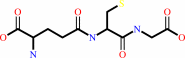 glutathione
|
=
|
S-substituted glutathione
|
+
|
halide anion
|
+
|
H(+)
|
|
|
|
|
|
|
|
|
|
|
|
|
Molecule diagrams generated from .mol files obtained from the
KEGG ftp site
|
|
|
|
|
|
|
|
|
|
|
|
|
|
 |
|
|
|
|
|
|
| |
|
|
| |
|
DOI no:
|
Biochemistry
36:576-585
(1997)
|
|
PubMed id:
|
|
|
|
|
|
| |
|
The three-dimensional structure of the human Pi class glutathione transferase P1-1 in complex with the inhibitor ethacrynic acid and its glutathione conjugate.
|
|
A.J.Oakley,
J.Rossjohn,
M.Lo Bello,
A.M.Caccuri,
G.Federici,
M.W.Parker.
|
|
|
|
|
| |
ABSTRACT
|
|
|
|
| |
|
|
The potent diuretic drug ethacrynic acid has been tested in clinical trials as
an adjuvant in chemotherapy. Its target is the detoxifying enzyme glutathione
transferase which is often found overexpressed in cancer tissues. We have solved
the crystal structures of human pi class glutathione transferase P1-1 in complex
with the inhibitor ethacrynic acid and its glutathione conjugate. Ethacrynic
acid is found to bind in a nonproductive mode to one of the ligand binding sites
of the enzyme (the H site) while the glutathione binding site (G site) is
occupied by solvent molecules. There are no structural rearrangements of the G
site in the absence of ligand. The structure indicates that bound glutathione is
required for ethacrynic acid to dock into the H site in a productive binding
mode. The binding of the ethacrynic acid-glutathione conjugate shows that the
contacts of the glutathione moiety with the protein are identical to those
observed in crystal structures of the enzyme with other glutathione-based
substrates and inhibitors. The ethacrynic acid moiety of the conjugate binds in
the H site in a fashion that has not been observed in crystal structures of
other glutathione-based inhibitor complexes. The crystal structures implicate
Tyr 108 as an electrophilic participant in the Michael addition of glutathione
to ethacrynic acid.
|
|
|
|
|
|
|
|
|
|
|
|
|
|
|
|
|
|
 |
 |
 |
|
Literature references that cite this PDB file's key reference
|
|
|
| |
PubMed id
|
|
Reference
|
|
|
|
|
|
A.Oakley
(2011).
Glutathione transferases: a structural perspective.
|
| |
Drug Metab Rev,
43,
138-151.
|
|
|
|
|
|
|
G.Nocca,
R.Ragno,
V.Carbone,
G.E.Martorana,
D.V.Rossetti,
G.Gambarini,
B.Giardina,
and
A.Lupi
(2011).
Identification of glutathione-methacrylates adducts in gingival fibroblasts and erythrocytes by HPLC-MS and capillary electrophoresis.
|
| |
Dent Mater,
27,
e87-e98.
|
|
|
|
|
|
|
I.Quesada-Soriano,
L.J.Parker,
A.Primavera,
J.Wielens,
J.K.Holien,
J.M.Casas-Solvas,
A.Vargas-Berenguel,
A.M.Aguilera,
M.Nuccetelli,
A.P.Mazzetti,
M.L.Bello,
M.W.Parker,
and
L.García-Fuentes
(2011).
Diuretic drug binding to human glutathione transferase P1-1: potential role of Cys-101 revealed in the double mutant C47S/Y108V.
|
| |
J Mol Recognit,
24,
220-234.
|
|
|
PDB codes:
|
|
|
|
|
|
|
|
J.U.Flanagan,
and
M.L.Smythe
(2011).
Sigma-class glutathione transferases.
|
| |
Drug Metab Rev,
43,
194-214.
|
|
|
|
|
|
|
L.M.Balogh,
and
W.M.Atkins
(2011).
Interactions of glutathione transferases with 4-hydroxynonenal.
|
| |
Drug Metab Rev,
43,
165-178.
|
|
|
|
|
|
|
I.Quesada-Soriano,
L.J.Parker,
A.Primavera,
J.M.Casas-Solvas,
A.Vargas-Berenguel,
C.Barón,
C.J.Morton,
A.Paola Mazzetti,
M.Lo Bello,
M.W.Parker,
and
L.García-Fuentes
(2009).
Influence of the H-site residue 108 on human glutathione transferase P1-1 ligand binding: Structure-thermodynamic relationships and thermal stability.
|
| |
Protein Sci,
18,
2454-2470.
|
|
|
PDB codes:
|
|
|
|
|
|
|
|
J.Wang,
S.Wang,
D.Song,
D.Zhao,
Y.Sha,
Y.Jiang,
Y.Jing,
and
M.Cheng
(2009).
Chalcone derivatives inhibit glutathione S-transferase P1-1 activity: insights into the interaction mode of alpha, beta-unsaturated carbonyl compounds.
|
| |
Chem Biol Drug Des,
73,
511-514.
|
|
|
|
|
|
|
N.Kinsley,
Y.Sayed,
S.Mosebi,
R.N.Armstrong,
and
H.W.Dirr
(2008).
Characterization of the binding of 8-anilinonaphthalene sulfonate to rat class Mu GST M1-1.
|
| |
Biophys Chem,
137,
100-104.
|
|
|
|
|
|
|
T.Itoh,
L.Fairall,
K.Amin,
Y.Inaba,
A.Szanto,
B.L.Balint,
L.Nagy,
K.Yamamoto,
and
J.W.Schwabe
(2008).
Structural basis for the activation of PPARgamma by oxidized fatty acids.
|
| |
Nat Struct Mol Biol,
15,
924-931.
|
|
|
PDB codes:
|
|
|
|
|
|
|
|
C.J.Jackson,
J.W.Liu,
M.L.Coote,
and
D.L.Ollis
(2005).
The effects of substrate orientation on the mechanism of a phosphotriesterase.
|
| |
Org Biomol Chem,
3,
4343-4350.
|
|
|
|
|
|
|
G.Zhao,
T.Yu,
R.Wang,
X.Wang,
and
Y.Jing
(2005).
Synthesis and structure-activity relationship of ethacrynic acid analogues on glutathione-s-transferase P1-1 activity inhibition.
|
| |
Bioorg Med Chem,
13,
4056-4062.
|
|
|
|
|
|
|
N.E.Labrou,
M.Karavangeli,
A.Tsaftaris,
and
Y.D.Clonis
(2005).
Kinetic analysis of maize glutathione S-transferase I catalysing the detoxification from chloroacetanilide herbicides.
|
| |
Planta,
222,
91-97.
|
|
|
|
|
|
|
K.Fritz-Wolf,
A.Becker,
S.Rahlfs,
P.Harwaldt,
R.H.Schirmer,
W.Kabsch,
and
K.Becker
(2003).
X-ray structure of glutathione S-transferase from the malarial parasite Plasmodium falciparum.
|
| |
Proc Natl Acad Sci U S A,
100,
13821-13826.
|
|
|
PDB code:
|
|
|
|
|
|
|
|
R.M.Cardoso,
D.S.Daniels,
C.M.Bruns,
and
J.A.Tainer
(2003).
Characterization of the electrophile binding site and substrate binding mode of the 26-kDa glutathione S-transferase from Schistosoma japonicum.
|
| |
Proteins,
51,
137-146.
|
|
|
PDB codes:
|
|
|
|
|
|
|
|
M.Chang,
Y.G.Shin,
R.B.van Breemen,
S.Y.Blond,
and
J.L.Bolton
(2001).
Structural and functional consequences of inactivation of human glutathione S-transferase P1-1 mediated by the catechol metabolite of equine estrogens, 4-hydroxyequilenin.
|
| |
Biochemistry,
40,
4811-4820.
|
|
|
|
|
|
|
A.J.Oakley,
and
M.C.Wilce
(2000).
Macromolecular crystallography as a tool for investigating drug, enzyme and receptor interactions.
|
| |
Clin Exp Pharmacol Physiol,
27,
145-151.
|
|
|
|
|
|
|
C.Micaloni,
A.P.Mazzetti,
M.Nuccetelli,
J.Rossjohn,
W.J.McKinstry,
G.Antonini,
A.M.Caccuri,
A.J.Oakley,
G.Federici,
G.Ricci,
M.W.Parker,
and
M.Lo Bello
(2000).
Valine 10 may act as a driver for product release from the active site of human glutathione transferase P1-1.
|
| |
Biochemistry,
39,
15961-15970.
|
|
|
|
|
|
|
J.Wang,
S.Bauman,
and
R.F.Colman
(2000).
Probing subunit interactions in alpha class rat liver glutathione S-transferase with the photoaffinity label glutathionyl S-[4-(succinimidyl)benzophenone].
|
| |
J Biol Chem,
275,
5493-5503.
|
|
|
|
|
|
|
A.J.Oakley,
M.Lo Bello,
G.Ricci,
G.Federici,
and
M.W.Parker
(1998).
Evidence for an induced-fit mechanism operating in pi class glutathione transferases.
|
| |
Biochemistry,
37,
9912-9917.
|
|
|
PDB codes:
|
|
|
|
|
|
|
|
J.Wang,
S.Bauman,
and
R.F.Colman
(1998).
Photoaffinity labeling of rat liver glutathione S-transferase, 4-4, by glutathionyl S-[4-(succinimidyl)-benzophenone].
|
| |
Biochemistry,
37,
15671-15679.
|
|
|
|
|
|
|
M.C.Vega,
S.B.Walsh,
T.J.Mantle,
and
M.Coll
(1998).
The three-dimensional structure of Cys-47-modified mouse liver glutathione S-transferase P1-1. Carboxymethylation dramatically decreases the affinity for glutathione and is associated with a loss of electron density in the alphaB-310B region.
|
| |
J Biol Chem,
273,
2844-2850.
|
|
|
PDB codes:
|
|
|
|
|
|
|
|
M.Nicotra,
M.Paci,
M.Sette,
A.J.Oakley,
M.W.Parker,
M.Lo Bello,
A.M.Caccuri,
G.Federici,
and
G.Ricci
(1998).
Solution structure of glutathione bound to human glutathione transferase P1-1: comparison of NMR measurements with the crystal structure.
|
| |
Biochemistry,
37,
3020-3027.
|
|
|
|
|
|
|
R.N.Armstrong
(1998).
Mechanistic imperatives for the evolution of glutathione transferases.
|
| |
Curr Opin Chem Biol,
2,
618-623.
|
|
|
|
|
|
|
L.Prade,
R.Huber,
T.H.Manoharan,
W.E.Fahl,
and
W.Reuter
(1997).
Structures of class pi glutathione S-transferase from human placenta in complex with substrate, transition-state analogue and inhibitor.
|
| |
Structure,
5,
1287-1295.
|
|
|
PDB codes:
|
|
|
|
|
|
|
|
M.Lo Bello,
A.J.Oakley,
A.Battistoni,
A.P.Mazzetti,
M.Nuccetelli,
G.Mazzarese,
J.Rossjohn,
M.W.Parker,
and
G.Ricci
(1997).
Multifunctional role of Tyr 108 in the catalytic mechanism of human glutathione transferase P1-1. Crystallographic and kinetic studies on the Y108F mutant enzyme.
|
| |
Biochemistry,
36,
6207-6217.
|
|
|
PDB code:
|
|
|
|
|
|
|
|
X.Ji,
M.Tordova,
R.O'Donnell,
J.F.Parsons,
J.B.Hayden,
G.L.Gilliland,
and
P.Zimniak
(1997).
Structure and function of the xenobiotic substrate-binding site and location of a potential non-substrate-binding site in a class pi glutathione S-transferase.
|
| |
Biochemistry,
36,
9690-9702.
|
|
|
PDB codes:
|
|
|
|
|
|
|
The most recent references are shown first.
Citation data come partly from CiteXplore and partly
from an automated harvesting procedure. Note that this is likely to be
only a partial list as not all journals are covered by
either method. However, we are continually building up the citation data
so more and more references will be included with time.
Where a reference describes a PDB structure, the PDB
codes are
shown on the right.
|
|


 Links
Links


