 |
PDBsum entry 2pgt

|
|
|
|
|
 |
Contents |
 |
|
|
|
|
|
|
|
|
|
|
|
|
* Residue conservation analysis
|
|
|
|
|
|
|
|
|
|
|
Enzyme class:
|
|
E.C.2.5.1.18
- glutathione transferase.
|
|
|
|
|
|
|
Reaction:
|
|
RX + glutathione = an S-substituted glutathione + a halide anion + H+
|
|
|
|
|
|
RX
Bound ligand (Het Group name = )
matches with 57.14% similarity
|
+
|
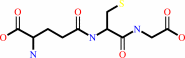 glutathione
|
=
|
S-substituted glutathione
|
+
|
halide anion
|
+
|
H(+)
|
|
|
|
|
|
|
|
|
|
|
|
|
Molecule diagrams generated from .mol files obtained from the
KEGG ftp site
|
|
|
|
|
|
|
|
|
|
|
|
|
|
 |
|
|
|
|
|
|
| |
|
|
| |
|
DOI no:
|
Biochemistry
36:9690-9702
(1997)
|
|
PubMed id:
|
|
|
|
|
|
| |
|
Structure and function of the xenobiotic substrate-binding site and location of a potential non-substrate-binding site in a class pi glutathione S-transferase.
|
|
X.Ji,
M.Tordova,
R.O'Donnell,
J.F.Parsons,
J.B.Hayden,
G.L.Gilliland,
P.Zimniak.
|
|
|
|
|
| |
ABSTRACT
|
|
|
|
| |
|
|
Complex structures of a naturally occurring variant of human class pi
glutathione S-transferase 1-1 (hGSTP1-1) with either S-hexylglutathione or
(9R,10R)-9-(S-glutathionyl)-10-hydroxy-9, 10-dihydrophenanthrene
[(9R,10R)-GSPhen] have been determined at resolutions of 1.8 and 1.9 A,
respectively. The crystal structures reveal that the xenobiotic
substrate-binding site (H-site) is located at a position similar to that
observed in class mu GST 1-1 from rat liver (rGSTM1-1). In rGSTM1-1, the H-site
is a hydrophobic cavity defined by the side chains of Y6, W7, V9, L12, I111,
Y115, F208, and S209. In hGSTP1-1, the cavity is approximately half hydrophobic
and half hydrophilic and is defined by the side chains of Y7, F8, V10, R13,
V104, Y108, N204, and G205 and five water molecules. A hydrogen bond network
connects the five water molecules and the side chains of R13 and N204. V104 is
positioned such that the introduction of a methyl group (the result of the V104I
mutation) disturbs the H-site water structure and alters the substrate-binding
properties of the isozyme. The hydroxyl group of Y7 forms a hydrogen bond (3.2
A) with the sulfur atom of the product. There is a short hydrogen bond (2.5 A)
between Y108 (OH) and (9R, 10R)-GSPhen (O5), indicating the hydroxyl group of
Y108 as an electrophilic participant in the addition of glutathione to epoxides.
An N-(2-hydroxethyl)piperazine-N'-2-ethanesulfonic acid (HEPES) molecule is
found in the cavity between beta2 and alphaI. The location and properties of
this HEPES-binding site fit a possible non-substrate-binding site that is
involved in noncompetitive inhibition of the enzyme.
|
|
|
|
|
|
|
|
|
|
|
|
|
|
|
|
|
|
 |
 |
 |
|
Literature references that cite this PDB file's key reference
|
|
|
| |
PubMed id
|
|
Reference
|
|
|
|
|
|
A.F.Thévenin,
C.L.Zony,
B.J.Bahnson,
and
R.F.Colman
(2011).
GSTpi modulates JNK activity through a direct interaction with JNK substrate, ATF2.
|
| |
Protein Sci,
20,
834-848.
|
|
|
|
|
|
|
A.Oakley
(2011).
Glutathione transferases: a structural perspective.
|
| |
Drug Metab Rev,
43,
138-151.
|
|
|
|
|
|
|
K.D.Tew,
and
D.M.Townsend
(2011).
Regulatory functions of glutathione S-transferase P1-1 unrelated to detoxification.
|
| |
Drug Metab Rev,
43,
179-193.
|
|
|
|
|
|
|
D.M.Townsend,
Y.Manevich,
L.He,
S.Hutchens,
C.J.Pazoles,
and
K.D.Tew
(2009).
Novel role for glutathione S-transferase pi. Regulator of protein S-Glutathionylation following oxidative and nitrosative stress.
|
| |
J Biol Chem,
284,
436-445.
|
|
|
|
|
|
|
N.Kinsley,
Y.Sayed,
S.Mosebi,
R.N.Armstrong,
and
H.W.Dirr
(2008).
Characterization of the binding of 8-anilinonaphthalene sulfonate to rat class Mu GST M1-1.
|
| |
Biophys Chem,
137,
100-104.
|
|
|
|
|
|
|
X.Ji,
A.Pal,
R.Kalathur,
X.Hu,
Y.Gu,
J.E.Saavedra,
G.S.Buzard,
A.Srinivasan,
L.K.Keefer,
and
S.V.Singh
(2008).
Structure-Based Design of Anticancer Prodrug PABA/NO.
|
| |
Drug Des Devel Ther,
2,
123-130.
|
|
|
|
|
|
|
Y.C.Huang,
S.Misquitta,
S.Y.Blond,
E.Adams,
and
R.F.Colman
(2008).
Catalytically Active Monomer of Glutathione S-Transferase {pi} and Key Residues Involved in the Electrostatic Interaction between Subunits.
|
| |
J Biol Chem,
283,
32880-32888.
|
|
|
|
|
|
|
G.Cornilescu,
E.B.Hadley,
M.G.Woll,
J.L.Markley,
S.H.Gellman,
and
C.C.Cornilescu
(2007).
Solution structure of a small protein containing a fluorinated side chain in the core.
|
| |
Protein Sci,
16,
2089.
|
|
|
|
|
|
|
S.N.Pandey,
M.Jain,
P.Nigam,
G.Choudhuri,
and
B.Mittal
(2006).
Genetic polymorphisms in GSTM1, GSTT1, GSTP1, GSTM3 and the susceptibility to gallbladder cancer in North India.
|
| |
Biomarkers,
11,
250-261.
|
|
|
|
|
|
|
W.G.Willmore,
and
K.B.Storey
(2005).
Purification and properties of the glutathione S-transferases from the anoxia-tolerant turtle, Trachemys scripta elegans.
|
| |
FEBS J,
272,
3602-3614.
|
|
|
|
|
|
|
L.A.Ralat,
and
R.F.Colman
(2004).
Glutathione S-transferase Pi has at least three distinguishable xenobiotic substrate sites close to its glutathione-binding site.
|
| |
J Biol Chem,
279,
50204-50213.
|
|
|
|
|
|
|
L.Tao,
and
A.L.Harris
(2004).
Biochemical requirements for inhibition of Connexin26-containing channels by natural and synthetic taurine analogs.
|
| |
J Biol Chem,
279,
38544-38554.
|
|
|
|
|
|
|
L.A.Ralat,
and
R.F.Colman
(2003).
Monobromobimane occupies a distinct xenobiotic substrate site in glutathione S-transferase pi.
|
| |
Protein Sci,
12,
2575-2587.
|
|
|
|
|
|
|
J.Blaszczyk,
J.E.Tropea,
M.Bubunenko,
K.M.Routzahn,
D.S.Waugh,
D.L.Court,
and
X.Ji
(2001).
Crystallographic and modeling studies of RNase III suggest a mechanism for double-stranded RNA cleavage.
|
| |
Structure,
9,
1225-1236.
|
|
|
PDB codes:
|
|
|
|
|
|
|
|
C.Micaloni,
A.P.Mazzetti,
M.Nuccetelli,
J.Rossjohn,
W.J.McKinstry,
G.Antonini,
A.M.Caccuri,
A.J.Oakley,
G.Federici,
G.Ricci,
M.W.Parker,
and
M.Lo Bello
(2000).
Valine 10 may act as a driver for product release from the active site of human glutathione transferase P1-1.
|
| |
Biochemistry,
39,
15961-15970.
|
|
|
|
|
|
|
J.Wang,
S.Bauman,
and
R.F.Colman
(2000).
Probing subunit interactions in alpha class rat liver glutathione S-transferase with the photoaffinity label glutathionyl S-[4-(succinimidyl)benzophenone].
|
| |
J Biol Chem,
275,
5493-5503.
|
|
|
|
|
|
|
Y.Gu,
S.V.Singh,
and
X.Ji
(2000).
Residue R216 and catalytic efficiency of a murine class alpha glutathione S-transferase toward benzo[a]pyrene 7(R),8(S)-diol 9(S), 10(R)-epoxide.
|
| |
Biochemistry,
39,
12552-12557.
|
|
|
PDB codes:
|
|
|
|
|
|
|
|
H.W.Dirr,
and
L.A.Wallace
(1999).
Role of the C-terminal helix 9 in the stability and ligandin function of class alpha glutathione transferase A1-1.
|
| |
Biochemistry,
38,
15631-15640.
|
|
|
|
|
|
|
P.Zimniak,
S.Pikula,
J.Bandorowicz-Pikula,
and
Y.C.Awasthi
(1999).
Mechanisms for xenobiotic transport in biological membranes.
|
| |
Toxicol Lett,
106,
107-118.
|
|
|
|
|
|
|
A.J.Oakley,
M.Lo Bello,
G.Ricci,
G.Federici,
and
M.W.Parker
(1998).
Evidence for an induced-fit mechanism operating in pi class glutathione transferases.
|
| |
Biochemistry,
37,
9912-9917.
|
|
|
PDB codes:
|
|
|
|
|
|
|
|
D.Mandelman,
F.P.Schwarz,
H.Li,
and
T.L.Poulos
(1998).
The role of quaternary interactions on the stability and activity of ascorbate peroxidase.
|
| |
Protein Sci,
7,
2089-2098.
|
|
|
|
|
|
|
J.Wang,
S.Bauman,
and
R.F.Colman
(1998).
Photoaffinity labeling of rat liver glutathione S-transferase, 4-4, by glutathionyl S-[4-(succinimidyl)-benzophenone].
|
| |
Biochemistry,
37,
15671-15679.
|
|
|
|
|
|
|
R.N.Armstrong
(1998).
Mechanistic imperatives for the evolution of glutathione transferases.
|
| |
Curr Opin Chem Biol,
2,
618-623.
|
|
|
|
|
|
The most recent references are shown first.
Citation data come partly from CiteXplore and partly
from an automated harvesting procedure. Note that this is likely to be
only a partial list as not all journals are covered by
either method. However, we are continually building up the citation data
so more and more references will be included with time.
Where a reference describes a PDB structure, the PDB
codes are
shown on the right.
|
|


 Links
Links


