|
|
|
|
|
 |
Contents |
 |
|
|
|
|
|
|
|
|
|
|
|
|
* Residue conservation analysis
|
|
|
|
|
|
PDB id:
|
|
|
|
| Name: |
|
Complex (isomerase/protein kinase)
|
|
|
Title:
|
|
Crystal structure of the cytoplasmic domain of the type i tgf-beta receptor in complex with fkbp12
|
|
Structure:
|
|
Fk506-binding protein. Chain: a, c, e, g. Synonym: fkbp12. Engineered: yes. Tgf-b superfamily receptor type i. Chain: b, d, f, h. Fragment: cytoplasmic portion. Synonym: serine/threonine-protein kinase receptor r4. Engineered: yes
|
|
Source:
|
|
Homo sapiens. Human. Organism_taxid: 9606. Cell_line: plys s. Expressed in: spodoptera frugiperda. Expression_system_taxid: 7108. Expression_system_cell_line: sf9. Expressed in: escherichia coli. Expression_system_taxid: 562.
|
|
Biol. unit:
|
|
 Dimer (from
)
Dimer (from
)
|
|
Resolution:
|
|
|
2.60Å
|
R-factor:
|
0.249
|
R-free:
|
0.269
|
|
|
Authors:
|
|
M.Huse,Y.-G.Chen,J.Massague,J.Kuriyan
|
Key ref:

|
|
M.Huse
et al.
(1999).
Crystal structure of the cytoplasmic domain of the type I TGF beta receptor in complex with FKBP12.
Cell,
96,
425-436.
PubMed id:
DOI:

|
|
|
Date:
|
|
|
13-Jan-99
|
Release date:
|
15-Jun-99
|
|
|
|
|
|
|
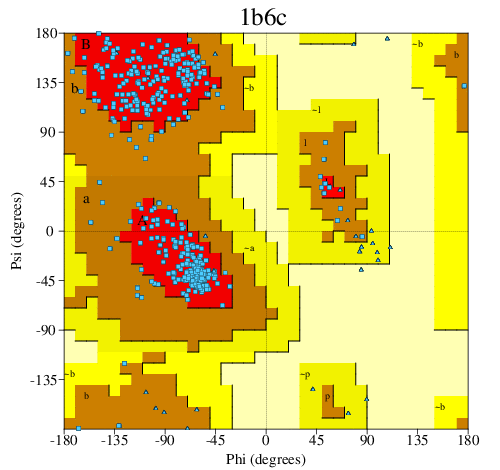
PROCHECK
|
|
|
|
|
|
Headers
|
|
|
|
References
|
|
|
|
|
|
|
|
|
|
|
|
Enzyme class 1:
|
|
Chains A, C, E, G:
E.C.5.2.1.8
- peptidylprolyl isomerase.
|
|
|
|
|
|
|
Reaction:
|
|
[protein]-peptidylproline (omega=180) = [protein]-peptidylproline (omega=0)
|
|
|
|
|
|
 Peptidylproline (omega=180)
|
=
|
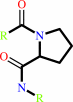 peptidylproline (omega=0)
|
|
|
|
|
|
|
|
|
|
Enzyme class 2:
|
|
Chains B, D, F, H:
E.C.2.7.11.30
- receptor protein serine/threonine kinase.
|
|
|
|
|
|
|
Reaction:
|
|
|
1.
|
L-seryl-[receptor-protein] + ATP = O-phospho-L-seryl-[receptor- protein] + ADP + H+
|
|
2.
|
L-threonyl-[receptor-protein] + ATP = O-phospho-L-threonyl-[receptor- protein] + ADP + H+
|
|
|
|
|
|
|
L-seryl-[receptor-protein]
|
+
|
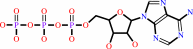 ATP
ATP
|
=
|
O-phospho-L-seryl-[receptor- protein]
|
+
|
 ADP
ADP
|
+
|
H(+)
|
|
|
|
|
|
|
L-threonyl-[receptor-protein]
|
+
|
ATP
|
=
|
O-phospho-L-threonyl-[receptor- protein]
|
+
|
ADP
|
+
|
H(+)
|
|
|
|
|
|
|
|
|
|
|
|
|
Note, where more than one E.C. class is given (as above), each may
correspond to a different protein domain or, in the case of polyprotein
precursors, to a different mature protein.
|
|
|
|
Molecule diagrams generated from .mol files obtained from the
KEGG ftp site
|
|
|
|
|
|
|
|
|
|
|
|
|
|
 |
|
|
|
|
|
|
| |
|
|
| |
|
DOI no:
|
Cell
96:425-436
(1999)
|
|
PubMed id:
|
|
|
|
|
|
| |
|
Crystal structure of the cytoplasmic domain of the type I TGF beta receptor in complex with FKBP12.
|
|
M.Huse,
Y.G.Chen,
J.Massagué,
J.Kuriyan.
|
|
|
|
|
| |
ABSTRACT
|
|
|
|
| |
|
|
Activation of the type I TGFbeta receptor (TbetaR-I) requires phosphorylation of
a regulatory segment known as the GS region, located upstream of the
serine/threonine kinase domain in the cytoplasmic portion of the receptor. The
crystal structure of a fragment of unphosphorylated TbetaR-I, containing both
the GS region and the catalytic domain, has been determined in complex with the
FK506-binding protein FKBP12. TbetaR-I adopts an inactive conformation that is
maintained by the unphosphorylated GS region. FKBP12 binds to the GS region of
the receptor, capping the TbetaR-II phosphorylation sites and further
stabilizing the inactive conformation of TbetaR-I. Certain structural features
at the catalytic center of TbetaR-I are characteristic of tyrosine kinases
rather than Ser/Thr kinases.
|
|
|
|
|
|
| |
Selected figure(s)
|
|
|
|
| |
|
|

|
|

|
|
Figure 4.
Figure 4. The Inhibited Conformation of T β R-I Is
Maintained by the GS Region and the Activation Segment(A) A
ribbon drawing showing the hydrophobic interactions made between
the GS region helices and the top of the kinase β sheet. T β
R-I is viewed from above the kinase N lobe. Thr-204, the site of
a constitutively activating T β R-I mutation ([55]), is
indicated.(B) A ribbon drawing of the complex showing
interactions between the GS loop and the T β R-I kinase, as
well as contacts formed between FKBP12 and T β R-I. Several
interacting residues are shown, with hydrogen bonding indicated
by dashed purple bonds. The L45 loop is indicated.(C) T β R-I
viewed from an oblique angle above the kinase N lobe. The T β
R-II phosphorylation sites are indicated, as are several
residues involved in ionic or polar interactions that stabilize
the placement of the C helix. The movement of the C helix and
the N lobe β sheet into an active conformation appears to be
blocked by the GS loop and a short stretch within the activation
segment. These two steric blockers have been colored magenta.(D)
The same view as in (C), with a molecular surface representation
of the kinase C lobe. The α C side chains have been included to
indicate the space occupied by the helix. The outward rotation
of the C helix and the N lobe β sheet is blocked by the barrier
created by the activation segment.
|
|
Figure 5.
Figure 5. A Comparison of the FKBP12–FK506 and FKBP12–T
β R-I ComplexesA surface representation of FKBP12 bound to
FK506 is shown to the left ([57]). To the right is shown a
surface representation of FKBP12 bound to the T β R-I GS
region. Leu-195 and Leu-196 are bound in the same hydrophobic
pocket used to engage immunosuppressant.
|
|
|
|
|
|
| |
The above figures are
reprinted
by permission from Cell Press:
Cell
(1999,
96,
425-436)
copyright 1999.
|
|
| |
Figures were
selected
by an automated process.
|
|
|
|
|
|
|
|
|
|
|
|
|
|
|
|
 |
 |
 |
|
Literature references that cite this PDB file's key reference
|
 Google scholar
|
|
|
| |
PubMed id
|
|
Reference
|
|
|
|
|
|
P.A.Suwanabol,
K.C.Kent,
and
B.Liu
(2011).
TGF-β and restenosis revisited: a Smad link.
|
| |
J Surg Res,
167,
287-297.
|
|
|
|
|
|
|
F.Fang,
J.Zheng,
T.L.Galbaugh,
A.A.Fiorillo,
E.E.Hjort,
X.Zeng,
and
C.V.Clevenger
(2010).
Cyclophilin B as a co-regulator of prolactin-induced gene expression and function in breast cancer cells.
|
| |
J Mol Endocrinol,
44,
319-329.
|
|
|
|
|
|
|
K.Miyazono,
Y.Kamiya,
and
M.Morikawa
(2010).
Bone morphogenetic protein receptors and signal transduction.
|
| |
J Biochem,
147,
35-51.
|
|
|
|
|
|
|
N.Garamszegi,
S.P.Garamszegi,
P.Samavarchi-Tehrani,
E.Walford,
M.M.Schneiderbauer,
J.L.Wrana,
and
S.P.Scully
(2010).
Extracellular matrix-induced transforming growth factor-beta receptor signaling dynamics.
|
| |
Oncogene,
29,
2368-2380.
|
|
|
|
|
|
|
N.Ricard,
M.Bidart,
C.Mallet,
G.Lesca,
S.Giraud,
R.Prudent,
J.J.Feige,
and
S.Bailly
(2010).
Functional analysis of the BMP9 response of ALK1 mutants from HHT2 patients: a diagnostic tool for novel ACVRL1 mutations.
|
| |
Blood,
116,
1604-1612.
|
|
|
|
|
|
|
R.Bourgeas,
M.J.Basse,
X.Morelli,
and
P.Roche
(2010).
Atomic analysis of protein-protein interfaces with known inhibitors: the 2P2I database.
|
| |
PLoS One,
5,
e9598.
|
|
|
|
|
|
|
D.Padua,
and
J.Massagué
(2009).
Roles of TGFbeta in metastasis.
|
| |
Cell Res,
19,
89.
|
|
|
|
|
|
|
F.Fang,
A.J.Flegler,
P.Du,
S.Lin,
and
C.V.Clevenger
(2009).
Expression of cyclophilin B is associated with malignant progression and regulation of genes implicated in the pathogenesis of breast cancer.
|
| |
Am J Pathol,
174,
297-308.
|
|
|
|
|
|
|
F.S.Kaplan,
M.Xu,
P.Seemann,
J.M.Connor,
D.L.Glaser,
L.Carroll,
P.Delai,
E.Fastnacht-Urban,
S.J.Forman,
G.Gillessen-Kaesbach,
J.Hoover-Fong,
B.Köster,
R.M.Pauli,
W.Reardon,
S.A.Zaidi,
M.Zasloff,
R.Morhart,
S.Mundlos,
J.Groppe,
and
E.M.Shore
(2009).
Classic and atypical fibrodysplasia ossificans progressiva (FOP) phenotypes are caused by mutations in the bone morphogenetic protein (BMP) type I receptor ACVR1.
|
| |
Hum Mutat,
30,
379-390.
|
|
|
|
|
|
|
F.S.Kaplan,
R.J.Pignolo,
and
E.M.Shore
(2009).
The FOP metamorphogene encodes a novel type I receptor that dysregulates BMP signaling.
|
| |
Cytokine Growth Factor Rev,
20,
399-407.
|
|
|
|
|
|
|
J.S.Kang,
C.Liu,
and
R.Derynck
(2009).
New regulatory mechanisms of TGF-beta receptor function.
|
| |
Trends Cell Biol,
19,
385-394.
|
|
|
|
|
|
|
K.A.Petrie,
W.H.Lee,
A.N.Bullock,
J.J.Pointon,
R.Smith,
R.G.Russell,
M.A.Brown,
B.P.Wordsworth,
and
J.T.Triffitt
(2009).
Novel mutations in ACVR1 result in atypical features in two fibrodysplasia ossificans progressiva patients.
|
| |
PLoS ONE,
4,
e5005.
|
|
|
|
|
|
|
K.H.Wrighton,
X.Lin,
and
X.H.Feng
(2009).
Phospho-control of TGF-beta superfamily signaling.
|
| |
Cell Res,
19,
8.
|
|
|
|
|
|
|
M.M.Rechtman,
A.Nakaryakov,
K.E.Shapira,
M.Ehrlich,
and
Y.I.Henis
(2009).
Different Domains Regulate Homomeric and Heteromeric Complex Formation among Type I and Type II Transforming Growth Factor-{beta} Receptors.
|
| |
J Biol Chem,
284,
7843-7852.
|
|
|
|
|
|
|
M.Puigmulé,
J.López-Hellin,
G.Suñé,
O.Tornavaca,
S.Camaño,
A.Tejedor,
and
A.Meseguer
(2009).
Differential proteomic analysis of cyclosporine A-induced toxicity in renal proximal tubule cells.
|
| |
Nephrol Dial Transplant,
24,
2672-2686.
|
|
|
|
|
|
|
R.Bocciardi,
D.Bordo,
M.Di Duca,
M.Di Rocco,
and
R.Ravazzolo
(2009).
Mutational analysis of the ACVR1 gene in Italian patients affected with fibrodysplasia ossificans progressiva: confirmations and advancements.
|
| |
Eur J Hum Genet,
17,
311-318.
|
|
|
|
|
|
|
V.Twombly,
E.Bangi,
V.Le,
B.Malnic,
M.A.Singer,
and
K.A.Wharton
(2009).
Functional analysis of saxophone, the Drosophila gene encoding the BMP type I receptor ortholog of human ALK1/ACVRL1 and ACVR1/ALK2.
|
| |
Genetics,
183,
563.
|
|
|
|
|
|
|
Y.G.Chen
(2009).
Endocytic regulation of TGF-beta signaling.
|
| |
Cell Res,
19,
58-70.
|
|
|
|
|
|
|
A.Miyahara,
T.A.Hirani,
M.Oakes,
A.Kereszt,
B.Kobe,
M.A.Djordjevic,
and
P.M.Gresshoff
(2008).
Soybean nodule autoregulation receptor kinase phosphorylates two kinase-associated protein phosphatases in vitro.
|
| |
J Biol Chem,
283,
25381-25391.
|
|
|
|
|
|
|
C.E.Konikoff,
R.G.Wisotzkey,
and
S.J.Newfeld
(2008).
Lysine conservation and context in TGFbeta and Wnt signaling suggest new targets and general themes for posttranslational modification.
|
| |
J Mol Evol,
67,
323-333.
|
|
|
|
|
|
|
D.Zheng,
G.Chen,
B.Guo,
G.Cheng,
and
H.Tang
(2008).
PLP2, a potent deubiquitinase from murine hepatitis virus, strongly inhibits cellular type I interferon production.
|
| |
Cell Res,
18,
1105-1113.
|
|
|
|
|
|
|
E.M.Shore,
and
F.S.Kaplan
(2008).
Insights from a rare genetic disorder of extra-skeletal bone formation, fibrodysplasia ossificans progressiva (FOP).
|
| |
Bone,
43,
427-433.
|
|
|
|
|
|
|
F.S.Kaplan,
Q.Shen,
V.Lounev,
P.Seemann,
J.Groppe,
T.Katagiri,
R.J.Pignolo,
and
E.M.Shore
(2008).
Skeletal metamorphosis in fibrodysplasia ossificans progressiva (FOP).
|
| |
J Bone Miner Metab,
26,
521-530.
|
|
|
|
|
|
|
H.Pan,
C.Luo,
R.Li,
A.Qiao,
L.Zhang,
M.Mines,
A.M.Nyanda,
J.Zhang,
and
G.H.Fan
(2008).
Cyclophilin A is required for CXCR4-mediated nuclear export of heterogeneous nuclear ribonucleoprotein A2, activation and nuclear translocation of ERK1/2, and chemotactic cell migration.
|
| |
J Biol Chem,
283,
623-637.
|
|
|
|
|
|
|
M.Thakur,
R.Chaba,
A.K.Mondal,
and
P.K.Chakraborti
(2008).
Interdomain interaction reconstitutes the functionality of PknA, a eukaryotic type Ser/Thr kinase from Mycobacterium tuberculosis.
|
| |
J Biol Chem,
283,
8023-8033.
|
|
|
|
|
|
|
M.Van der Zee,
R.N.da Fonseca,
and
S.Roth
(2008).
TGFbeta signaling in Tribolium: vertebrate-like components in a beetle.
|
| |
Dev Genes Evol,
218,
203-213.
|
|
|
|
|
|
|
A.S.Ethayathulla,
D.B.Srivastava,
J.Kumar,
K.Saravanan,
S.Bilgrami,
S.Sharma,
P.Kaur,
A.Srinivasan,
and
T.P.Singh
(2007).
Structure of the buffalo secretory signalling glycoprotein at 2.8 A resolution.
|
| |
Acta Crystallogr Sect F Struct Biol Cryst Commun,
63,
258-265.
|
|
|
PDB code:
|
|
|
|
|
|
|
|
D.L.Riggs,
M.B.Cox,
H.L.Tardif,
M.Hessling,
J.Buchner,
and
D.F.Smith
(2007).
Noncatalytic role of the FKBP52 peptidyl-prolyl isomerase domain in the regulation of steroid hormone signaling.
|
| |
Mol Cell Biol,
27,
8658-8669.
|
|
|
|
|
|
|
F.S.Kaplan,
D.L.Glaser,
R.J.Pignolo,
and
E.M.Shore
(2007).
A new era for fibrodysplasia ossificans progressiva: a druggable target for the second skeleton.
|
| |
Expert Opin Biol Ther,
7,
705-712.
|
|
|
|
|
|
|
J.C.Groppe,
E.M.Shore,
and
F.S.Kaplan
(2007).
Functional modeling of the ACVR1 (R206H) mutation in FOP.
|
| |
Clin Orthop Relat Res,
462,
87-92.
|
|
|
|
|
|
|
K.Goto,
Y.Kamiya,
T.Imamura,
K.Miyazono,
and
K.Miyazawa
(2007).
Selective inhibitory effects of Smad6 on bone morphogenetic protein type I receptors.
|
| |
J Biol Chem,
282,
20603-20611.
|
|
|
|
|
|
|
K.Pardali,
and
A.Moustakas
(2007).
Actions of TGF-beta as tumor suppressor and pro-metastatic factor in human cancer.
|
| |
Biochim Biophys Acta,
1775,
21-62.
|
|
|
|
|
|
|
M.K.Lee,
C.Pardoux,
M.C.Hall,
P.S.Lee,
D.Warburton,
J.Qing,
S.M.Smith,
and
R.Derynck
(2007).
TGF-beta activates Erk MAP kinase signalling through direct phosphorylation of ShcA.
|
| |
EMBO J,
26,
3957-3967.
|
|
|
|
|
|
|
P.T.Loverde,
A.Osman,
and
A.Hinck
(2007).
Schistosoma mansoni: TGF-beta signaling pathways.
|
| |
Exp Parasitol,
117,
304-317.
|
|
|
|
|
|
|
S.Han,
P.Loulakis,
M.Griffor,
and
Z.Xie
(2007).
Crystal structure of activin receptor type IIB kinase domain from human at 2.0 Angstrom resolution.
|
| |
Protein Sci,
16,
2272-2277.
|
|
|
PDB code:
|
|
|
|
|
|
|
|
T.Ikura,
and
N.Ito
(2007).
Requirements for peptidyl-prolyl isomerization activity: a comprehensive mutational analysis of the substrate-binding cavity of FK506-binding protein 12.
|
| |
Protein Sci,
16,
2618-2625.
|
|
|
|
|
|
|
F.Huang,
J.Shan,
S.Reiken,
X.H.Wehrens,
and
A.R.Marks
(2006).
Analysis of calstabin2 (FKBP12.6)-ryanodine receptor interactions: rescue of heart failure by calstabin2 in mice.
|
| |
Proc Natl Acad Sci U S A,
103,
3456-3461.
|
|
|
|
|
|
|
G.Mátyás,
E.Arnold,
T.Carrel,
D.Baumgartner,
C.Boileau,
W.Berger,
and
B.Steinmann
(2006).
Identification and in silico analyses of novel TGFBR1 and TGFBR2 mutations in Marfan syndrome-related disorders.
|
| |
Hum Mutat,
27,
760-769.
|
|
|
|
|
|
|
J.Kumar,
A.S.Ethayathulla,
D.B.Srivastava,
S.Sharma,
S.B.Singh,
A.Srinivasan,
M.P.Yadav,
and
T.P.Singh
(2006).
Structure of a bovine secretory signalling glycoprotein (SPC-40) at 2.1 Angstrom resolution.
|
| |
Acta Crystallogr D Biol Crystallogr,
62,
953-963.
|
|
|
PDB code:
|
|
|
|
|
|
|
|
Q.Su,
S.Wang,
D.Baltzis,
L.K.Qu,
A.H.Wong,
and
A.E.Koromilas
(2006).
Tyrosine phosphorylation acts as a molecular switch to full-scale activation of the eIF2alpha RNA-dependent protein kinase.
|
| |
Proc Natl Acad Sci U S A,
103,
63-68.
|
|
|
|
|
|
|
S.A.Abdalla,
and
M.Letarte
(2006).
Hereditary haemorrhagic telangiectasia: current views on genetics and mechanisms of disease.
|
| |
J Med Genet,
43,
97.
|
|
|
|
|
|
|
W.Ishida,
Y.Mori,
G.Lakos,
L.Sun,
F.Shan,
S.Bowes,
S.Josiah,
W.C.Lee,
J.Singh,
L.E.Ling,
and
J.Varga
(2006).
Intracellular TGF-beta receptor blockade abrogates Smad-dependent fibroblast activation in vitro and in vivo.
|
| |
J Invest Dermatol,
126,
1733-1744.
|
|
|
|
|
|
|
A.C.de Gouville,
V.Boullay,
G.Krysa,
J.Pilot,
J.M.Brusq,
F.Loriolle,
J.M.Gauthier,
S.A.Papworth,
A.Laroze,
F.Gellibert,
and
S.Huet
(2005).
Inhibition of TGF-beta signaling by an ALK5 inhibitor protects rats from dimethylnitrosamine-induced liver fibrosis.
|
| |
Br J Pharmacol,
145,
166-177.
|
|
|
|
|
|
|
E.D.Scheeff,
and
P.E.Bourne
(2005).
Structural evolution of the protein kinase-like superfamily.
|
| |
PLoS Comput Biol,
1,
e49.
|
|
|
|
|
|
|
J.R.Bradford,
and
D.R.Westhead
(2005).
Improved prediction of protein-protein binding sites using a support vector machines approach.
|
| |
Bioinformatics,
21,
1487-1494.
|
|
|
|
|
|
|
M.Lei,
M.A.Robinson,
and
S.C.Harrison
(2005).
The active conformation of the PAK1 kinase domain.
|
| |
Structure,
13,
769-778.
|
|
|
PDB codes:
|
|
|
|
|
|
|
|
R.K.Bhogal,
C.M.Stoica,
T.L.McGaha,
and
C.A.Bona
(2005).
Molecular aspects of regulation of collagen gene expression in fibrosis.
|
| |
J Clin Immunol,
25,
592-603.
|
|
|
|
|
|
|
S.Eyckerman,
I.Lemmens,
D.Catteeuw,
A.Verhee,
J.Vandekerckhove,
S.Lievens,
and
J.Tavernier
(2005).
Reverse MAPPIT: screening for protein-protein interaction modifiers in mammalian cells.
|
| |
Nat Methods,
2,
427-433.
|
|
|
|
|
|
|
S.Zissimopoulos,
and
F.A.Lai
(2005).
Interaction of FKBP12.6 with the cardiac ryanodine receptor C-terminal domain.
|
| |
J Biol Chem,
280,
5475-5485.
|
|
|
|
|
|
|
A.Andreeva,
D.Howorth,
S.E.Brenner,
T.J.Hubbard,
C.Chothia,
and
A.G.Murzin
(2004).
SCOP database in 2004: refinements integrate structure and sequence family data.
|
| |
Nucleic Acids Res,
32,
D226-D229.
|
|
|
|
|
|
|
C.Nourry,
L.Maksumova,
M.Pang,
X.Liu,
and
T.Wang
(2004).
Direct interaction between Smad3, APC10, CDH1 and HEF1 in proteasomal degradation of HEF1.
|
| |
BMC Cell Biol,
5,
20.
|
|
|
|
|
|
|
D.Shegogue,
and
M.Trojanowska
(2004).
Mammalian target of rapamycin positively regulates collagen type I production via a phosphatidylinositol 3-kinase-independent pathway.
|
| |
J Biol Chem,
279,
23166-23175.
|
|
|
|
|
|
|
E.H.Lee,
S.H.Rho,
S.J.Kwon,
S.H.Eom,
P.D.Allen,
and
d.o. .H.Kim
(2004).
N-terminal region of FKBP12 is essential for binding to the skeletal ryanodine receptor.
|
| |
J Biol Chem,
279,
26481-26488.
|
|
|
|
|
|
|
I.Yakymovych,
C.H.Heldin,
and
S.Souchelnytskyi
(2004).
Smad2 phosphorylation by type I receptor: contribution of arginine 462 and cysteine 463 In the C terminus of Smad2 for specificity.
|
| |
J Biol Chem,
279,
35781-35787.
|
|
|
|
|
|
|
J.Griffith,
J.Black,
C.Faerman,
L.Swenson,
M.Wynn,
F.Lu,
J.Lippke,
and
K.Saxena
(2004).
The structural basis for autoinhibition of FLT3 by the juxtamembrane domain.
|
| |
Mol Cell,
13,
169-178.
|
|
|
PDB code:
|
|
|
|
|
|
|
|
M.de Caestecker
(2004).
The transforming growth factor-beta superfamily of receptors.
|
| |
Cytokine Growth Factor Rev,
15,
1.
|
|
|
|
|
|
|
N.J.Dibb,
S.M.Dilworth,
and
C.D.Mol
(2004).
Switching on kinases: oncogenic activation of BRAF and the PDGFR family.
|
| |
Nat Rev Cancer,
4,
718-727.
|
|
|
|
|
|
|
S.R.Hubbard
(2004).
Juxtamembrane autoinhibition in receptor tyrosine kinases.
|
| |
Nat Rev Mol Cell Biol,
5,
464-471.
|
|
|
|
|
|
|
W.Sebald,
J.Nickel,
J.L.Zhang,
and
T.D.Mueller
(2004).
Molecular recognition in bone morphogenetic protein (BMP)/receptor interaction.
|
| |
Biol Chem,
385,
697-710.
|
|
|
|
|
|
|
Y.G.Chen,
and
A.M.Meng
(2004).
Negative regulation of TGF-beta signaling in development.
|
| |
Cell Res,
14,
441-449.
|
|
|
|
|
|
|
A.E.Elkak,
R.F.Newbold,
V.Thomas,
and
K.Mokbel
(2003).
Is telomerase reactivation associated with the down-regulation of TGF beta receptor-II expression in human breast cancer?
|
| |
Cancer Cell Int,
3,
9.
|
|
|
|
|
|
|
B.Boitel,
M.Ortiz-Lombardía,
R.Durán,
F.Pompeo,
S.T.Cole,
C.Cerveñansky,
and
P.M.Alzari
(2003).
PknB kinase activity is regulated by phosphorylation in two Thr residues and dephosphorylation by PstP, the cognate phospho-Ser/Thr phosphatase, in Mycobacterium tuberculosis.
|
| |
Mol Microbiol,
49,
1493-1508.
|
|
|
|
|
|
|
F.Sun,
P.Li,
Y.Ding,
L.Wang,
M.Bartlam,
C.Shu,
B.Shen,
H.Jiang,
S.Li,
and
Z.Rao
(2003).
Design and structure-based study of new potential FKBP12 inhibitors.
|
| |
Biophys J,
85,
3194-3201.
|
|
|
PDB codes:
|
|
|
|
|
|
|
|
H.Masumiya,
R.Wang,
J.Zhang,
B.Xiao,
and
S.R.Chen
(2003).
Localization of the 12.6-kDa FK506-binding protein (FKBP12.6) binding site to the NH2-terminal domain of the cardiac Ca2+ release channel (ryanodine receptor).
|
| |
J Biol Chem,
278,
3786-3792.
|
|
|
|
|
|
|
J.Greenwald,
J.Groppe,
P.Gray,
E.Wiater,
W.Kwiatkowski,
W.Vale,
and
S.Choe
(2003).
The BMP7/ActRII extracellular domain complex provides new insights into the cooperative nature of receptor assembly.
|
| |
Mol Cell,
11,
605-617.
|
|
|
PDB codes:
|
|
|
|
|
|
|
|
J.P.Himanen,
and
D.B.Nikolov
(2003).
Eph signaling: a structural view.
|
| |
Trends Neurosci,
26,
46-51.
|
|
|
|
|
|
|
N.Josso,
and
N.Clemente
(2003).
Transduction pathway of anti-Müllerian hormone, a sex-specific member of the TGF-beta family.
|
| |
Trends Endocrinol Metab,
14,
91-97.
|
|
|
|
|
|
|
P.M.Chan,
S.Ilangumaran,
J.La Rose,
A.Chakrabartty,
and
R.Rottapel
(2003).
Autoinhibition of the kit receptor tyrosine kinase by the cytosolic juxtamembrane region.
|
| |
Mol Cell Biol,
23,
3067-3078.
|
|
|
|
|
|
|
P.M.Siegel,
W.Shu,
R.D.Cardiff,
W.J.Muller,
and
J.Massagué
(2003).
Transforming growth factor beta signaling impairs Neu-induced mammary tumorigenesis while promoting pulmonary metastasis.
|
| |
Proc Natl Acad Sci U S A,
100,
8430-8435.
|
|
|
|
|
|
|
R.Derynck,
and
Y.E.Zhang
(2003).
Smad-dependent and Smad-independent pathways in TGF-beta family signalling.
|
| |
Nature,
425,
577-584.
|
|
|
|
|
|
|
R.E.Harrison,
J.A.Flanagan,
M.Sankelo,
S.A.Abdalla,
J.Rowell,
R.D.Machado,
C.G.Elliott,
I.M.Robbins,
H.Olschewski,
V.McLaughlin,
E.Gruenig,
F.Kermeen,
M.Halme,
A.Räisänen-Sokolowski,
T.Laitinen,
N.W.Morrell,
and
R.C.Trembath
(2003).
Molecular and functional analysis identifies ALK-1 as the predominant cause of pulmonary hypertension related to hereditary haemorrhagic telangiectasia.
|
| |
J Med Genet,
40,
865-871.
|
|
|
|
|
|
|
Y.Shi,
and
J.Massagué
(2003).
Mechanisms of TGF-beta signaling from cell membrane to the nucleus.
|
| |
Cell,
113,
685-700.
|
|
|
|
|
|
|
A.C.Dar,
and
F.Sicheri
(2002).
X-ray crystal structure and functional analysis of vaccinia virus K3L reveals molecular determinants for PKR subversion and substrate recognition.
|
| |
Mol Cell,
10,
295-305.
|
|
|
PDB code:
|
|
|
|
|
|
|
|
A.Mehra,
and
J.L.Wrana
(2002).
TGF-beta and the Smad signal transduction pathway.
|
| |
Biochem Cell Biol,
80,
605-622.
|
|
|
|
|
|
|
B.Y.Qin,
S.S.Lam,
J.J.Correia,
and
K.Lin
(2002).
Smad3 allostery links TGF-beta receptor kinase activation to transcriptional control.
|
| |
Genes Dev,
16,
1950-1963.
|
|
|
PDB codes:
|
|
|
|
|
|
|
|
D.S.Horowitz,
E.J.Lee,
S.A.Mabon,
and
T.Misteli
(2002).
A cyclophilin functions in pre-mRNA splicing.
|
| |
EMBO J,
21,
470-480.
|
|
|
|
|
|
|
D.U.Kloos,
C.Choi,
and
E.Wingender
(2002).
The TGF-beta--Smad network: introducing bioinformatic tools.
|
| |
Trends Genet,
18,
96.
|
|
|
|
|
|
|
F.Verrecchia,
and
A.Mauviel
(2002).
Transforming growth factor-beta signaling through the Smad pathway: role in extracellular matrix gene expression and regulation.
|
| |
J Invest Dermatol,
118,
211-215.
|
|
|
|
|
|
|
J.H.Till,
M.Becerra,
A.Watty,
Y.Lu,
Y.Ma,
T.A.Neubert,
S.J.Burden,
and
S.R.Hubbard
(2002).
Crystal structure of the MuSK tyrosine kinase: insights into receptor autoregulation.
|
| |
Structure,
10,
1187-1196.
|
|
|
PDB code:
|
|
|
|
|
|
|
|
K.N.Brazin,
R.J.Mallis,
D.B.Fulton,
and
A.H.Andreotti
(2002).
Regulation of the tyrosine kinase Itk by the peptidyl-prolyl isomerase cyclophilin A.
|
| |
Proc Natl Acad Sci U S A,
99,
1899-1904.
|
|
|
|
|
|
|
M.Huse,
and
J.Kuriyan
(2002).
The conformational plasticity of protein kinases.
|
| |
Cell,
109,
275-282.
|
|
|
|
|
|
|
R.A.Engh,
and
D.Bossemeyer
(2002).
Structural aspects of protein kinase control-role of conformational flexibility.
|
| |
Pharmacol Ther,
93,
99.
|
|
|
|
|
|
|
J.W.Wu,
M.Hu,
J.Chai,
J.Seoane,
M.Huse,
C.Li,
D.J.Rigotti,
S.Kyin,
T.W.Muir,
R.Fairman,
J.Massagué,
and
Y.Shi
(2001).
Crystal structure of a phosphorylated Smad2. Recognition of phosphoserine by the MH2 domain and insights on Smad function in TGF-beta signaling.
|
| |
Mol Cell,
8,
1277-1289.
|
|
|
PDB code:
|
|
|
|
|
|
|
|
J.Yue,
and
K.M.Mulder
(2001).
Transforming growth factor-beta signal transduction in epithelial cells.
|
| |
Pharmacol Ther,
91,
1.
|
|
|
|
|
|
|
L.E.Wybenga-Groot,
B.Baskin,
S.H.Ong,
J.Tong,
T.Pawson,
and
F.Sicheri
(2001).
Structural basis for autoinhibition of the Ephb2 receptor tyrosine kinase by the unphosphorylated juxtamembrane region.
|
| |
Cell,
106,
745-757.
|
|
|
PDB code:
|
|
|
|
|
|
|
|
M.A.Shogren-Knaak,
P.J.Alaimo,
and
K.M.Shokat
(2001).
Recent advances in chemical approaches to the study of biological systems.
|
| |
Annu Rev Cell Dev Biol,
17,
405-433.
|
|
|
|
|
|
|
M.Huse,
T.W.Muir,
L.Xu,
Y.G.Chen,
J.Kuriyan,
and
J.Massagué
(2001).
The TGF beta receptor activation process: an inhibitor- to substrate-binding switch.
|
| |
Mol Cell,
8,
671-682.
|
|
|
PDB code:
|
|
|
|
|
|
|
|
N.Garamszegi,
J.J.Doré,
S.G.Penheiter,
M.Edens,
D.Yao,
and
E.B.Leof
(2001).
Transforming growth factor beta receptor signaling and endocytosis are linked through a COOH terminal activation motif in the type I receptor.
|
| |
Mol Biol Cell,
12,
2881-2893.
|
|
|
|
|
|
|
P.Mulsant,
F.Lecerf,
S.Fabre,
L.Schibler,
P.Monget,
I.Lanneluc,
C.Pisselet,
J.Riquet,
D.Monniaux,
I.Callebaut,
E.Cribiu,
J.Thimonier,
J.Teyssier,
L.Bodin,
Y.Cognié,
N.Chitour,
and
J.M.Elsen
(2001).
Mutation in bone morphogenetic protein receptor-IB is associated with increased ovulation rate in Booroola Mérino ewes.
|
| |
Proc Natl Acad Sci U S A,
98,
5104-5109.
|
|
|
|
|
|
|
S.R.Hubbard
(2001).
Theme and variations: juxtamembrane regulation of receptor protein kinases.
|
| |
Mol Cell,
8,
481-482.
|
|
|
|
|
|
|
T.Chen,
W.Yan,
R.G.Wells,
D.L.Rimm,
J.McNiff,
D.Leffell,
and
M.Reiss
(2001).
Novel inactivating mutations of transforming growth factor-beta type I receptor gene in head-and-neck cancer metastases.
|
| |
Int J Cancer,
93,
653-661.
|
|
|
|
|
|
|
Y.Shi
(2001).
Structural insights on Smad function in TGFbeta signaling.
|
| |
Bioessays,
23,
223-232.
|
|
|
|
|
|
|
A.Galat
(2000).
Sequence diversification of the FK506-binding proteins in several different genomes.
|
| |
Eur J Biochem,
267,
4945-4959.
|
|
|
|
|
|
|
C.Petritsch,
H.Beug,
A.Balmain,
and
M.Oft
(2000).
TGF-beta inhibits p70 S6 kinase via protein phosphatase 2A to induce G(1) arrest.
|
| |
Genes Dev,
14,
3093-3101.
|
|
|
|
|
|
|
C.Schiene,
and
G.Fischer
(2000).
Enzymes that catalyse the restructuring of proteins.
|
| |
Curr Opin Struct Biol,
10,
40-45.
|
|
|
|
|
|
|
C.T.Rollins,
V.M.Rivera,
D.N.Woolfson,
T.Keenan,
M.Hatada,
S.E.Adams,
L.J.Andrade,
D.Yaeger,
M.R.van Schravendijk,
D.A.Holt,
M.Gilman,
and
T.Clackson
(2000).
A ligand-reversible dimerization system for controlling protein-protein interactions.
|
| |
Proc Natl Acad Sci U S A,
97,
7096-7101.
|
|
|
PDB code:
|
|
|
|
|
|
|
|
D.Yao,
J.J.Doré,
and
E.B.Leof
(2000).
FKBP12 is a negative regulator of transforming growth factor-beta receptor internalization.
|
| |
J Biol Chem,
275,
13149-13154.
|
|
|
|
|
|
|
G.Wu,
Y.G.Chen,
B.Ozdamar,
C.A.Gyuricza,
P.A.Chong,
J.L.Wrana,
J.Massagué,
and
Y.Shi
(2000).
Structural basis of Smad2 recognition by the Smad anchor for receptor activation.
|
| |
Science,
287,
92-97.
|
|
|
PDB code:
|
|
|
|
|
|
|
|
J.Massagué,
and
D.Wotton
(2000).
Transcriptional control by the TGF-beta/Smad signaling system.
|
| |
EMBO J,
19,
1745-1754.
|
|
|
|
|
|
|
J.Massagué,
S.W.Blain,
and
R.S.Lo
(2000).
TGFbeta signaling in growth control, cancer, and heritable disorders.
|
| |
Cell,
103,
295-309.
|
|
|
|
|
|
|
L.Gilboa,
A.Nohe,
T.Geissendörfer,
W.Sebald,
Y.I.Henis,
and
P.Knaus
(2000).
Bone morphogenetic protein receptor complexes on the surface of live cells: a new oligomerization mode for serine/threonine kinase receptors.
|
| |
Mol Biol Cell,
11,
1023-1035.
|
|
|
|
|
|
|
M.T.Ivery
(2000).
Immunophilins: switched on protein binding domains?
|
| |
Med Res Rev,
20,
452-484.
|
|
|
|
|
|
|
C.S.Mason,
C.J.Springer,
R.G.Cooper,
G.Superti-Furga,
C.J.Marshall,
and
R.Marais
(1999).
Serine and tyrosine phosphorylations cooperate in Raf-1, but not B-Raf activation.
|
| |
EMBO J,
18,
2137-2148.
|
|
|
|
|
|
|
D.Michel,
S.Kramer,
S.Höhn,
P.Schaarschmidt,
K.Wunderlich,
and
T.Mertens
(1999).
Amino acids of conserved kinase motifs of cytomegalovirus protein UL97 are essential for autophosphorylation.
|
| |
J Virol,
73,
8898-8901.
|
|
|
|
|
|
|
R.W.Padgett
(1999).
Intracellular signaling: Fleshing out the TGFbeta pathway.
|
| |
Curr Biol,
9,
R408-R411.
|
|
|
|
|
|
|
S.Akiyoshi,
H.Inoue,
J.Hanai,
K.Kusanagi,
N.Nemoto,
K.Miyazono,
and
M.Kawabata
(1999).
c-Ski acts as a transcriptional co-repressor in transforming growth factor-beta signaling through interaction with smads.
|
| |
J Biol Chem,
274,
35269-35277.
|
|
|
|
|
|
|
Y.Sun,
X.Liu,
E.Ng-Eaton,
H.F.Lodish,
and
R.A.Weinberg
(1999).
SnoN and Ski protooncoproteins are rapidly degraded in response to transforming growth factor beta signaling.
|
| |
Proc Natl Acad Sci U S A,
96,
12442-12447.
|
|
|
|
|
|
The most recent references are shown first.
Citation data come partly from CiteXplore and partly
from an automated harvesting procedure. Note that this is likely to be
only a partial list as not all journals are covered by
either method. However, we are continually building up the citation data
so more and more references will be included with time.
Where a reference describes a PDB structure, the PDB
code is
shown on the right.
|
 |


 Links
Links